
Casen Pointe: True Crime Detective is releasing Episode 2 on Friday, April 10th. Please subscribe at the link below in order to get updated when it comes out. Thanks for supporting this little silly, hilarious, ridiculous series.
Filmstack LA In-Person Meetup #9 will be held on Sunday, April 19th at 4PM in Highland Park at The Hermosillo. Really excited to see your faces there!
Register for Filmstack Meetup!
This year at Slamdance, I announced my intention to produce and/or release 10 separate series this year. Counting the ones that are through post or in post, I’m up to 3, with another 6 in different stages of development. I’m not exactly on target, but I’m definitely further ahead than I deserve to be.
In my presentation – virtual and in-person – I gave a throwaway explanation referencing the Power Law / Pareto Principle as to the why behind that decision. To sum it up:
If 90% of results come from 10% of (qualified1) effort / input, I need to make 10 things to reach a successful outcome from one of them.
It’s pretty simple logic: More shots on goal = more opportunities for success.
But the fact is: My motivation to produce that many (mostly micro-)series is about much more than statistical probability.
I’ve always held that every writer should be working on multiple projects simultaneously, and it’s a big red flag when I hear someone who wants a career in entertainment / cinema only has one project in the works at any given time.
So… what’s so great about working on multiple things at once? And what’s the ideal number of projects to be working on at any given time?
🎯 Shots on goal aren’t enough – Why the real reason to juggle projects goes deeper than statistical probability
📉 The Enthusiasm Curve – Why your newest idea always feels like the best one (and what to do about it)
🧸 The 4-Toy Rule – What toddler psychology reveals about the ideal number of creative projects
💀 Stop polishing turds – How stepping away from a script might just be the fastest way to fix it
And, as always, if you’re not subscribed, please change that below so you can get helpful strategies delivered right to your inbox every fortnight-ish:
Let’s start with the reasons it might be helpful to have multiple projects cooking at once:
If you read the aforementioned Slamdance post, you’ll know my feelings about this. The more shots you take, the better your odds.
There are so many obstacles in between a concept and seeing that concept get produced and released: Development, budget, timing, talent avail, the competitive market, whether the pitch meeting happens before or after the exec has had their lunch…
It’s a gauntlet. And a lot of it is outside your realm of control. Putting only one project up against the gauntlet is like trying out archery for the first time, only giving yourself 1 arrow, and telling yourself you’ll never try it again unless you hit a bullseye.
Also, it’s in the middle of a hurricane.
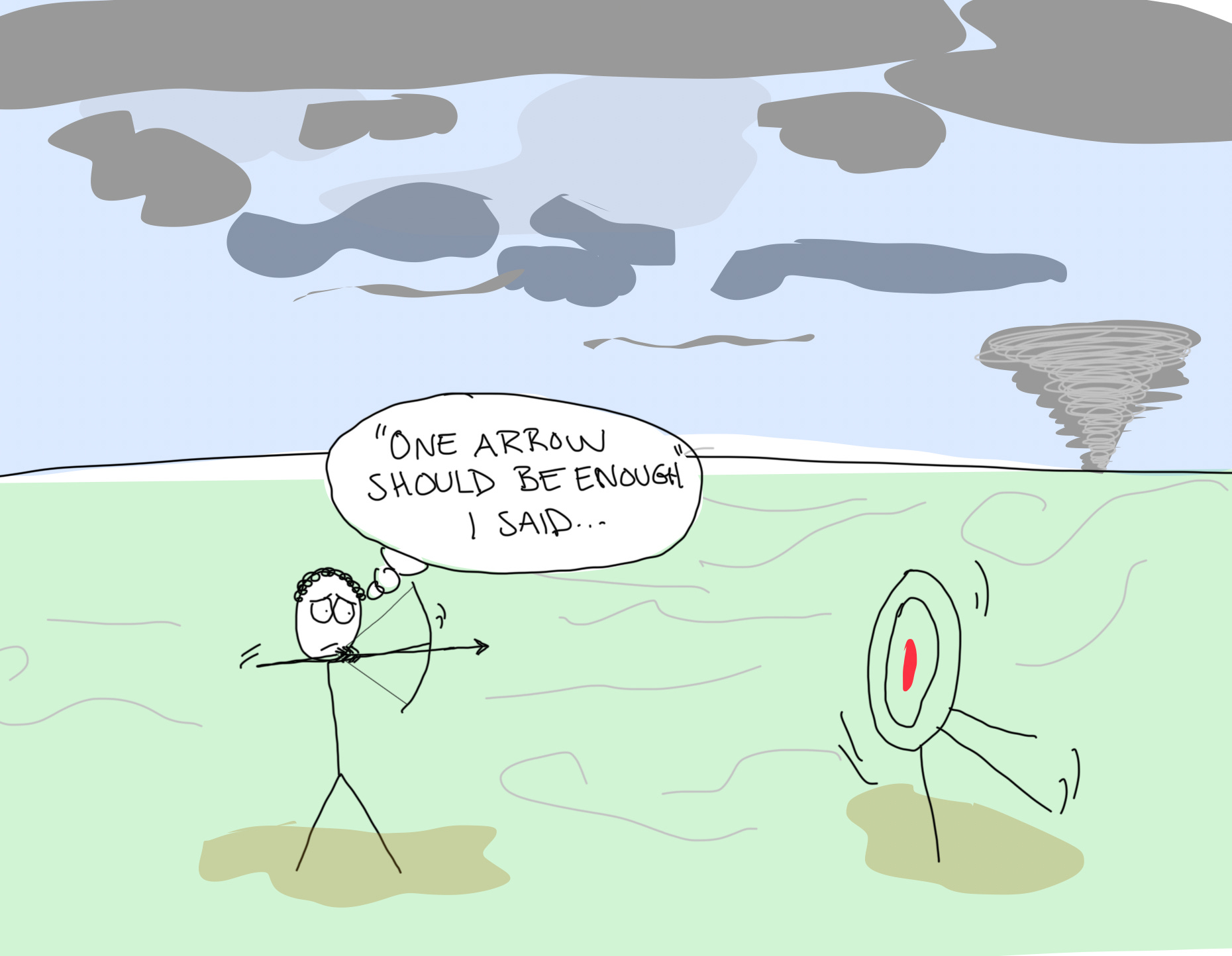
Expecting success with one attempt is unrealistic and betrays an amateur’s mindset.
There’s a curve of excitement that happens when encountering anything new.
Predictably, this curve starts very high as the thing/person/place triggers our natural sense of curiosity and exploration. Then, as we become accustomed to that thing – uncover its mysteries, plumb its depths – that curve drops.
I’ve taken to calling this phenomenon The Enthusiasm Curve.
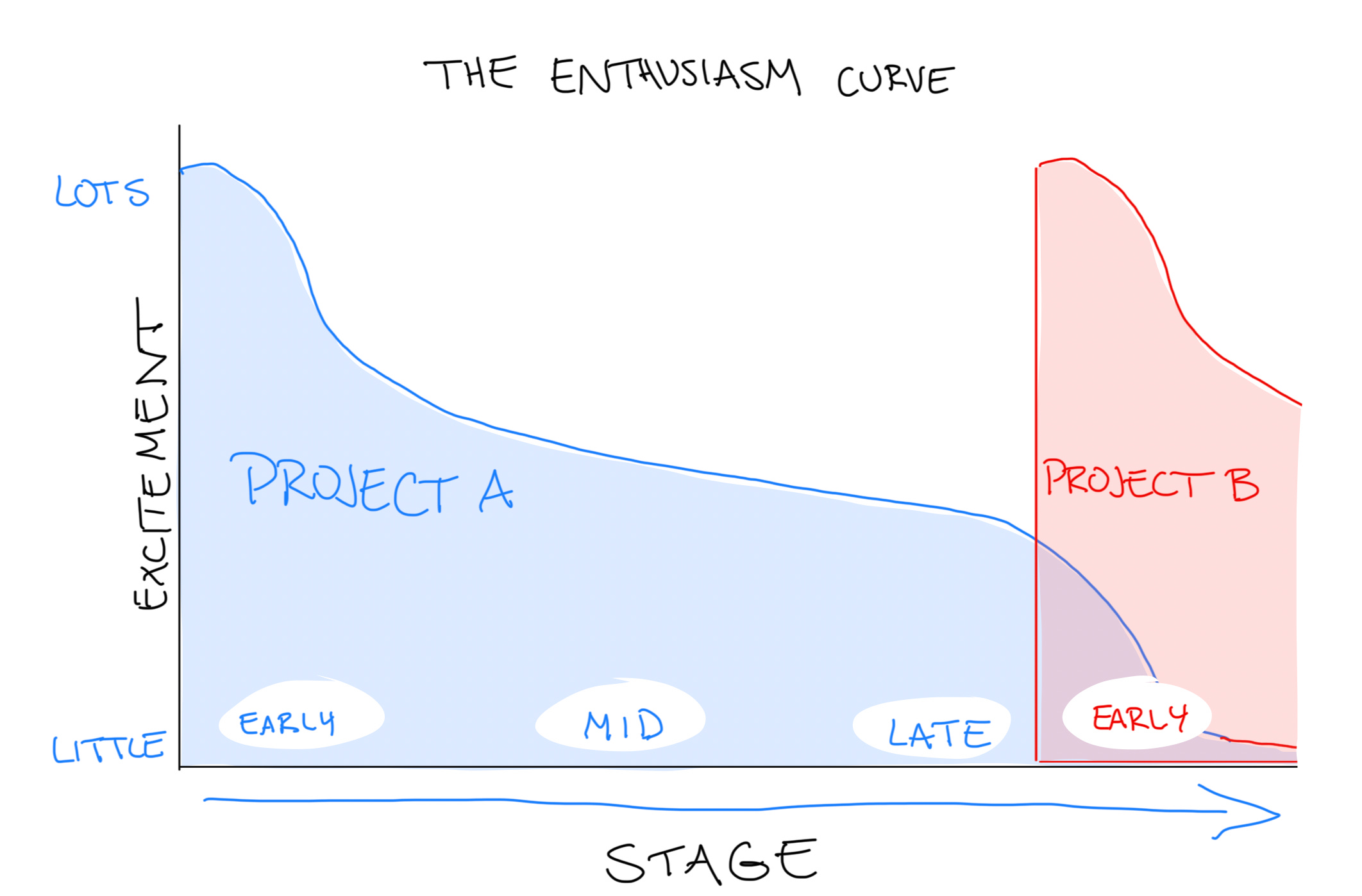
We’ve all seen it: When a 4 year old unboxes a brand new toy for her birthday, the new toy registers in brilliant cascade of colors while her existing toys turn to dull shades of gray.
We’ve also probably felt it: The pull of a fresh, new, half-baked idea for a project. After we’ve been toiling away on a project for months or years and we’ve mined the depths of character and story... When a new idea shows up, it feels exciting, precisely because it’s unexplored.
Funnily enough, kids who have fewer toys engage with them more deeply and their play ends up being more imaginative. So what’s the ideal number of toys for a toddler? Science says just 4.
Share these pseudoscientific insights with your friends and neighbors:
It’s not so many that they’re splitting focus to the point of overstimulation, but just enough so that they can alternate between toys, allowing them to discover something new and fun about each of them with every play session.
I would venture to guess that that number also roughly corresponds to the appropriate number of projects for a writer to be working on simultaneously.
If you have around that many projects, ideally in different stages of development – ideation, character development, beat sheet, outlining, drafting, rewriting, producing (if you play that game) – you allow yourself the flexibility to step away from a project when things turn to shades of gray.
But it’s not so many that you don’t have the bandwidth to give each project the attention it deserves.
If you don’t have a deep well of experience as a working writer/director, you should expect most of your projects to land in the marketplace with a thud.
I know I’ve said this (repeatedly) before, but I’m going to keep repeating it:
By conventional success metrics – audience size, career traction, monetary gain, acclaim – most of your projects WILL FAIL.
Not (necessarily) because you don’t have talent, but because – especially at this moment in history – your talent is largely irrelevant.
Amazing movies with top talent attached flop. So-so movies with a huge leg up in distribution rocket to the moon.
A lot of times it comes down to your taste not aligning with that of the marketplace.
A lot of times it comes down to a similar project stealing your thunder.
There are so many things outside your locus of control that can stop your project in its tracks, even after it gets made and released.
It sucks to watch something you’ve spent months/years of your life on “go nowhere,” which – again, mathematically – it will.
It’s disappointing. But you have to be okay with that. You have to be okay learning any lessons there are to be learned. You have to be okay with having made the thing at all.
Because otherwise, you will fall into a deep, creatively stifling depression, and that’s not a very productive place to be.
So put your head down and do the work. The way that I put it the other day to a friend:
Be so busy making Project B that you don’t allow yourself the time to be disappointed in the outcome of Project A.
“Writing is rewriting.”
–Attr. Ernest Hemingway
I want to specify: Rewriting is a necessary part of the creative process, particularly in cinema and TV.
AND, I also want to point out that there is a difference between genuine rewriting, and – to use a phrase I have heard in many a writers’ room, “polishing a turd.”
That line is very thin, and it’s very easy to go from making substantive story changes to merely “pencil-fucking” (another gem from the writers’ room) the script.
Walking away from a project and working on a different one has two benefits:
Sometimes, stepping away for a while gives you the space to approach the original story from a new perspective.
I can’t tell you how many times I’ve come back to a script after months of working on something else and been like: “Of course! I can solve all the script’s problems just by cutting the water-skiing Butler!”
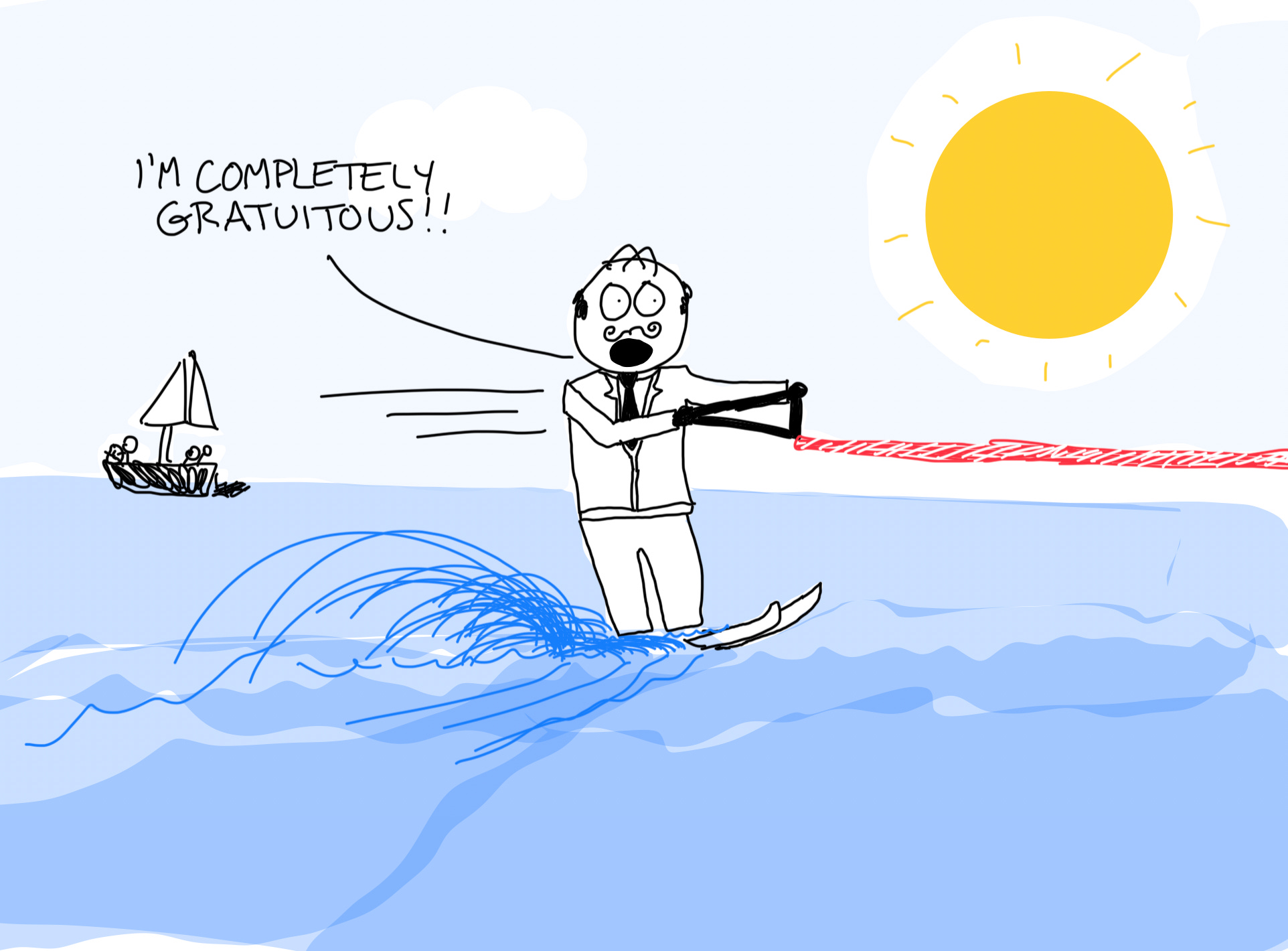
But beyond just solving script problems, working on different projects is a great way to grow as a writer / creative.
When you’re exposed to different types of creative problems, you exercise different muscles in the process of solving them.
In other words: You learn more and grow faster by working on different projects than if you had spent the same amount of time rewriting the same script over and over again.
BTW: This isn’t mere speculation. I conducted an unscientific poll with a few writers I know and they unanimously agreed with this statement.
Be open to learning different lessons from different projects, and don’t polish turds. It’s not a good look.
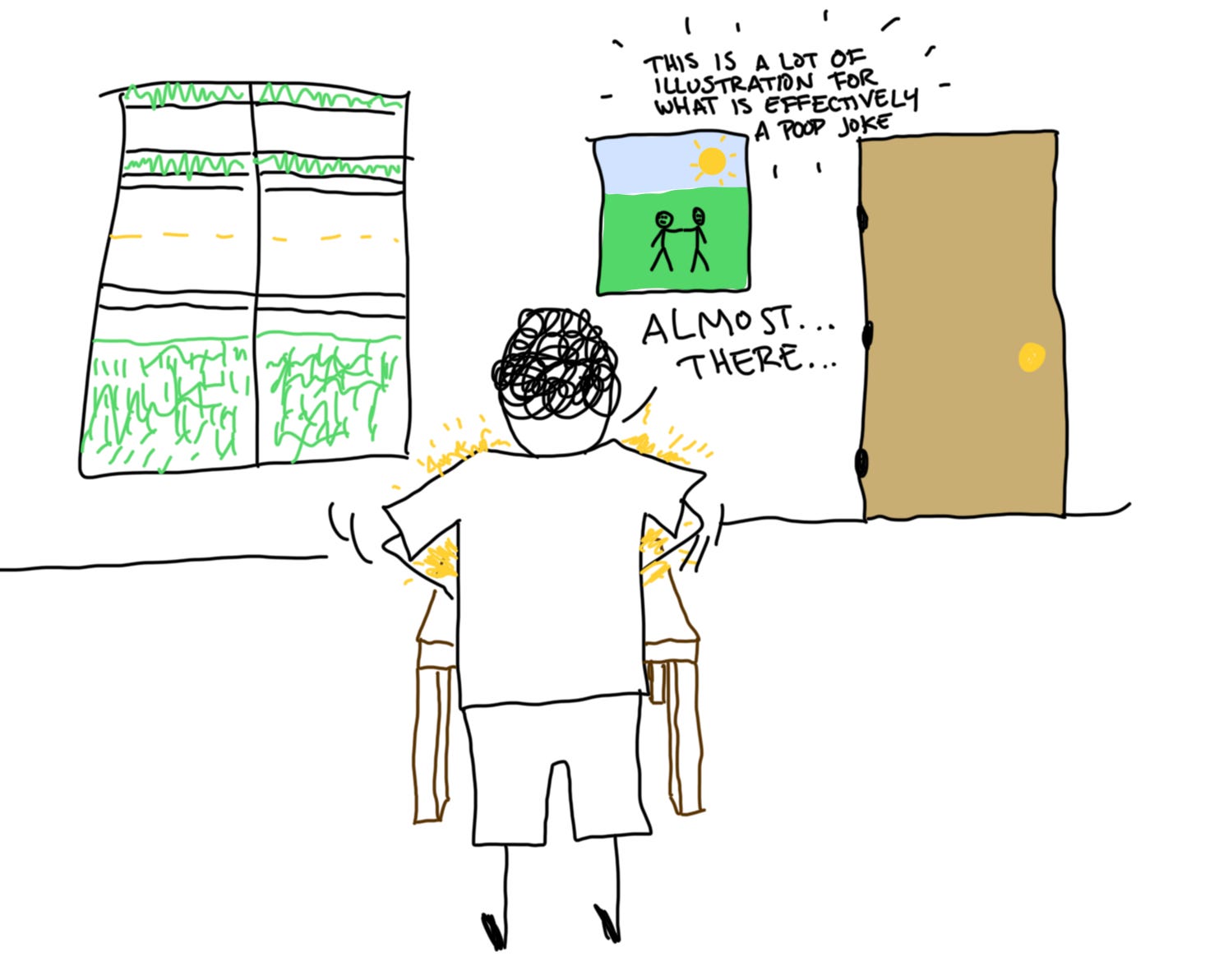
Ask any working writer or other creative in Hollywood and they’ll tell you they’ve heard this question asked in just about every general meeting they’ve taken.
If you find yourself sitting opposite a gatekeeper who’s considering collaborating with you, you don’t want to end up staring back slack-jawed when this question gets popped. If you’re working on a couple projects in different stages of development, you’ll always have an answer to it and you’ll never be caught flat-footed.
If you only have one project you’re working on, that’s a lot of fucking pressure to “get it right.” And despite your best intentions, that pressure is a really bad environment to take risks in.
Having multiple projects means you’re alleviating the pressure – not just on yourself, but on any given project you’re working on. And, ideally, that means you’re giving yourself the space to take some much-needed creative risks on all your projects.
So… what’s a reasonable number of projects to have in your creative pipeline? And, very importantly…
Your optimum project pipeline will depend on a few things:
What size are the projects? Are you only working on features? Pilots? Micro-series? I’m only able to shout “I’m gonna release 10 series this year!” like a deranged lunatic mostly because none of these series are full-length (yet). Shorter episodes means a lighter development and drafting load. If these were full-length pilots that required a greater production (and writing) commitment, I wouldn’t be able to hit 1/3 of that number.
What is your bandwidth? Do you work full-time? Do you have kids? What other responsibilities do you have? It’s easy for me to focus fully on 10 projects/year (plus my Substack plus some software I’m developing) because this IS my job. I have no kids. I have no paid role. And I spend an unhealthy number of waking hours working on these projects. I understand not everyone is able to do that and I understand the enormous amount of privilege I possess having a wife who is able to support both of us (plus our fur babies 🐶🐶🐱).
Are you in active production / pre-pro on a project? If so, that is a huge time commitment and you are absolved from having to focus your attention on other projects.
And please understand this model is not for everyone. I wouldn’t encourage you to spread yourself so thin you that you abandon standards of quality you typically hold yourself to.
And I wouldn’t ask you to give up vital stuff like sleep or family life or actually earning bread for your household.
But if you do have a little more love to give to some of your creative pursuits, I’d encourage you to consider reallocating some of the time you’d normally spend on one project to one or two others.
If you want a sense of what I’m working on, here’s a breakdown of all the projects I’m developing/producing right now:
My Role: Writer | EP | Producer
Episodes: 2
Stage: Release – Uploading the second (and thus far final) episode to YouTube this week (subscribe here).
My Role: Writer | EP | Producer | Director
Episodes: 4
Stage: Release – Setting up social accounts and prepping episodes 1-4 for release starting next week.
My Role: Writer | EP | Producer | Director (collab)
Episodes: 36
Stage: Post – Giving editorial notes for the first batch of 12 episodes. Working with someone to set up social accounts / create key art.
My Role: Writer | EP | Producer | Director
Episodes: 6
Stage: Pre-Production – Casting, budgeting, finding locations, meeting with actors. Setting up table read… For first batch of 6 episodes.
My Role: Writer | EP | Producer | Director (collab)
Episodes: 4-6
Stage: Development & Beat Sheeting – Outlining Ep. 101, ideating on 101-106
My Role: Writer | Producer | EP? (collab)
Episodes: 4-6
Stage: Development – Working on ideas with co-creatives, ideating storylines, characters, scenarios
My Role: Producer | EP? | Writer? (collab)
Episodes: 4-6
Stage: Development – Awaiting initial scripts and bible details from writers, browsing possible cast / locations, will provide notes and potentially write alongside co-creatives
My Role: Writer (collab)
Stage: Outlining – Writing the outline for a hyper-low-budget comedy feature film
My Role: Producer | Director
Episodes: 4-6
Stage: Development – Casting salon owners and stylists to participate in an unscripted micro-doc series for a hair care brand
For the visual learners among us:
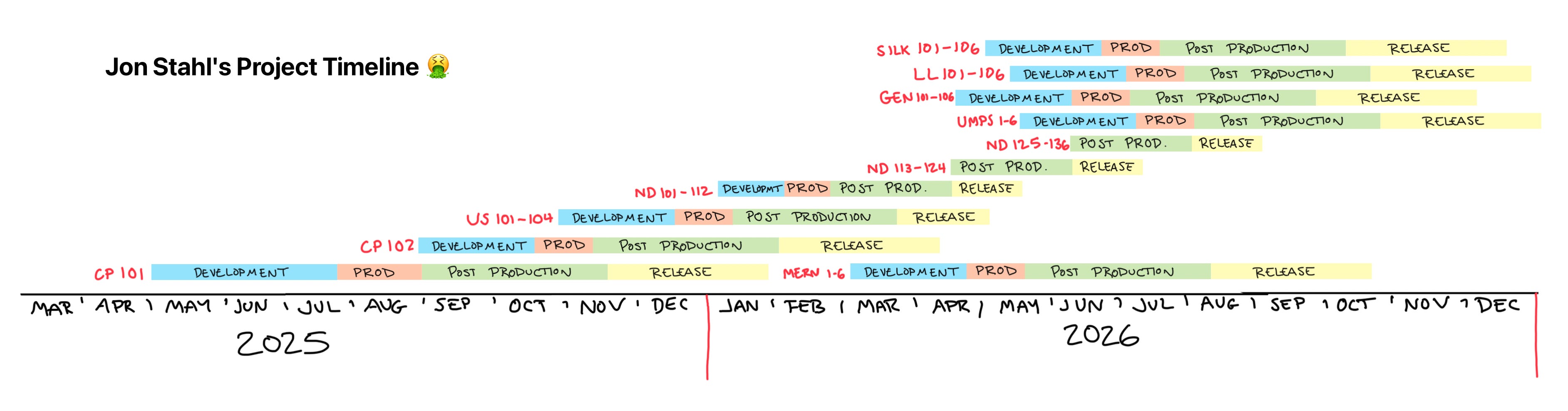
What about you? What are you working on? Consider this an open-ended invitation to share your current “slate” in the comments below.
This lineup is weighted SUPER heavily towards short-form. I do have a couple other longer-form ideas in early stages of development, including a couple pilots… but they didn’t make it on here because it’s really too early to even count them as projects.
Short-form exercises a different muscle than long / longer-form, and it’s been too long since I’ve worked that muscle. I’m going to start going deeper into development of those longer-form projects, which I really do love writing.
But first I’ve gotta get through at least a portion of my existing slate.
So that’s 9 projects. Plus the Substack, plus meetings, plus some side hustles to potentially open up opportunities for generating revenue…
So how do I manage all these things simultaneously?
Quite poorly. But I’m getting better because I’m learning to block my time in an efficient way, and learning the pain points of juggling this many things…
Context switching sucks. If you’re not familiar with the phenomenon, it’s basically the practice of switching your attention between multiple tasks in a relatively short period of time.
If you’ve ever been checking email while talking on the phone with your mom before realizing you haven’t heard a single word she’s said in the last 10 minutes, you’ve encountered the cost of context switching.
That’s why if you want to effectively manage multiple projects, you have to develop a plan to eliminate context switching (or at least mitigate its effects). This plan should involve blocking out reasonable chunks of time to devote to individual tasks associated with each project.
As you start budgeting time in your calendar for these tasks, you’ll begin to learn how long it actually takes to complete them and you’ll be able to adjust the length of the blocks accordingly.
The important thing is the specific allocation of time to each task/project.
Now, I understand it’s not always possible to pre-schedule creative work. Sometimes inspiration strikes when you least expect it, and some days you feel more motivated to write than others. But by blocking out specific creative time and sticking to those blocks, I’ve realized I’m building a creative muscle that wouldn’t otherwise get exercised if I only wrote when I was “feeling creative.”
Creativity is an activity, not a feeling. If inspiration strikes when you’re in the middle of another task, write it down. Email it to yourself and come back to it later.
I know it’s hard. I still suck at it. But I’m improving, bit by bit. And you should try to improve too.
Don’t take my advice as gospel. Listen to your instincts. Listen to your body. Flex your creative muscle in the way that best suits your lifestyle.
But if you’re feeling stuck, if you’re feeling overwhelmed, if you’re feeling like you’re not getting everything you want out of your creative journey… the answer might actually be taking on more projects as opposed to fewer.
I’ll admit: I might be working on too many projects at the moment. I may be spreading myself too thin and obliterating my sleep patterns.
But I wouldn’t be doing it if I didn’t believe in the potential of every single one of these projects.
Yes, finish the projects you start.
But also: Don’t feel guilty for getting excited about the new project idea that’s been bopping around your head for the past couple weeks. Explore new ideas, see how they fit within your creative pipeline, and keep me posted on the projects you’re developing. Maybe we can commiserate.
Stay busy…
And stay tuned,
Jon
I specify “qualified” here because a newcomer will not have the same success rate as an experienced professional. For established creatives, that hit rate may be higher. For people who have no experience, that number will be substantively lower, closer to the figure stated in Doug Shapiro’s Creato Principle post. I consider myself somewhere in between, so my ballpark ratio is 10:1.
No posts
Comments
Nothing yet. Say the first thing.
Sign in to join the conversation.