
By Howard Wolinsky, Editor, The Active Surveillor
Active Surveillance (AS) has long been the safe harbor for men with lower‑risk Gleason 6 and 3+4 prostate cancer—a strategy built on watching carefully and treating only when necessary.
The goal is simple: avoid the side effects of surgery and radiation until they’re truly needed. But as AS matures, a new question is emerging: “What treatments should be considered when the decision is made that active therapy is now warranted?
Immunotherapy trials, “micro‑dose” chemotherapy concepts, and Aquablation have all been floated as possibilities. Androgen Deprivation Therapy [ADT] has been intensified with the addition of androgen pathway receptor blockers (i.e., Xtandi, Erleada, Nubeqa, Zytiga).
Now, a new contender is entering the conversation: transdermal estradiol.
Transdermal estradiol is ADT—without the harsh side effects of standard ADT. As Dr. Paul Schellhammer, a retired urologic oncologist, prostate cancer patient, and past president of the American Urologic Association, The Active Surveillor, the goal is not to redefine the concept of ADT but to “a lessen the harm” when treatment becomes necessary.
Dr. Schellhammer is on the of the founders of the Estradiol Initiative. The aim of the Initiative is to bring awareness to physicians and patients of this effective, QOL-preserving, cost-friendly ADT.
The Estradiol Initiative: A Push for Change
The Estradiol Initiative is led by:
Richard Wassersug, PhD—Retired professor of anatomy and neurobiology in Canada and long‑time ADT educator
Paul Schellhammer, MD—Past president of the American Urological Association and distinguished prostate‑cancer researcher
Bob Watson, PhD—an independent scientist and data‑modeling specialist
These three men have not only used transdermal estradiol for their own ADT but collectively have spent years studying estradiol as an alternative to standard ADT. They’ve lived on both sides of the treatment landscape—as both researchers and as patients.
The idea of using estradiol to bridge from AS to treatment is new. Drs. Wassersug and Schellhammer, the main subjects in this story, had not been on AS.
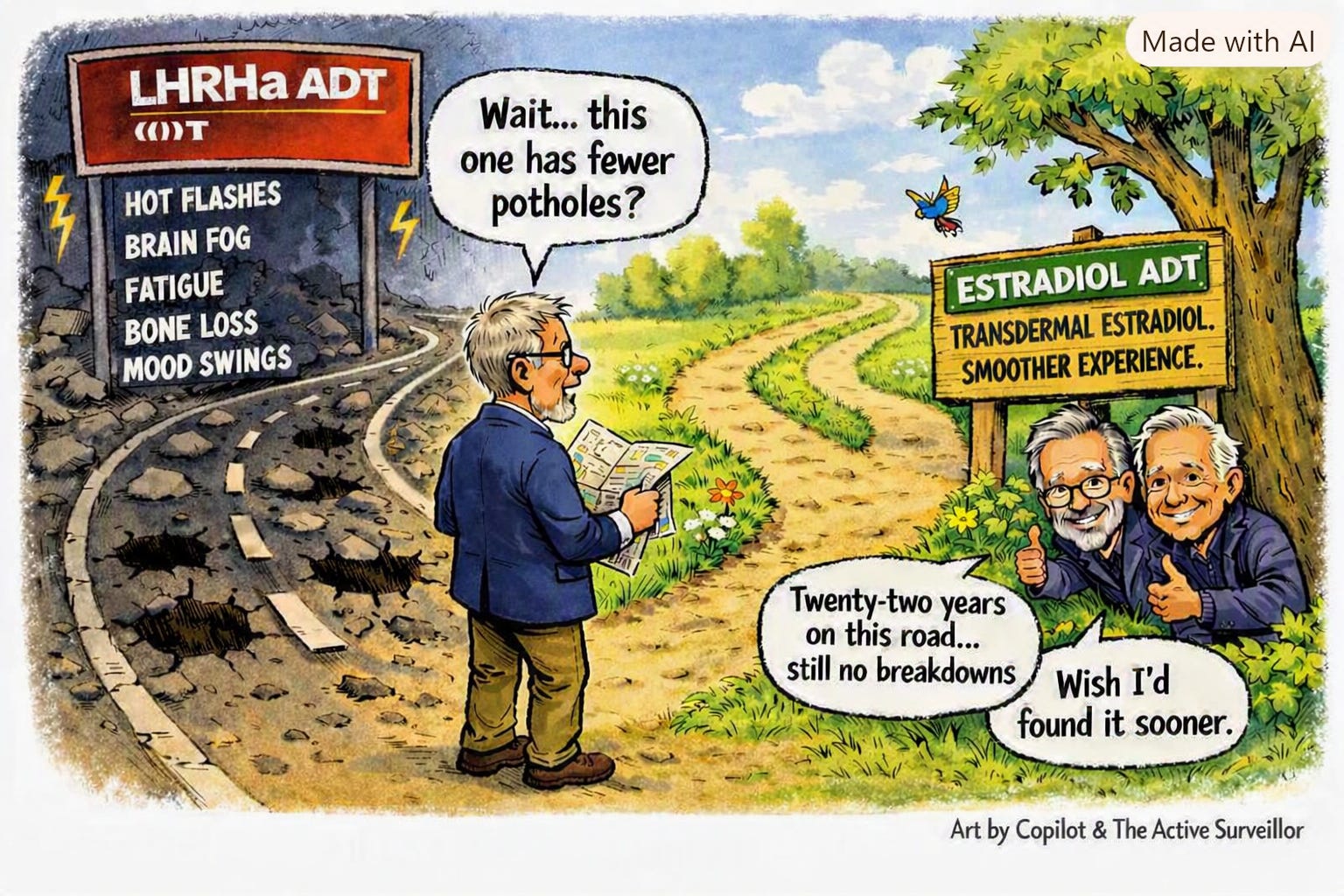
Wassersug has been on transdermal estradiol for more than two decades. “I’ve been on it now over 22 years… with complete PSA control.” He claims the world record for being on that form of hormone therapy. Guiness are you listening?
Schellhammer has said publicly—including in my interview with him—that estradiol could have spared him years of side effects from ADT. “I could have avoided years of misery if I had known about estradiol earlier.”
Their work has now reached a critical moment: they’ve formally petitioned the National Comprehensive Cancer Network (NCCN), which writes guidelines for managing and treating prostate cancer, to approve transdermal estradiol as an alternative to the standard LHRH agonists and antagonists drugs used to treat prostate cancer.
Wassersug told me: “We are hoping that we will hear this fall from NCCN about their decision to include transdermal estradiol as an option for ADT.”
Schellhammer added that while nothing is official, but the signals are encouraging: “Conversationally, with people who are in the know… transdernal estradiol will have some position in NCCN guidelines.”
Transdermal estradiol would greatly expand hormone options.
I’m wowed that patient advocates can accomplish this sort of thing, creating new options for us patients with prostate cancer when ADT enters the conversation.
ADT suppresses testosterone—the fuel for most prostate cancers. ADT is delivered through LHRH agonists like Lupron, antagonists like Orgovyx, or (rarely) surgical castration. ADT works, but its side effects are infamous and much dreaded: hot flashes, fatigue, brain fog, bone loss, weight gain, mood changes, and loss of sexual interest.
Estradiol taken through the skin (hence “transdermally”), however, accomplishes the same level of testosterone suppression and cancer control without depriving the male body of its natural estrogen, i.e. estradiol. Androgen suppression with the LHRH agonists and antagonists, in contrast, deprives the body of both testosterone and estradiol.
Although identified as a female hormone in common parlance, estradiol plays an important role in normal male biology and helps maintain bone density, sleep quality, cognition function, and sexual interest.
Wassersug’s own research on rodents backs this up: “We castrated male rats and gave them estradiol… They had significantly better REM sleep… and were more active.” REM sleep is when we dream and is known to be cognitively protect.
Better sleep. Better cognition. Less fatigue. Bone protection. These are precisely the areas where men on traditional LHRHA ADT struggle.
Estradiol patches plus topical creams and gels have been used for decades to treat menopausal symptoms in women—hot flashes, night sweats, mood instability, sleep disruption, and bone loss. Millions of women have used them safely.
But for men, access to these same transdermal products is surprisingly difficult.
Wassersug explained why: “No drug companies are backing any transdermal estradiol products for men since they don’t yet have NCCN endorsement. Also, there is littl money to be made of a natural hormone.”
Estradiol is cheap. But drug companies can’t patent natural hormones, which limits how much profit they can make by selling such products. That makes selling transdermal products to men unattractive to pharmaceutical companies—and harder for patients to obtain, even when the science supports its use.
When men take estradiol, some breast tissue can develop. This is called gynecomastia. At an early stage, this can feel like tender lumps under the nipple. Patients can get a very low dose of radiation to the buds and breast tissue to minimize enlargement. This is termed low‑dose prophylactic radiation to prevent gynecomastia — a technique used for decades in men receiving hormonal therapy and concerned about gynecomastia.
Wassersug emphasized that the amount of breast growth is typically minimal: “Patients need to be informed how minimal this side effect is.”
The Estradiol Initiative research team recently published a paper that quantified this. Their data suggest that adult men who take estradiol are likely to experience only a small amount of breast enlargement—not the dramatic breast development that they might fear.
Gynaecomastia secondary to transdermal oestradiol used for androgen deprivation therapy: informed reality vs subjective fear. British Journal of Urology International.https://onlinelibrary.wiley.com/share/author/FIXRHZIMGI4KBGTGU6UQ?target=10.1111/bju.70374
Transdermal estradiol for prostate cancer: How do patients compare it to other options for androgen deprivation therapy? Canadian Journal of Urology. https://www.techscience.com/CJU/online/detail/26795
Estradiol offers a rare combination:
Testosterone suppression to castrate levels, PSA suppression and cancer control with much reduced side effects.
Better sleep and less brain fog
Less fatigue
Bone protection
Low cost [“For me, ADT with transdermal estradiol cost one tenth the cost of the standard ADT drugs,” Wassersug said.]
Long‑term tolerability
On this last point, the 20+ years of good cancer control have led Wassersug to view his estradiol ADT as essentially a “maintenance therapy”.
Could ADT with transdermal estradiol be a low‑toxicity treatment that could stabilize PSA and extend the non‑treatment window before surgery or radiation? Extrapolating from his personal experience, he speculated that: Transdermal estradiol could be a drug… properly presented and tested as a maintenance drug.”
Active Surveillance is built on monitoring, not treating. But many men—especially Gleason 3+4 and 4+3 — eventually face rising PSA and rising anxiety as they face the transition to active therapy.
I told Schellhammer: “I don’t think the ‘pure’ Gleason 6 people are thinking about ADT, but for guys with 3+4 and 4+3, it’s on their minds as therapy that may be necessary in the future. “ADT with estradiol is still treatment.” Yes, but a treatment with a far lower adverse event burden.
Dr. Schellhammer, as a rigorous and highly experienced clinical trialist, summarizes this as, “men on AS may face the necessity of active therapy when monitoring indicates disease progression. If therapy includes antigen suppression, they can be assured that transdermal estradiol will provide antigen suppression as effective as the currently used ADT agents, but better quality of life. That includes preserving bone health, and a significantly lower financial cost.”
The real question for AS patients is not: Is estradiol part of Active Surveillance?
It isn’t.
The real question is: Could estradiol safely be used to control advanced prostate cancer without suffering the quality‑of‑life crash of standard ADT?
That’s the story. That’s the opportunity.
And that’s the conversation the AS community should have.
The New England Journal of Medicine just published the most definitive evidence yet that transdermal estradiol patches (tE2) can match traditional ADT for men with locally advanced prostate cancer — while sidestepping several of ADT’s most notorious side effects.
In a phase 3 trial of 1,360 men across 75 U.K. centers, estradiol patches delivered:
Noninferior 3‑year metastasis‑free survival (87.1% vs. 85.9%)
Equivalent testosterone suppression (85% in both groups during year one)
Comparable 5‑year overall survival (81.1% vs. 79.2%)
Where the treatments diverged was side effects:
Hot flashes were dramatically lower with tE2
Gynecomastia was more common — but breast enlargement is typically manageable with standard clinical approaches, including low‑dose breast irradiation or medications that many clinicians already use
Bone loss and metabolic complications — common with ADT — were largely avoided with estradiol patches
This is exactly the kind of “what does this mean for me?” evidence the UCSF Prostate Cancer Journal Club for Patients was built to unpack.
Ruth Langley, MD, PhD
U.K. medical oncologist and principal investigator of the estradiol‑patch trial, known for leading large, practice‑changing cancer studies.
Noel Clarke, MBBS, FRCS (Urol)
Senior urologic oncologist and surgeon, a key leader in U.K. prostate cancer trials and long‑time expert in patient management.
Paul Schellhammer, MD
Past president of the American Urological Association and a pioneer in prostate cancer care with decades of clinical leadership. Also, an advanced prostate cancer patients on tE2.
Matthew Cooperberg, MD, MPH
UCSF professor of Urology and Epidemiology, internationally recognized for prostate cancer outcomes research and patient‑centered decision‑making. He will moderate the session.
9 AM PDT / 12 PM EDT
These leaders will break down the data, discuss real‑world implications, and answer patient questions live.
https://ucsf.zoom.us/webinar/register/WN_GmD_ova4R_GbYxiQl157gw#/registration
Abstract: https://www.nejm.org/doi/full/10.1056/NEJMoa2511781
Full text available with free NEJM registration
Biomarkers Take Center Stage in Debate Over Expanding Active Surveillance into Intermediate PCa
By Howard Wolinsky, The Active Surveillor
At the 2026 United States Prostate Cancer Consensus Conference (USPCC), Dr. Matthew Cooperberg—Professor of Urology and Epidemiologist at the University of California, San Francisco (UCSF)—opened his session with a reminder of how dramatically prostate cancer management has changed.
Two decades ago, Active Surveillance was still viewed with suspicion. Today, both NCCN and AUA/ASTRO/SUO guidelines name it as the preferred strategy for low‑risk prostate cancer.
“This is no longer an emerging concept,” he told the audience. “It’s standard of care.” And notably, these guidelines don’t carve out exceptions based on race, tumor volume, or genetics. If it’s low‑risk, surveillance is the right first step.
The speech was covered in UroToday.
With that foundation established, Cooperberg turned to the question at the heart of his argument: Can molecular biomarkers help clinicians safely expand Active Surveillance into intermediate‑risk disease? His answer was yes—and he made the case that modern diagnostic tools are already reshaping how clinicians understand prostate cancer biology.
He pointed to the rapid evolution of imaging and molecular testing. Multiparametric MRI, PSMA PET, tissue genomic assays, urine biomarkers, blood‑based tests, and polygenic risk scores now populate the diagnostic landscape. These tools don’t answer the same question, he said, but together they help clinicians distinguish cancers that matter from those that don’t. Increasingly, they also help avoid diagnosing clinically insignificant Grade Group 1 disease in the first place.
Cooperberg was blunt about Gleason 6: “Grade Group 1 disease never, ever metastasizes.” In his view, it may eventually be reclassified as something other than cancer.
If it’s discovered incidentally while looking for more serious disease, he argued, there is little rationale for immediate treatment. This shift in thinking underscores why biomarkers are becoming central—not optional—in modern risk assessment.
He also challenged the traditional risk‑group system, calling it “heterogeneous and nonlinear.” The familiar categories—very low, low, favorable intermediate, unfavorable intermediate, high, very high—don’t fully capture the continuous nature of prostate cancer risk.
Biomarkers, he argued, offer a more individualized approach. They can help identify which intermediate‑risk cancers behave indolently and which harbor aggressive biological features that warrant treatment.
Cooperberg highlighted recent work showing that certain histologic patterns—such as Gleason pattern 5, large expansile cribriform architecture, and intraductal carcinoma—are the true drivers of metastasis and mortality. When these features are absent, long‑term outcomes are overwhelmingly favorable.
Biomarkers, layered on top of pathology, can refine this picture even further.
By the end of his USPCC presentation, Cooperberg had delivered a clear message: biomarkers should be used to encourage Active Surveillance in appropriately selected men with intermediate‑risk disease. Modern tools make surveillance safer, more precise, and more personalized than ever before.
“We should use every modern tool available to avoid overtreatment,” he said.
For patients, the takeaway is reassuring. Biomarkers aren’t here to push men toward surgery or radiation. They may help more men avoid treatment—confidently, safely, and with evidence on their side.
Full session coverage is available at UroToday:
USPCC 2026: Point‑Counterpoint—Molecular Biomarkers Should Be Used to Encourage Active Surveillance in Intermediate‑Risk DiseaseWould a paid sub hurt? If $80/year is too much, contact me and we can work it out. I need your help. The Active Surveillor is a reader-supported publication. To receive new posts and support my work, consider becoming a free or paid subscriber.Microbiome topic for Aug. 22 webinar at ASPI
A fast‑moving area of prostate cancer research is gaining attention: the gut microbiome and its potential connection to prostate cancer. Early studies suggest gut bacteria may influence inflammation, metabolism, immune activity — even patterns seen in prostate cancer itself.
Join ASPI for a look at what researchers actually know — and what remains speculation — with urologic oncologist Dr. Michael Liss of UC San Diego, a leading voice in microbiome research and prostate cancer innovation.
Webinar: Saturday, August 22, 2026 • 12 PM Eastern
Where: Zoom — Register here: https://aspatients.org/event/gut-microbiome-prostate-cancer/
Check out how surgical micro-moves make a difference in prostate surgery. See my Substack Prostate Cores.
Also see This Guy’s Guide on aging with Obama, Eastwood, and the rest of us.



No posts
Comments
Nothing yet. Say the first thing.
Sign in to join the conversation.