
Welcome back to House Rules. I thought it was about time we tackled bathrooms.
Bathrooms and kitchens are my favourite areas to design, however, they are also two of the hardest. There are already a million decisions when you’re renovating a house, but these two spaces seem to come with a million more, and there’s an added pressure attached to those decisions because most of them aren’t particularly cheap or easy to change if you get them wrong. Once the tiles are down and the plumbing is in, you really need to love what you’ve chosen.
A bathroom needs to be functional, but practical doesn’t have to mean taking the easiest option. Often, the detail that looks best is the one your tiler, plumber, or bathroom fitter would rather you didn’t pick, because it’s a little more work. It’s these small finishing details that make a bathroom feel professionally designed.
So here are four bathroom rules I always stand by. I do have 7million more tips and tricks, so no doubt a part 2,3,4 will be incoming.

The almighty mitred edge! This is my number one rule!!! DAY UNO of any job, I tell the builder, plumber, tiler, anyone who cares to listen, “We will be mitring tile edges”.
A tile trim is that little strip of metal or plastic capping the edge of your tiling and is the easiest way to finish an edge. For me, it feels like a plaster over a problem! And for some bizarre reason, somewhere along the way, someone decided to call it a feature. On went a metal trim around the niche or the bath’s edge, like a bit of jewellery to finish things off. Ugh! It draws your eye around an area you’d rather nobody look at. You want a bathroom to feel seamless. A trim does the opposite.
Rather than capping the joint, have a beautiful 45-degree cut so the tile wraps around the niche, the wall or the bath edge. No strip, no line, just tile flowing over. Whether you’re using a large-format tile or a 10x10, it makes an edge look finished and quite sexy.
The one trim I’ll allow is a ceramic or stone pencil trim, used as a detail rather than a cover-up. Finishing the top of a half-tiled wall or forming a break between two tiles. I might need to eat my hat here. BUT I will just about allow a white trim on a white tile. Often you won’t see it, so as long as it matches 100% I’ll just about let it slide, but it needs to be so so so thin. The whole point is that you don’t want your eyes to be drawn to the seams of your bathroom.
Chances are you will get pushback. Mitring is more work, and some tiles are genuinely harder to do it with. Some ceramics can be brittle and tricky to cut cleanly, so always check with your tiler first that it’s doable with the tile you’ve chosen. And hold your nerve, because some will kick up and tell you it can’t be done anyway. It can! We mitre the edges on every bathroom we do. They just don’t love to do it, because it’s hard work. So if yours refuses, find another tiler who will. You’re the client, you’re paying for the job, and this is the one thing I’ll always push hardest for.
Try this: Ask your tiler to show you an example of a mitred edge they’ve done before. If you’re spending thousands on tiles, this is not the moment to discover they’ve never done one.
Lydia’s Rule: If an edge can be beautifully mitred, please don’t cover it.
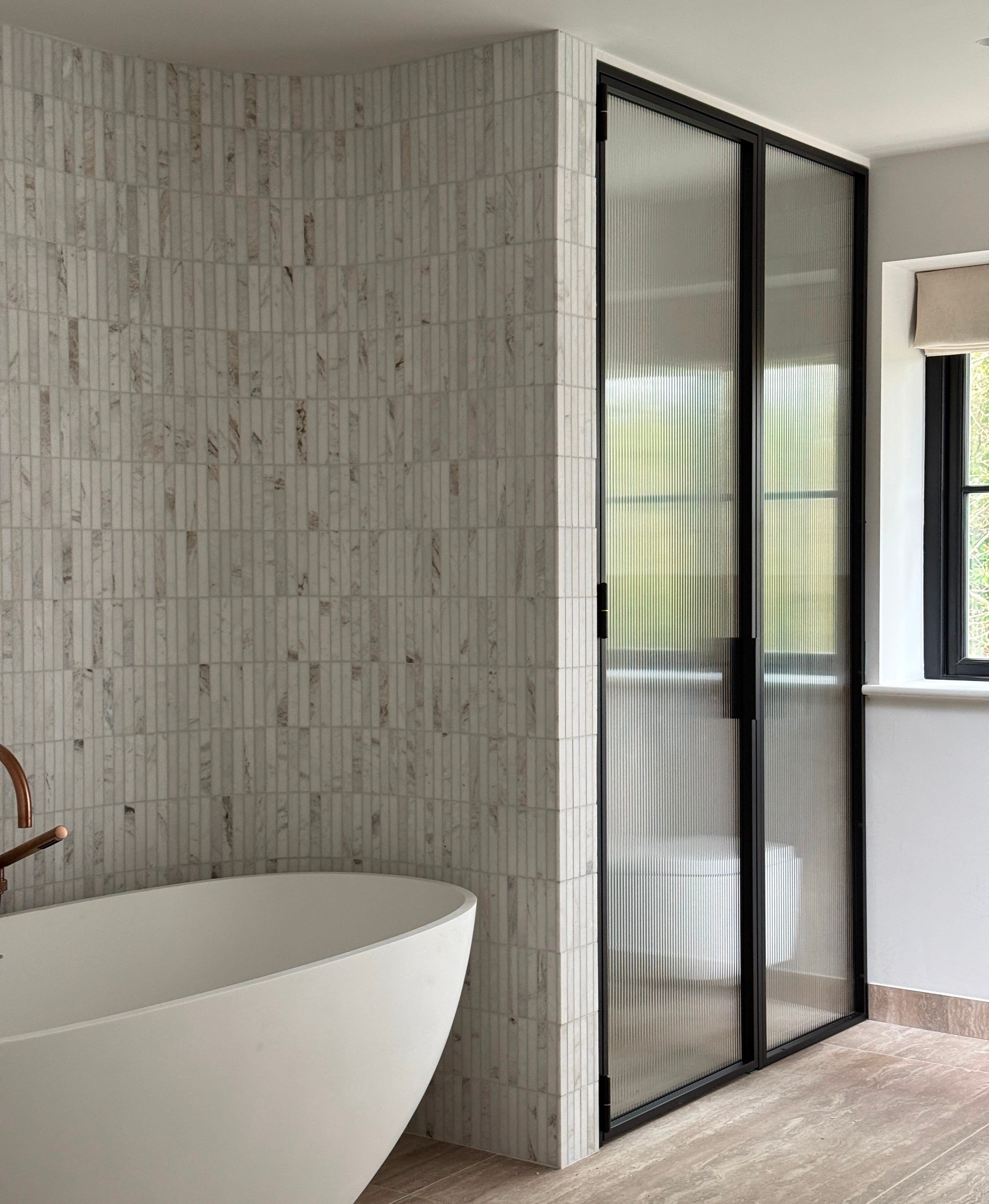
Picking the tiles is probably one of the hardest decisions; the world is quite literally your oyster, and somehow you’re supposed to narrow that down to a handful that are all going to live happily ever after in one room. And I think this is where people can get caught up in finding the perfect tile. It’s less about finding one perfect tile and more about understanding how they all work together.
You need to create a hierarchy. Not every surface needs to be screaming for your attention. A large-format tile has fewer grout lines, so visually it tends to feel calmer and more seamless. A smaller tile naturally has more going on, more grout lines, maybe more pattern and more to draw your eye to.
I love the contrast of something large against something small. You might have a large-format stone or porcelain across the floor and continue it half-height up the wall, then introduce a subway, kit-kat or square tile above. Or do the reverse: a small marble mosaic or herringbone on the floor, with a larger tile on the walls.
The proportion of a tile can change how you read the room. A rectangular tile stacked vertically draws your eye upwards and when laid horizontally it can emphasise the width. Even changing the laying pattern of the same tile can give you another layer without introducing another tile.
You do not need to tile every wall! Unless it’s a wet room, I will always have at least one or two walls that aren’t fully tiled. Often we’ll tile the wall half-height, use panelling instead or even simply have skirting and a painted wall. This is just as important as choosing the tiles themselves. Bathrooms already have a lot of hard surfaces, and this gives the room some breathing space. It will also save you money. Big Win!
I love a balance of different textures and finishes. All matt or all gloss can feel flat. Find a combination of the two. Matt porcelain floor against a glazed wall tile. Honed marble against polished sanitary-ware. A timber vanity against stone or ceramic.
Try this: Stand in the doorway and look at your bathroom. Is everything hard? Shiny? Roughly the same scale? Work out what’s dominating, then add the opposite.
Lydia’s Rule: Not every bathroom wall needs a tile. Give the room somewhere to breathe.
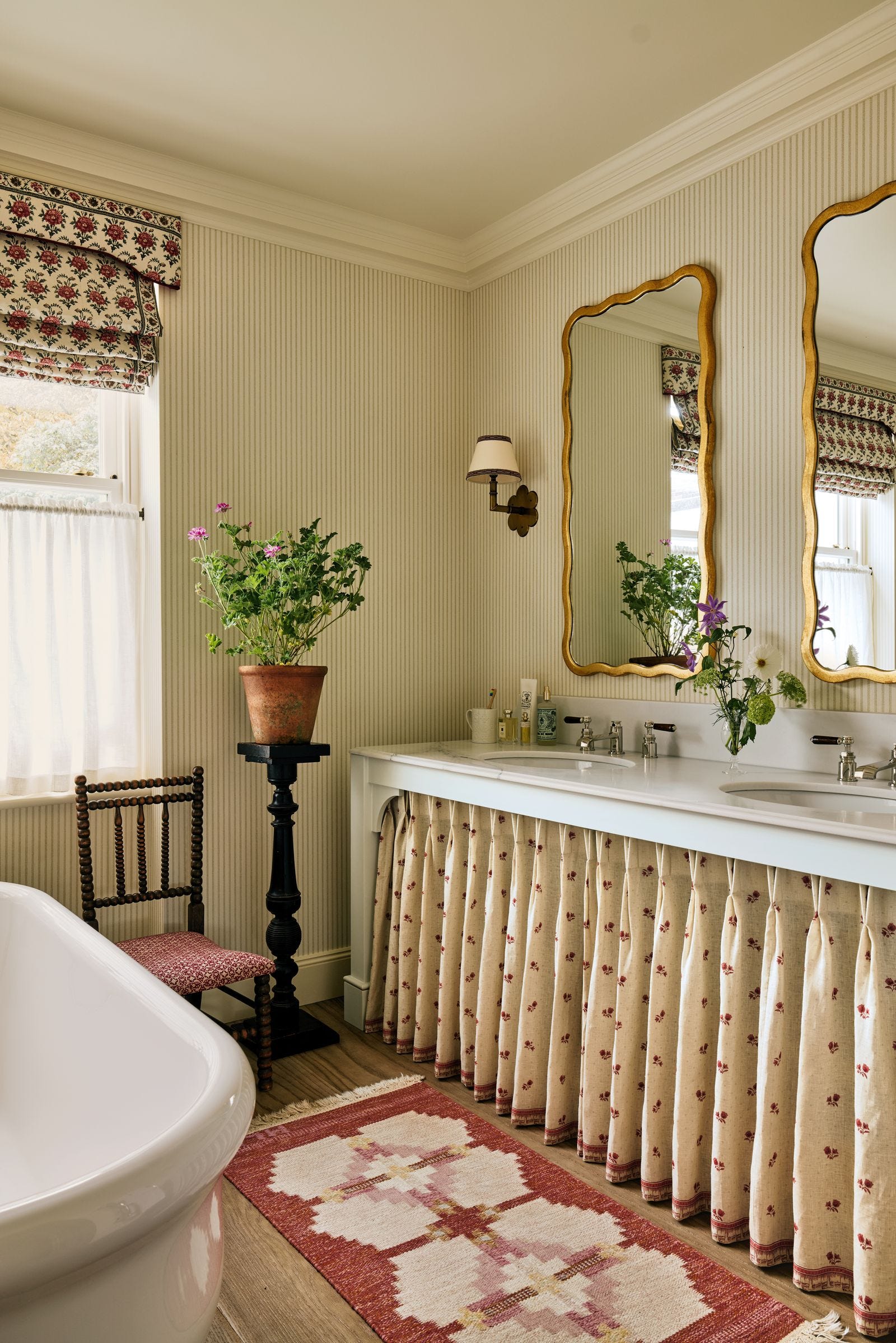
A bathroom is basically a hard box, tiles, glass, stone, metal. So always find ways to soften it.
We love a timber vanity with a stone or porcelain top that’ll withstand the test of time. Wood instantly takes the edge off. If wood’s not your thing, or scares you in a wet area, a painted vanity or one with fluted or grooved fronts gives you another layer of texture.
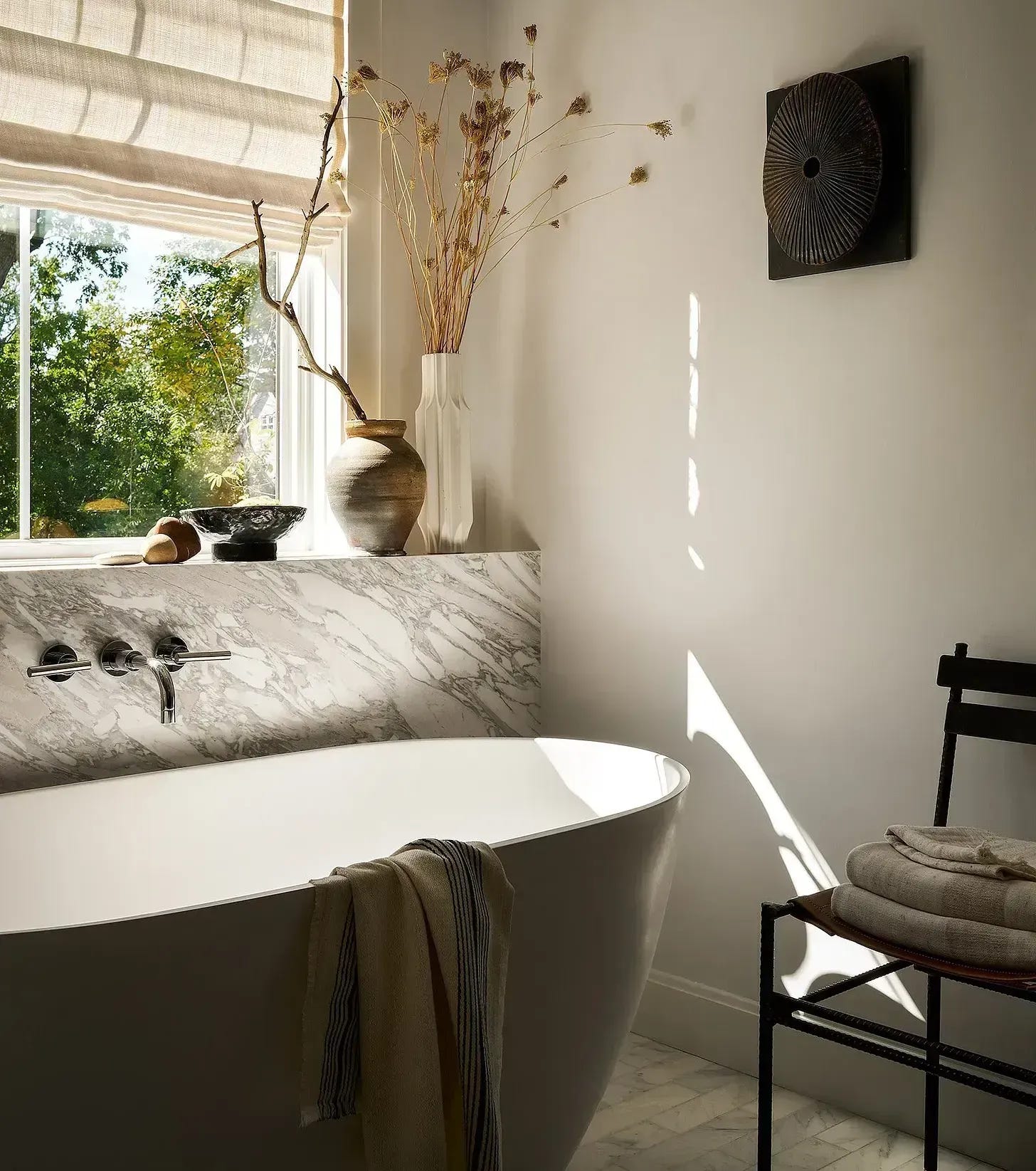
If you have a window that isn’t in the splash zone, add a Roman blind. You get privacy, it helps with acoustics, and it is a great way to add softness. There are some great water-resistant, in/outdoor fabrics now, so you don’t have to hang a beautiful linen and pray every time someone showers.
Style depending, there are some gorgeous fabric shower curtains out there, or you can even add a little skirt to your vanity. If you have wall lights, consider one with a fabric or rattan shade rather than adding more glass. We’ll come back to bathroom lighting because that’s a whole House Rule in itself.
And if you’re blessed with a bigger bathroom, add a little chair or stool somewhere to throw a towel, perch or, realistically, pile your clothes on. Introducing a piece of furniture makes the bathroom feel much more like a room rather than somewhere purely functional.
Try this: Look around your bathroom and see what’s actually soft. If the answer is nothing! Introduce it: fabric, timber, plant, furniture or a basket.
Lydia’s Rule: Treat your bathroom like a room, not just a wet room.
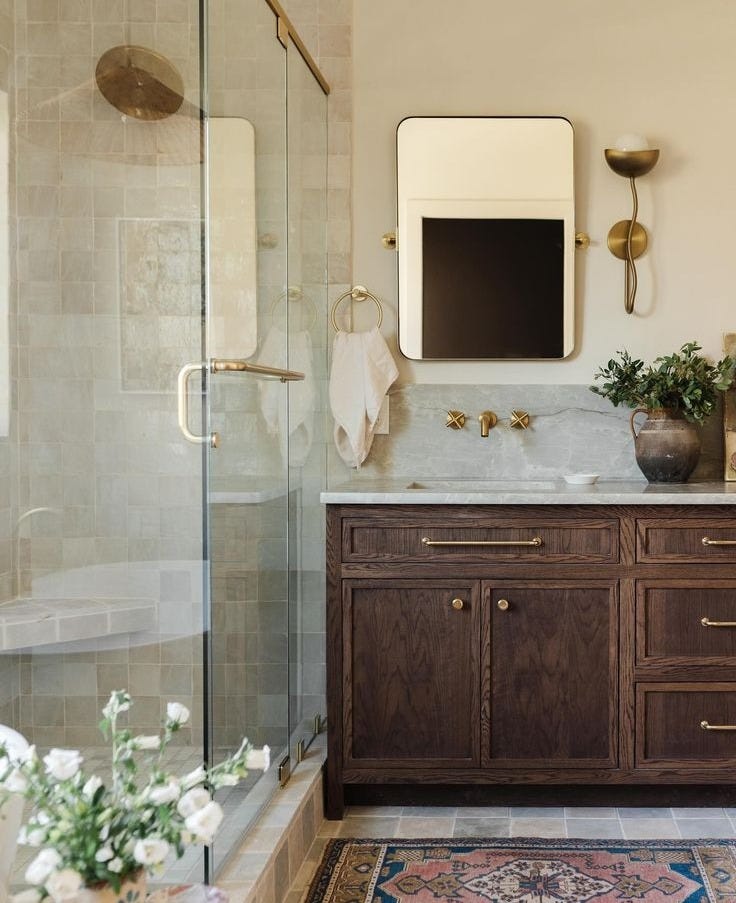
One of the few things I remember whilst studying Interior Architecture at uni. Don’t create a new line for the sake of it. Whether I learnt it there or was always slightly obsessive about things lining up, I don’t know, but it’s something I notice constantly now.
A bathroom has lines everywhere! The top of a door, a shower screen, shower niche, every tile, mirrors, taps, valves. Wherever possible, I want those things talking to each other.
And this is where our drawings really earn their keep. We produce detailed bathroom elevations before a single pipe is put in place, right down to the tile setting-out, grout lines, the height of a niche and exactly where a tap or shower valve should sit. Those drawings then go to the builder and trades to work from, so by the time everything is installed, all those little lines should meet exactly where we intended them to.
If you’ve got a half-height tiled wall, make sure it lines up with the shower niche. If the shower screen sits near the door, make them the same height.
If you’re using a small square or subway tile, think about where your taps and valves sit within it, centred on a tile or deliberately on a grout line, rather than sitting awkwardly off-centre.
You don’t necessarily look at a beautiful bathroom and think, “God, I love the alignment of that shower screen with the door.” But all those little lines working together create a sense of balance. And when they’re slightly off, even if you can’t immediately work out why, something can feel off.
Then there’s the practical side of positioning too. For example, shower valves. Wherever your layout allows, try to position them away from the showerhead, so you can turn the shower on and let it warm up without getting a wet arm. It sounds sooo obvious, but I still see it missed all the time.
And this is exactly why we spend so much time setting things out before they’re installed. Moving something slightly on a drawing is easy. Moving it once your £100sqm tiles are on, not so much.
Try this: If you’re planning a bathroom, don’t look at your tile layout and fittings separately. Look at them together before anything is installed: where the grout lines fall, where the taps sit, where the niche starts and finishes, and what else those lines could align with.
Lydia’s Rule: If it can line up, line it up.
I could babble on for a lifetime. If you want a Bathroom Edition Part Two, let me know in the comments; I can keep going.
See you in the next one.
Lydia x
If you haven't already, catch up on House Rules — Part One and House Rules — Part Two.
No posts
Comments
Nothing yet. Say the first thing.
Sign in to join the conversation.