
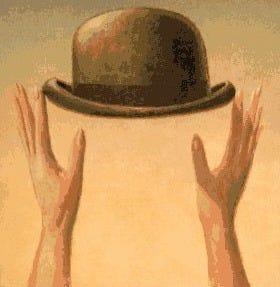
There is a sentence I love from one of my favorite books of all time, Milan Kundera’s The Unbearable Lightness of Being.
“Life is a drawing without a sketch.”
I first read it at fourteen and it short-circuited something in me. Kundera spends the whole novel playing with the tension between lightness and weight, between the intoxicating freedom of knowing none of this is rehearsed and the crushing responsibility that comes with the fact that none of this is rehearsed. We make it up as we go along. There are no drafts, alternate takes, or final versions we arrive on at after comparing renditions.
I have thought about that line for a decade, and the older I get, the more it sits with me differently.
Think about how strange this is.
For almost everything else that matters, we give ourselves an outline. We sketch so we can stand back, compare versions, and hand the world our best one.
You never get to do that with your own life.
By definition, every choice (the college you attend, the person you marry, the startup you join) is irreversible in the sense that the moment you enact it, every alternative life collapses. An entire world of counterfactuals disappears the second you take a step down one path. You cannot hop back to see how it might have felt if you had taken the other road after all.
That reality unsettled me so much as a student that I went and studied the theories that pretend to tame it.
Economics and psychology dress that existential messiness up in equations about “rational agents” maximizing some notion of expected lifetime utility. If, given everything you know now, and everything you can probabilistically forecast under uncertainty, you choose today the action that will on average make “you” happiest over the course of your life, congratulations, you have behaved rationally.
I have always thought those models were beautiful in the way Platonic solids are beautiful. Self-contained, logical, hovering somewhere far above messy human lives.
They also always struck me as insane.
For one, we know shockingly little when we are called upon to make our biggest life decisions. Choosing a major at eighteen means I am asked to conjure a future version of myself in a decade or two and consult her preferences. Would thirty-year-old me rather spend her days reviewing contracts or balancing ledgers? I cannot know, because who I am at thirty will be partially a product of what I happen to study at eighteen. The preferences I am trying to serve will be shaped by the very choice I am about to make. How do you optimize over feedback loops like that?
Even if I could time-travel into my own future and peer with perfect clarity into what brings that self joy, the world around her will still refuse to behave nicely. I plan a summer around the assumption that my partner and I will fly to Greece in July, until he takes a new job and is grounded, or we break up, and suddenly the whole calculation collapses. These are the contingencies that flip best decisions on their heads if only they were knowable, and yet they sit stubbornly outside any forecast.
Then there is the absurd ask at the heart of “lifetime utility.” Optimize the area under the curve of your happiness over eighty years, even though the axes themselves keep shifting. What fills me up at twenty is not what will fulfill me at forty. Yet somehow I am supposed to accept the trade-off that staying in tonight to practice scales will pay off in the montage later? We are wired to want to be happy now. Imagining with any visceral force the quality of a happiness we will not feel for ten years is hard. Making a sacrifice for it is harder.
And yet, for much of my twenties I tried, devoutly, to behave like that mythical economic agent.
I sat in cafes and on dorm room floors and drew decision trees as if my life were a business case. I listed paths, traced branches, assigned subjective probabilities to success and failure modes. I asked myself what version of me each branch produced and then tried to ask that phantom what she cared about most. In a particularly unhinged semester, when I was losing sleep over whether to accept a job offer or apply to graduate school, I wrote a piece of software to simulate different choices over decades and spit out an optimal path based on weighted criteria I fed in.
(Yes, I built a model of my own life. Yes, I now see it was a little nuts.)
It sounds funny in retrospect, but at the time it was the most earnest tribute I could pay to the fact that there are no drafts. The counterfactuals you don’t think about don’t hurt less because you are oblivious to them. All of that modeling never made the uncertainty go away. It did force me to sit with my values, to surface what I actually wanted instead of what I thought I should want, to take a shot instead of drifting.
The older I get, the more I return to Kundera’s sentence with a different feeling. Yes, there is no outline handed to you. And, astonishingly, for the first time in human history we are all walking around with a tool in our pockets that can, if not give you a sketch, at least help you draw one.
When people in tech talk about one-shot learning, they mean feeding an algorithm a single example and having it generalize beyond that. When I talk about one-shotting your life, I mean something more intimate. Taking seriously that you only get one shot at this, and doing everything within your power to make that shot good.
Why do I think artificial intelligence can help?
Because getting your one shot right comes down to two things: 1) Clarifying what actually matters to you, and 2) reverse-engineering from there the mundane series of next steps that move you toward it.
Most dreams do not die because they are impossible. They die because they remain atmospheres; never becoming calendars, habits, conversations, constraints, or decisions.
AI can help with that translation. A large language model will listen while you talk in circles at two in the morning about whether you want another child or to move across the country. It asks questions you had not thought to ask yourself, reflects back inconsistencies you have been politely ignoring, and shows you variants of lives other people are leading that had simply never occurred to you. An aspiration becomes a roadmap, a roadmap becomes a project, a project becomes a calendar entry this afternoon. Tomorrow, the notification arrives at the right moment, reminding you of the promise you made to that future self.
This is what I have started calling human alignment: the gap between who we are and who we want to be, and the possibility that AI might help us close it. Our striving stays ours, scaffolded by something patient enough to hold the long view with us. I have written about it here, and about what becomes valuable in a world where production is cheap and orientation is rare here. Both are downstream of the same conviction: the scarce things are the ones that still carry human stakes inside them, and AI gives us a better chance of putting those stakes where they belong.
For the first time, you can have in your hand, any hour, a patient, opinionated, well-read board of advisors with infinite time for you. You do not have to author your life alone in front of a blank canvas.
Maybe if Kundera were writing in 2026, he would not feel compelled to insist on the helplessness of drawing blind. The lightness and the heaviness would still be there. The irrevocability of each stroke would still matter. But he might nod to the fact that we are the first generation with something like a sketchpad if we care to pick it up.
You still only got one shot as Eminem says.
We do not get to rehearse our lives.
But perhaps, for the first time, we can learn to one-shot them better.
— With love,
Houda
P.S. I really believe in one-shotting your life. I believe in it so much that I created hats :)
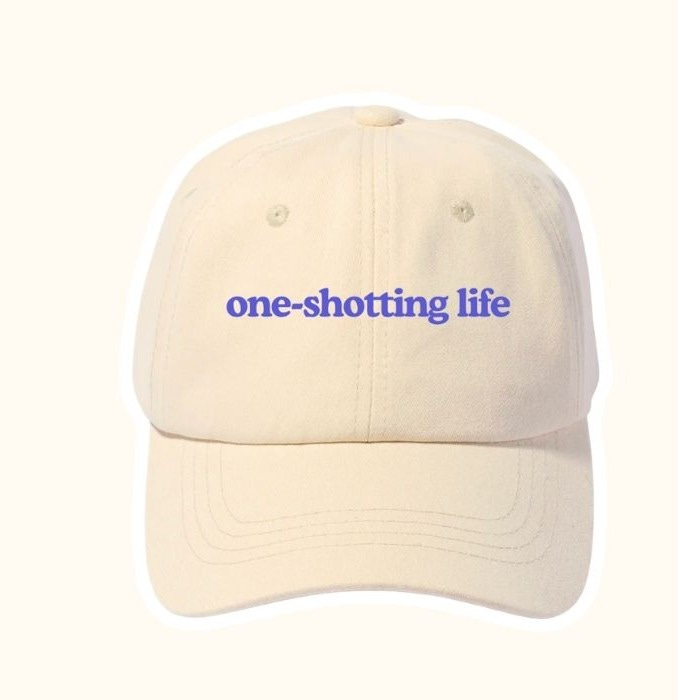
If five people you send here subscribe, I’ll mail you one. Substack automatically gives every subscriber a unique link to share. Tap the “Refer a friend” button below this post and send it to anyone you think would enjoy this essay.
No posts
Comments
Nothing yet. Say the first thing.
Sign in to join the conversation.