
A few weeks ago I wrote about human rights being about small acts of humanity, like letter-writing. So today I want to share a letter written by a member of the hope-based community, Ngare (you can follow his substack here).
I want to share a few words from Ngare before the letter itself because they speak to the power of everyday activism.
I wrote the letter as a shot in the dark. It was deeply personal. And I have had the pleasant surprise of seeing two media platforms in Ghana have now published it!
I am also glad this was a personal initiative, though it made the moment even more vulnerable for me because rejection would have felt “personal”.
I believe the personal agent is still the most powerful tool we have in social change. Institutions and systems are necessary but as infrastructure. We cannot separate our work from who we are and still remain effective.
An open letter from a Kenyan citizen to His Excellency John Dramani Mahama, President of the Republic of Ghana
Your Excellency,
My name is Ngare Kariuki. I am Kenyan. And I am writing to you about my friend *Kofi (name changed for his safety).
Kofi is Ghanaian. He is funny and warm and exhausting in the best possible way — the kind of person who remembers your birthday, who sends you voice notes at odd hours just to check in, who will argue passionately about football and theology and the price of tomatoes in the same breath. He is also gay. And right now, because of a bill that sits waiting in your Parliament, Kofi’s life — as he has built it, as he loves it — is under threat.
I know you understand the ties that bind our two nations. The same colonial lines that separated our grandparents into “Kenyan” and “Ghanaian” never managed to sever what truly connects us: a shared story of resilience, a shared sun, a shared dream of what this continent can become.
When I think of Ghana, I do not think of a foreign country. I think of Accra’s ocean air and Nairobi’s highland wind as cousins breathing from the same lung. Kofi is not just my friend. In the deepest sense of what it means to be African, he is family. And I am asking you, as one African to another, to protect him.
I want to tell you something about Kofi that I suspect might surprise you, Your Excellency.
He is more devout than I am. I say this without embarrassment. I am a straight man who grew up in the church, and in recent years, if I am honest, my faith has grown thin and complicated. Not because of anything Kofi did. Quite the opposite. It is because of what other Christians have done — to people like him.
The condemnations from the pulpit. The family members who read Bible verses like weapons.
The pastors who speak of love on Sunday and support legislation like this one on Monday. I have watched all of this and found myself quietly stepping back, asking whether I want to belong to something that treats my friend as a problem to be legislated out of existence.
And yet — here is Kofi. Every morning, without fail, his WhatsApp status is a gospel song. Not the triumphalist kind, but the tender, aching, reaching kind. Scriptures about grace. Quotes about the faithfulness of God. The man who is the target of all this religious condemnation is more consistent in his faith than I, his straight, churchgoing friend, have been in years. He has not abandoned God, even as God’s self-appointed representatives have tried, repeatedly, to abandon him. There is something in that which I can only call extraordinary. It does not make me want to lecture him. It makes me want to be more like him.
I remember, Your Excellency, when you took office and some of us — watching from across the continent — dared to hope. In the early months of your presidency, you said something that carried weight. You suggested that the bill might not be the most urgent priority, that teaching genuine family values in schools was a more meaningful path than passing punitive legislation.
An activist named Yaw Mensah said at the time that you were teaching Ghanaians to be tolerant of everyone, to build a Ghana where the real values — hospitality, integrity, honesty — are what define us.
Many of us heard those words and felt something loosen in our chests. We thought: here is a leader who understands that governance is not the same as enforcement of conformity.
I am writing because I want to believe that man still sits in Jubilee House.
The Human Sexual Rights and Family Values Bill, should it pass and should you sign it, would imprison people for simply existing. Three years for identifying as gay. Years more for speaking openly, for supporting a friend, for being seen.
Your Excellency, Kofi is not asking Ghana to rewrite its constitution. He is not demanding that anyone celebrate his identity or change their theology. He is asking for something so modest it should not even require a letter like this one: to be left alone.
To wake up in the morning and go to work.
To make a living.
To love and support the people in his life.
To post his gospel songs on WhatsApp without fearing that the knock on the door in the night is the police.
These are not special rights. They are the ordinary rights that every other Ghanaian already holds quietly in their pocket, without ever having to think about it.
Jesus, whose teachings you and I both grew up hearing, did not build his ministry around punishing the marginalised. He built it around finding them. Sitting with them. Eating with them.
Defending them from the religious establishment of his day. The most consistent target of his sharpest words was not the sinner on the street, but the powerful religious leader who used sacred language to crush the vulnerable. I do not believe it is heresy to point this out. I believe it is simply reading the Gospel.
Your Excellency, I am one man writing from Nairobi about one friend in Accra. But there are hundreds of thousands of Kofis in Ghana — people of faith, people of family, people who simply want to live. They are your citizens. They are our brothers and sisters.
Please, sir. Do not sign this bill.
I am asking you the way one African asks another. I am asking you the way a friend asks for mercy on behalf of someone he loves. I am asking you the way someone who believes in the possibility of this continent asks a leader not to shrink from that possibility.
Kofi posted a song on his WhatsApp status this morning. It was about how God does not abandon those who call on him. I listened to it on a matatu to work, stuck in Nairobi traffic, and I thought of you, and I thought of this letter, and I decided to believe it was still worth writing.
I hope it was.
Respectfully yours,
Ngare Kariuki, Nairobi, Kenya
Ngare Kariuki is a Kenyan writer and communication specialist based in Nairobi.
Please help us amplify Ngare’s message. All you have to do is go comment on his LinkedIn post.
We had two great reframing clinics last week. Next up, a possibility space around multilateralism on 7 May. Sign up here.
I am rolling out some basic hope-based course material on YouTube. First instalment here. Stay tuned.
“The window to shape how [narratives around AI] develop is open”: Narrative learnings from Harmony Labs.
Building Power: MobLab report warns progressive civil society is underinvesting in people. How can we grow if we don’t invest in our people and offer other people a pathway into and through our movements? The amount of people I’m hearing from who can’t see how to start or continue a career in social change is overwhelming.
Currently 2 spots left in Belina’s next Sustainable Stand-Up course starting next week!
Our friends at Fine Acts have built an amazing repository of works for activists to use. But I just came across one this week that really stood out to me. It’s from Team Earth where they paired artists with climate activists.
The work depicts Evelyn Acham, a young climate justice activist from Uganda. And as Evelyn says, “We cannot achieve climate justice when there are still other injustices like gender inequality, and social and racial injustice.”
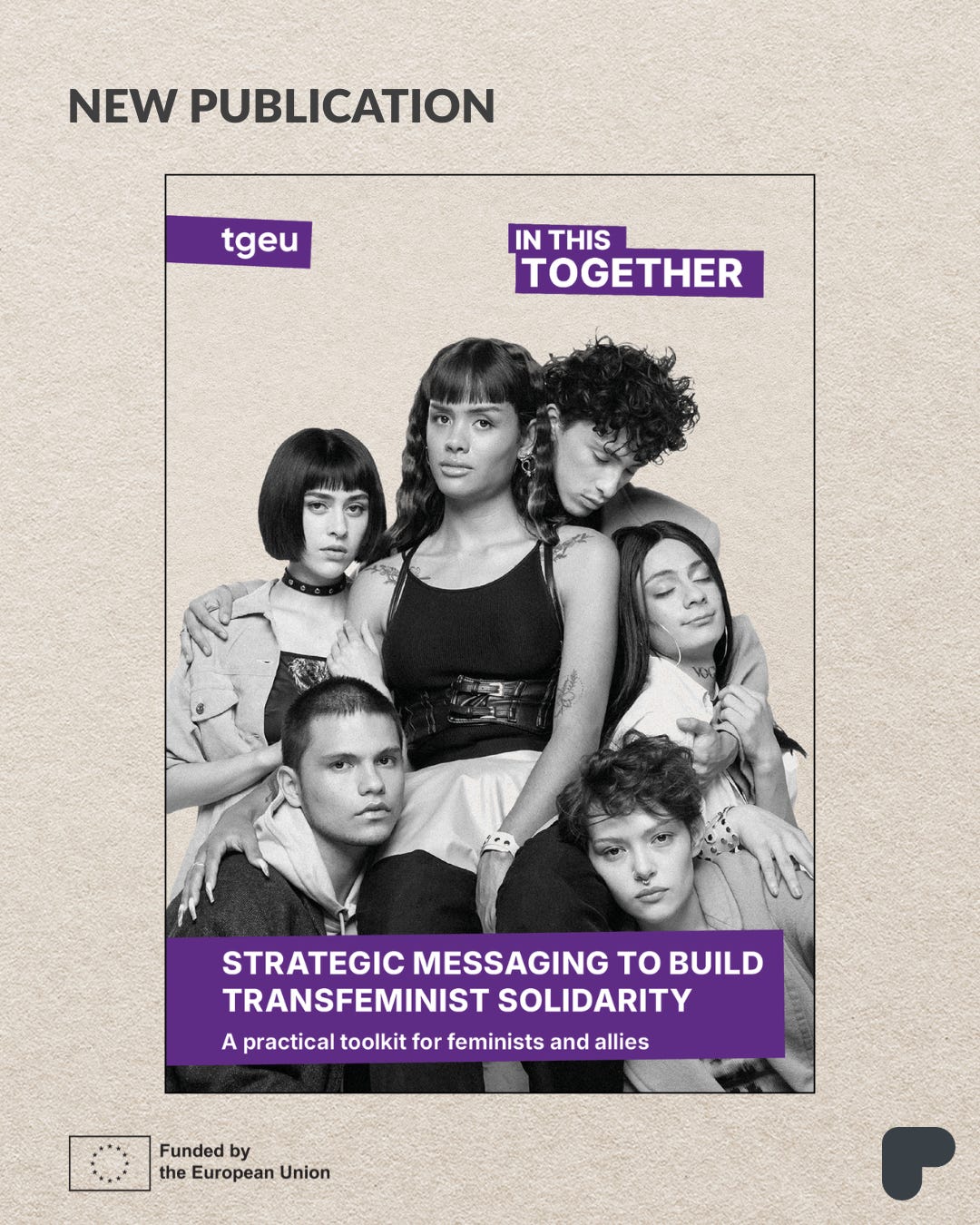
In This Together: new transfeminism messaging guide from TGEU with a manifesto to sign and assets to share on social!
Feminism has always challenged the idea that gender has to fit specific roles. Anyone, no matter who they are, where they come from, or the job they do, should be free to be themselves. Yet those who don’t fit in what is seen as the ‘norm’ are still being pushed out of the spaces where everyone deserves to be themselves without fear.
A future where trans people can live safely and openly is a future where all of us can do the same. Together, we can break this cycle of violence and reclaim what feminism has always stood for: bodily autonomy, equality and freedom for everyone
I think Ngare’s letter is an example of something we need to do a lot more; applying deep canvassing insights to the rest of our activism. I think we could call this “deep communication”.
Here is deep canvasser for LGBTQ+ rights Steve Deline, quoted in David McRaney’s How Minds Change:
“The only way they are going to change their mind is by changing their own mind - by talking themselves through their own thinking, by processing things they’ve never thought about before, things from their own life that are going to help them see things differently.”
And another quote from Steve from Anand Giridharadas’s The Persuaders:
“Changing your mind is about navigating through this morass of conflicting emotions and trying to pick your way through it and come out somewhere that makes you feel a little bit more resolved.”
No posts
Comments
Nothing yet. Say the first thing.
Sign in to join the conversation.