
If you live in Europe, you probably saw this campaign on your streets this week. The title is quite good “Protect what matters”. It talks about free press, free speech and science. But somehow it fails to resonate.
Same problem with their last campaign.
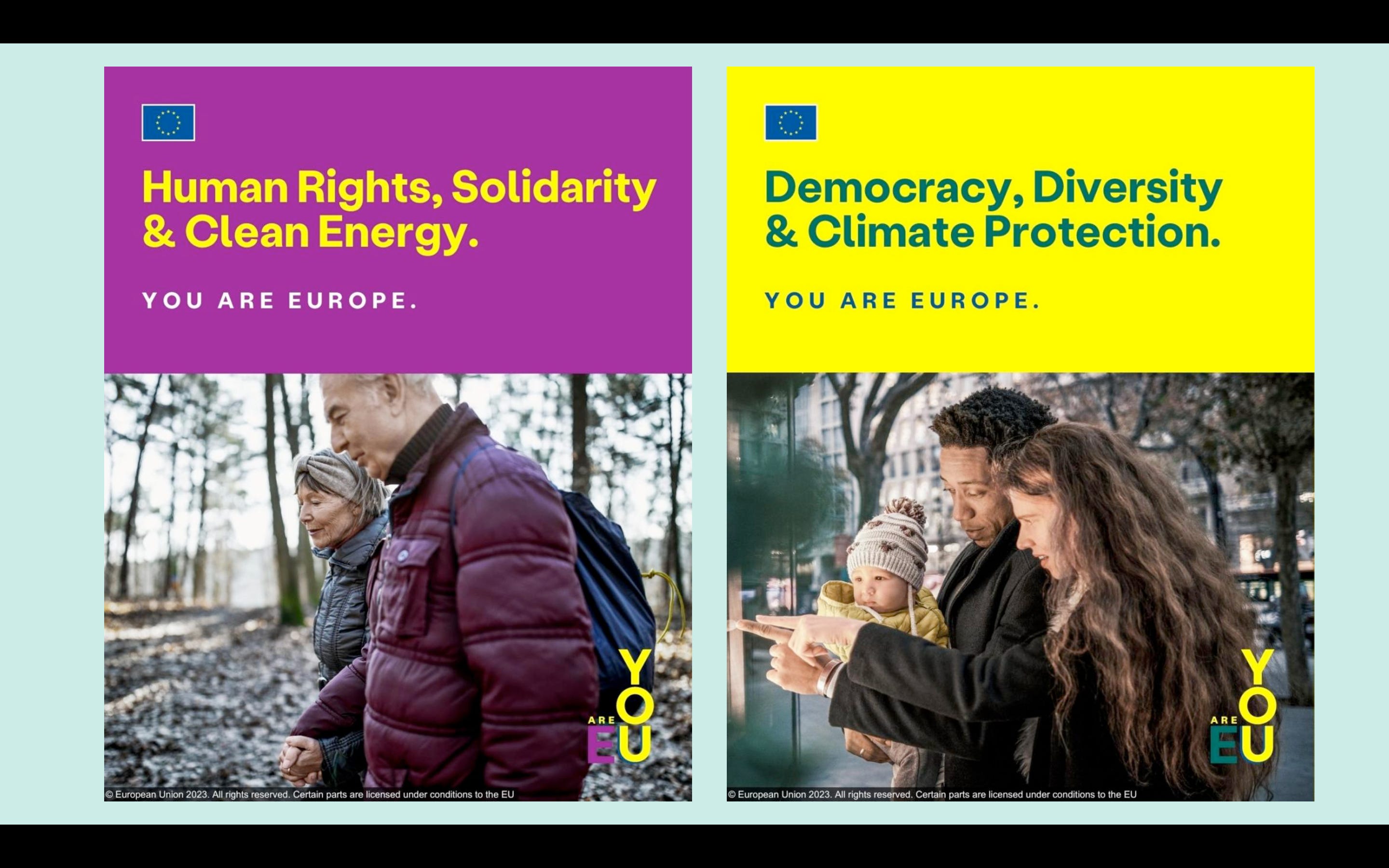
At least this time the pictures are less abstract. But it remains a collection of words without a deeper message. It forgets to tell us WHY democracy matters.
This is a valiant effort that illustrates the challenge pro-democracy campaigns face worldwide: contested concepts.
→ Just saying the word doesn’t communicate the meaning in your head.
Saying “Democracy is Good” is a first step. But then you need to also say WHY democracy is good. Then tell an illustrative story people will remember.
When you talk about a concept like democracy, freedom, justice or equality, you are using a word that means different things to different people. The word has a certain meaning to you based on your memories, experience, beliefs and values. But the word might activate a whole other set of connections in the brain of the person you communicate with.
Here is George Lakoff:
“Every essential component of both simple freedom and political freedom is open to contestation. They are all blanks to be filled in with greater detail, and they are all subject to argument over the best way to fill in those blanks.
…
“From a neural point of view….concepts don’t exist in some abstract philosophical universe, where they can somehow be distinguished from ”conception”. … Each person has a concept that makes sense to him or her. That concept is instantiated in the synapses of the brain. No brains, no concepts.”
“For that person, her concept of freedom is the concept of freedom. She uses it to think with.”
We often explain contested concepts with other “attendant concepts” but these are also “blanks to be fleshed out”.
Every time you name a concept without adding meaning to it, you are leaving a blank in the mind of your audience. But our brains don’t like ambiguity, so they will fill the blank some other way - their own experience, or what they hear someone else say about your concept.
Lakoff says we fill the blanks left by contested concepts with our deeper worldview.
“You can’t get away from contested concepts. There will always be disagreements about the meanings of our most important moral and political ideas.
“Take responsibility. Conservative thinking stresses individual responsibility - no matter what. Progressive thinking stresses interdependency and social responsibility, alongside individual responsibility.”
I’d argue the EU is built on solidarity, collective responsibility and interdependence - that is the worldview its ads should be reinforcing.
So to avoid losing meaning to contested concepts, we must break down our words into words more likely to share the meaning we want. Lakoff calls these uncontested concepts. I’d like to reframe that as “accepted concepts”: words that tap into shared meaning and understanding.
You might think: “I am talking about my values! I talk about justice, freedom, equality, anti-racism all the time. People just don’t care about these things as much as I do.”
I often hear that “people don’t share our values” - but I think activists haven’t actually expressed our true values: we have only named our concepts, without activating the deeper meaning in other people!
During elections on my street in Berlin (helpfully called Berliner Straße) I often see posters with the word “justice” from both the left and the far-right. The same concept, but with its meaning contested by both sides.
You might use the word justice to express ideas and deeper meanings. The word you use may trigger different associations in their brain.
So we have to unpack these concepts ourselves first.
What does justice mean to us? When we are anti-racist, what are pro-?
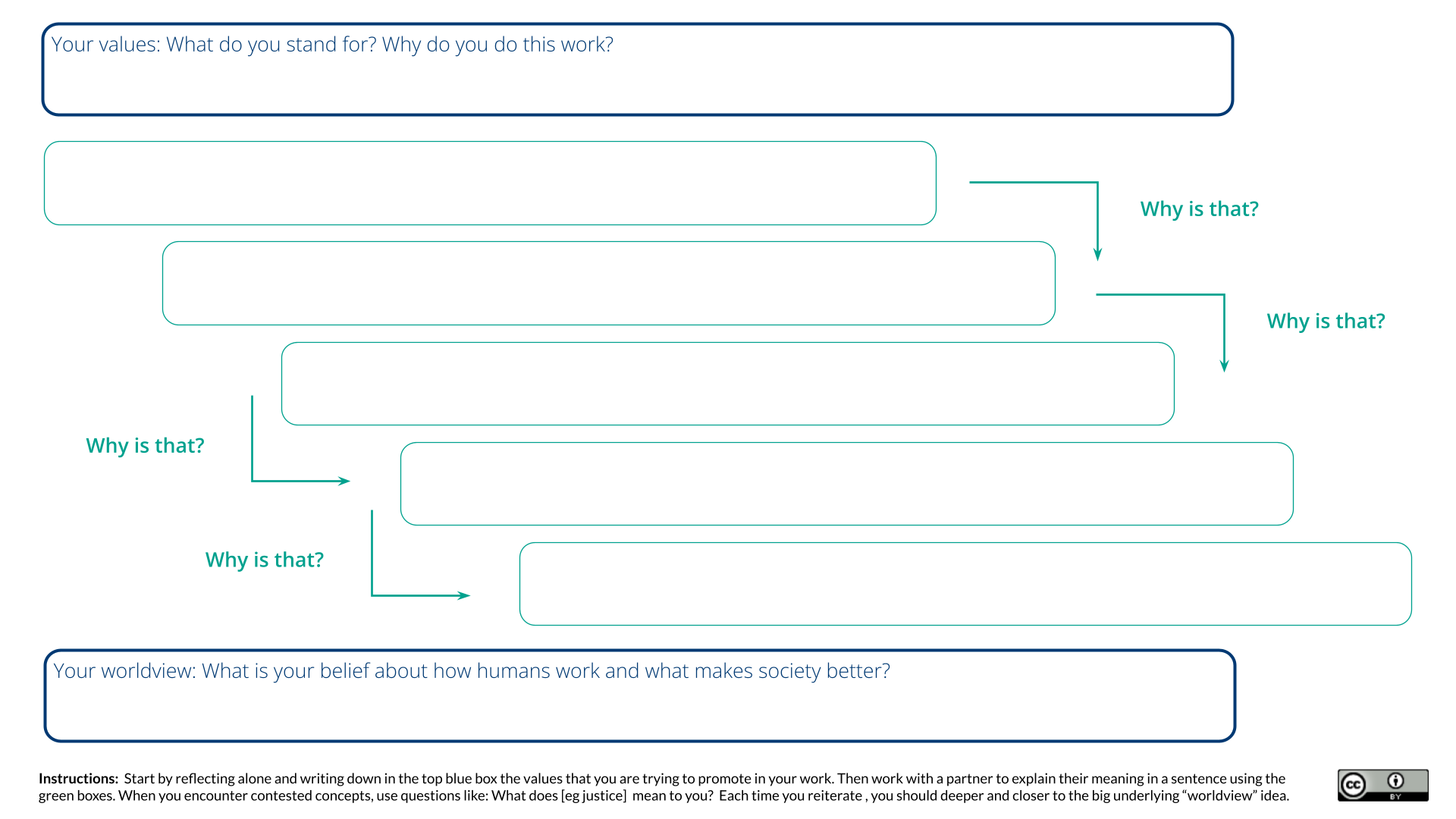
Getting activists to say what they are for has been the hardest exercise for me to develop in my work. When they name what they are for, activists tend to write down contested concepts like equality, human rights, etc. When they explain those concepts, they refer to yet more concepts.
That’s when we use The Five Whys: channel your inner 6-year-old to help you go deeper and clarify what your values mean to you.
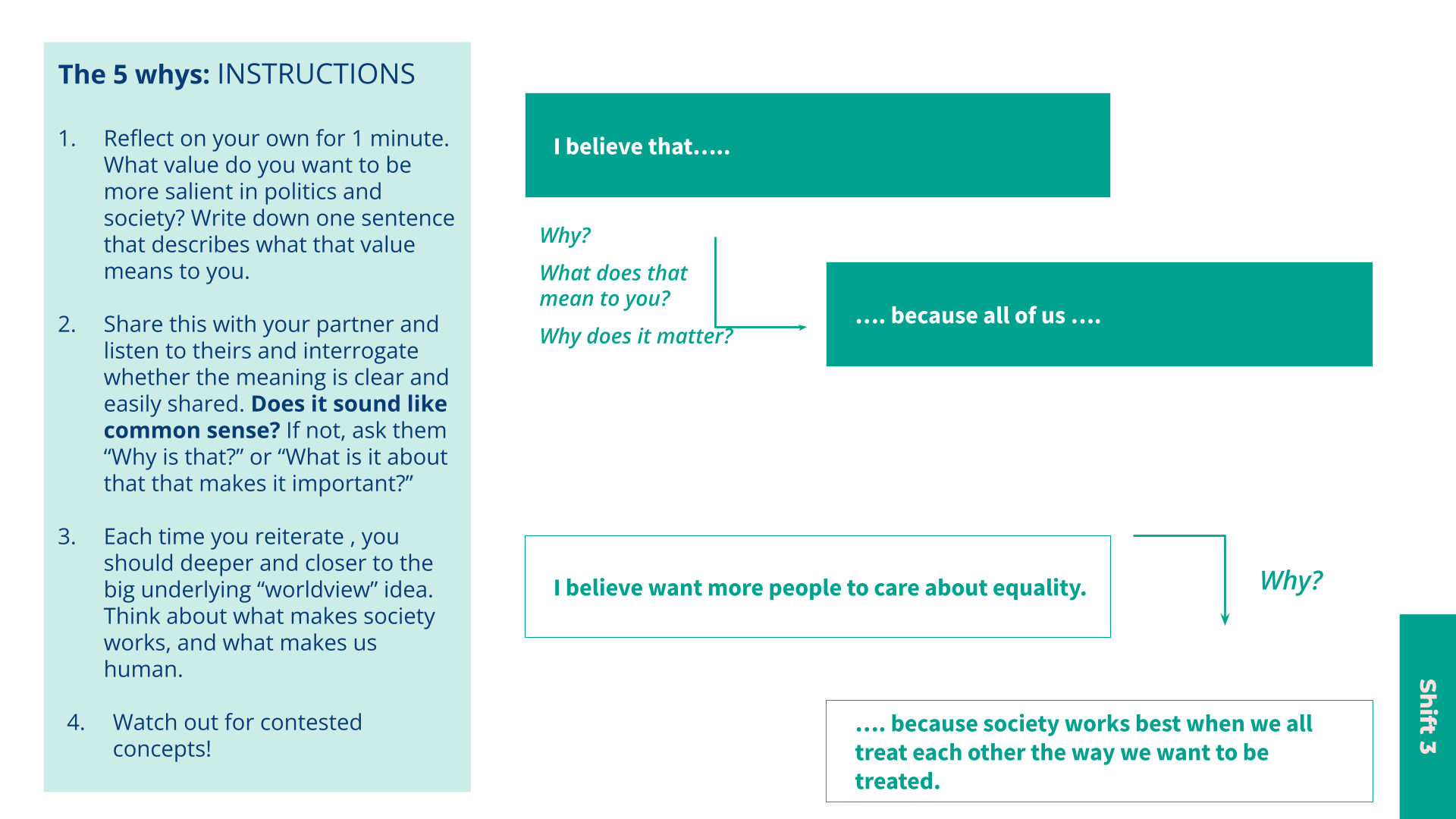
With equality, you might go deeper and say: “To me, that means everyone gets a chance in life”, or “We treat people the way we want to be treated ourselves”.
In future, whenever you find yourself using a contested concept, try to always add another sentence explaining why it matters based on what that concept means to you.
I find that when activists ask themselves what words like justice, freedom and equality mean to them, they tend to arrive at a core set of ideas around what it means to be human and what makes a good society - I have turned this into a moral compass worksheet (coming soon!).
Here is a formula for that: show a story, tell people why it matters, plant a deeper belief.
Story: start with a story that visually illustrates your belief. Because a person needs just one story to change their mind.
Meaning: tell people what is happening in the story using your values framing.
Belief: share the deeper truth behind this, the core belief that underpins your concept.
You can easily plug words from your five shifts worksheet or the five shifts into this formula. The story part is often hardest to find, which is why we focus on it in hope-based workshops.
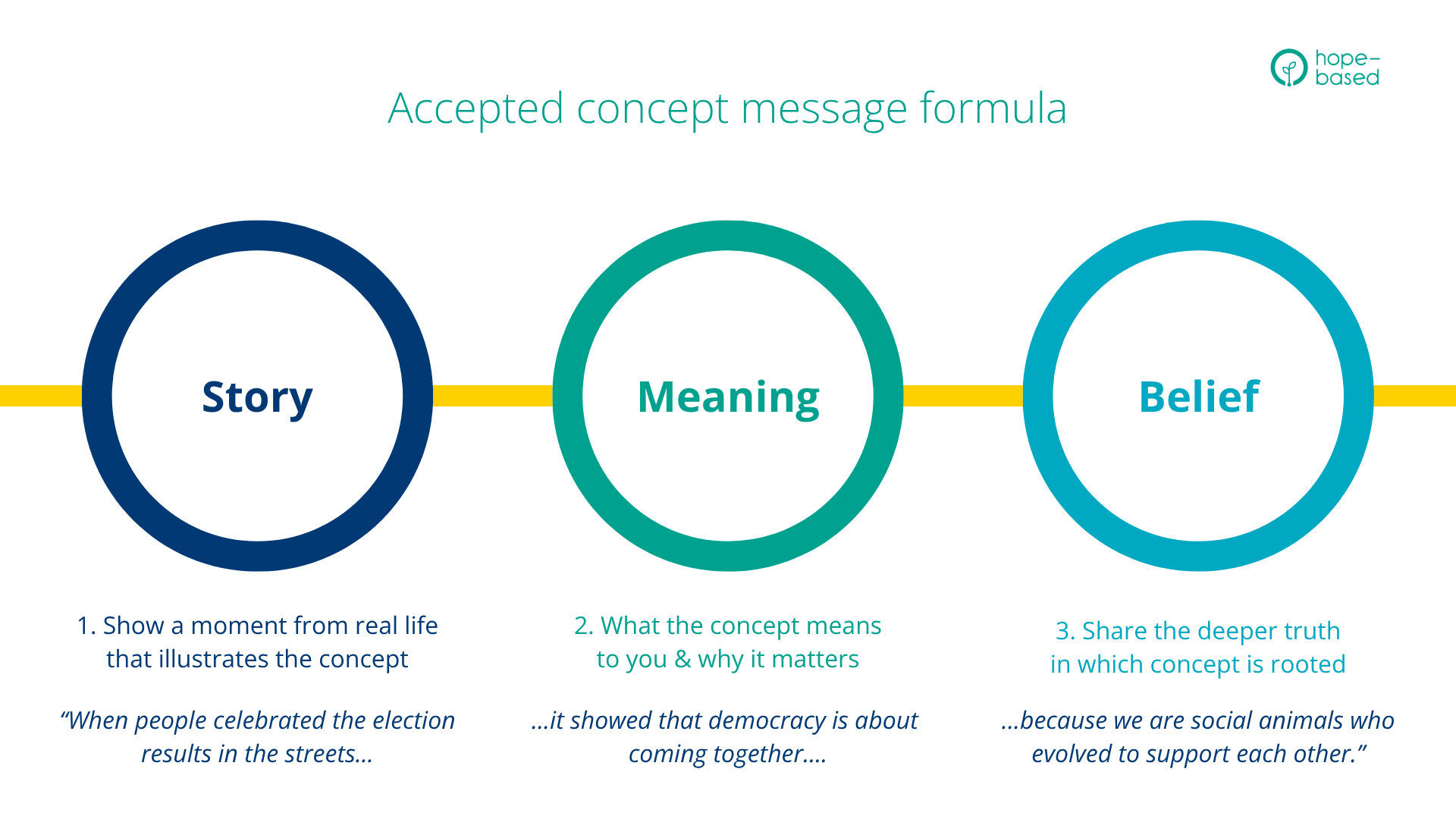
Using this formula, here’s how we could fix the EU’s next campaign:
Tell a real story: replace the stock images with real people doing real things. Like Centrul Filia’s hope-based campaign about care or this EU documentary about Roma people.
Share Meaning: say what is at stake and why this matters. Like Together for Democracy, the Czech campaign using a simple metaphor to show that democracy is about all of us taking part.
Tell a deeper truth: Connect to our core beliefs about the way we live: like OHCHR’s work making migration about welcome, kindness and shared humanity.
We often go looking outward to find messaging. But actually, this work is basically excavating our unspoken deep truths.
“Reframing is not just spin or propaganda but a means of telling deep truths effectively.” - George Lakoff
What we are doing here is:
Digging down to access the meanings we rarely think about consciously.
Naming them so that they become a natural “extension” of the contested concept (e.g. human rights → shared humanity → we are all human).
Repeating them so they become accepted by others.
From now on, every time you find yourself using a concept like “human rights”, ask yourself, “what does it mean to me?” Then always repeat that second sentence when you say the word.
What words and pictures do you want to connect to the word democracy?
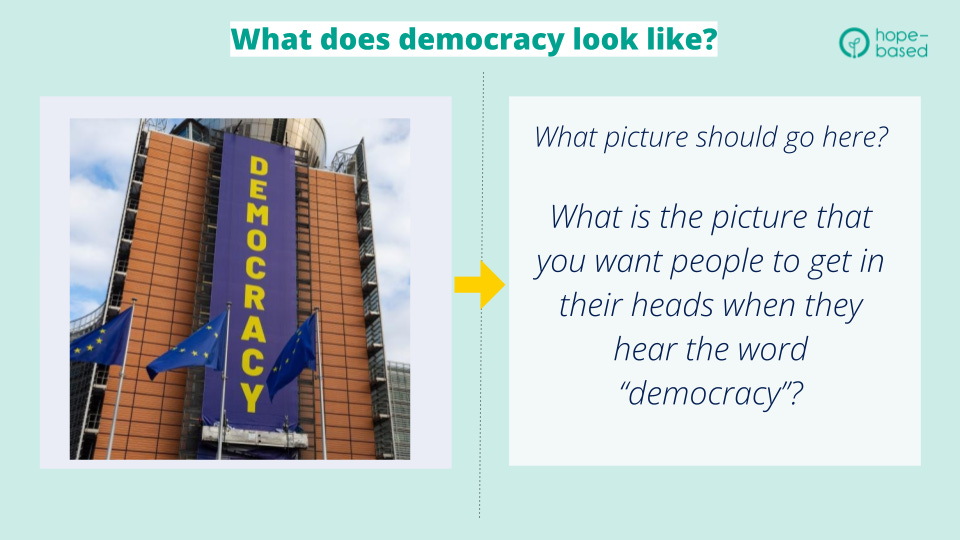
Why the EU campaign is a missed opportunity: There are progressive and conservative versions of contested concepts. Lakoff says we have to put your version “uppermost in the public mind”.
“Remember, you are not alone. There is power in numbers. If hundreds of thousands of people are saying the same thing-ideas that are based in American values, that ring true, and that stimulate positive emotions -those ideas become powerful.”
“Say things not once, but over and over. Brains change when ideas are repeatedly activated.”
Imagine if there were ads all over Europe reminding us to care for each other? Naturally, its easier to agree a message based on contested concepts, because we all think the slogan means something different in our head.
But if we want to communicate effectively and preserve European community and democracy, at some point we are going to have dig down and ask what we really want them to mean.
I’m going to share some new messaging tools in the June edition of our monthly reframing clinic. (Kristin is kindly hosting the May edition because I have a workshop!)
The EU did a much better job with this documentary sharing the stories of Roma people.
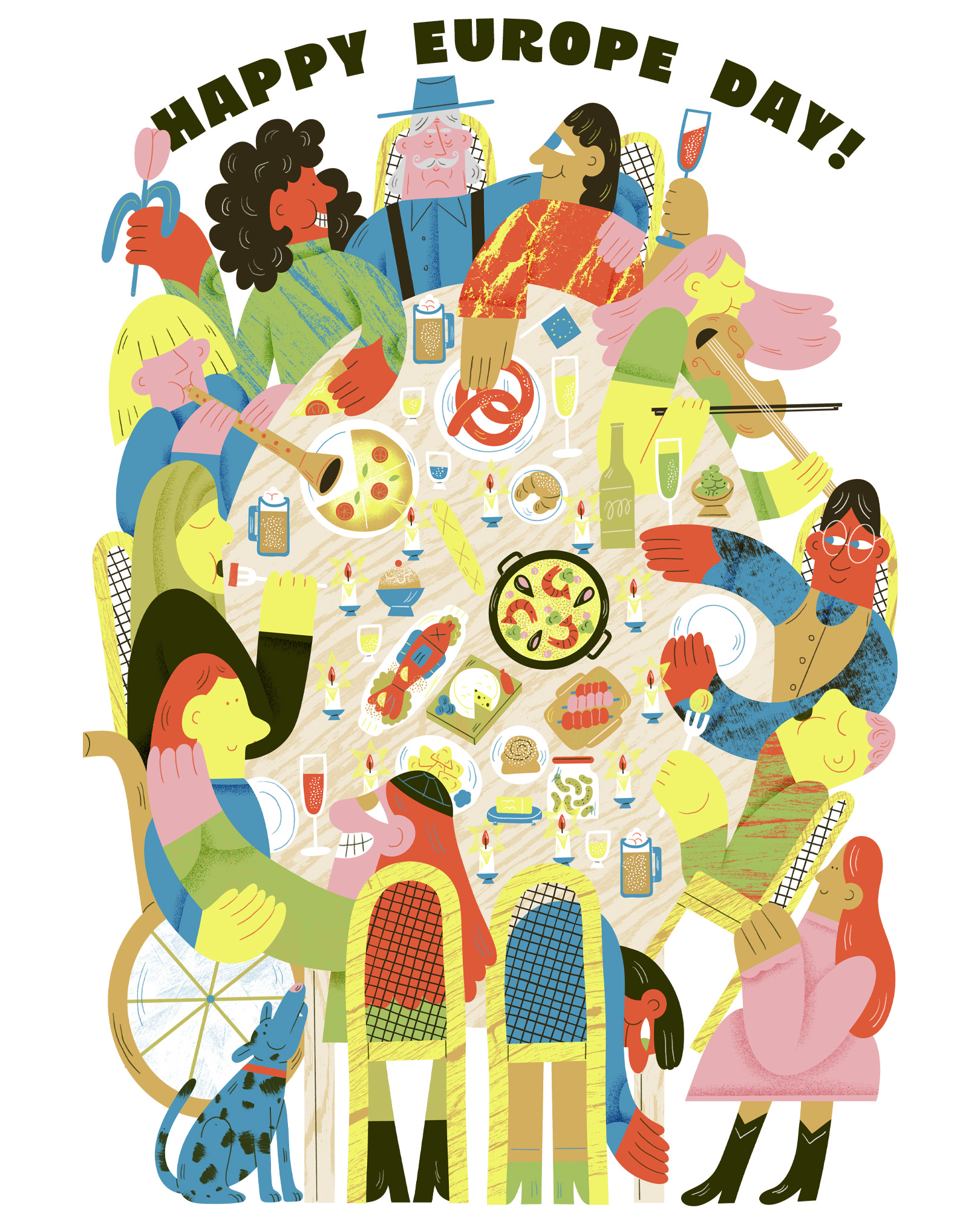
Fine Acts have a more colourful way to mark Europe Day.
“Capitalism, patriarchy, criminal violence, and state violence are systems of death. In the face of these forces, we women strive to generate life - but, above all, to sustain it.” Paloma Martínez in Intrasentido on women challenging war and war narratives.
Exemplary comms and narrative going on over at Antidote - follow, like, share, etc! Love this post about Civic Square.
Lessons for organisers in a time of monsters - featuring a new book by the great Hahrie Han!
Check out the great campaigning of Nina Schwalbe over in NYC (and check out Shape Change if you are wondering how to get some of that magic for your own work.)
Thanks for reading hope-based! This post is public so feel free to share it.
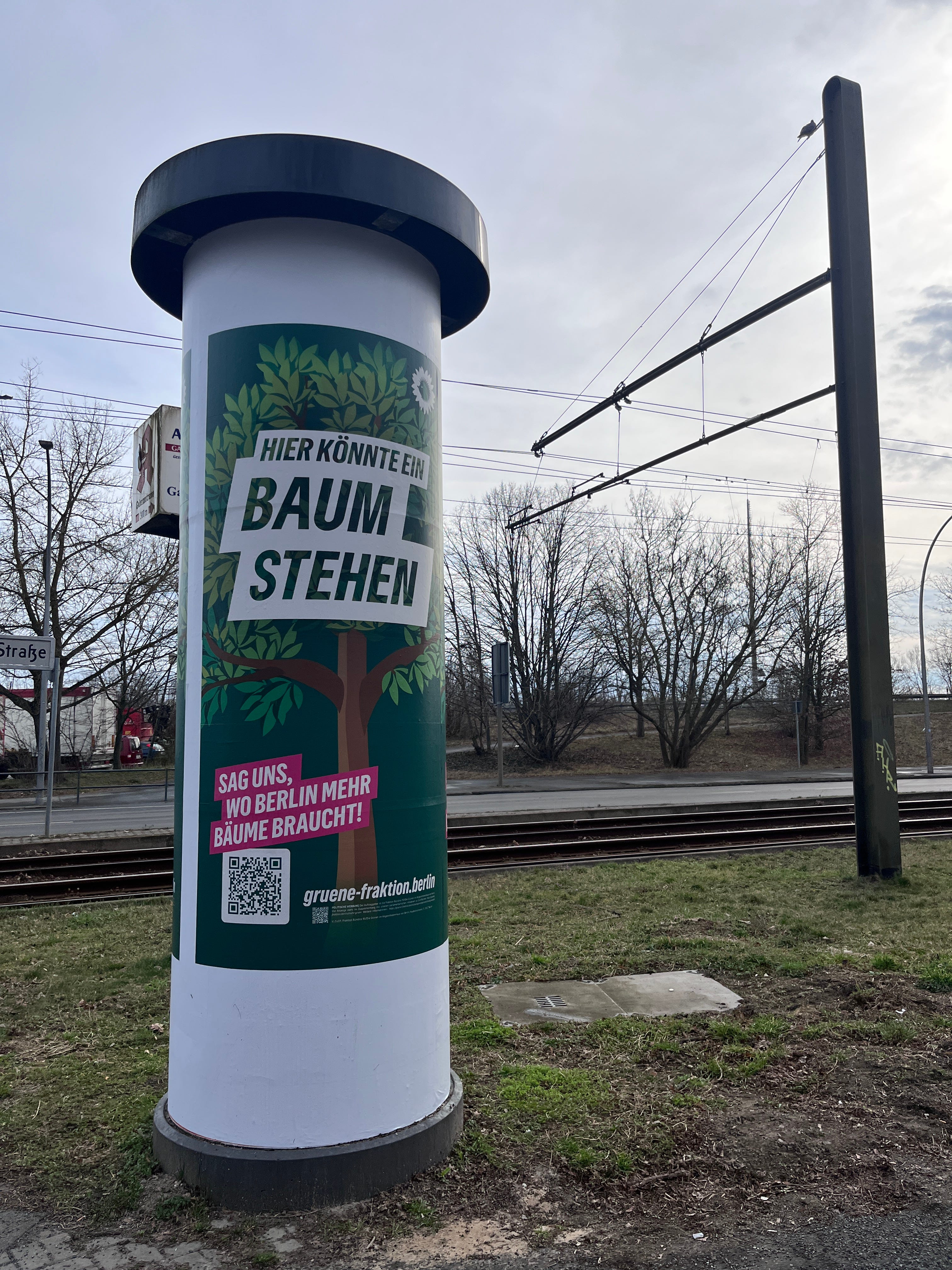
Now here is a billboard that activates the imagination:
“There could be a tree here.”
Then the QR code takes you to a Million Trees for Berlin campaign.
Unpacking wealth myths:
I was quoting this Walter Lippmann line from his 1922 book Public Relations long before I discovered narrative. Never gets old:
“In order then that the distant situation shall not be a gray flicker on the edge of attention, it should be capable of translation into pictures in which the opportunity for identification is recognisable.
“Unless that happens it will interest only a few for a little while. It will belong to the sights seen but not felt, to the sensations that beat on our sense organs, and are not acknowledged.
“We have to take sides. We have to be able to take sides. In the recesses of our being we must step out of the audience on to the stage, and wrestle as the hero for the victory of good over evil. We must breathe into the allegory the breath of our life.” - The Image of Democracy
No posts
Comments
Nothing yet. Say the first thing.
Sign in to join the conversation.