
This article was edited from a transcript of a podcast episode. Feel free to listen to this article in podcast form below.
Also available on Apple podcasts
For many of us, our first entry into the realm of astrology begins with the signs, as they’re the archetypes that describe our personalities and personas – they help us understand and tell our story. But as we get a little deeper, we learn that there are these other things called houses, and aspects, and transits and many, many other components that contribute to the whole world and language of astrology.
Over the years I’ve found that houses in particular are where people usually get stumped when they’re learning the astrological dialect, and so I in this article I want to give a very basic breakdown of the houses.
There’s so much minutia that we could get into when it comes to houses, houses systems, and history of the house systems, but we’re going to skip a big swath of those details for now and focus on the essence of this one component of astrology. For many of you, this information is going to be pretty familiar and rudimentary, and for many others of you I hope that this information is educational and enlightening.
The purpose of this piece is to help you define for yourself what you’re looking at when you're assessing your chart – to give you a little more language to support your translations and sense making.
YOUR INVITATION TO SPACIOUS
Everything I discuss here I go into further detail in my workshop Spacious. If you're at all interested in learning more about the houses and specifically your empty houses in your chart (and how to work with them), this workshop is for you.
(01) You’ll learn what empty houses are really – how to identify them in your chart, and how to know they’re actually empty.
(02) You’ll discover what energy your empty houses come with based on your natal chart and what areas of life they describe – so you can start seeing them at work in your day to day life.
(03) You’ll gain an understanding of how your planetary placements influence and describe your empty houses, and develop a guide for how your planets support you in developing a relationship to these spaces.
(04) You’ll learn practices for how to work with transits through your empty houses – so you can continue to build a relationship to this part of yourself and life based on what the astro weather is encouraging for you
Available for immediate download
To begin we have to answer the question – what is a house?
We’re going to answer this question in two parts:
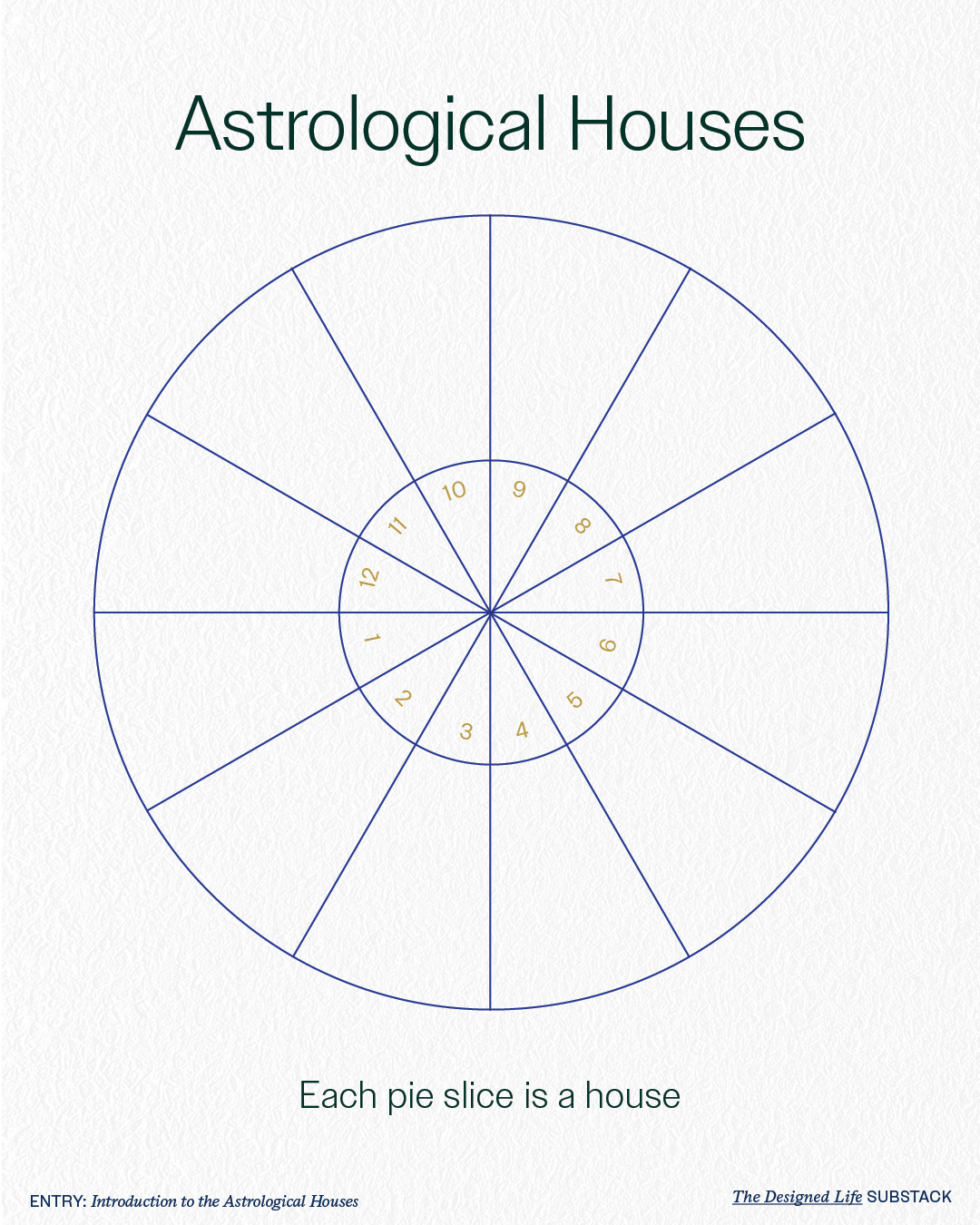
When you're looking at your natal chart as a wheel (not as a list or a graph) you'll see that the whole 360 degree circle has been divided into 12 pie slices. And depending on which house system you're using, those pie slices could be either equal (meaning that they're each exactly 30 degrees of the 360 degree circle) or they could be varying widths.
A quick note here:
I want to take a moment to just briefly touch on house systems, because there are different lineages of astrology that divide the chart (the whole circle) into different degrees. And depending on the lineage that you come from, you might be looking at one version of your chart versus another.
My good friend Jess and I are going to go into a bigger discussion of this specifically for whole sign versus Placidus, which are perhaps the two main house systems that we use for the tropical zodiac, in a secondary publication.
For the sake of this article, I'm going to be speaking specifically to the whole sign house system. And if you're already lost, let me just say that the whole sign house system looks at the chart in exact 30 degree segments all the way around the circle.
So when you look at your chart from a whole sign house perspective, there's exactly 12 pie slices of the same exact width – each 30 degrees. Each pie slice is a house.
The second part to the question “what is a house?” is that the houses are the where – the areas of life, where things actually get enacted.
Every house describes a variety or a collection of areas of life.
How you have your work life, your home life, your relationship life, your friendship life, your money life – you have all these different areas that make up the whole of your lived existence – these areas are described by the houses.
I like to think of them as the setting and the stages - the environment within which events happen. Additionally, every environment has an aura that influences the events that happen within them (and this environmental aura will be described via the sign that’s on the house) but we’ll get into that in a later section.
As for now, let’s get into the very basic delineations of what areas of life each house represents.
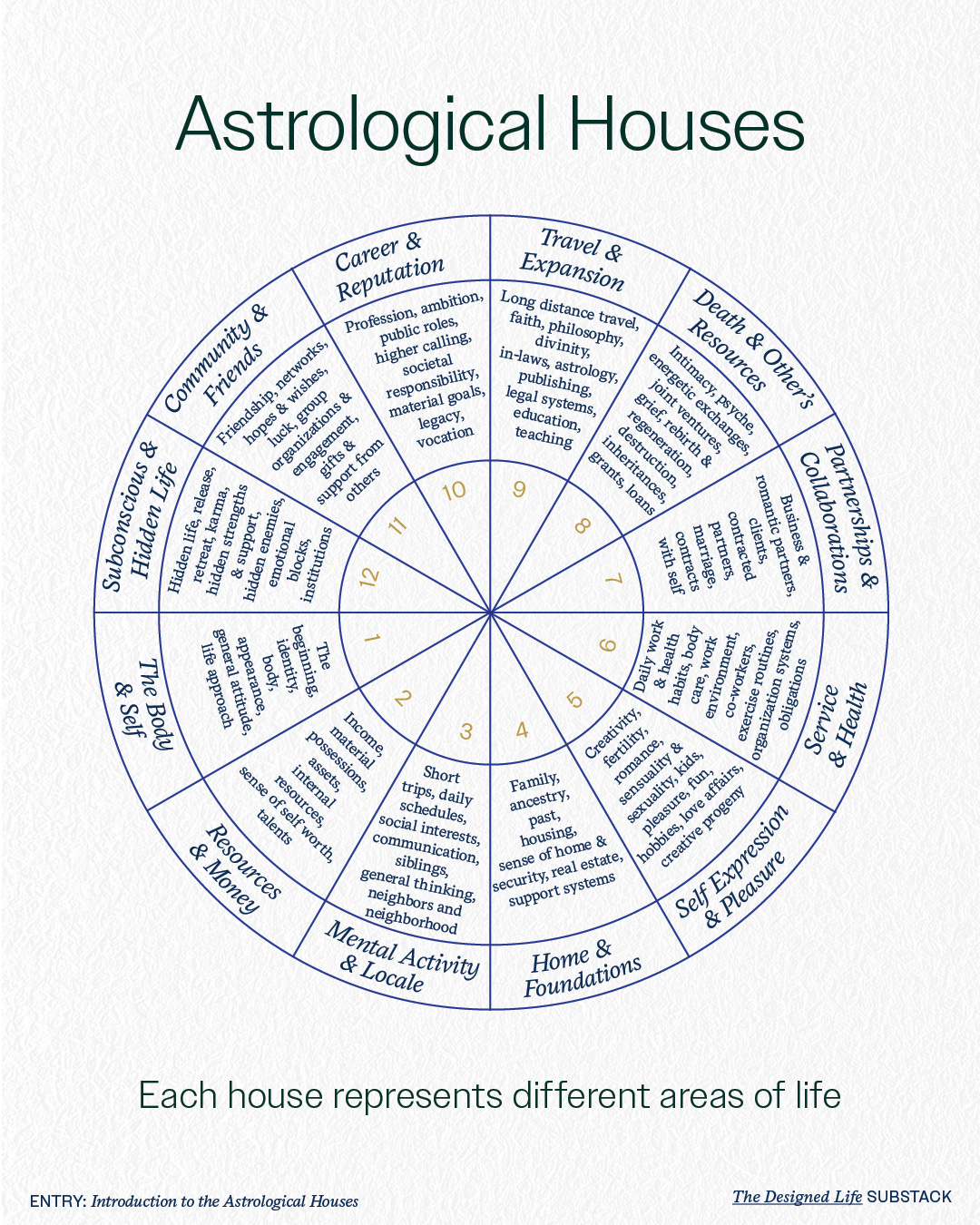
As we move around the chart in a counterclockwise direction, we start to encounter different collections of the lived experience. When talking about what the houses represent, we could go into the description of each house potentially for hours – to try to describe parts of the human experience often requires many, many words. But for the sake of brevity, below you’ll find my quick and dirty descriptions of each house.
Identity, body, appearance, general attitude, life approach, your motivation and sense of direction
The 1st house represents the body, the self. This is you in the chart. This is your appearance. This is your general attitude. This is your life approach.
I like to describe this house not just as you and your body, but also the energy that fuels you into existence – the breath that propels you moment by moment. It’s the motivating energy, or in yoga we call it the prana (life force energy), that allows you into live, and allows you to move move from this moment to the next, to the next, to the next.
And yes, it’s your appearance. If you look at a variety of Sagittarius risings, for example, there’s a lot of similarity to how we all look. Obviously, there’s other things that describe your appearance (such as your Venus and your moon sign) but the first house will describe your physical capabilities because it’s your body – it’s you.
This part of the chart was defined at the moment you took your first breath in this lifetime, and so it describes your essence. You also have a relationship to your vessel, and how you embody your vessel in this lifetime is described via the 1st house.
Income, material possessions, assets, internal resources, sense of self worth, talents, livelihood, self care, inner strengths
I like to also describe this part of the chart as your vitality. It’s just underneath your first house, so it holds up your body. It’s everything that you need to support your life, your livelihood, all the resources that you need to sustain your body.
In medical astrology, this house is often looked at for your relationship to food and your relationship to like how you nourish your body, which can be a little bit confusing because once we get to the 6th house there’s some crossover here. But nourishment is also accessed and described by your income, your material possessions, your assets – the things that support your ability to live.
I like to think of every house as having an outward expression and an inward expression. For that reason the 2nd houses also describes your internal resources as well – your talents and skills. It’s your sense of self-worth. The 2nd house is “worth” in many ways – it’s the valuable things that you own, but it’s also the value that you carry within you.
Short trips, daily schedules, daily rituals, social interests, communication and communication projects, siblings, general thinking, neighbors and neighborhood
Historically, the 3rd house is considered the house of the Goddess. It represents our daily rituals, and in a modern day sense, that could be considered your daily schedule. But it’s also short trips to nearby destinations like the grocery store or local events. It’s your social activities and engagements. It’s communication and writing projects, it’s your general thinking and how you mentally approach the world. It’s also your siblings and it’s your neighborhood and your neighbors.
As you can see here with the 3rd house, there can be a lot of different and seemingly disparate areas of life contained within each of these spaces. And yet at the same time what I’m sharing here is really just the surface level of what the houses each represent – there’s so much we could parse through with all of these areas of life, but hopefully this information is helping you make sense of how the houses function and the basics you can find in each space.
Family, ancestry, past, housing, sense of home and security, grounding practices, lineage, real estate, support systems, death and the afterlife
Your 4th house is your family and ancestry, your past, your home and your housing, your relationship to housing, your sense of home and security, and your sense of groundedness. It can be real estate, it can be support systems, and in many ways it can also be the people that feel like family.
When we’re looking at the chart, this is the very bottom of the chart, so it’s also considered to be connected to the subconscious. There’s a few different parts of the chart that are related to the subconscious, but this is definitely one that - if you think about it - acts as the grounding cord that anchors us all the way into the depths of the earth and connects us to energies and people that came well before us in our lineage. It’s the thread of connection all the way behind us and below us that’s allowing us to move forward.
Whether or not you have a relationship to your family members, this house will speak to that relationship and where you came from, and your sense of home as a whole.
Creativity, fertility, romance, sensuality and sexuality, children, inner-child work, pleasure, fun, hobbies, games, love affairs, creative progeny, entrepreneurship
The 5th house is historically considered the house of children, but what I like to think of is that it’s a creative extension of you. It represents the things or people you bore, and that you bring to life in this world.
And that can be so many different things, but it’s essentially your creative energy that’s expressed outwards. The 5th house then represents fertility, anything related to fertility efforts, your kids or other children in your life, but also anything related to sexuality and sexual pleasure. Romance, sensuality, fun, pleasure, hobbies and games and good times all live in this house. The 5th is considered to be the house of good fortune, and so it’s everything that comes with the joys of life.
Because it’s your creative progeny, and what it is you want to bring into existence in this world, I sometimes also put entrepreneurship here.
Daily work and health habits, body care, work environment, co-workers and/or employees, exercise routines, organization systems, mundane chores, obligations, service
The medical astrologer Kira Sutherland describes health as a series of mundane, minute choices that we make over the course of our days and over the course of our lives that contribute to the strength or the weakness of our body. And those choices, routines, and work all live in the 6th house.
All of these little choices that we have to make on a day-to-day basis to support our bodies, and to support our lives – whether that’s, the choices that you make for to your exercise routines or the chores that you have to do around your house – all of that lives here.
It’s also become the house of your work and/or service. It’s not necessarily the work that you want to be known for, but it’s the work that you’re obligated to do in some sense. It’s the daily work that you have to show up and do, and all of the minutiae that goes into everything that you do for work.
It can look like work that’s attached to an income, or it can look like the work of being a parent, or the work you have to do around the house, or the work you do to support an organization.
When I think about my own 6th house, I think about how after moving into house I currently own, I suddenly had so much more cleaning and maintenance to do. This was partially thanks to Uranus moving through my 6th house too, but there became so many more chores, like mopping and vacuuming and surfaces to wipe down. It’s those kinds of required tasks that live here.
Your relationship to this area of life will be delineated by the sign and any planets that might exist in this house, and we’ll get into those details in a minute.
Business and romantic partners, close client relationships, contracted partners, marriage, contracts with self and others, 1:1 relationships
Now, if you’re looking at your chart, you’ll see there is a direct line of connection from your 1st house to your 7th house. This is the first axis we encounter in the chart.
So the 7th house acts as a mirror, and what I love about this house is that when you’re in a relationship with somebody, whether it’s a friendship or romantic or business partnership, there’s a lot of things that you end up discovering about yourself based on the dynamics of that relationship. The other person inevitably reflects you back to yourself.
What’s interesting about this is that when we see ourselves reflected back to us, sometimes we see things that we don’t want to see, right? There are parts of us that either we’re hiding or we’re not expressing – or we are expressing, but we can be unconscious to. So in many ways our “shadow” can live in this house.
This house is also where open enemies live. And I find the term “open enemy” really interesting because so much of the time if we have an open enemy, there’s something in that person that rubs us a certain way. Most of the time, if there is somebody we have an aversion to, there is something about them that we are also averse to in ourselves.
Intimacy, energetic exchanges, entanglements, joint ventures, grief, rebirth and regeneration, death, destruction, inheritances in all senses of the word, grants, loans, taxes
The 8th house is one of my favorites (I have my Sun, Mercury and Chiron here). It’s often referred to as the death and taxes house, but I like to also describe it as death and other people’s resources.
The 8th house overview is that it is taxes, it’s joint finances, and it’s the literal assets and resources that intermingle between you and another person. Those things can be physical, but they can also be psychological. Inheritances live in this house, and inheritances can be actual physical stuff that gets handed down to you from other people that have passed on, but they can also be things that you psychologically inherit from other people. It can look like, the things that you’ve carried from your maternal lineage that go way, way back, that have been embedded into your psyche, and that you get to work and parse through.
When you’re looking at your chart and you’re looking at the 8th house and its place, it’s directly across from the 2nd house. The 2nd house describes your talents, your material resources, your income, your possessions, your self-worth. The 8th house describes all of those things but co-mingled with other people.
I see a lot of people who are in service provider positions with placements in this house, and it’s because people come to them with their “stuff”, whether it’s a project or a problem or something that needs to be organized or solved or created, and they take it, they transform it, and they give it back to them via their service work. Many people attribute service providers such as financial planners or managers to this house, but I’ve also seen graphic designers, copy-writers, doula’s, and a variety of other service provider positions as described by strong placements in this house.
And because this house is related to death, the experiences of grief, anxiety, and fear live here, and the kinds of emotional experiences that come with death and loss. This is one of those houses whose topics can sometimes feel intangible, because they’re the parts of life that are a bit more difficult for us to see or make sense of or directly point to and name. They exist as these kind of challenging gray areas.
And I want to go into this a little bit more because I love this house. Historically, this house was called the idle place. It’s the time of day when the sun is heading down towards the horizon, typically between 3:00 and 5:00 in the afternoon, when you get a little sleepy and want to take a siesta. There’s a lull in the energy and in your day. That the energy this house embodies.
When you’re looking at your chart, and you’re looking at the 1st house, based off of aspects, you can’t actually see at the 8th house. It’s kind of in your peripheral vision. So there’s an energy to this house that makes it difficult for you to clearly sense what’s going on here. For that reason, I like to call it the gray area, and we all know to some extent what a gray area means and what it looks like and what it feels like – it’s difficult to grasp but it has certain sensations attached to it.
Grey areas can be small – when we don’t necessarily have an answer to something and we’re parsing through a solution guiding us towards a destination. It can feel like there’s something working behind the scenes, telling you how to operate, but you don’t realize is activated because it’s like out of your vision, and out of your line of sight.
Grey areas can also be quite big – such as when you lose something or someone and you don’t exactly know what life looks like without them. Or you’re stepping into a marriage or a business contract, and you’re questioning how to mix your resources with the other person in a way that functions for the two of you.
After you move through a grey area, however, there is always some kind of rebirth or reclamation on the other side. When you move through that liminal space, there’s a recovery or a new definitely of self – that experience of transformation lives in this house as well.
So it’s a little bit of a tricky place, but I find that it’s endlessly fascinating. And it’s worth spending time getting to know this part of your chart, whether you have planets here or not, because it’s like there’s so much richness in understanding these parts of life that we don’t always talk about.
Long distance travel, faith, philosophy, divinity, in-laws, astrology, publishing,
legal systems, learning and higher education, teaching
Traditionally the 9th house it’s called the house of God, but it’s also the house faith, philosophy, divinity, pilgrimage, and in many ways self-discovery. If you look the placement of the 9th house in the chart, it’s directly across from the 3rd (the house of the Goddess) which describes your close neighborhood or your close community. Therefore, your 9th house is your distant community, and the people and places that are much farther away and farther to get to.
When you have a transit through the 9th house, you’re likely going on some kind of long journey, either physically to somewhere on the other side of the world, or metaphorically/ philosophically where you’re discovering, a new wisdom tradition or a new part of yourself that you didn’t know existed.
Kira Ryberg talks about how this is a part of your chart where (and I’m paraphrasing) you discover yourself by going out into the world. When you travel to different cultures and environments, you inevitably end up refining different parts of who you are. You take yourself out of your day-to-day context, you learn what skills and talents you have, and you learn what you’re interested in. You meet new people and you describe yourself to them and you remember who you are. There’s a lot of self-discovery here. Anyone who’s traveled to different parts of the world can say they’ve found a part of themselves when they’ve been in an entirely different culture.
For that reason, the 9th house includes travel and long distance travel, but also faith. And that faith can be religion, but it’s also inner faith. I’ve seen many difficult 9th house transits experiences as compromise to the faith people have within themselves.
But then there’s also things like legal systems, in-laws, publishing, teaching, higher education, and divination systems like astrology that live here. So again, there’s a lot of different things in this house, but they’re all within the same realm of the question – what and who am I in this existence, and in coexistence with the rest of the world?
Public roles, ambition, profession, higher calling, societal responsibility, material goals, legacy, vocation, what you’re known for and what you’re striving to be known for
The reason why I say career and reputation is because they don’t always go hand in hand, right? You don’t necessarily have to have a career to have a reputation. You don’t necessarily have to have a reputation if you have a career. So both things together and separately can live here.
The 10th house represents your profession, but it’s also your ambition, what you’re striving towards, and what you’re seeking. It’s what you’re known for, and your societal and public responsibility. It’s your legacy and what you leave behind.
It can be your vocation, and your vocation could be attached to your career, or it might not be. Not everyone’s work life actually connects to the mark that they want to leave on the world. Sometimes they can be different things.
It’s the highest part of your chart, so it’s what you’re reaching for and striving for. And sometimes it can feel like it’s out of reach, right? It can sometimes feel like what lives here in our chart for us can feel really far away. But ultimately it’s what we’re pulled towards as what it is that we want to leave as our legacy and what we want to be known for.
Friendship, networks, community and community engagements, hopes and wishes, luck, group organizations, gifts and support from others
The 11th house is traditionally called the house of good wishes or hopes and dreams, and hopes and dreams and luck can really only ever be achieved with others, right? This house represents community, friends, networks, and group organizations and group engagements.
With part of my background being in yoga instruction, virtually everyone I know who is a yoga instructor or is in the yoga world has some sort of major placement in the 11th house – because yoga studios are where you go to be in community. Using that as an example – similar organizations, group engagements and group efforts all live in the 11th house.
Because it represents your friendships, if you have a tricky 11th house transit, you might actually lose friends depending on what the transit is. If you have a really positive 11th house transit, you could find yourself engaged in a lot of group activities or meeting new people or being out in the world and discovering yourself through friends and through new acquaintances.
It’s also audiences, so your supporters or the people who are drawn to you, that want to cheer you on and want to support you, are all represented by this place. People who are like-minded, share similar values, share similar hopes and dreams – they all can be found in the 11th house.
And again, if you’re looking at the chart and you’ll see that the 5th house (of children and creative expression and creative progeny) is directly across from the 11th house. Anything that you create as an extension of you, it exists just for you when you create it and then inevitably it becomes shared with others. If you have children, they inevitably go out into the world and you meet lots of people via your kids. If you have a creative expression, there is usually some sort of desire to share that expression with other people. And that’s what’s expressed in the 11th house.
Hidden life, release, retreat, karma, hidden strengths and support, hidden enemies
and challenges, emotional blocks, shadow-work institutions
And then we get to the final house – the 12th house. Looking at this place from a slightly different perspective – this house lives just next to the 1st house, so I always like to think of the 12th house as what’s in your peripheral vision that you can’t really see. It exists, but it’s either really blurry because it’s right next to you and you can’t make it out clearly, or you just can’t see it at all because it’s just slightly behind you and you don’t even know it’s there. But it’s there, and it does exist.
The external expression of this is places of retreat. Meditation centers, spaces where you’re physically alone, and places where you can temporarily (or permanently) shut out the world. It’s also institutions of isolation or separation such as prisons, but it can also be institutions of mental respite or exploration like libraries.
A lot of people who have strong 12th house placements need a lot of time alone and time to come back to themselves. The internal expression is your hidden life, and the things that you keep private and to yourself. It’s your subconscious, and everything that’s running under the surface that maybe you’re not completely aware of. This is your hidden mental life in many ways.
If you have difficult transits through the 12th house, sometimes that can look like anxiety or depression or some sort of some sort of temporary mental instability, or even the development of a chronic physical or mental illness. If you have positive 12th house transits, it can look like discovering parts of yourself, internal belief systems, or narratives and being able to look at them, name them, and consciously integrate them. It’s internal emotional blocks, and again, your relationship to those things is going to be very dependent on your chart.
It’s also the house of hidden enemies, and when I think of hidden enemies, I think of not just the actual people in our life that could be “enemies,” but it can also be the inner parts of psyche that are our inner bullies. It can be the parts of our brain and psyche that tell us that we’re not good enough or that we “can’t do xyz” or that we “should be doing this better,” etc. You don’t necessarily realize that voice is running under the surface, but we all have one.
This is another house that I really love, because it’s a fascinating place, and very similar to the 8th house in that it’s one of those places where the hidden aspects of life live. If we spend time here, we can get a stronger sense of who we are as a whole. And when we do work with the things that live in these houses, we get to understand so much more about ourselves and how we function. These spaces can teach us a lot of grit and resilience and self-awareness when we spend time with them.
In summation for this section, while all the house topics are the same through the natal chart, how the houses will be experienced will change depending on a person’s personal chart. Now that I’ve described an overview of what these houses generally represent, let’s get into how your relationship to these areas of life will be experienced for you specifically.
The whole sign house system applies one sign for every house. The chart is divided into equal 30º increments, and each of those increments is assigned one zodiac sign. The zodiac signs that are assigned to each house will be applied in their natural order, moving counterclockwise, all around the chart starting with your rising sign.
So for example, if you’re a Libra rising, Libra will be on the 1st house, and then the zodiac continues in its natural order all the way around the circle from pie slice to pie slice. As a Libra rising, your 2nd house will be Scorpio, the 3rd house Sagittarius, the 4th house Capricorn, etc., all the way around until you get to the very end, which will be Virgo on the 12th house.
If you’re Gemini rising, Gemini will be on the 1st house, the 2nd house will be Cancer, the 3rd house Leo, the 4th house Virgo, all the way around the circle until you get to Taurus on the 12th house.
Take a moment again to look at your chart and orient yourself – what sign is on the first house (your rising sign or ascendent) and what is the order for your houses?
This is where things start to get interesting. As you identify the energy of each zodiac sign, you can start to recognize that the style of that zodiac sign is going to be the style in which you approach those corresponding areas of life.
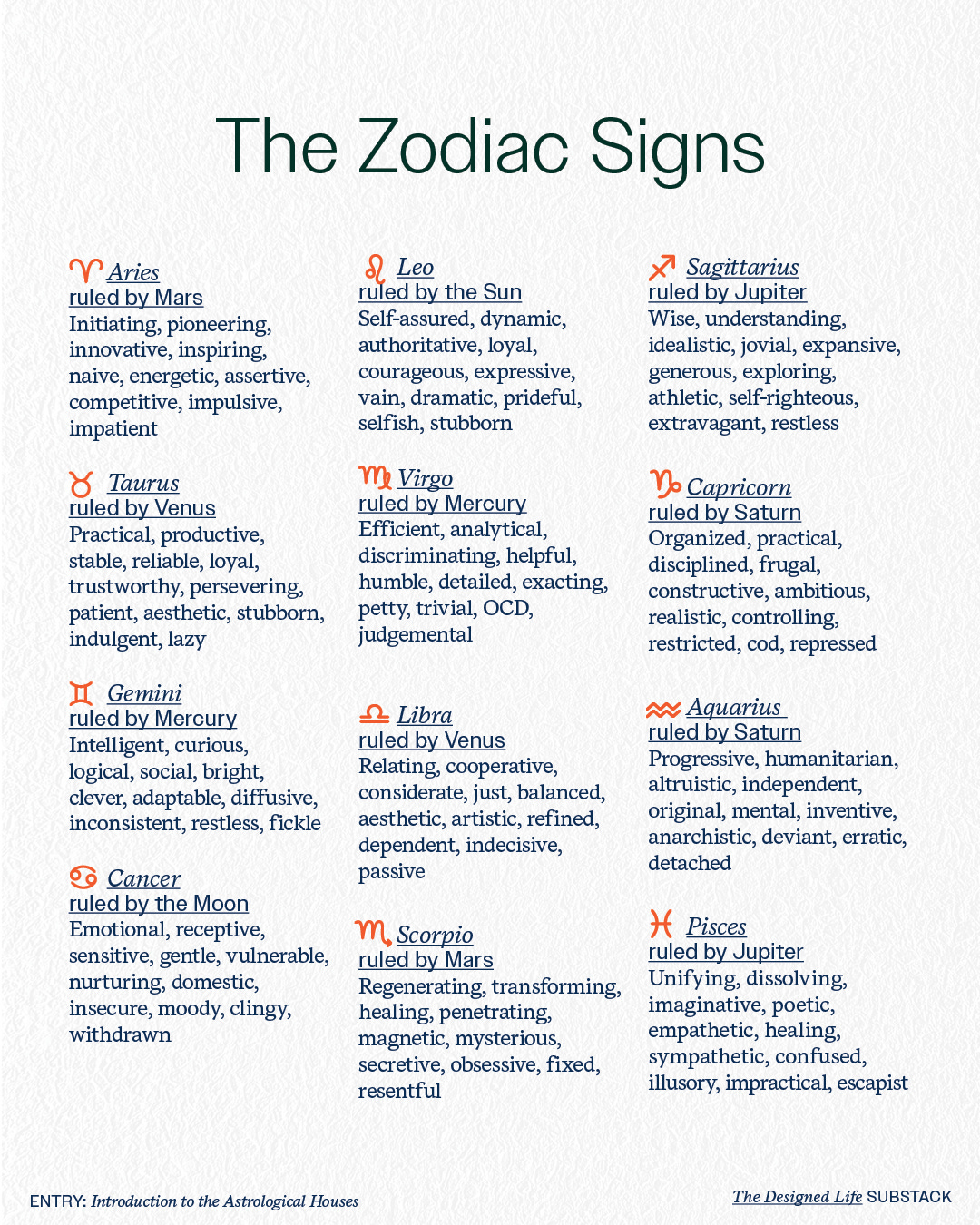
So again, I'm a Sagittarius rising, so my body, my energy, my life approach is in the style of Sagittarius. My 2nd house is Capricorn, so the way I approach my resources, money, assets and my self-worth is going to be in the style of Capricorn. My third house is Aquarius – how I'm going to approach my neighborhood and my short trips and my daily schedules is going to be in the style of Aquarius. And then again, all the way around the chart, all the way around the zodiac.
We each have all 12 houses in our chart, and we each have all 12 signs active in the areas of life the houses represent – it doesn’t matter if you have planets in a house or not. Your relationship and experience of all the areas of life that are expressed through each of the houses will be described in the style and archetypal energy of the zodiac sign that is on that house.
To take this even further into practical personalization, look at your chart and look at a house that you're not super familiar with or you don't fully understand. Identify the sign that is on that house, and the areas of life that house represents, and ask yourself – do I approach or experience these areas of life in the style that zodiac sign?
Let’s look at another example. Let’s say you’re a Virgo rising, that means your 7th house is going to be ruled by Pisces. Your partnerships and collaborations are going to be experienced in the style and energy of Pisces energy. That's how you're just naturally going to approach that area of life and those relationships. You might even be drawn towards Pisces people.
This is where the chart starts to get specific, because you can look at any area of your life and you can determine how you specifically approach that area of life. For example, I have Capricorn on my second house and I’m very regimented and ambitious with my finances and resources. I have spreadsheets for everything. Versus somebody who maybe has Pisces on their second house (if they're a Aquarius rising) – the way that they approach their money and resources might be more intuitive. It might be more of a felt experience. Maybe they don't love spreadsheets. Maybe they're like, “oh my god, spreadsheets would make me crazy.”
And this is what I love about astrology – you can start to understand why people approach certain areas of life differently. It gives you so much more understanding of how people function.
There’s a lot of information that you can learn simply by looking at the signs that are on your houses. Let's say you are going on a long trip with a friend. You can pull up your charts, look at what signs are on your respective 9th houses, and you can observe how you’ll approach your shared trip differently solely based on the sign that's on your 9th house versus their 9th house.
Do you see how rich this basic level information is? If this is exciting to you, I’d like to invite you to just start getting familiar with the different energies of the different houses for you based on the signs that are on your houses. You can look at your 10th house, identify what sign is there and ask yourself – How does this energy show up in my life? How do I relate to my career and my public roles and my societal responsibility and my vocation? And is it in the style of the sign that's on this house for me?
It can feel like parts work because we're different people in different parts of our lives, and different parts of our lives pull out different expressions of us. And you can give language to the different expressions of yourself based on the zodiac signs that are on your houses.
So that is the basic connection of the signs on the houses, but it gets better. The next layer of understanding your houses is how they relate to each other.
There are few different ways the houses relate to each other, so we’re once again going to take this section in parts:
Part 1: Houses that have the same ruling planet
Part 2: Houses that have the same element
Part 3: Houses that have the same modality
All of the signs have a ruling planet, which means that there are planetary rulers for each of your houses. All planets, except the luminaries (Sun and Moon) rule two signs.
For example, if Taurus is on your 1st house, your first house is ruled by Venus. Venus also rules Libra, so your Taurus and Libra houses will be connected.
Let’s say you have Virgo on your 2nd house (aka you’re a Leo rising). Your 2nd house is ruled by Mercury, and Mercury also rules Gemini. So your Virgo and Gemini houses will be connected.
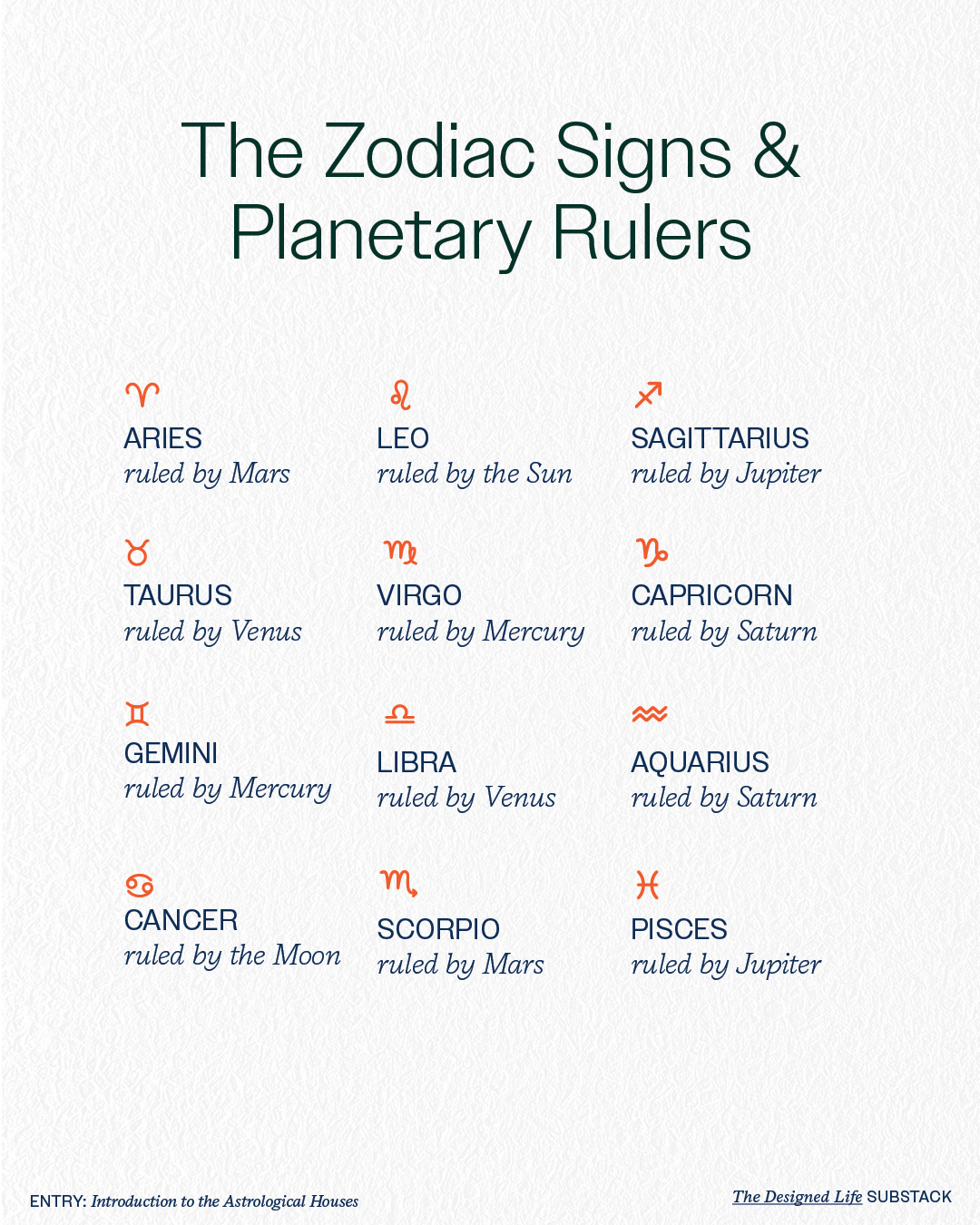
When you're looking at your chart, you can start to see that two areas of life (two houses) are already going to be connected (again, whether you have planets there or not) simply because they have the same planetary ruler. There is some kind of energetic or literal tie between these two spaces, and co-mingling of these areas of life.
You can ask yourself – how are these two areas of life naturally intertwined?
The next layer of how houses can be connected is by element which describes the form and temperament of each sign. The 12 zodiac signs each have an energetic element that’s related to the natural world – fire, air, earth and water. All of the fire signs are going to have similar temperaments, and so will all the air signs, water signs, and earth signs.
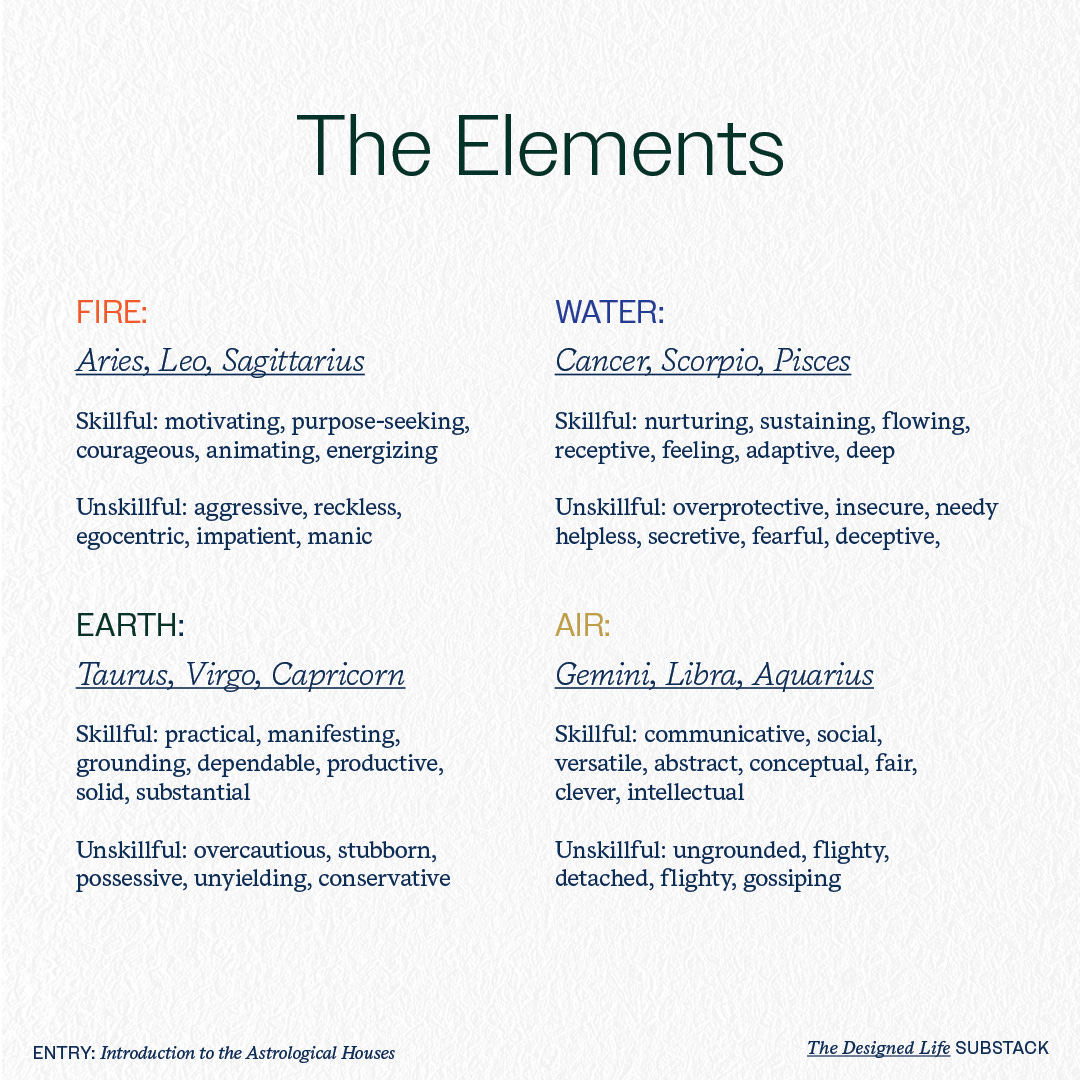
Similarly, the signs that are connected by element have a symbiotic relationship to one another, because they form a trine aspect in the chart. There becomes a natural flow between these connected areas of life.
For example, your 2nd house, 6th house, and 10th house are often considered to be the work or career-based houses. Your 2nd house is your money and resources and talents, your 6th house is your daily work and routines, and your 10th house is your career, reputation, vocation and/or legacy. All of these houses are connected by area of life, but they will each also have the same element as part of their expression.
If you are a Gemini rising, your 2nd house is Cancer, your 6th house is Scorpio, and your 10th house is Pisces. These are all water signs, so you’re going to approach these areas of life in a connected style – the style of water.
If you are a Leo rising, that means you have Virgo on your 2nd house, Capricorn on your 6th house, and Taurus on your 10th house. All of those are Earth signs, and so you’ll approach these areas of life in the same earth-style of energy.
This is where you can again start to recognize how the houses are connected to one another simply by the energetic styles they relates to. Knowing that you approach these areas of life in a similar energetic fashion can give you key insights into understanding another layer of how you approach different life arenas.
Similar to the elements, each of the signs have a particular modality which describes the movement and expression of the sign. The modalities are divided into cardinal, fixed, and mutable.
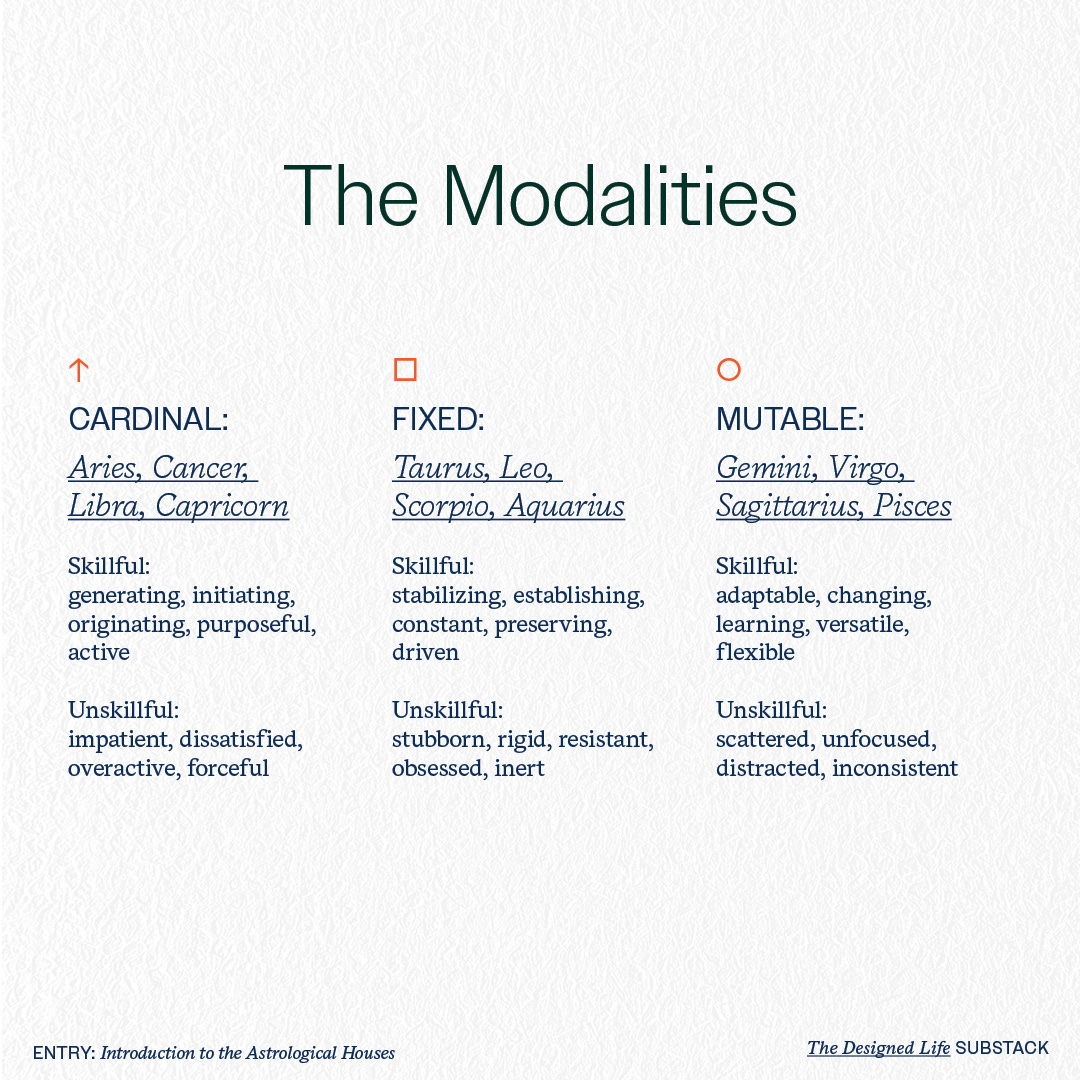
All of your houses with cardinal signs on them (Aries, Cancer, Libra, and Capricorn) are going to relate to each other in a similar initiatory style. All of your houses with fixed signs (Taurus, Leo, Scorpio, and Aquarius) are going to relate to each other in a certain stabilizing kind of way. And of course same with the houses ruled by mutable signs (Gemini, Virgo, Sagittarius and Pisces).
There's going to be a relationship between those houses, because their expression will be similar and because they relate to one another by square aspect, meaning there is a bit of friction that causes action and therefore expression between these areas of life.
A QUICK PAUSE
If this is already a lot of information, I definitely recommend sitting with what I’ve shared thus far and developing more of a connection to just one or two of your houses.
Perhaps you choose a house that you haven’t quite understood but want to learn more about, and you look at it’s planetary ruler, element and modality and start to observe how the energy of that area of life functions in real time.
That right there offers such a wealth of insight. There’s so much you can learn about yourself via just your house placements and how they interact with one another, before we even get into the planetary placements.
That said, if you’d like to keep going, and learn a little more about how your planetary placements function in your houses – read on.
When you have a house unoccupied by any planet, that does not mean that area of life doesn't exist for you. As we've already determined, that area of life exists, and it exists in the style of the sign that is on that house. But because there are no characters (planets) within that house, that area of life might as loud or obvious as other areas of life.
And what I mean by that is – those areas of life might be operating in the background, and in a way that you're not fully paying attention to. They might come a bit more organically to you, and it might feel as though they doesn’t require your conscious awareness because they exists so naturally.
To better understand your empty houses and how you relate to them, you can look directly to the planet that rules that house, and where that planet is located in your chart.
For example: I have an empty 5th house, and my 5th house is ruled by Aries. As we’ve established, the 5th house is the house of creative self-expression, creative progeny, children, pleasure, hobbies, etc. I'm a very creative person – I would like to say that I am a creative as part of my identity. You might say people even know me because of some of my hobbies (knitting for example). I don't have any planets in this house, however, Aries rules this house for me. Aries is ruled by Mars, and Mars is in my 9th house. One of the things the 9th house is concerned with is astrology, and so a lot of my creative self-expression is expressed via the subject of astrology.
There's a lot of other interpretations I could parse through with the location of my 5th house’s ruling planet, but that in itself is enough information, right? That helps me understand so much of who I am.
How you can personalize this for yourself:
Pick one empty house in your chart.
Identify what this house represents – what areas of life.
Name the sign that's on this empty house.
Ask yourself – do I approach this area of life in the style of this sign?
Then identify the planet that rules this sign, and look to where that planet is in your chart.
Notice what correlation there is between where the ruling planet is in your chart and the empty house.
This relationship between the ruling planet of your empty house and your empty house can describe to you how this area of life is already functioning for you – in ways you might not have realized. But once you start connecting the dots, it can be really satisfying.
The planetary rulers are just like actual owners of a piece of property – they might be off in another part of the world but they have their one or two houses that they own, and so wherever they currently are, they’re still importing information back to their houses. They’re gathering experiences and momentos and souvenirs, and calling back to their houses to check on them all the time.
Whether the planet is in one of the houses that they own or not, they're distributing information back to that house and they're telling that house how to operate – aka they’re describing how you as a person approach those areas of life.
There are so many ways to get to know your houses to understand yourself more fully, and in this article we explored:
What a house is and what they each represent.
The energy that defines each house for you based on the sign that’s on each house.
How the houses relate to one another via their planetary ruler, sign element and sign modality.
How to understand your houses even more via the location of their planetary ruler in your chart.
To make this information alive for you, I really recommend that you pick one house in your chart that you're not super familiar with and start to develop a relationship to it via any one of these entry points.
There's such a wealth of information you can gather just with the houses, and I really hope that you start to get more and more familiar with the houses in your chart so that you can understand how you show up to your different areas of life.
You have all these different stages where you show up and experience different facets of life, and you’re not going to be the exact same person in each of these spaces – this is a way to start to get to know all parts of yourself and all your different expressions.
If this was interesting to you and you’d like to learn more, I recommend that you sign up for my Spacious workshop. You’ll be walked through several worksheets that enable you to get a hands-on experience of your empty houses and how to work with them, but you’ll also walk away with so much more of an understanding of how all of your houses function.
If you have any questions about any of the above information, I'd love to hear from you! Thank you for being here, and I hope this was insightful.

No posts
Comments
Nothing yet. Say the first thing.
Sign in to join the conversation.