
The old hospital on Huffine Mill Road opened in 1948 to treat sick children. By 1963, the city of Greensboro decided it had another use. When Black students became the emergency, the hospital became a cage.
On the night of June 6, 1963, the North Carolina State Highway Patrol wrote down the words of a freedom song. A thousand Black people were marching toward downtown Greensboro, singing “If Jackson goes to jail, we will go too,” and a patrolman took down the words the way patrolmen take down license plates. By the next morning, the song had been carried into the governor’s office inside a memorandum.
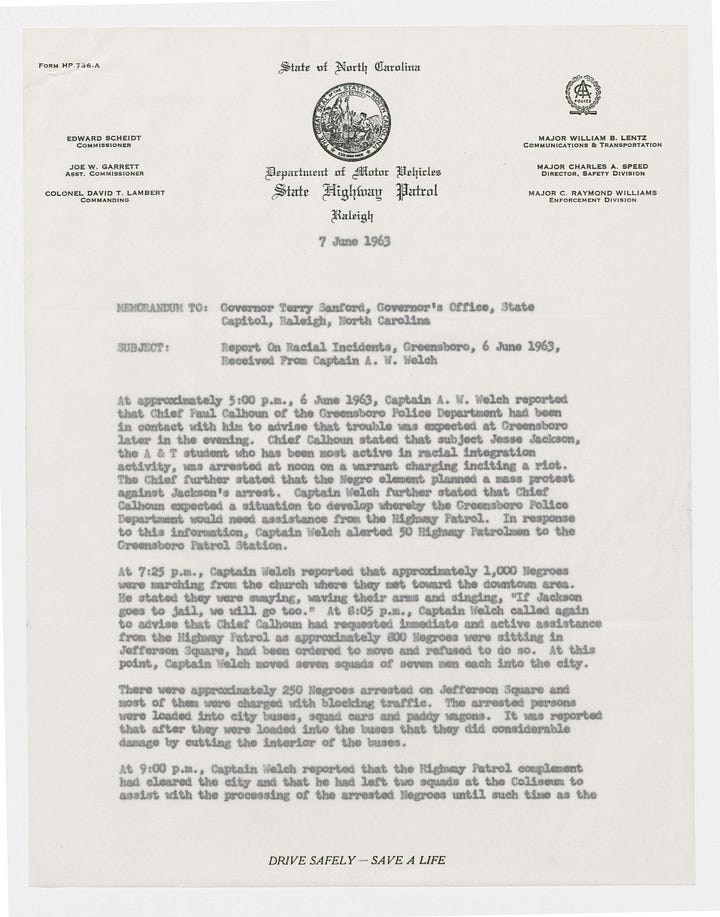
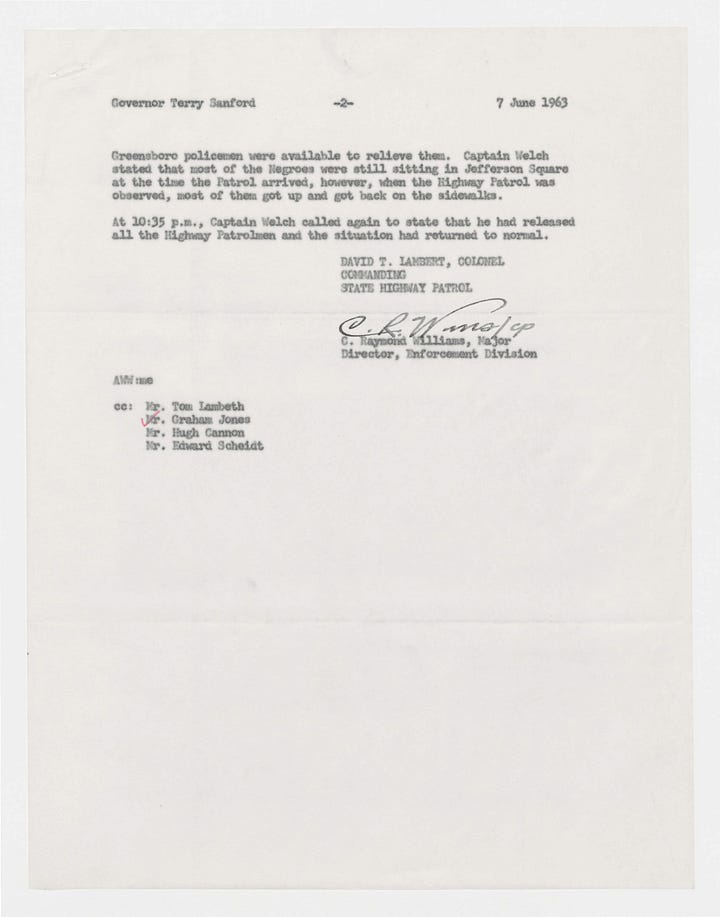
The record sits in the State Archives of North Carolina to this day, a memorandum addressed to Governor Terry Sanford at the State Capitol, preserved in his press secretary’s files, written by Major C. Raymond Williams, Director of the Enforcement Division of the State Highway Patrol, under the letterhead of Colonel David T. Lambert’s command. The subject was “Report on Racial Incidents, Greensboro.”
Greensboro in June 1963 wasn’t dealing with incidents. It was dealing with the fallout of its own choices, stacked up over decades, and the people who’d been forced to swallow those choices finally stood up and said no more. The state took all that marching, all that singing, all those arrests, and crushed it down into a label a clerk could file away and a governor could skim between meetings.
The day before the memo, the city served its warrant. Greensboro police had charged Jesse Jackson, then a student leader at North Carolina A&T, on a warrant the state’s own memo describes as “charging inciting a riot.” There had been no riot. There had been marches, prayers in the street, students kneeling on pavement, their own taxes paid for.
On June 6, Jackson spoke to a large crowd of Black demonstrators and reporters at the Church of the Redeemer, the movement’s home base near the A&T and Bennett campuses, and Captain William Jackson arrested him there in front of everybody. The city wanted that arrest seen. The answer was seen too.
Later that day, more than a thousand Black people gathered at Providence Baptist Church and marched downtown to Jefferson Square, where Market crosses Elm in the middle of white Greensboro’s money, and they danced, chanted, sang freedom songs, and sat down in the street. Police arrested approximately 250 of them before the night ended, by the Highway Patrol’s own count.
Those arrests were no surprise. For weeks, students from A&T and Bennett College, joined by Dudley High School teenagers, ministers, maids, and working people from all over Black Greensboro, had been marching downtown almost nightly, demanding the right to eat in a cafeteria and sit in a theater without a color line drawn through their dignity. The city had answered with mass arrests, wave after wave, since the middle of May, until the county jail ran out of room. The movement was forcing the city to choose, and to keep choosing, night after night, in public.
Segregation was the real incident, hundreds of years old, enforced with handcuffs and paddy wagons. In June, the city panicked as the cost of defending segregation became visible to everyone. The students had made the struggle too large to ignore, and across town, the hospital on Huffine Mill Road, a building that had already been pressed into jail work that May stood waiting.
This is what Holler & Hammer is for: pulling North Carolina history out from under the words officials used to bury it. Subscribe for 25% off if you want more of it.
The arrests did not quiet Greensboro. That was the city’s first mistake, and the city knew it by five o’clock the same afternoon, when Chief Paul Calhoun of the Greensboro Police Department picked up the phone and called the State Highway Patrol. A warrant could put one student leader in handcuffs and do nothing else. The movement had learned something the city was slower to grasp: the jail was a threat only as long as Black people feared it one at a time. Filled deliberately, by the hundreds, it burdend the city that ran it.
The June 7 memo lays out the evening in police time, relayed up the chain from Calhoun to Captain A. W. Welch of the Highway Patrol, to Major Williams’s desk, to the governor’s office.
At approximately 5:00 p.m., Calhoun advised that “trouble was expected” in Greensboro later in the evening. He reported that Jackson, whom the memo describes as “the A & T student who has been most active in racial integration activity,” had been “arrested at noon on a warrant charging inciting a riot,” and that, in the memo’s words, “the Negro element planned a mass protest against Jackson’s arrest.”
Not citizens, students, or the people whose labor kept half the city running. An element, something to be monitored and managed. Welch alerted fifty patrolmen to the Greensboro Patrol Station and waited.
At 7:25 p.m., the Patrol logged approximately one thousand people marching from the church toward downtown, “swaying, waving their arms and singing.”
At 8:05 p.m., forty minutes after the reported song, Calhoun wanted more than a phone line. Approximately 800 people were sitting down in Jefferson Square, had been ordered to move, and had refused.
The people sitting at Market and Elm weren’t confused about the law. They knew exactly what Greensboro had legalized, and that’s exactly why they sat down.
The law protected cafeterias that served only white customers, theaters that split their seats by race, and police power whenever police power defended the color line, and it protected a city where Black people could work, spend, clean, cook, serve, and pay taxes, then be told they could not sit down like full human beings. So they sat down where the city told them not to.
Calhoun requested immediate and active assistance, and Welch moved seven squads of seven patrolmen each into the city, forty nine state patrolmen entering a downtown square because Black people refused to keep moving. The memo records an important detail: when the patrolmen appeared, most of the crowd got up and went back to the sidewalks. The roughly 250 who stayed in the street stayed on purpose. They chose the charge over the sidewalk, and for most of them, the charge was blocking traffic.
White Greensboro spent generations blocking Black life, blocking theater seats and hotel rooms and restrooms and jobs and schools and the basic right to walk through your own city without the color line shoved in your face. But when Black people blocked one street for one night, Greensboro called them the problem and slapped them with charges.
The arrested were loaded into city buses, squad cars, and paddy wagons. The memo throws in one more accusation, that prisoners did ‘considerable damage by cutting the interior of the buses.” Take the allegation at face value if you want. Notice what it concedes either way: the only property damage the Patrol found worth reporting that night came after the handcuffs, inside the city’s own buses, from people being dragged across town because Greensboro’s jail couldn’t hold them all.
At 9:00 p.m., Welch reported that the Patrol had cleared the city, leaving two squads at the Coliseum “to assist with the processing of the arrested Negroes.” Processing meant names, charges, waiting, bodies sorted out of the square and into the city’s custody, moved through rooms never built to hold that many people at once, into whatever space Greensboro could find after weeks of demonstrations had strained the regular jail past its limits.
At 10:35 p.m., Welch released his patrolmen and filed the line the governor’s office would read last: “the situation had returned to normal.”
Normal meant the S&W fed white people. Normal meant theaters split their seats by race.Normal meant 800 people had to sit down in the street just to be seen, and 250 of them got hauled off so the rest of the city could call the night quiet. The state read the sentence and filed it, which means it accepted it.
The Patrol’s memo was not the only official account written that day. On June 7, Mayor David Schenck delivered a televised address in which he told Greensboro, “Now is the time to throw aside the shackles of past customs.”
Schenck named the customs shackles, on camera, in his own voice, the same day the Highway Patrol filed the enforcement of those customs as normal. June 7, 1963, produced both sentences, the confession for the cameras and the normal for the file.
The memo is damning because the state didn’t need hindsight. They had the timeline by the hour, the warrant at noon, the song at 7:25, the sit-down at 8:05, the squads, the buses, the Coliseum sorting names, normal by 10:35. Greensboro held its order all night, and the memo shows what holding it required: a square cleared by uniforms, state patrolmen standing behind city police, charges that turned Black protest into a traffic problem, and public buildings turned into cages. The city ran out of room for Black freedom, so it found more rooms for cages.
By the time those demonstrators sat down at Market and Elm, Greensboro had already spent weeks learning what happened when Black students refused to keep their resistance symbolic. The city could handle a protest; it could photograph it and contain it. It could survive a polite petition, issue statements, appoint committees, and absorb the kind of dissent that ended before business hours got uncomfortable.
What Greensboro could not handle was repetition. Night after night, students and residents came back downtown and challenged the cafeterias, the theaters, the restaurants, the whole apparatus of public accommodation that had made segregation feel normal by spreading it across ordinary life with a white manager saying no while a police officer stood close enough to make clear whose side the city had chosen.
That was the genius of the demonstrations. They made segregation answer for itself at the exact places where it lived.
By the middle of May, the city was answering with mass arrests. On May 17 and 18, the city responded to the demonstrations with mass arrests, more than 700 people over two days in the first major wave, most of them students from A&T and Bennett.
Four days later, on May 22, roughly two thousand people marched in silence, saying nothing because the city had already heard everything and answered with buses.
700 arrests in two days is a movement large enough to hand the city a material crisis, a problem of where to put all of these people, and the regular jail system could not hold what Greensboro’s own segregation had created.
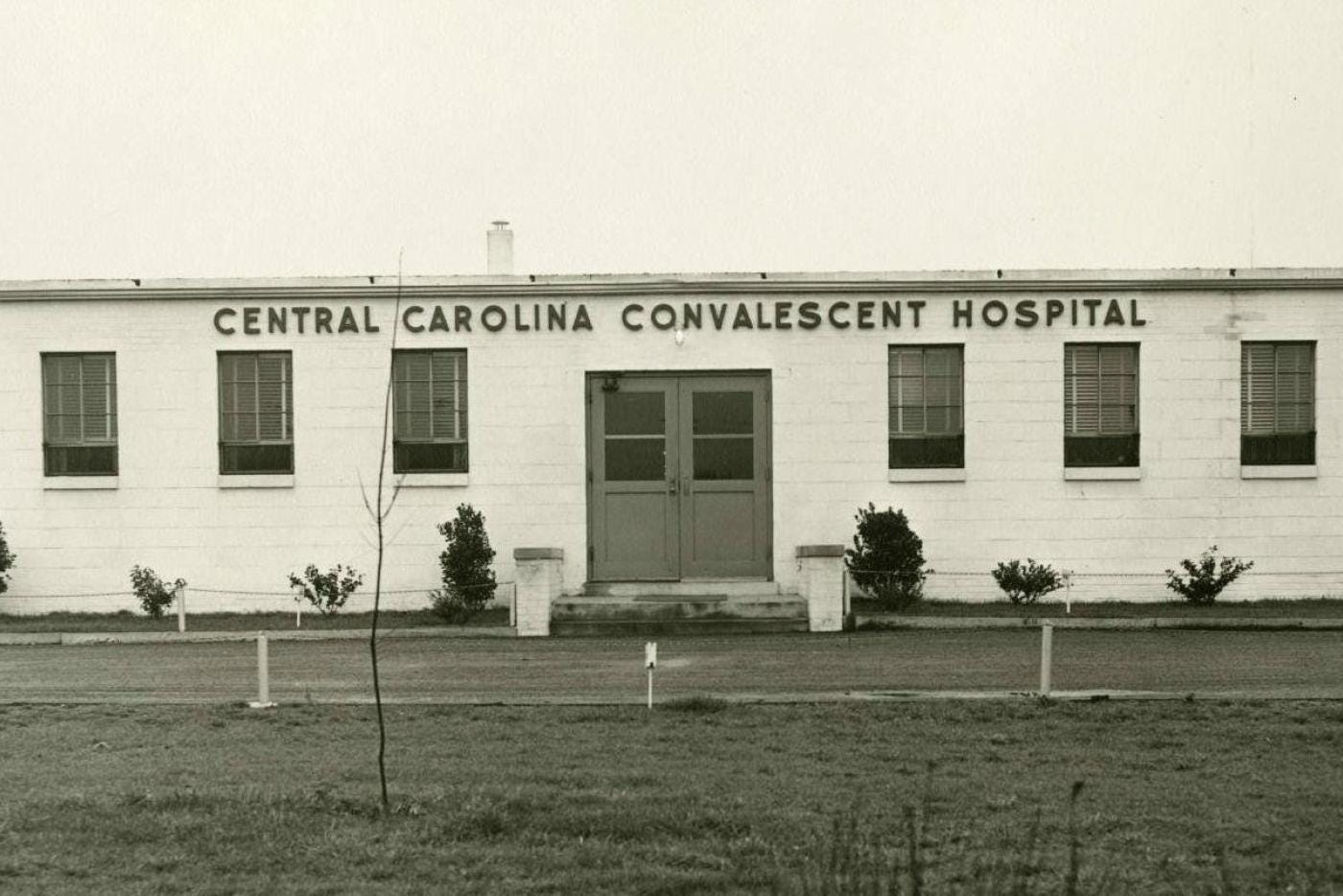
The students filled the streets, then filled the cells, and the city had to admit its usual punishments weren’t big enough. Officials scrambled, spreading detention all over Greensboro and Guilford County like they were just solving a logistics problem, not covering up a moral crime. The National Guard armory took prisoners. The county prison farm took prisoners. The Memorial Coliseum sorted and booked them. And that long white building on Huffine Mill Road—the old Central Carolina Convalescent Hospital—took prisoners too.
The city did not stumble into that decision on June 6. The hospital had been pulled into service during the May overflow, when the arrests came faster than the cages could take them, and by June, it sat inside the city’s expanded detention map, waiting behind every new mass arrest.
The June 7 memo is a report from a city that crossed the line weeks before, a city that had already decided if Black students kept filling the jail, it would find other buildings and make those buildings do jail work. There was no announcement for any of it, just a public building repurposed for punishment.
Greensboro had choices. The city could have stopped arresting people for wanting to eat supper or see a movie. It could have put its weight behind desegregating downtown and seen the protests for what they were: proof the old order was finished. Instead, Greensboro treated Black freedom like a problem to crush with police power, then went looking for another building when the jail overflowed.
The Polio hospital was the physical proof that Black freedom had outgrown the city’s ordinary system of punishment. The city would convert care into confinement before it would free a single prisoner.
Fifteen years before Greensboro sent prisoners there, the building went up because children were dying.
In the summer of 1948, polio tore through North Carolina, 2,517 cases by the end of the year, and 147 dead, and no place in the country had it worse per person than Guilford County. The sick overflowed every bed Greensboro had. Children lay in the Greensboro Record’s newspaper building and in a recreation hall at the Army depot while the county scrambled. In 1948, polio was not a manageable fear. There was no vaccine, nobody knew for certain how the disease spread, and it took children’s legs and lungs in the middle of summer while their parents watched.
Greensboro answered with money and labor at a speed that should embarrass every government that has ever pleaded process. Organizers set a $60,000 goal to build a hospital. The county and its neighbors gave $325,000 in cash and another $170,000 in donated materials and labor, dimes from schoolchildren, a countywide auction, a nightly radio show, volunteer crews driving in from Burlington, Lexington, Winston-Salem, Leaksville, and Charlotte, after their own shifts ended. Life magazine sent reporters to watch it happen.
Construction started in July. The Central Carolina Convalescent Hospital opened on October 11, 1948, ninety-five days after the fundraising began, a single-story building of white cinder block with seven wings, 134 beds, an operating room, whirlpool tanks, iron lungs from the National Foundation for Infantile Paralysis, and a school inside so sick children would not lose their grade while they fought to walk.
The hospital was integrated from its first day. Black patients and white patients were treated under the same roof, and Black workers and white workers drew pay from the same payroll, in a state that segregated nearly everything else a body could touch. The National Foundation money came with a rule: care for every child, regardless of race or means. A medical journal would later sum up the building’s reputation in two words: “Everybody’s Hospital.”
My family knows those wards.
My father was carried into that building in 1957 through 1958 from Horsepasture, Virginia, tobacco country, about an hour north across the state line, as the hospital was nearing the end of its polio years. He was a poor rural child from a tenant family, raised in a four-room house by a father farming land he did not own.
The kind of child a place like Central Carolina Convalescent Hospital was supposed to reach if all that fundraising, all those dimes, all that talk about public care meant a damn thing once you got past the speeches.
He remembers the pain. He remembers being fitted with leg braces. He remembers his mother cussing about that long drive down to Greensboro.
The hospital took him because taking him was the whole point. A child from across the state line, from tobacco fields and tenant ground, was brought into a building that had been raised in ninety-five days because people still believed a sick child should not be left to whatever poverty could afford. It sent him home with a chance to walk.
He wore those braces until his legs outgrew them. Then he wore nothing. By then, the polio hospital had closed, and his family could not afford new braces on their own. That is the part public memory never knows what to do with. The building gave my father his start at walking, but it could not promise him one thing past its own front door.
The Salk vaccine arrived in 1955, one year after my father was born, and shortly thereafter, the polio wards started to empty. The hospital ran through its last polio years into 1958, carried on for a while as a rehabilitation center, then closed. By the spring of 1963, it stood empty on Huffine Mill Road, seven wings of white cinder block left over from a city that had once moved fast to save children. Greensboro was about to show how fast it could move to cage Black students.
The caging took no time at all. The wards filled again in the third week of May 1963, five years after the last polio beds emptied, and the city that had once needed ninety-five days to build the place needed no ceremony to convert it.
There was no vote or public notice that the county’s proudest building had a new line of work. The arrests simply outran the jail, the buses kept rolling out Huffine Mill Road, and a hospital with 134 beds became a holding pen for roughly 400 people, most of them college students, many of them young women from Bennett.
The place was built for 134 patients, with nurses on duty day and night. The city jammed in three times that many prisoners and called it overflow. The stories that survive describe the conditions candidly: not enough beds, not enough toilets, no privacy, young people locked in rooms meant for whirlpool tanks and iron lungs.
Anne Parsons, the UNCG historian who later helped force this history into the official record, said it without decoration: “For the students, it was a particularly traumatic place to be held.”
The women of Bennett College carried a heavy share of those wards. Their president, Willa Player, the first Black woman in the country to lead a four-year accredited liberal arts college, stood behind them without a flinch, and she went to her students every day they were held, carrying food, mail, and class assignments so that jail would not cost them their semester with final exams coming. Look at the building’s record at that moment. In 1948, it held a school inside so sick children would not lose their grade. In 1963, it held college women doing coursework under guard. The same walls held students at their lessons both times, once because the county loved its children, once because the city had arrested them.
The jailed students refused to become a crowd that Greensboro could process and release. By then, the tactic had a name across the movement: jail, no bail. More than a thousand people waved toothbrushes in the air at the May 19 mass meeting, packed for jail before the buses ever came. The speaker that night was James Farmer, the CORE leader who helped organize the Freedom Rides.
When the city tried to ease its own burden by waiving bail and telling prisoners to go home, most said no. Paying a fine just put money in the pocket of the city that locked you up. But every cell filled by someone who refused to leave cost Greensboro real money, day after day. They’d been arrested for demanding their rights, and if the city wanted that shame, the city could house it and feed it.
Officers ended up dragging students limp out of custody and busing them back to their campuses because Greensboro could no longer afford its own arrests. Governor Sanford’s office moved through channels, directing A&T’s president, Lewis Dowdy, to take his jailed students into a college president’s custody, the state managing its embarrassment the way the state manages everything, administratively, with somebody else’s signature on the release.
Greensboro didn’t run out of order. It ran out of cages.
A place built by dimes to heal any child, no matter their color, became the spot where Greensboro locked up Black students for daring to move through public life without bowing to Jim Crow. The city took a building meant for healing and used it to cage the very people trying to heal Greensboro.
For half a century, Greensboro remembered the hospital and buried the jail. The polio story stuck around the way pride always does, in anniversary stories and the warm memory of the year everybody pulled together. The jail story lived in arrest records and the memories of the women and men who had been held there.
The proof sits in the marker file. In 2012, somebody applied to the state for a highway historical marker telling the hospital’s story, the polio story alone, the ninety-five days, and the dimes and the healing. The state committee turned it down. The polite version of the building’s history could not demonstrate sufficient significance to warrant a roadside sign.
The story Greensboro had spent fifty years telling itself about that building was not, by the state’s own standard, worth marking. The building only became history when somebody put the cage back in.
That somebody was a class of nine graduate students. In 2017, UNCG’s museum studies program assigned its incoming cohort to commemorate the hospital’s seventieth anniversary, and the students did what the city never had: they followed the building beyond 1958. They presented their research at public meetings; neighbors pushed for a marker, which included both uses of the building, the wards, and the cells.
The state approved it in December 2018. Anne Parsons, the historian who guided the work, said the building had been “both a source of pride and of pain for Greensboro,” and the marker would carry both. The pride had been celebrated for decades. The pain had simply been ignored.
The state announced the marker on June 11, 2019, and dedicated it on June 15, fifty-six years after the Patrol cleared Jefferson Square. It stands at East Wendover Avenue and Elwell Avenue, and it reads: “POLIO HOSPITAL. During 1948 epidemic, integrated hospital built in 95 days. In 1963, it was makeshift jail for civil rights protesters. Operated 1/10 mi. S.”
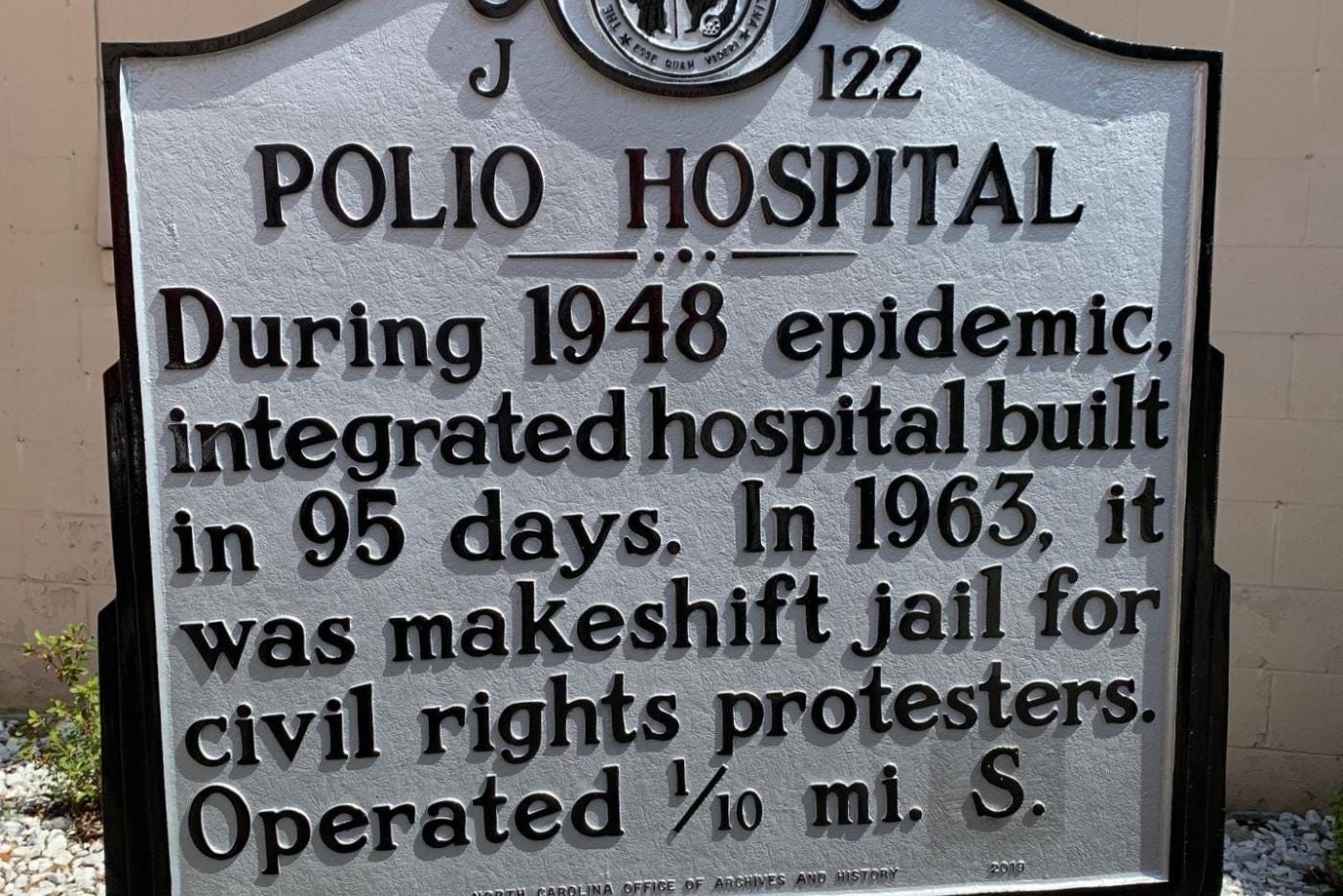
Even now, the plaque softens the real history. Makeshift, as if the cage were improvised in a panic and not operated for weeks by a city that knew exactly what it was doing.
Most of the hospital is gone now. One wing survives on Huffine Mill Road, low and white and ordinary, used in recent years by county animal services and by a program that teaches kids to train shelter dogs, People & Paws for Hope.
A tenth of a mile away, out where the heat shimmers off the asphalt where Wendover meets Elwell, the silver marker stands alone. There, in raised aluminum sentences, it says what Greensboro spent fifty years trying not to say at all.
Children learned to walk inside those walls starting in 1948, my father among them a few years later. In 1963, Bennett College women were held inside that same building after Greensboro arrested them for demanding rights that white Greensboro treated like private property.
The marker calls it a makeshift jail, but the record says it was a hell of a lot more than that. A marker isn’t memory unless it carries the whole weight, and even then, it’s just a few words on a post that traffic passes at fifty miles an hour.
North Carolina earns nothing for marking a truth it buried for half a century. The credit belongs to the people who made the truth in the first place, the thousand who marched from Providence Baptist, the 800 who sat down at Market and Elm, the two hundred fifty who chose the charge over the sidewalk, the four hundred packed into the wards, the Bennett women who did their homework in a cage and walked out unbroken.
The truth was in that building the whole time, buried under arrest records, under the word incident, under the word normal, under the word makeshift, just waiting for somebody to call the damn thing what it was.
This story is public because the record belongs to the people, not the officials who buried it. Share it with somebody who needs to know what Greensboro did.
Comments
Nothing yet. Say the first thing.
Sign in to join the conversation.