
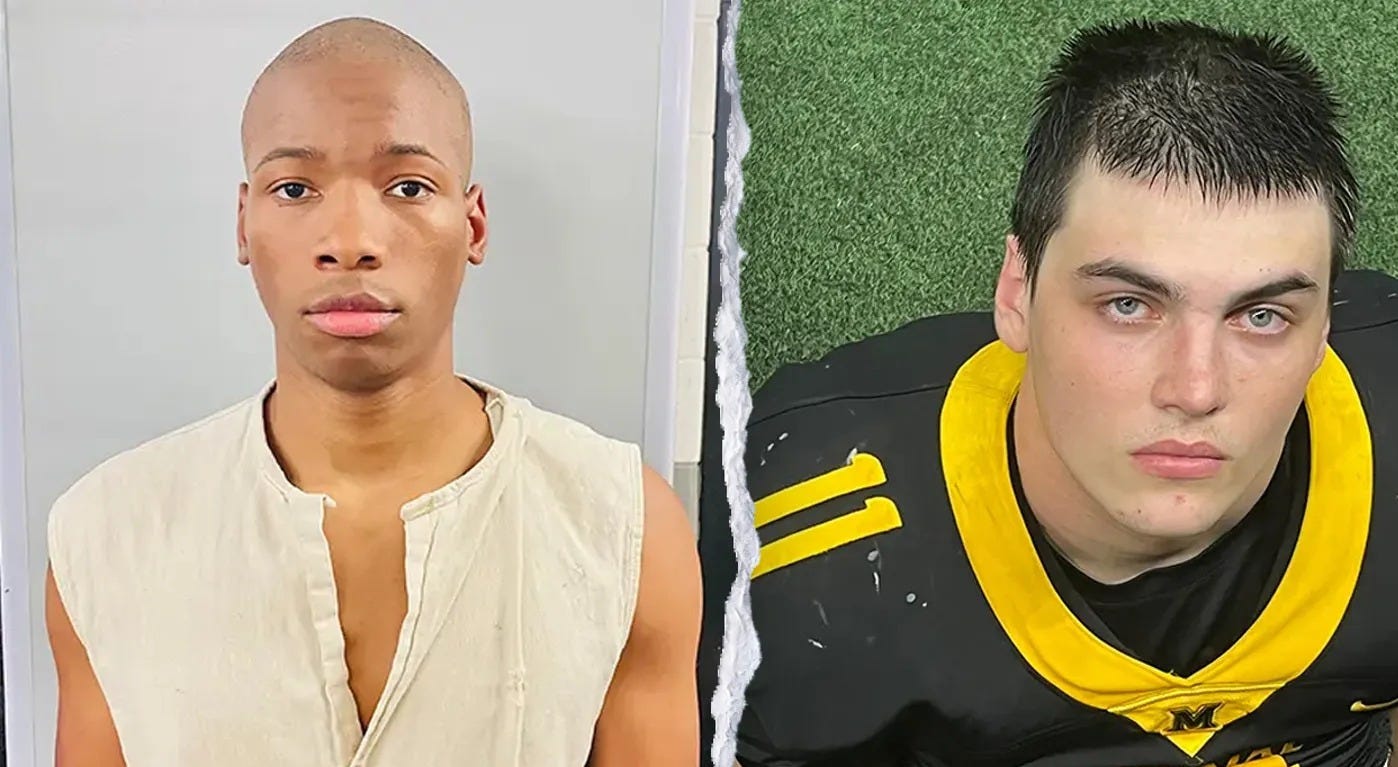
Karmelo Anthony got thirty-five years this week for the death of Austin Metcalf, a white teenager killed under a team tent at a high school track meet in Frisco, Texas. The fight over what happened didn’t end in the courtroom. It exploded out into every place in America that loves to turn a scared Black kid into a public spectacle, feeding the crowd’s appetite for punishment.
Everyone got stuck on what Karmelo said before the stabbing: touch me and see what happens. That line got dragged through TV, courtrooms, Facebook, twisted into a confession, as if a Black kid trying to keep his own body safe was already guilty. They tore apart his words, posture, and fear, desperate to find a reason to call him dangerous. Not one of them wanted to ask why another much larger teenager thought he had the right to lay hands on him in the first place.
That’s where Dr Stacey Patton’s writing punched me in the chest this week. In her piece ‘Touch Me and Find Out!,’ she says what most people are too scared to say out loud: this is about Black kids trying to keep their bodies safe, and white people crossing lines, acting like a Black child’s boundary is a threat to them.
Patton did not stop there. In ‘Black People Have Been Boycotting The Same Insult For 40 Years,’ she reaches back to Latasha Harlins and forward to Cyrus Carmack-Belton, showing how Black children keep being turned into suspects in the marketplace.
Building further on this theme, ‘3 Black Youth, 3 Verdicts, 1 Message’ connects the stories of Karmelo Anthony, Cyrus Carmack-Belton, and Elijah McClain, tying them together under the same backlash politics.
After all the public talk about racial reckoning after George Floyd, America is showing just how desperate it is to snap back to the old order of locking up, excusing, or rolling back any accountability for what happens to Black youth.
To confront this head on, Patton wrote directly to Jeff Metcalf.
She did not tiptoe around white grief or white entitlement. She named white supremacy at the level of the body. The belief that a Black child’s no is negotiable, that his fear is aggression, and that his refusal to bow is another injury to whiteness.
Those pieces dragged me straight back to Roger Brooke Taney and the Dred Scott decision of 1857. Taney wrote that Black people were ‘beings of an inferior order’ and had ‘no rights which the white man was bound to respect.’ That sentence has not left the American legal imagination. It echoes beneath headlines, verdicts, and the explanations offered for what happens to Black children now.
Stylistically, this poem is written in documentary free verse with a jeremiad cadence. It uses short lines, repetition, quoted legal language, case references, and public-record language. The structure moves from the present day news cycle into the 1857 Dred Scott decision, then circles back through modern examples of Black children whose fear, boundaries, or deaths were put on trial in public.
The poem does not use rhyme or fixed meter. It relies on accumulation, indictment, historical echo, and plain speech, so the argument builds line by line, until the old legal sentence and the word justified blur together, and you see it’s all the same American record.
This is not a poem about a single moment. It is about an old ruling that still shapes the way the country speaks. It is about a Black child saying this is my body, and I want to keep it, inside a country that was built to answer otherwise.
It is important for me to note: I am writing as a white man indicting the inheritance I come from, not as someone entitled to narrate Black grief from the inside.
Text within this block will maintain its original spacing when published
This Sunday, like every Sunday,
the country took its pew
and faced the bright screen like an altar.
Two boys
side by side,
one in a jersey,
one in a shirt the county issued him.
Local news called it a tragedy.
Then it called the living boy
the cause.
Then the country bowed its head,
said grace over both of them,
and began to eat.
It took the few words the child got out
with his hands up and his back against a tent
and turned them over on its tongue.
It weighed the pitch of his voice.
It weighed the wet in his eyes.
It watched fear move across a Black face
and ruled fear a provocation,
a flavor.
It never weighed the other boy,
never asked who raised him
to believe a Black child standing still in the rain
was his to move.
It had no appetite for that.
It was already full of the boy it had chosen.
The verdict they are fighting about
was handed down in 1857.
Dred Scott had stood on free soil
and asked the court to call him a man.
The court took his name into its mouth and answered no:
he was not a citizen, and never could be;
Black people were beings of an inferior order,
with no rights which the white man was bound to respect.
He was an ordinary article of merchandise,
bought and sold whenever a profit could be made of him.
The ruling died on paper.
The war came, the amendments came, the ink went dry,
but its mouth kept moving.
A Black child says do not touch me,
do not follow me, do not corner me,
do not put your hands on my body
to move me from where I chose to stand.
Karmelo said it five times
in a tent, in the rain:
touch me and see what happens.
The state entered his fear
into evidence
as motive.
The country hears a threat where he says please.
It hears a confession where he says let me live.
While the jury debated,
the answer was already on the page.
Ten times.
That is how far the word justified opens
for the white hand
over the Black body,
how tightly it shuts
when the hand is Black
and the body white.
Ten times —
the old ruling feeling for its pulse
and the pulse comes back strong.
1991: a girl named Latasha, fifteen,
money in her hand,
shot in the back of the head
for a bottle of juice she meant to pay for,
and the woman who killed her
went home.
2023: a boy named Cyrus, fourteen,
chased down a street
for the crime of carrying water,
and a jury called it doubt.
Neither child got to say a word.
No warning to parse.
No boundary to bend.
Only a girl with juice, a boy with water,
and the verdict already in.
A child can die
in the aisle of a store
fed by his family's dollars,
and the country will stand over the body
asking what was hiding in his bag.
Say the rest of the names.
Trayvon, walking home in the rain,
who turned to the man trailing him and asked,
why are you following me —
and the last words anyone heard him speak were
get off, get off.
Jordan, seventeen, told to make himself quieter,
who said turn it back up,
and a man decided that no was a gun.
Mike Brown, eighteen, lay four hours in the August street,
uncovered, where the whole block could see,
a body left in the road as a lesson.
No one wrote down his last words,
so the country chanted some for him:
hands up, don't shoot.
Tamir was twelve.
He had a toy.
He was given two seconds:
not time enough to say do not,
not time enough to say anything at all.
When a Black child dies,
the country empties his pockets in public.
It reads his texts at the funeral.
It puts his report card on the stand.
It asks his mother
what she failed to teach him.
But this Black child lived.
So they tried him instead.
They looked at a child
who was never given permission to be afraid,
and called his fear a felony,
and handed his survival a number:
thirty-five years.
And the dead boy's father rose
and took aim
the way he had taught his own son to take aim
and fired all that grief at the living child.
In court he swore it was never about race.
He said he did not see color.
Then the judge lifted the gag order,
and he reached for the white hood he swore he'd never owned,
the one this country keeps folded beside the cross and the kerosene,
the horse still saddled from the last night ride,
ready for any white man who decides he has been wronged.
He went on a podcast,
grinned into the lens,
and gave Karmelo a new name.
Let me make something racist up, he said:
watermelon felon,
the cartoon and the cage in two words,
a Jim Crow joke he announced before he told it,
and called it his to make.
He called the boy's parents grifters.
He asked the state to go count their other children.
He called all of it grief.
Grief does not keep a slur loaded
for the day the gag order lifts.
He wanted the eyes,
the bowed head,
the performance of shame:
one last thing
he believed the world still owed him.
Karmelo gave him nothing.
And in that nothing
was the only freedom left in the room.
So here is the verdict,
read back to the country.
The receipt was never lost.
The merchandise is still on the shelf.
The sentence of 1857
was not retired.
It was promoted.
You gave it a badge
and a press pass
and a comment section.
You taught it to say suspicious in the store,
disruptive in the school,
threat in the report,
should have complied in the thread,
and justified in the file
where they put the body.
And the file is heavy.
Ten times heavier.
That is not the past.
That is the pulse.
A Black child said
this is my body, and I would like to keep it.
The country built on the opposite answer
called the asking a crime,
called the killing a right,
bowed its head,
and went back for seconds.
No rights it was ever bound to respect.
It is still not bound.
Amen. And indict.
Thanks for reading. This Sunday Verse is public because work like this needs to travel.
Share it so more people can find writing that carries the news with the weight it deserves, where art and journalism meet.
Paid subscriptions are 20% off right now. Holler & Hammer takes time, records, research, grief, and a lot of late nights. A paid subscription helps keep this work going.
Comments
Nothing yet. Say the first thing.
Sign in to join the conversation.