
The North Carolina flag didn’t just hang there on May 20th. It sold a lie the entire day, a lie the state has spent generations teaching as gospel. May 20th isn’t just a date stitched on cloth. It’s the day North Carolina hides white freedom behind Black bondage and calls it heritage.
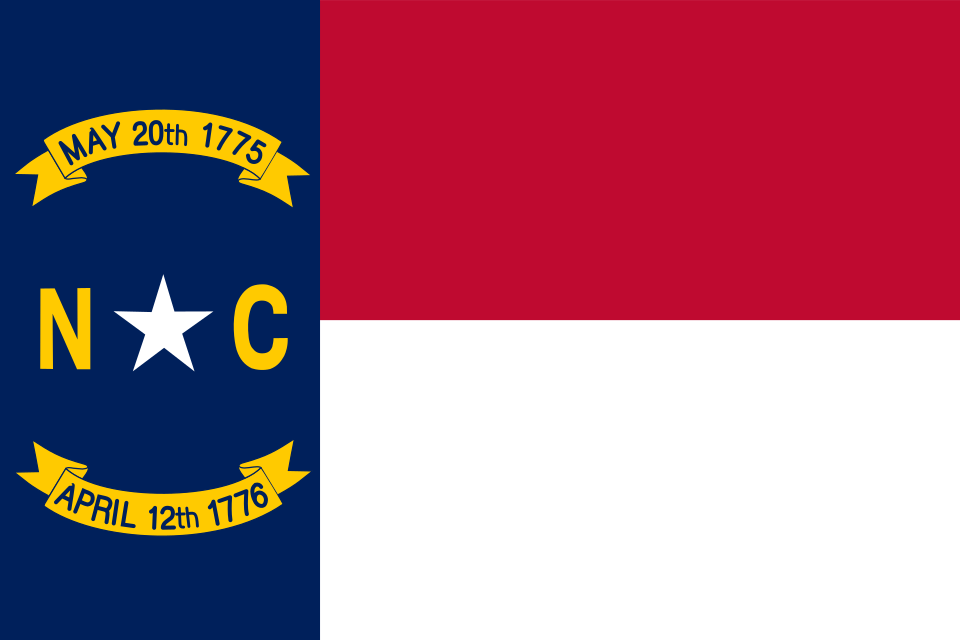
The blue field presses against the red and white. The white star sits in the middle. The gold N and C flank it. Above that star, framed like scripture, sits the date May 20th, 1775.
North Carolina picked its freedom myth, stitched it into law, and hoisted it over every courthouse, schoolhouse, and official show of state pride.
That’s the problem, right there.
This is not about hurt feelings over a date. This is about power.
A racist memory system does not need to scream slurs to do its work. Sometimes it just chooses the white freedom claim, funds it, prints it, flies it, teaches it, and calls the rest of the record too complicated for the public. It turns one people’s mythology into state identity and another people’s freedom struggle into archival debris.
True history does the opposite. It does not ask whether the old story made white North Carolina proud. It asks who paid for it, who disappeared inside it, and what institutions kept cashing the check.
May 20, 1775, is supposed to mark the Mecklenburg Declaration, the day Charlotte’s Patriots claimed they broke from Britain before Philadelphia. It’s a hell of a story if you need a whitewashed origin myth. Brave white men, courthouse courage, freedom before freedom was fashionable. North Carolina out front, beating the whole damn Revolution to the punch.
Modern historians reject the Mecklenburg Declaration as an authentic 1775 document in the form North Carolina turned into civic gospel. The documentary trail is thin where it needs to be solid, late where it needs to be immediate, and wrapped in patriotic storytelling that lets powerful men pass a weak record off as holy writ.
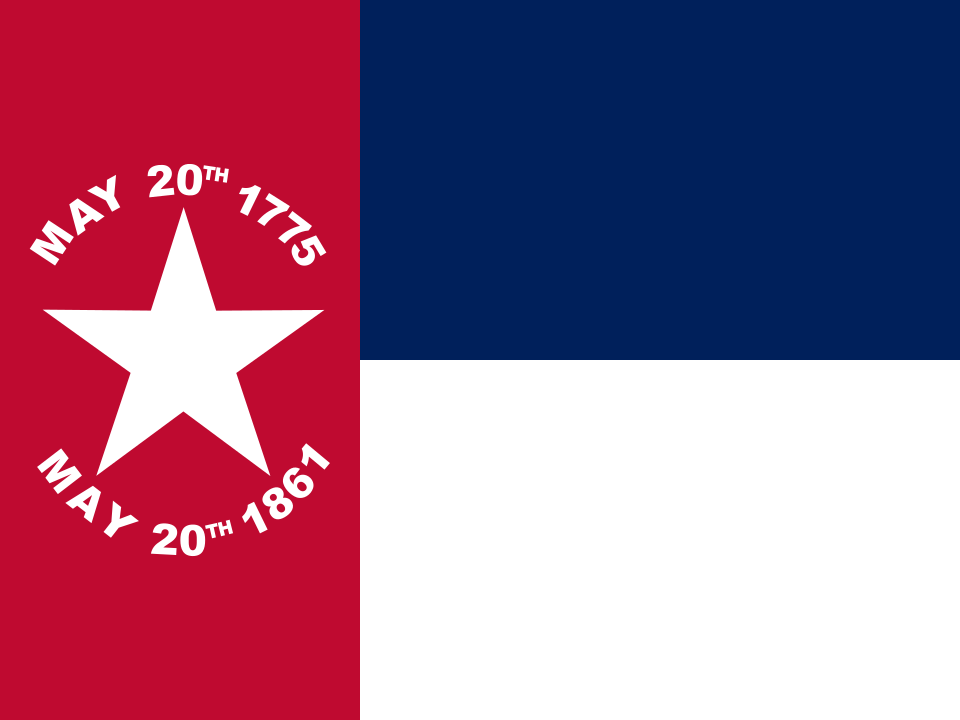
North Carolina’s first official state flag was adopted on June 22, 1861, after secession, in the opening season of the Confederacy. Designed by Raleigh artist William Garl Browne and approved by the state convention, it came at the very moment North Carolina was leaving the United States to defend slavery.
The original flag paired May 20th, 1775, the alleged Mecklenburg Declaration date, with May 20th, 1861, the date North Carolina seceded from the Union. One May 20 claimed revolutionary liberty. The other marked a slaveholders’ rebellion against the country. The symbolism was not accidental. The state drew a straight white line from Patriot mythology to Confederate treason and called both freedom.
Folks want to skip past that part because it makes the heritage story smell like what it is.
Bullshit.
In 1885, North Carolina tried to clean up the evidence. The state took the secession date off the flag because some truths get harder to decorate when the bodies are still in the ground. But it kept the May 20th myth because that story still did its job.
April 12, 1776, the Halifax Resolves, went on the flag too: real, documented, actually important
The Mecklenburg Declaration claim is simple enough on its face: men in Mecklenburg County supposedly declared independence from Great Britain before Philadelphia, before July 4, before the national story had found its scripture.
That version did not survive by accident. It was carried into the flag, the seal, speeches, school lessons, monuments, commemorations, and the state’s habit of teaching white children that Southern freedom began with brave white men standing up for themselves.
The problem is that the document did not enter the public record in 1775. It wandered in during 1819, forty-four years later, through the Raleigh Register, after the Revolution had become memory, after the founders had become marble, after states had started competing over who loved liberty first and loudest.
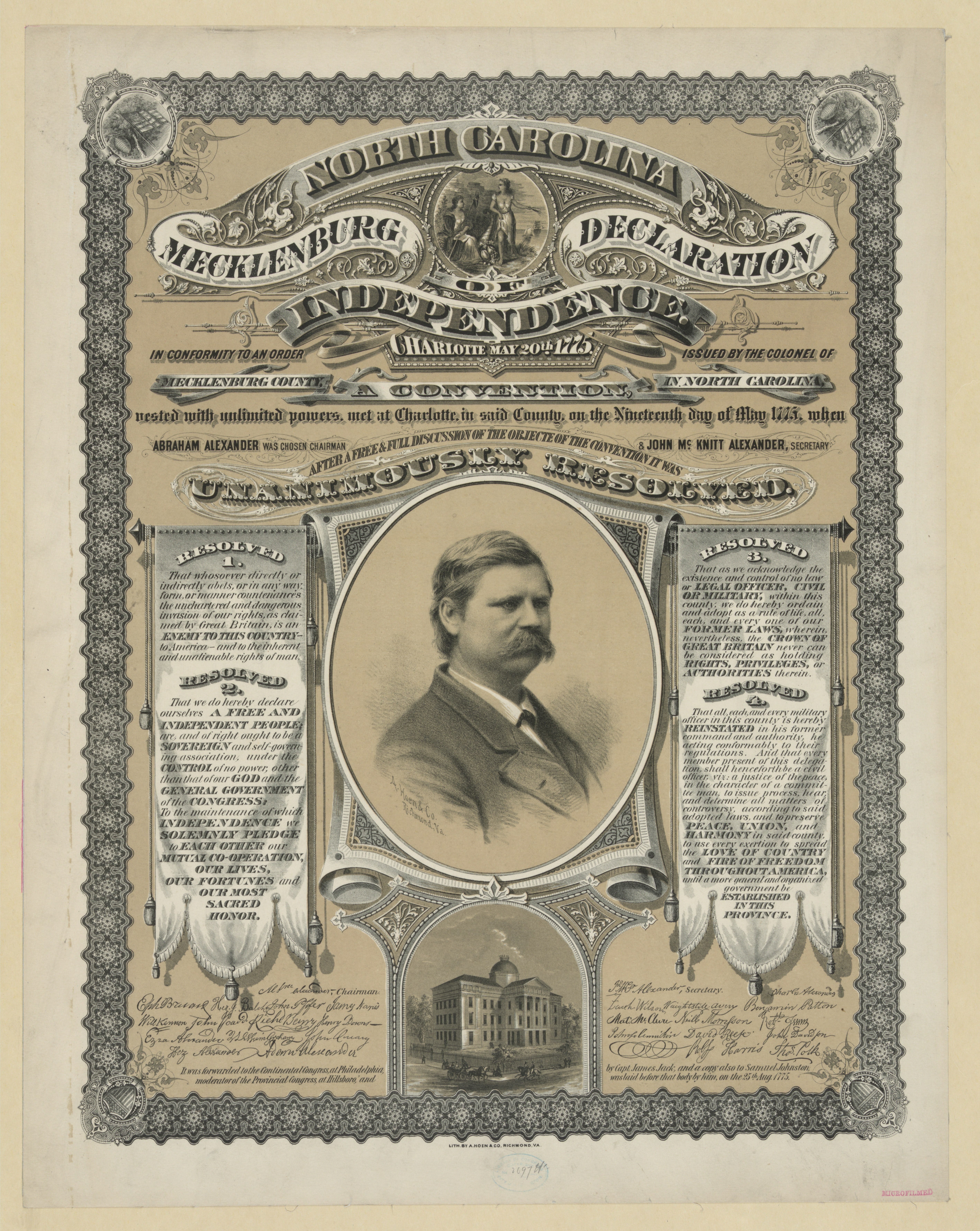
The supposed original was gone. The story said John McKnitt Alexander had preserved the papers, then lost them when his house burned in 1800. What came forward in 1819 was reconstructed by Alexander’s son from memory and family papers, after the document that would have settled the matter had conveniently turned to ash.
Jefferson saw the problem immediately. On July 9, 1819, he wrote to John Adams about the Mecklenburg claim and did not treat it like a harmless local tradition. He was skeptical, blunt, and clearly irritated by the idea that North Carolina had suddenly produced a document so close in spirit and structure to the Declaration of Independence after more than four decades of silence.
He had reason to notice. If the Mecklenburg Declaration had existed as claimed, if it had been known beyond the county, if it had truly anticipated the Continental Congress, then Jefferson and Adams would have been two of the last people likely to miss it.
The defenders always had an answer. They brought out old men’s memories, family stories, local tradition, witnesses who remembered the feeling, or heard about it, or could piece together enough scraps for boosters to sew up a patriotic quilt and call it proof.
North Carolina wanted the story badly enough that the General Assembly conducted investigations in 1830 and 1831, gathering testimony, publishing reports, and defending the state’s honor. The investigations did not settle the matter. They showed a government protecting a myth after the verdict was already written.
Later historians were less friendly. William Henry Hoyt’s 1907 study went through the evidence and cut the thing down. Hoyt did not merely say there were doubts. He argued that the alleged Mecklenburg Declaration was spurious and that the evidence did not support the state’s proudest version of the story.
Over time, that became the mainstream historical judgment. The Mecklenburg Declaration, in the form North Carolina adopted as public identity, could not carry the weight the state kept piling on.
Still, the date stayed put on the flag.
The myth did the dirty work the truth never could. It let North Carolina tell itself that white men here invented American freedom first, while the same revolution left Black people in chains, sale records, wills, tax lists, and the hands of men who could shout liberty while holding human property.
Mecklenburg County didn’t need a legend. It already had a record. The Mecklenburg Resolves were adopted in May 1775, printed in contemporary newspapers, and deserve their place in history. The state did not build its flag around the documented resolves. It built the flag around May 20th, 1775, the disputed Declaration story, the one that made North Carolina look braver, earlier, and more righteous than the record could honestly support.
On May 31, 1775, Mecklenburg leaders adopted resolves bold enough to matter without dressing them up in fake elder robes. They declared that British laws and commissions were “annulled and vacated.” They said royal authority in the colony had collapsed. They suspended the old civil structure and created a local governing arrangement under Patriot control.
That was radical.
That was dangerous, too.
That was Mecklenburg stepping into the revolutionary crisis and asserting that British rule no longer had legitimate force there. The Resolves were published in June 1775. They belong in the record as established history.
The May 20th myth gave the state what the real record couldn’t: first place. First to declare, first to break, first to shout freedom into the air. It turned Charlotte into a shrine and white Patriot memory into a trophy case.
None of that proves the May 20th Declaration existed.
Serious history can hold those truths at once. North Carolina did not have to invent glory. It had enough, but it chose the lie anyway.
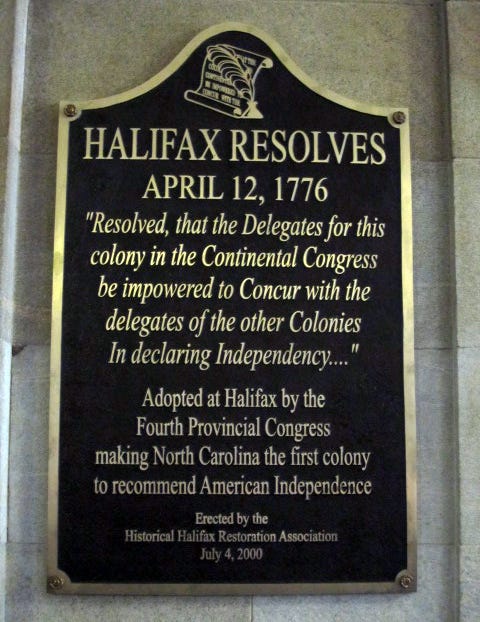
The Halifax Resolves were adopted by North Carolina’s Fourth Provincial Congress, written into the record, sent to the colony’s delegates in Philadelphia, and tied directly to the machinery of independence. The language was official. The delegates were empowered “to concur” with the other colonies in declaring independence. North Carolina really did become the first colony to authorize its Continental Congress delegates to vote for independence.
Halifax was history with paperwork.
The state could have built its whole identity on that and stood on solid ground. April 12 had the resolution, the congress, the delegates, the minutes, the public act, and a straight road to July 4th. Less theater than Mecklenburg, but a hell of a lot more proof.
That was the tradeoff.
Halifax gave North Carolina history. Mecklenburg gave it a brand. The state picked the brand, then spent generations pretending it was history.
Before white North Carolina could turn that brand into heritage, it had to turn Native land into property.
The May 20 story begins on Catawba ground.
The courthouse legend, the Charlotte speeches, the later flag date, the story of Mecklenburg men standing up for liberty, all of it sits on land with a history older than the state’s favorite myth.
The Catawba had lived along the Catawba River for thousands of years, farming, trading, governing, burying their dead, and holding a world together before Scotch-Irish settlers, survey lines, county courts, and revolutionary committees started turning that ground into white property.
Mecklenburg did not rise out of empty land. It rose out of a Piedmont world already shaped by Catawba power, survival, and loss.
By the 1740s, white settlers were pouring into the region that became Mecklenburg. In 1762, the colonial legislature carved Mecklenburg County out of Anson County. The county that later built a civic religion around May 20 was a settler county, made through deeds, roads, militia power, and courthouse authority layered over Native land.
Even the routes that helped make the backcountry valuable were not born from white genius. The Catawba lands sat along the Great Trading Path, one of the arteries that connected the Virginia and Carolina traders, and colonial settlement followed those exact paths.
The Catawba were not background characters in Mecklenburg’s freedom pageant. They were a Native nation navigating disease, settler pressure, war, shrinking land, and colonial governments that kept finding new legal language for old theft.
Catawba leaders made hard choices for survival. Catawba warriors later fought with the Patriots in the Revolution. That fact should have blown a hole through the state’s whitewashed memory, because the story North Carolina kept using had room for white declarations, anniversaries, committees, and flags, while the Native people whose land made that possible were pushed out.
The flag’s May 20th story picks and chooses what it wants to remember about slavery, and it does the same with land. It lets white North Carolina pretend it was born out of resistance, while hiding the fact that it was built on stolen ground.
The same towns that bragged about fighting the British had already cashed in on Native dispossession and turned Catawba country into settler property. The real question isn’t just who got freedom in 1775. It’s who had to pay for the ground where white men stood up and called themselves free.
On August 8, 1774, freeholders in Rowan County met and denounced parliamentary taxation. They complained that Parliament imposed duties without colonial representation, deprived them of property without consent, and reduced them to a “State of Slavery.”
They wrote that phrase while actual enslaved people lived across North Carolina under a system that did not need metaphor.
Black people in the colony were bought, sold, inherited, mortgaged, taxed, whipped, jailed, and worked under the legal power of men who could speak of liberty in the morning and enforce bondage by nightfall.
White colonists looked at taxes on tea and reached for slavery as their language of injury. They knew it meant domination, theft, humiliation, coercion, and the stripping away of human will. They knew enough to use the horror as a political weapon.
The horror itself stayed legal, profitable, and ordinary all around them.
That is the contradiction at the heart of the language of freedom. The word became a grievance when white property was touched. The reality stayed a business when Black bodies were the property.
That’s how the pattern worked. White fear of being ruled became freedom heritage. Black bondage got shoved out of the frame.
In Wilmington and the Cape Fear region, in June 1775, revolutionary authority was already learning how to govern through fear. This was not an era of liberty where men sat around with quills and resolves while everyone else waited for freedom to arrive. Committees made rules. Associations named threats and patrols moved through Black life.
The Wilmington association carried that fear in political language. It spoke of the “dread of instigated insurrections,” a phrase that tells on the whole moment. White Patriots feared that enslaved Black people might hear the British side whisper freedom, or hear the Crown offer protection, or simply read the fracture between white men as an opening.
The fear did not come from nowhere. Enslaved people had always watched white power closely because survival required it. They listened, moved news, judged risk, found gaps, and knew that a war between masters could become something else if the balance shifted far enough.
“For the more effectually disarming and keeping the negroes in order,” the Wilmington committee appointed patrols to search for and take arms from Black people.
“Disarming.”
“Keeping.”
“In order.”
This was revolutionary government acting as racial police. For Black people, those same committees could mean a patrol at the door, a search through a house, a weapon taken, and a reminder that white liberty would be guarded against Black freedom.
Committees of Safety were safe for some people. They gave white Patriots structure in a collapsing imperial order. They coordinated supplies, watched Loyalists, managed local authority, communicated with other committees, and helped turn protest into organized power.
Janet Schaw was a Scottish traveler and writer who visited the Cape Fear region in 1775 and left behind one of the sharper outside accounts of revolutionary North Carolina. Schaw saw the Cape Fear region with an outsider’s eye, and her record keeps the panic from disappearing into committee minutes alone. She described Wilmington and the surrounding region at a moment when rumor, rebellion, and surveillance ran together.
Stories moved through the region that Governor Josiah Martin, or the Crown more broadly, might offer freedom to enslaved people who joined the British side. White Patriots treated those rumors as a public danger. The response was seizure, search, patrol, and punishment.
This is the part that never fits on the plaque. The revolutionary committees did not merely debate rights. They built power, and North Carolina’s revolutionary authorities knew exactly where to aim it.
The surviving record is white, hostile, and scared. On July 15, 1775, John Simpson wrote from Chatham in Pitt County to Richard Cogdell in Craven County with news of what white authorities believed they had uncovered, what punishments had already been carried out, and what kind of fear was running through eastern North Carolina.
The Black people at the center of the alleged plot do not get to speak from the page in their own hands. They come to us through the handwriting of a white Patriot describing accused people hunted, whipped, jailed, and mutilated by the same revolutionary world that was busy talking about liberty.
That source has to be read with care. It was not written to preserve their truth, but from inside the panic of men who believed Black freedom was a threat to their own.
Simpson still gave away enough, and what he gave away was not just white fear. He gave away Black political imagination.
Enslaved people were not waiting around for white men to finish defining liberty. They were listening to the fracture in white power. They knew that when rulers split, doors could open.
They knew that empire, colony, master, militia, governor, committee, and courthouse were not eternal things. They were arrangements, and arrangements could break.
That is the part white records try hardest not to preserve, not merely that Black people suffered, but that Black people studied power. They imagined futures that did not require white permission.
According to a July 15, 1775 letter there had been an “intended insurrection” involving enslaved people in Pitt, with the alarm reaching into Beaufort, Craven, and the wider eastern region.
The planned date, as Simpson reported, was July 8, 1775. That date should resonate in a state that flies May 20th, 1775, as sacred public memory. North Carolina has spent generations asking people to honor a disputed white declaration from that revolutionary season while leaving a documented Black freedom panic from that same summer buried.
By the time Simpson wrote, the machinery was already moving. More than one hundred patrollers had been appointed. Nearly forty enslaved people had been jailed. Some people were killed while being apprehended, and Simpson described a plan to compensate enslavers for those deaths through a tax on enslaved people.
The whippings were public, deliberate, and meant to teach.
Simpson described severe punishment, including eighty lashes, both ears cropped, and public suffering carried out before the committee and spectators.
The point was to break people in front of other people. The committee used the body as a document. The lashes, the cropped ears, the watching crowd, the official presence, the daily rhythm of “taking up, examining and scourging.” All of it told enslaved people what white revolutionary order meant when Black freedom entered the room.
Then Simpson’s letter gives us the phrase that should have haunted the state flag from the beginning. He wrote that the alleged plan involved enslaved people seeking “a free government of their own.”
A free government of their own.
That phrase appears inside a letter about crushing Black freedom. That is North Carolina’s real revolutionary mirror.
Simpson was not sympathetic. He was not writing to celebrate Black liberation. He was writing from within the white Patriot world that treated the alleged plan as a threat, a crime, a disorder to be suppressed. That makes the phrase even more devastating.
The enslaved people wanted political freedom, collective authority, a government not ruled by the men who owned them, beat them, sold them, and claimed their children.
Simpson did not give us their testimony, prayers, meetings, arguments, fear, courage, or names. He gave us a white account of suppression, and inside that account sits the claim North Carolina chose not to remember.
The state’s public memory narrows the frame to Mecklenburg. The records widen it back out. They show the colony dealing with a different kind of declaration, one that came not as a parchment myth from white elites, but as a feared Black political possibility.
The letter’s violence also forces us to reconsider how we talk about revolutionary government. Committees were not automatically democratic because they opposed British rule. Local control did not become justice simply because it was local.
A committee could speak against imperial tyranny in one meeting and supervise the whipping of enslaved people in another. A county could claim rights while organizing patrols. A revolutionary network could fight British authority while defending racial domination at home.
That’s the hard center of this story. The Black freedom claim in Pitt County never got honored because honoring it would wreck the state’s favorite memory of 1775.
It would force North Carolina to admit the revolution wasn’t just white declarations and provincial resolves. It was also enslaved people, allegedly imagining a government of their own, and white authorities responding with exactly the kind of violence that reveals what power fears most.
May 20th, 1775, sits on the flag. July 15th, 1775, sits in the records. The first date points to a Mecklenburg Declaration that appeared publicly decades after the fact.
The second points to Simpson’s contemporary letter describing an alleged Black freedom plot, mass patrols, jailings, killings during apprehension, public whippings, cropped ears, and the phrase “a free government of their own.”
One story got disputed and celebrated. The other got documented and buried.
The Black freedom claim accused the whole story. It showed that North Carolina’s revolutionary year was not a march toward independence, but a contested field in which some freedom claims were honored and others treated as crimes.
Mecklenburg doesn’t get to dodge the sin of slavery by pointing east at bigger plantations. Pitt County shows Black freedom being crushed in the same revolutionary season North Carolina later used for white freedom mythology. Wilmington shows committees and patrols turning revolutionary authority into racial enforcement.
Mecklenburg County existed within the same slaveholding world, and the men tied to its freedom story benefited from it. One of those men was Thomas Polk.
Polk was a central figure in Charlotte, a militia officer, a local power broker, and one of the men tied to Mecklenburg’s revolutionary memory. The old story casts men like Polk in the familiar heroic frame: white leaders gathering, speaking bravely, risking British anger, and pulling North Carolina toward independence.
That is the version public memory knows how to handle. It knows how to bronze a Patriot, to immortalize certain figures in public monuments or statues that serve to celebrate their supposed virtues while elevating them as models of civic identity. It knows how to name a street. It knows how to make revolutionary politics sound like moral clarity.
By 1790, Thomas Polk enslaved forty-seven people.
That number belongs in the story of the state flag. Polk could be remembered as a Patriot, militia officer, civic founder, and local father of the Revolution, but the 1790 census adds the part ceremonies skip. The freedom story didn’t happen somewhere separate from slavery. In Mecklenburg, it was carried by men who claimed liberty while holding Black people as property.
Mecklenburg’s own numbers make the point harder to dodge. In 1790, enslaved people made up about 14 percent of the county’s population. By 1860, that share was roughly 40 percent.
The county did not move away from slavery as the freedom story aged. It grew deeper into it. The myth of early liberty sat on top of a place where Black labor and Black confinement became more central to wealth, order, and power.
So when North Carolina points to Mecklenburg as sacred freedom ground, the answer has to include enslaved people counted in households, taxed as property, passed through estates, forced into labor, and written into the wealth of men who spoke of liberty without applying it to the people they owned.
The men North Carolina dressed up as apostles of liberty weren’t outside the slaveholding order. Some of them were the order. They claimed liberty in public and owned people inside a system enforced by law, patrols, courts, taxes, inheritance, and violence.
The myth is still doing its job.
Mecklenburg County built a 250th anniversary celebration around the story in 2025, calling the document “cherished” and “debated,” the kind of public wording that lets celebration and doubt sit beside each other without forcing a verdict. PBS Charlotte framed a program around the Mecklenburg Declaration as a bold Southern freedom story.
Museums still have to teach about the controversy because it is inseparable from the thing itself. Charlotte still has Meck Dec Day, still has commemorations, still has the old civic hunger to be first.
One museum detail cuts through the polite handling. A Charlotte Museum of History exhibit pointed to an 1839 Catawba Journal page where a printing of the Mecklenburg Declaration sat next to a runaway slave advertisement.
A freedom text and a slave-catching notice on the same newspaper page. No abstract lecture needed. No soft museum voice required. The page itself shows the fraudulence of a freedom memory that never had to answer for the people being hunted in the same print culture that celebrated liberty.
North Carolina did not build flags, plaques, school lessons, license plates, and anniversary celebrations around an accident. It took a disputed white claim, paired it with secession, cleaned it after defeat, and carried it into the present tense with enough ceremony that doubt itself became part of the branding. Cherished and debated. Legendary and questionable. False enough to require explanation, useful enough to keep.
May 20th, 1775, is still there, sitting above the star, carrying the old claim every time the flag moves in front of a courthouse, school, meeting room, polling place, parade, or government office.
Most people will never ask what survived to put that date there. Fewer will ask what had to disappear so that date could keep doing its work.
The archive isn’t silent. It’s just been treated that way because the records that disturb power get left where only stubborn, wounded, trained, or suspicious people go looking.
What was buried here was not merely a story. It was a freedom claim: Black people imagining a world beyond the men who owned them, and white authorities using violence to stop them.
That is the part North Carolina’s public memory cannot stomach without tearing up the story it has spent generations selling as heritage. The state can live with white Patriots declaring independence from Britain. It can live with the Halifax Resolves and the paperwork that sent delegates to Philadelphia.
It can even live with controversy around Mecklenburg, as long as the argument stays polite and the myth keeps working. What the state cannot face is the record from Pitt County, where a white Patriot wrote down that enslaved Black people were accused of seeking “a free government of their own.”
That phrase does not ask for a footnote in the white story. It calls the whole story a lie. It shows that the flag’s version of freedom was built on the backs of people who were never meant to be included, and that the violence was not a side effect. It was the foundation.
Public history is a battlefield. The winners get flags. The losers get footnotes, if they are lucky. That pretense collapses the minute July 15 stands beside May 20, Wilmington stands beside Charlotte, Pitt County stands beside Mecklenburg, and the runaway ad sits beside the freedom text on the same newspaper page.
No reconciliation language or civic panel can sanitize this history into a comfortable narrative where responsibility is diffused or ignored. The historical record exposes a starker reality: white North Carolina claimed its own freedom, built patrols, enforced racial control, crushed Black claims to liberty, protected slavery, and turned a disputed declaration into state identity. The flag became a lesson in who mattered and who got erased, and the state kept teaching it long after the bodies were in the ground.
The myth has a flag.
The truth has receipts.
A serious public memory would stop treating May 20th as a harmless tradition. It would ask whether the flag itself can keep flying unchanged once the public record has been forced back into view, because a symbol does not become innocent just because people are used to it.
Comments
Nothing yet. Say the first thing.
Sign in to join the conversation.