
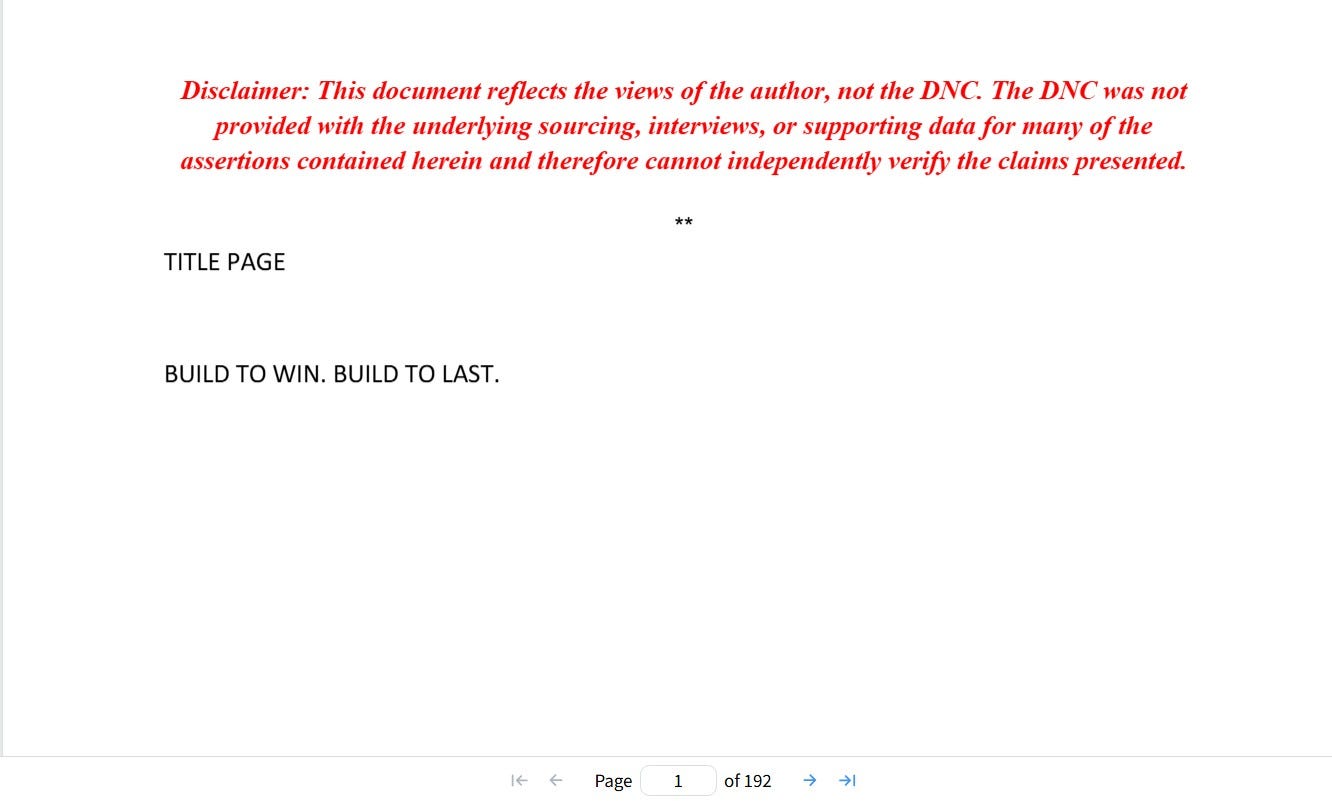
The Democratic National Committee dragged its feet for months before coughing up the so-called 2024 election autopsy, and by the time it landed, the thing was so gutted it needed its own coroner. One hundred ninety-two pages of hedging, disclaimers, and bureaucratic ass-covering.
It was released only after months of pressure and internal embarrassment. The DNC even slapped a warning label on it, like a pack of cigarettes, saying the report was just the author’s opinion and nobody at the committee had seen the receipts, interviews, or data behind it. That is how you know they were already running from their own story.
The report is public. The labor of reading it, breaking it open, and turning it into something usable is not. If you want this kind of work to continue, subscribe - 20% off is available right now.
Here in North Carolina, the report’s effect was even messier. The News & Observer caught the DNC’s so-called autopsy screwing up basic facts about Josh Stein’s 2024 governor’s race against Mark Robinson, getting Robinson’s share of the vote wrong and leading political observers to question how a national party could mess up numbers you can pull off the state board’s website in five minutes. Chris Cooper, a political scientist at Western Carolina, called them out for getting ‘basic facts wrong.’ DNC Chair Ken Martin admitted the report was a mess, but claimed it had to be released so people could trust the party’s word. Trust? After this? Trust who, exactly?
The official numbers out of Johnston County tell a sharper story than the report does. Donald Trump beat Kamala Harris here 60.06% to 38.59%, an absolute blowout. In the governor’s race, though, Mark Robinson only edged Josh Stein in Johnston County by 152 votes, 57,757 to 57,605.
I have lived and organized in rural North Carolina long enough to know the problem is not the slogan on the mailer. The problem is trust. What those numbers show is voters split their tickets because Robinson’s campaign was leaking scandal like a busted septic tank, and Stein almost won in a place where Harris got buried. That is the story, not some fantasy about a rural revival.
In fact, when making sense of these numbers, some of the best explanations did not come from the party at all. They came from the independent writers, organizers, data nerds, and pro-worker folks who looked at the same mess and saw what the DNC still can’t get right.
Take Will Robinson’s essay, for example; “The DNC Autopsy Says the Quiet Part Out Loud.” It is what lit the fuse for this poem. Robinson looked at the leaked DNC autopsy and saw past the mess of the document itself, past the missing confidence and the procedural embarrassment, straight into the thing Democrats still hate saying out loud, stripping away the language the party hides behind and calling out the cycle they keep repeating.
“For too long, Democratic campaigns have treated communication like a seasonal purchase. Raise money. Test messages. Buy TV. Send texts. Knock doors late. Hope voters tune in. Then disappear. That model is broken.” - Will Robinson
His argument is not about a better slogan. It is about infrastructure, trust, relationships, local messengers, year-round presence, and the hard damn truth that nobody in rural North Carolina believes a campaign that only shows up when it is asking for money.
Gwen Frisbie-Fulton echoed the same frustration from the ground level, “Listen, y’all. I’m not holding my breath for any party, but I will for my people,” she wrote. “Will Robinson is spot on here: you can’t show up, even with the best message you’ve ever written, during an election and act like regular ass people haven’t been living through the whole year.”
Fulton argued that people build political meaning from daily life, not campaign ad buys. “We learn about our lives and make meaning from what we see every day, not just in the weeks before November,” she wrote, criticizing communicators “fixated on the right message and the perfect ad, instead of consistent, year round storytelling during the course of everyday life.”
Then came the line that cuts the whole argument down to its bone: “Shoot, I find and write a new story about working class people doing incredible stuff every week… it’s not like there’s a shortage of stories, you just have to bother to look.”
That’s where this poem starts. Not in some D.C. think tank or consultant Zoom call, but in the real lives of North Carolinians. The fight isn’t about left, right, center, or whatever donor-funded slideshow they’re calling strategy this week. It starts on the bypass, at the gas pump, in the rental neighborhood, on the church floor where campaign mailers show up too late, with the workers who keep this state running while campaigns remember them only when October money starts burning holes in somebody else’s pocket.
This is written as a Carolina broadside, not a polished lyric, and not a policy memo with line breaks. Broadsides were meant to travel fast, hit hard, carry news, mock power, and give regular people a way to remember what happened before the official story got cleaned up for rich folks.
This one carries some ballad in it, some campaign autopsy, some county-road cussing, some Outer Banks memory, some JoCo math, and a whole lot of working-class disgust. The argument is simple enough to fit on a bulletin and hard enough that the DNC ought to tape it to the damn conference room wall.
Text within this block will maintain its original spacing when published
Can’t Rent Trust Come October
GPS say take the bypass,
phone say twenty minutes more,
gas light blinkin’ on the dash
and rent still waitin’ at the door.
The DNC marked us red
in Rivera’s incomplete report,
then called the gaps analysis
and blamed us for comin’ up short.
I come up where the swamp road bends,
Moyock mud on my shoes,
summer folks headin’ toward the Banks
like the coast was theirs to use.
Local folks were scrubbin’ sheets,
somebody fried that fish,
somebody smiled for tourist tips,
then scrubbed somebody’s dish.
Mama said watch the weather, boy,
Daddy watched the road,
rich folks draggin’ coolers down,
workin’ folks haulin’ the load.
The sound don’t care about your plans
or if your fish don’t sell,
the tide don’t ask about your shift
or if your knees feel like hell.
The old men in the marina
spoke a language thick and slow,
salt baked hard inside their jaws
from ninety years ago.
They called it hoi toide on the marsh
when water started risin’ high,
they called it hard toime in the shack
when winter choked the sky.
Now them old fish houses turn boutique
for folks just wantin’ shore,
but you can’t pave the memory out
by buildin’ one more store.
Forty’s backed up before the sun
can climb above the pines,
brake lights stretchin’ past Wake
across the county lines.
The Raleigh money’s rollin’ out
to buy the family land,
before the estate gets settled up
or folks can raise a hand.
They put a subdivision down
where tobacco used to grow,
with stone veneer and fancy signs
for names we’ll never know.
Men in boots are wakin’ up
at four AM alone,
to frame another rental row
of homes they’ll never own.
JoCo told the story well,
for anybody that looked,
Harris got beat bad up top,
while Stein damn near had it took.
That ain’t some magic blue wave,
that ain’t no moral win,
that’s folks markin’ different boxes
soon as screenshots started rollin’ in.
Don’t write that in the report
like y’all found some master plan,
Robinson cracked the door some,
but trust ain’t built in MiniVAN.
Charlotte got the skyline glow,
Raleigh got the glass,
Chapel Hill got lecture halls
explaining working class.
Asheville got the bumper stickers,
Durham got the grants,
hotel maids and kitchen crews
still barely get a chance.
They sort folks by diplomas
like that tells the whole damn tale,
like debt and dirt and daycare
don’t leave fingerprints on mail.
They count the blue dots shining bright
and call that half the state,
then wonder why the porch light’s off
when they come knockin’ late.
The workin’ class ain’t disappeared
inside no spreadsheet space,
they’re runnin’ freight on eighty-five
or packin’ boxes by the case.
They’re cleanin’ rooms in mountain towns,
pourin’ drinks till two,
stockin’ shelves in Wake County,
for pay that barely pulls ’em through.
They say the right built signal
like it sparked up from a chart,
they built it over breakfast,
in church and down at Walmart.
They built it in the rumor chain,
the page your auntie reads,
the preacher’s wink, the sheriff’s talk,
the fear dressed up as need.
They didn’t win overnight
with a flag and a culture war,
they just stayed inside the room
when everybody else walked out the door.
Here come Democrats again,
October’s at the door.
Mailers slick as funeral fans
fallin’ on the church floor.
Texts from numbers we don’t know
come buzzin’ like they’re preyin’,
from some campaign consultant
who don’t know what we’re sayin’.
They think that rural is a word
that means just one thing,
they never set the folding chairs
in fire halls come spring.
They said the thing was half done,
red warnings on each side,
a hundred ninety-two pages
to tell us how we died.
They called it an autopsy,
couldn’t even tag the toe,
kept fightin’ over the body
like nobody else would know.
That autopsy in a PDF
while rent is runnin’ high,
while light bills ride the dashboard
and the workday eats the sky.
We’re fixin’ to stretch the paycheck thin,
we’re fixin’ to count the cost,
gas high at the pump again,
and the school board’s gettin’ lost.
You can’t just visit the country
when the campaign money’s flush,
then act surprised the doors stay shut
when you never showed up much.
Can’t rent trust come October.
Can’t buy back what you let rot.
Can’t learn a county from a dashboard.
Can’t win back roads you forgot.
Thanks for reading. This post is public, so share it freely. If it mattered to you, pass it along. This kind of work only travels if people carry it.
Comments
Nothing yet. Say the first thing.
Sign in to join the conversation.