
That was the line that made Hubbard stomp across the stage and shut her down in front of the whole crowd at Nixon-Fowler Stadium for Clayton High School’s graduation on Thursday, May 28, 2026.
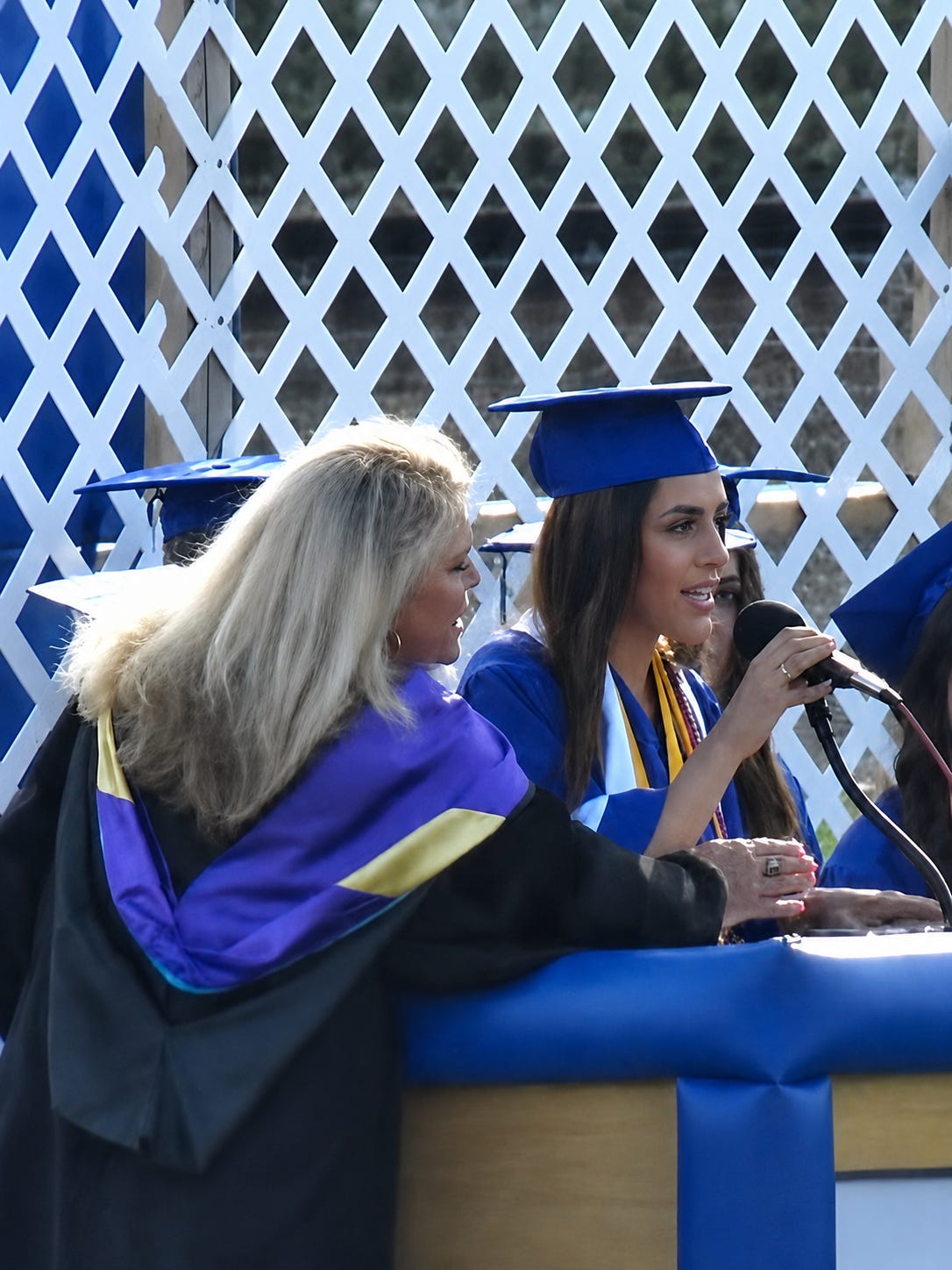
The ceremony did not stop there. Less than five minutes later, Senior Class Vice President Cecelia Trader stepped up, asked the audience to bow their heads, and opened with a Christian prayer: “Dear Heavenly Father.” Hubbard stayed seated. A few minutes after that, Student Body Vice President, Mallory Kuykendall introduced senior class president Gates Hale through his church work and mission trips, then Gates quoted Proverbs 3:5-6 and told the graduating class the Lord had a purpose and path for each of them. Hubbard stayed seated. At the end of the ceremony, Allison Lowery, Student Body Historian, closed the night with a prayer and a Bible verse. Hubbard stayed seated for that, too.
The approved part of Leen’s speech was the kind of graduation talk schools love, because it doesn’t ask anyone anything risky. She welcomed students, staff, families, honored guests, and the whole Class of 2026. She talked about hard work, growth, memories, sacrifice, perseverance, parents, guardians, teachers, coaches, loved ones. She told her classmates to be proud. She said they will always be Comets. She gave the school the safe version, warm enough for the program, broad enough for the bleachers, careful enough to slip past whatever adult hands were holding the gate.
Then she said, “Before I leave the stage, I have one last thing to say.”
That was the part she left out of the official draft, because she already knew exactly how this place works and who gets to speak.
“Every single person here has a voice,” her written speech says, “and we are privileged to have the freedom to use it when so many people around the world are suffering and struggling to be heard.” She named “the millions suffering in Palestine, Sudan, Congo, Afghanistan, and so many other countries around the world,” and “the families being torn apart by ICE.”
Then came the line she was trying to finish.
“My point is, we were not given a voice so we could stay silent in the face of suffering. Every person deserves dignity, safety, and the chance to dream for their future just like we do. As we all move forward, I hope we choose to speak up against oppression, support one another, and use our voices to bring compassion and humanity into the world.”
That’s all she tried to say.
Dignity, safety, compassion, and humanity. That is what Principal Melissa Hubbard could not let finish. Not a threat, not a disruption, just the wrong truth from the wrong mouth in the wrong county.
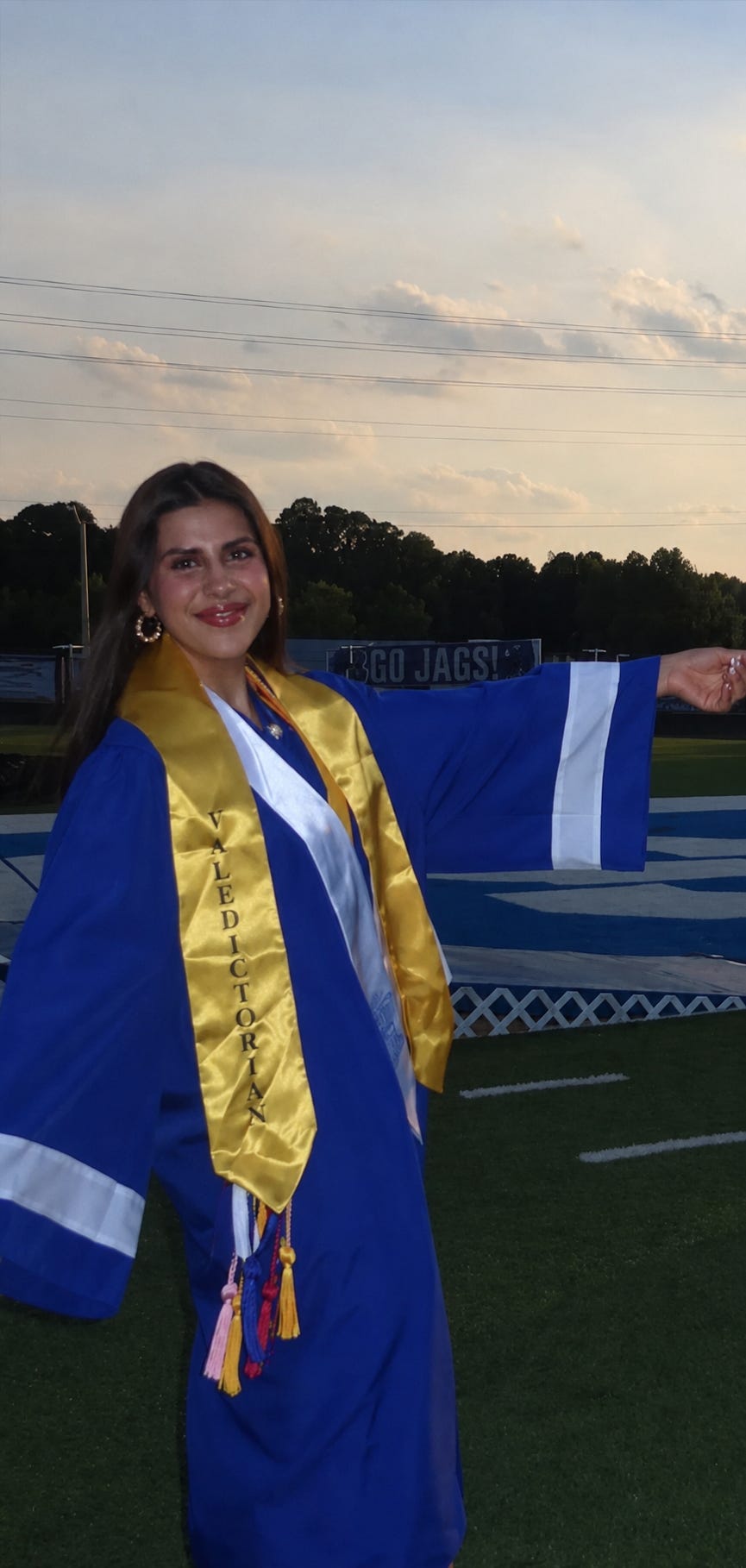
Leen Hijaz is Palestinian. She is Muslim. She graduated early, a junior with the highest GPA at the school, and was valedictorian of the Class of 2026 at Clayton High. She did not walk onto that stage as a prop in somebody else’s culture war. She walked up there carrying a life that most of the room had never had to understand.
Leen did not keep the final lines separate because she misunderstood the rules. She kept them separate because she understood the rules too well.
In our interview, she explained that the approved part of the speech was written to do what graduation speeches are usually expected to do. She wanted “to make a good impression.” She wanted it to be “a reflection of everything that we’ve gone through the past couple of years.” She kept it “very simple” and “something that everyone could relate to.” That was the safe speech. The warm welcome speech that thanks everybody, offends nobody, and lets the ceremony keep moving.
The second part came from somewhere else.
“I wanted something to be spread about the awareness about everything that’s going on in the world,” Leen told me, “because I knew that they weren’t going to bring it up, especially because I am Palestinian.” Then she said the part that should embarrass every adult pretending she is just some kid who doesn’t know what she is talking about.
“I’ve lived in Palestine and I’ve gone through things that a lot of people here don’t know about and don’t experience, and I wanted to put that out there.”
That is why she wrote it. She did not write it because it was a political talking point she learned from a TikTok clip. That was a student explaining why the final part of her speech mattered to her, why she wanted to name suffering beyond Clayton, beyond Johnston County, beyond the comfortable little ceremony adults wanted.
That is also why she knew it would not survive approval.
Her senior quote for the yearbook had been “From the river to the sea,” and Clayton High made her change it. Leen said it was “apparently too political” and “too offensive.” She did not describe it as a threat. She described it as “just a simple phrase that a lot of Palestinians say because of our ethnic cleansing.” That experience told her what the school would do if she submitted the final part of her speech. Nobody had to spell it out. The lesson had already been taught.
That lesson did not stop with the yearbook.
Clayton High has student groups like Turning Point USA and First Priority Christian Club, and Leen was blunt about how that looked from where she stood.
“Every single time that something culturally in our school is trying to be put out there, it’s often ignored,” she said. “The First Priority and the Turning Point USA club at our school got a lot of praise from teachers and students.”
When she and her friends tried to organize a culture day, they had to get a poster approved, and even that became “a whole process” just to get something displayed in the school.
Turning Point USA, for anyone who has somehow missed the last several years of right-wing campus pipeline politics, is the late Charlie Kirk’s organization that has made defunding public education, attacking immigrants, and mainstreaming white grievance part of its brand.
First Priority is a national organization built around getting students to evangelize other students inside public schools, an approach designed to accomplish through peer pressure what the First Amendment prevents school staff from doing directly.
Students have the right to organize, including students I disagree with, including Christian students and conservative students. The problem is why Clayton High made Leen and her friends fight through a dragged-out approval process for a culture day meant to recognize Muslim, Hispanic, Palestinian, Arab, immigrant, and other students, while Turning Point and First Priority were treated as ordinary parts of the school environment.
Why did the school push Leen’s Palestinian cultural poster through a grinding approval gauntlet while Turning Point and First Priority collect institutional applause?
That is not a neutral standard. That is a school telling certain students that their culture is a process problem, while telling certain other students that their politics are just fine.
This is how students learn the real approval process. Not from a policy on a district website. Not from a student handbook. From watching which words get waved through and which words get sent back. From noticing which clubs get smiled at in the hallway and which ones have to justify their existence before they are even allowed to be visible. From learning that Christian speech can be tradition, conservative speech can be leadership, Palestinian speech can be political, Muslim visibility can be friction, and immigrant grief can be treated like bad manners.
Leen understood the rules before she wrote a single word of her speech. She wrote the approved portion carefully, warmly, with genuine regard for her classmates and their families. She gave the school exactly what it asked for. Then she wrote the rest of it, and she knew she would not submit it, because her own experience in that building had already told her what would happen if she did.
On graduation day, she delivered the approved speech first. Then she said, “Before I leave the stage, there’s one last thing that I have to say.” According to Leen, that was the moment Principal Melissa Hubbard started yelling her name.
“She’s like, ‘Leen, Leen, stop speaking right now! ‘” Leen said. She said she kept going because she had already started. She told me, “I was focusing on her, but I was also trying my best to focus on what I was saying at the same time.” Then, according to Leen, Hubbard came toward her and said, “Stop speaking right now. You’re not graduating.” Leen said the video shows Hubbard “kind of grabs my hand and took me out of the way,” and that she was “basically kind of forced to move and sit back down.”
Afterward, Leen says Hubbard found her and told her, “I’m so disappointed in you. I gave you the privilege to speak, and you abused it. And you’re so selfish.”
Privilege.
Melissa Hubbard told a junior graduating early that she had been given the privilege.
Leen had the highest GPA in the school. After being narrowed from valedictorian to welcome speaker, after writing the safe speech, and then daring to use the last few seconds for something real, the principal told her the microphone had been a privilege she had abused.
Leen does not accept that framing.
“There was no written rule,” she told me. “There’s no policy.” She said she understood that the school expected speeches to be approved, but she did not believe there was anything in the student handbook or written rules that made her words forbidden.
“I don’t think it was rebellious. I think it was necessary.”
When Leen found that she held the highest GPA in her junior class and in the school overall, and she asked Principal Hubbard whether that meant she would speak at graduation. “When I found that out,” Leen said, “I was like, doesn’t that mean I get a speech at graduation? Because in most high schools in America, the valedictorian does.”
Hubbard said no. Leen kept asking. Throughout the school year, the answer stayed no. Hubbard told her that if anyone spoke as valedictorian, it would be the senior ranked number one, because Leen was a junior, and it would not be fair to the senior class. Hubbard said she had spoken to others at the county level, and they agreed it would not be appropriate.
“It was no, no, no,” Leen said in the interview.
By March, Leen eventually stopped pushing. “I did give up,” she told me.
Then, near the end of April, a friend told Leen that the senior number one was saying she would give two speeches at graduation, one as valedictorian and one as student body president. Leen went directly to Hubbard’s office and recorded the conversation.
Hubbard told her the other student was only speaking as the student body president. The program, Hubbard said, would say student body president, with nothing about valedictorian. Hubbard also said she would handle the claim that the other student was telling people she had two speeches.
About two days after that recorded confrontation, Leen was told she could give a welcome speech.
Not a valedictorian speech.
A welcome speech.
After being constantly told no, after a confrontation she felt compelled to record for her own protection, what she received was a welcome speech, offered only when the pressure of saying no became greater than the pressure of saying yes.
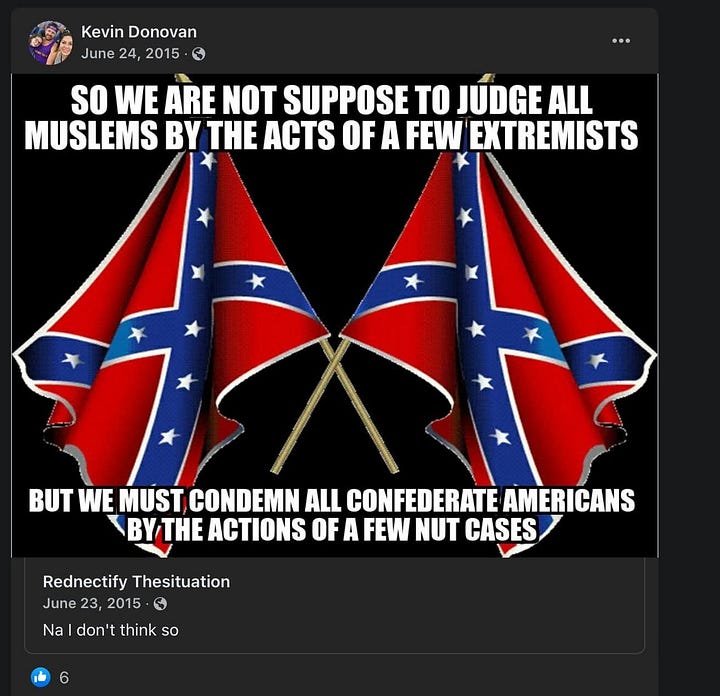
Kevin Donovan, vice chair of the Johnston County Board of Education, commented on Facebook after Leen’s story began spreading. Within hours, he posted a public defense of the school’s handling of her speech. His argument was process. Students submit speeches. Principals review them. Principals can approve them or recommend changes. Leen, in Donovan’s framing, did not deliver the speech as approved.

Let’s take his process talk at face value for a minute.
Now the process is the evidence. The paper trail is the story.
If Clayton High required every student speaker to submit remarks in advance, the public should be able to view all submitted speeches. Produce the program. Produce the rules. Produce the policy.
A process that allows Christian prayer to proceed while stopping a Palestinian Muslim student from saying that human beings deserve safety is not neutral simply because it is written down.
Donovan jumped in to defend the school without saying anything about the Christian prayers and Bible verses that kept rolling after Leen got cut off. He didn’t start with Leen’s words. He didn’t mention the prayer parade. He didn’t ask why a Palestinian Muslim student would know the approval process was stacked. He didn’t ask about the diploma. He didn’t ask which rule allows a principal to threaten graduation over a speech. He just said process, like that makes the process legal.
His public record makes his rush to defend this decision predictable.
Process does not become credible just because Kevin Donovan says it in public. If you have followed his political career, you know his credibility on questions of fair treatment for Muslim and Palestinian students is not a strong foundation.
Process becomes trustworthy when the records show it was written, neutral, consistent, and applied to Christian prayer and Palestinian suffering the same way.
In prior Holler & Hammer reporting, I documented that Johnston County already had the record before Donovan was elected and later elevated. Donovan called himself a “Confederate American.” He described Dylann Roof’s white supremacist manifesto as “carefully typed up and interesting.” He shared anti-Muslim propaganda. He mocked Black Lives Matter and pushed All Lives Matter and Blue Lives Matter talking points. He defended Confederate imagery and treated the removal of Confederate symbols from public spaces as an attack on American identity.
He participated in violent and misogynistic text exchanges with Ronald Johnson that became evidence in Johnson’s criminal case, then received immunity in that investigation. He blocked constituents from his official school board Facebook page and scrubbed criticism. He chaired the Policy Committee work tied to attacks on the protections of LGBTQ+ students and staff.
Despite all of this, the Johnston County School board made him vice chair on December 9, 2025, with votes from Kay Carroll, Jeffrey Sullivan, Lyn Andrews, and Donovan himself.
Donovan’s first public move was to shrink the story into something easier to defend. He focused on Leen’s words while leaving out the approved Christian prayer, the Bible verse, the Jesus language, and the scripture that closed the ceremony. He also left out the retaliation claim at the center of the story: Leen says her diploma was withheld, she was threatened with not graduating, and another student was threatened after hugging her on stage. That is selective omission.
That is what people in power do when they do not want to talk about the thing everybody saw. They point at the paperwork before anybody can inspect it. They tell the public the rules were followed before the public has even seen them. They make a student’s moral claim disappear inside an administrative box.
In Johnston County, the word “process” is often used by those in power when they want the public to stop asking who the process is designed to protect.
That is the position Clayton High now faces. If the Christian content was approved, then the school approved Christian prayer, scripture, testimony, and a Christian closing while treating Leen’s humanitarian statement as misconduct. If the Christian content was not approved, then the school allowed unapproved Christian departures from the script while stopping an unapproved Palestinian Muslim statement about suffering and dignity. Either way, the process does not shield Clayton High. The process itself becomes evidence of the problem.
When the video spread, Johnston County showed the reflex it keeps pretending doesn’t exist anymore. A young Muslim, Palestinian woman spoke from her conscience, and too many people heard danger instead of grief, disobedience instead of courage, and politics instead of humanity.
Plenty of people supported Leen. Classmates, friends, family, and people far beyond Johnston County saw what happened and understood exactly why it mattered. They saw a young woman use the one public moment she had to speak for people who do not get a microphone at all.
“I have gotten nothing but support,” she told me. “If it wasn’t for them, then I wouldn’t have had the courage.”
When people online said graduation was the wrong place and treated her words like an attack on their comfort, Leen did not dance around it.
“The people who were uncomfortable with me saying what I said are privileged,” she told me, “because they are able to turn their backs to something so important in the world.”
That is what her critics skip over. They were not being asked to agree with every word she said. They were being asked to hear a Palestinian student call out suffering without turning the whole football field into a manners hearing. Leen’s speech did not harm anybody sitting in those stands. It made some people face what they would rather leave outside the stadium gates.
One person compared Leen’s graduation speech to interrupting a private wedding, as if a public school ceremony funded by public tax dollars is a private living room where Leen did not belong.
That argument tries to shrink a public institution into a private comfort zone. Clayton High is not a reception hall. It is a public school, serving students who are Muslim, Christian, Jewish, atheist, immigrant, Black, brown, white, queer, straight, rich, poor, and every other reality that exists in Johnston County, no matter how much some would prefer to ignore it.
Others said the families being torn apart by ICE “have no business being here,” which is not a concern about graduation protocol. It is a statement that certain families are not human enough to be grieved in public.
When someone hears a teenager say families are being torn apart and responds by saying those families should not be here, that person is telling you exactly what they believe about human worth. One commenter invoked the Muslim world destroying civilization, offered up in response to a seventeen-year-old asking her classmates to care about people who are suffering.
None of this is surprising. None of it is new. The pattern is familiar: call the speech disrespectful to avoid addressing its content, invoke time and place until the student is worn down, then claim you would have supported her if only she had chosen a moment where those in power would not have to listen. Time and place often means not here, not now, not in front of us, not where the comfort of the majority is asked to share space with someone else’s grief.
That is how the pattern repeats.
Leen refused it.
JCPS will probably cite Hazelwood v. Kuhlmeier because a graduation speech gives the district more room to claim school control than a student’s private expression in a hallway. That argument still has to survive the facts of this ceremony.
Hazelwood says school officials can exercise editorial control over school-sponsored student speech when that control is reasonably related to legitimate pedagogical concerns. It does not let a public school use speech review as a viewpoint filter.
If Christian prayer, church praise, Proverbs, and a closing Bible verse were approved, JCPS needs to explain why Leen felt words about Palestine, Sudan, Congo, Afghanistan, ICE, dignity, safety, compassion, and humanity would fail the same review.
If those Christian remarks were not approved, JCPS needs to explain why unapproved Christian speech continued without interruption while Leen was stopped at the microphone.
Tinker is the next case people love to throw around when they want to pretend student speech can be killed the second an adult feels uncomfortable. Tinker does not say that.
Tinker protects student expression unless the school can point to material and substantial disruption or an invasion of others’ rights. Leen’s twelve seconds did not disrupt the ceremony. Hubbard, walking to the podium, did.
Leen did not create disorder by saying every person deserves dignity and safety. The principal, Melissa Hubbard, created the public spectacle by deciding those words were inappropriate and divisive.
The Supreme Court has been clear that viewpoint discrimination is a First Amendment danger in its own right. When the government does not merely regulate a subject but instead targets the particular view a speaker takes on that subject, the constitutional problem becomes sharper.
The Court called viewpoint discrimination “an egregious form of content discrimination.”
That phrase should be sitting on every desk inside JCPS right now, because the ceremony sequence presents the public with a clear, factual question: Did Clayton High apply one standard to Christian religious expression and another to Leen Hijaz?
Leen named Palestine, suffering, and ICE families and dignity. Hubbard stood up.
Christian prayer moved. Hubbard stayed seated.
Jesus language moved. Hubbard stayed seated.
Proverbs moved. Hubbard stayed seated.
A closing prayer and Bible verse moved. Hubbard stayed seated.
The Supreme Court has dealt directly with public schools using graduation ceremonies and school-controlled events to move prayer through official channels, then pretending the religious pressure on students is no big deal. Lee v. Weisman matters because this was a graduation ceremony, not a random conversation in a hallway.
They have also already held that a public school may not include religious prayer in an official graduation ceremony and then pretend the pressure on students does not count.
In Santa Fe Independent School District v. Doe, the Court dealt with a Texas school district that tried to call football game prayer student-led, and wash its hands of responsibility when the prayer happens on school property, at a school-sponsored event, through the school’s sound system, by a student speaker chosen for an official role, under adult supervision, and as part of a ceremony the school controls.
The Establishment Clause question and the viewpoint discrimination question feed each other. One asks whether the school used its influence to promote religious expression at graduation. The other asks whether the school used that same influence to favor one kind of message over another.
Then there is the diploma issue.
Withholding a diploma from a student who completed graduation requirements is not some small administrative flex. If Leen’s diploma was withheld because of what she said at a public school ceremony, JCPS has a separate problem, one that moves into due process and retaliation territory. What written policy allowed it? Who made the decision? Who approved it? Was Leen given notice? Was the diploma used to punish speech after the fact?
JCPS now has three fires burning at once. The first is viewpoint discrimination, and the ceremony sequence alone makes that question impossible to ignore. The second is the Establishment Clause, and the official program may decide how hot that fire gets. The third is retaliation and due process, especially if the diploma was withheld because Leen refused to let the school’s comfort be the final word.
Together, they look like another ACLU-led federal civil rights lawsuit, with a Comet logo.
In 2010, the ACLU of North Carolina Legal Foundation sued Johnston County Schools on behalf of Clayton High freshman Ariana Iacono and her mother. Ariana had been repeatedly suspended and then banned from Clayton High for wearing a small nose stud that she and her mother said was part of their religious practice. The district’s dress code allowed religious exemptions.
School officials rejected the request. A federal judge issued an emergency order allowing Ariana to return to school while the lawsuit moved forward. In 2011, the case settled. Johnston County Schools agreed to amend its dress code so administrators would not decide which practices were “central to religious doctrine,” and Ariana’s discipline tied to the nose stud was wiped clean.
Clayton High has already been in the public record over administrators deciding which student beliefs deserve protection and which ones can be disciplined. In 2010, that fight involved a student’s religious nose stud.
In 2026, it involves a Palestinian Muslim valedictorian who said she knew her humanitarian statement would not survive the school’s approval process, then got stopped at the microphone while Christian prayer and scripture moved through the ceremony.
Clayton High did not make this decision in isolation from the politics of Johnston County. JCPS has spent years giving certain speech more room than others. Leen’s speech was not stopped in a neutral environment. It was stopped in a district where Christian expression, anti-LGBTQ pressure, and right-wing school politics have repeatedly been treated as normal governance, while students outside that comfort zone are made to explain, defend, revise, and shrink themselves before they are heard.
Leen Hijaz did not walk into a neutral institution. She walked into one that had been shaped, vote by vote and policy by policy, into something that looked neutral to the people whose speech it favored and felt like a minefield to everyone else.
During our interview, Leen shared her full speech.
What she tried to do was simple: tell her classmates that a voice is not worth much if it only works when everybody in power approves of the words coming out of it.
Here is what Melissa Hubbard walked to that microphone to stop:
“My point is, we were not given a voice, so we could stay silent in the face of suffering. Every person deserves dignity, safety, and the chance to dream for their future just like we do. As we all move forward, I hope we choose to speak up against oppression, support one another, and use our voices to bring compassion and humanity into the world. Thank you, and welcome everyone to Clayton High School’s Class of 2026 graduation ceremony.”
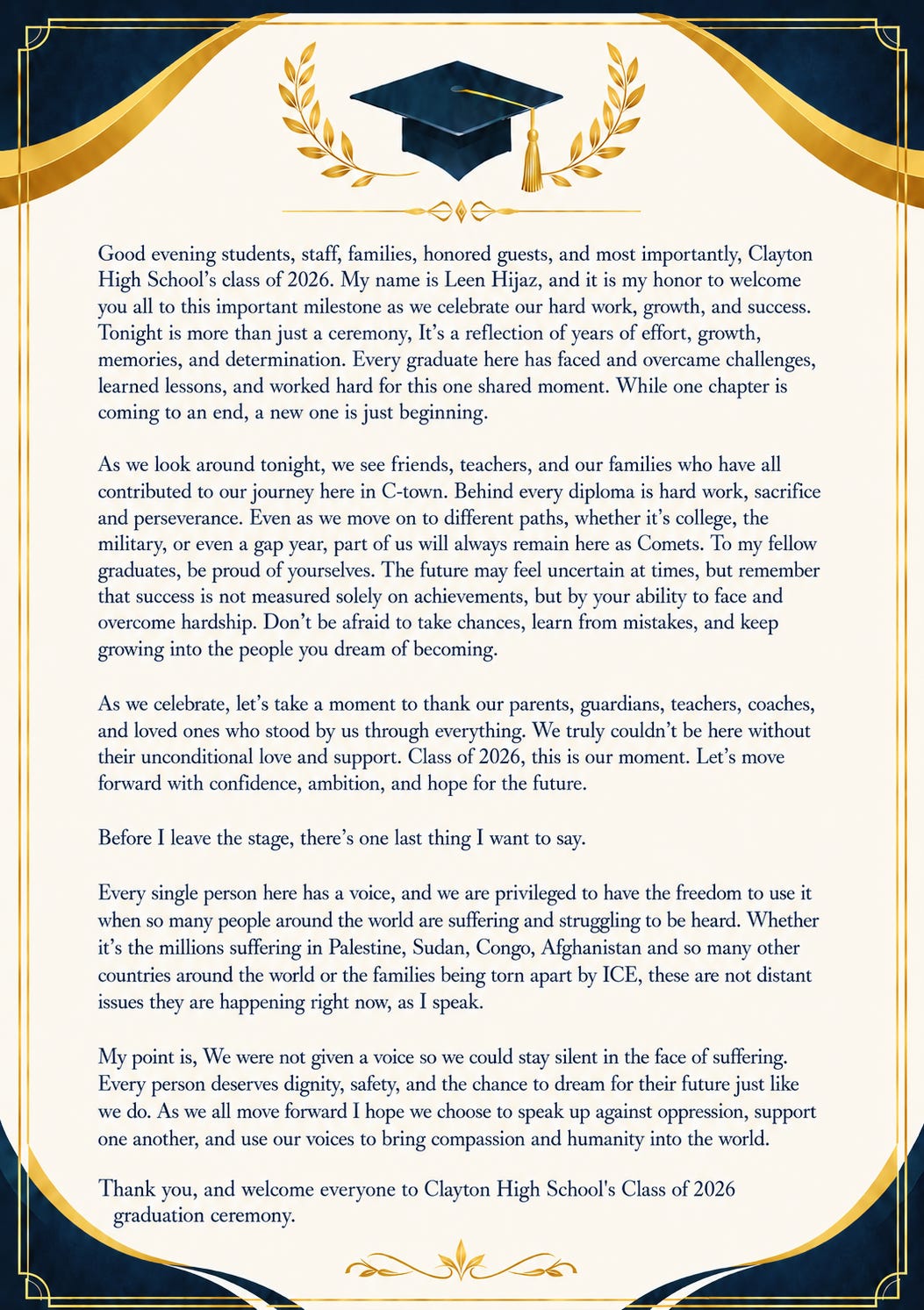
That is the speech. A welcome, a reflection, a call to care about the suffering that exists outside that football field and outside this county and outside the comfortable story Johnston County keeps trying to tell about itself.
Leen Hijaz earned that stage. She earned it with the highest GPA in the school, with a life that included Palestine, with years of watching Clayton High decide whose expression was tradition and whose was trouble. She gave the school the safe speech. Then she tried to give it the true one.
She was told to stop.
She didn’t stop in time to keep the truth from getting out.
But Leen still does not have her diploma.
Leen spoke with courage. Johnston County reacted with fear. This post is public so please share it.
Comments
Nothing yet. Say the first thing.
Sign in to join the conversation.