
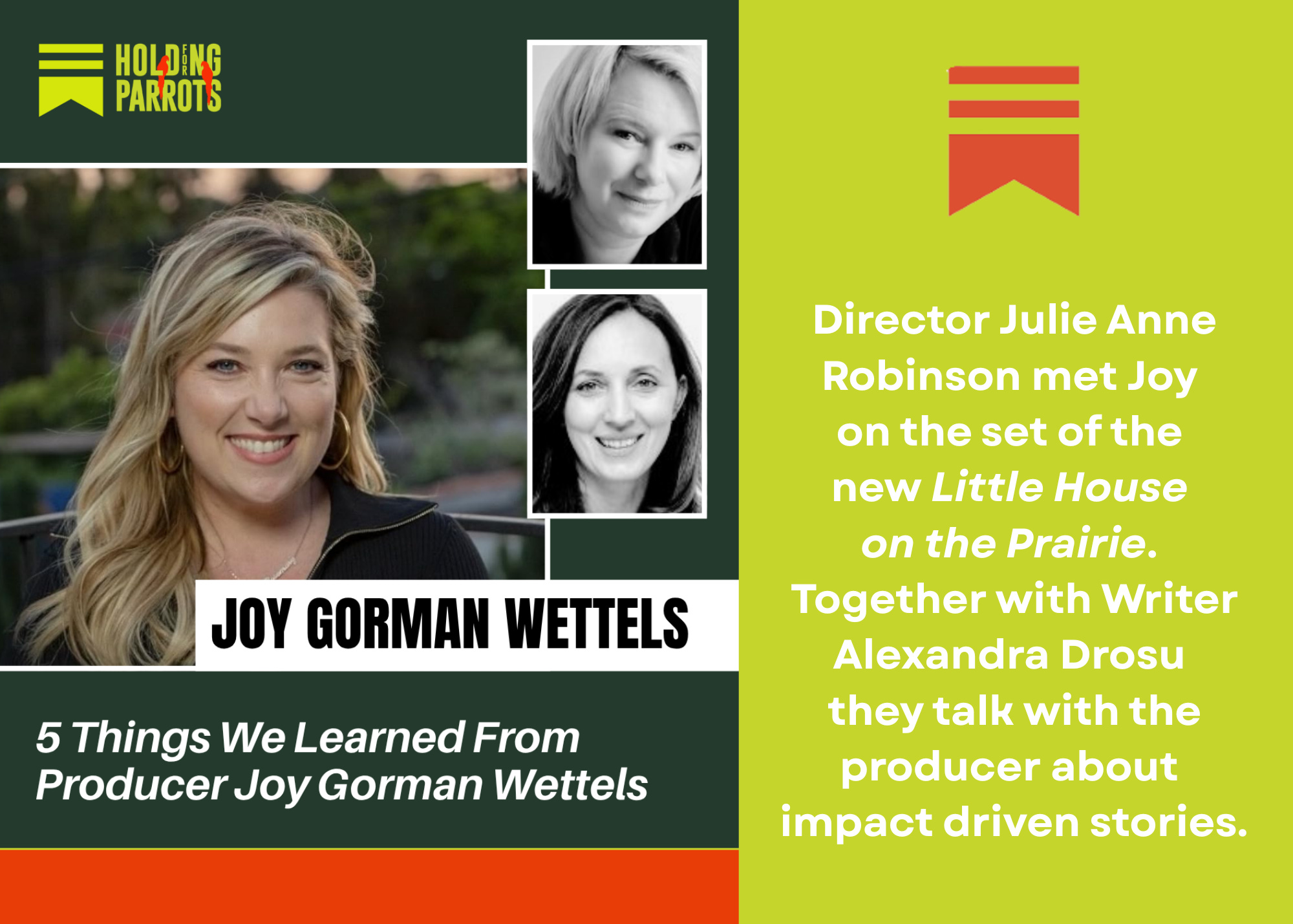
Some people make television. Producer Joy Gorman Wettels creates opportunities for conversation.
Throughout her career, she has shepherded stories that tackle difficult questions—from 13 Reasons Why to Little House on the Prairie. But what struck us most wasn’t her impressive list of credits. It was her intentional approach to every project and the thoughtful responses she brought to our questions.
Joy has a rare ability to connect storytelling with social impact in a way that inspires dialogue. “I really look for stories that heal and create connection,” she says. Through the Joy Coalition, the production company and nonprofit she founded, Joy partners with experts and advocacy organizations in the earliest stages of development to ensure stories approach material authentically and lead to meaningful conversations.
Joy and director Julie Anne Robinson first met professionally while working on the new Little House on the Prairie. During our conversation, though, it became clear they shared many similar perspectives as Joy spoke candidly about balancing motherhood with a demanding career, how to define success, and the importance of creating collaborative environments where people feel seen, heard, and empowered to do their best work.
Here are five lessons we’re still carrying with us.
During the pandemic, Joy began reading Little House on the Prairie to her then 8-year-old daughter. Families during lockdown were reconnecting, learning to bake bread and grow vegetables, and the series seemed strangely appropriate.
“Laura [Ingalls Wilder] wrote the books in the ‘30s during the depression, reminiscing about her childhood and trying to offer stories of hope and resilience to families,” says Joy. “It was very much how we were all feeling during 2020… how can we hang on to each other at this time of isolation and fear and doubt.”
While the heart of the story resonated with contemporary audiences, it also had parts that were problematic, and Joy’s daughter had strong feelings about it: “It just opened up such an important conversation.”
This dialogue became the foundation for a new approach to adapting the beloved classic. She and Trip Friendly (the steward and rights holder for Little House) saw an opportunity to explore the story through a broader historic lens that included the Osage people and how pioneers were squatting on their land. This commitment to authentic narratives requires “locking arms with experts and organizations early on in the process,” and Joy turned to Osage professor, Dr. Robert Warrior, to help navigate the conversation.
That same philosophy to explore challenging topics in a truthful way extends beyond Little House. Through the Joy Coalition, she brings experts and advocacy organizations into projects ensuring that stories don’t just entertain but that they create community impact. Entertainment can be a beautiful way to invite dialogue that people may not have otherwise, says Joy, whether tackling mental health, social justice, or family dynamics.
”The thing that I think I’m here for, and I’m driven by, is what are people not saying or not comfortable saying out in the world that we can put into a narrative that helps them talk about it,” says Joy.
Compelling ideas aren’t enough. Joy believes every project must answer two fundamental questions before she embarks on it: “I always say, ‘Why now and why me?’”
These questions help Joy get clarity on her purpose and whether the project is worth pursuing. If someone else is better suited to tell the story, she isn’t afraid to step aside. Of course meaningful work always comes with trade-offs, especially when balancing a demanding career with motherhood. “You’re constantly making sacrifices that your family or your work have to pay for when you have a child,” she says.
Those sacrifices become easier to carry when you’re deeply connected to why you are saying yes. “I think that’s why mental health stories capture my heart,” she says, “I’m like a magnet to something that has stigma and shame around it.”
“I think of my own childhood and what my struggles were,” she adds. “My mom took us to $5 standing-room-only Broadway shows, and no matter how poor we were, the arts were everything to her. I would listen to “[At the] Ballet” from A Chorus Line and harmonize with my sisters.” Watching Kramer vs. Kramer, for example, helped Joy understand her parents’ divorce. “I just think movies and art have the power to heal,” and she takes this belief into each project she pursues.
Now that her daughter is older, it’s more challenging to spend time away on set but she makes sure to be present when she is home—driving her daughter to after school activities, hosting her friends, and trying to make daily moments count. It’s not about perfection but doing your best.
“As long as you’re on the other end of the phone or the text…” she says, you’re still showing up. And, sometimes the grace we extend to everyone else is what we need to offer ourselves.
Even after building a rewarding career, Joy says that success rarely feels the way we imagine it when we are younger. We achieve one goal only to replace it with another one before we acknowledge what we’ve accomplished.
“It’s hard to feel successful when you’re ambitious because you always feel like there’s something else you’re supposed to be doing, and I think a lot of us feel that way, especially moms,” she says.
Of course, success will always stay just out of reach if you keep redefining it. So if she could talk to her younger self today, she would say: “Stop moving the goal post.” Instead of continually reaching for the next milestone allow yourself to recognize how far you’ve already come. “I think moments like this, where you’re allowed to reflect and talk to new friends about how you got here, really help you accept and see your success,” she says. It also allows you to consider what it means to you.
“I think that success is reaching people and changing hearts and minds,” says Joy. But she also believes success should feel less like another accomplishment and more like peace.
“I grew up in a loud Italian family,” says Joy of her upbringing, where family members were open and straightforward about their feelings. It taught Joy early on that being frank with someone creates a more productive environment.
Joy has seen firsthand what happens when difficult conversations are avoided. “When you ignore people, it creates so much panic and paranoia... the work isn’t good anymore,” she says. Instead of postponing difficult or uncomfortable conversations, she believes it’s important to address challenges early with kindness, transparency, and respect.
“I really try to find a kind way to be frank and tell the truth when something seems to be going wrong before it goes completely wrong,” she says. “Honest feedback is so much better and easier than being ignored,” she says because avoiding these conversations creates uncertainty, anxiety, and unnecessary self-doubt, which can impact the work.
Whether you’re leading a creative team, managing colleagues, or simply navigating everyday relationships, thoughtful honesty builds trust in a way silence never can. “What drives me is being a person who people can depend on, who can get the best work out of them, who could find them the resources they need, no matter how little the budget is, who can problem solve,” she says.
Honesty isn’t about criticism. It’s about giving people the information they need to do their best work. It’s a lesson that’s as valuable off set as it is on.
“Everybody’s an expert at something that they do,” says Joy, and the role of a producer is to recognize talent and create an environment where everyone can do their best work.
“When you get to be a producer who gets to peek in and learn what they’re an expert at... and find them what they need and fix what needs to be fixed... that’s just such a cool job,” she says. That philosophy is rooted in respect, curiosity, and trust. And she believes the strongest teams are built when people feel seen, heard, and valued for what they uniquely bring to the table.
Looking back, Joy traces this mindset to her childhood in Yonkers, New York, during the city’s landmark school desegregation efforts. As one of the few white girls on her bus route, she found herself navigating a community in transition, where children from different neighborhoods and backgrounds were suddenly learning alongside one another. “I think that experience made me a very empathic and compassionate person who really wants to know where other people are coming from and really wants to connect with someone who is different from me,” she says.
These experiences stayed with her throughout her life. She went on to study urban affairs at Barnard College and wrote her thesis on the Yonkers desegregation case, deepening an interest in representation and authenticity that continues to shape every project she produces.
“I just care a lot about representation and authenticity, and people seeing themselves in each other,” she says, and that extends to ensure the projects she works on includes a crew with a diverse range of experiences. In an industry built on creativity, Joy reminds us that the best work isn’t created by one brilliant person. It’s created by crews where everyone has the freedom to contribute what they do best, and where understanding one another’s perspective and expertise is just as important as the work itself.
No posts
Comments
Nothing yet. Say the first thing.
Sign in to join the conversation.