
A common complaint about Rowling-Galbraith’s Hallmarked Man mystery is one that its characters voice on the drive to Ironbridge for the climactic confrontation with Ian Griffiths in his home. After Strike explains to Wardle and Barclay what he believes has happened and what they will find, Wardle objects that the complexity of the crime strains credulity — and Strike agrees:
‘If that’s what happened,’ said Wardle, ‘it’s the most convoluted fucking murder I’ve ever heard of and I can’t believe he brought it off.’
‘He didn’t,’ Strike pointed out, ‘or we wouldn’t be coming for him, would we? The thing was too complicated by half. Too many moving parts. Well, that and the fact he couldn’t resist adding a sex crime into the caper. Never mix business with pleasure.’
‘I think you’re going to be lucky pinning the whole thing on that footprint,’ said Wardle. ch 120
The problem that jurors will have believing what he is convinced happened in the vault haunts Strike during his illicit interrogation of Griffiths and his mates after subduing them:
He wasn’t in such agony that he failed to noticed Griffiths’ pigeon-toed walk as they dragged him alone, a peculiarity Strike had attributed to Griffiths’ trip over his guitar the first time they’d come face to face. This small, extra confirmation of his theory was enough to make Strike determined to see the thing through himself, because he was worried that Ian Griffiths might yet get away with the murder of Tyler Powell. ‘Not proven’ was the verdict he feared. Even if the killings of Sofia Medina, Jim Todd and Todd’s mother could be pinned on Griffiths, even if the man was rightly sentenced to multiple life sentences, that wouldn’t be enough for Strike.
He wanted justice, even vengeance, for Tyler Powell: a young man who’d suffered an inordinate amount of bad luck while living, and who most certainly hadn’t deserved the fate he’d met at Griffiths’ hands. The ingenious, complicated and outlandish nature of his murder might yet prevent a jury believing it could have happened as Strike was certain it had, but Powell had become real to him lately: a little lost, as Robin had said, but brave, resourceful and determined, not the fool people might have thought him; a young man who, Strike believed, had been ‘proper good’, and whose biggest mistake had been to believe that a man who held out a helping hand was doing so out of kindness. ch 123
Ed Shardlow and Nick Jeffery have pointed out that ‘Not Proven’ was not possible as a verdict in England, only in Scotland, but Rowling seems here to be highlighting that she was well aware the story as told would be difficult not just for jurors to grasp and embrace but also for her readers. The most frequently voiced complaint about Hallmarked Man was disappointment that the two principal characters were not lovers by story’s end; close behind it was bewilderment with respect to (1) the complexity of the plot with its multiple threads and suspects overlaid the Strellacott romance, (2) the overwhelming number of characters, many with names assonant and thus easily confused with the names of other characters, and (3) the simply bizarre aspect of the murder mystery at the story’s core.
The conversations Nick Jeffery and I have had here about Hallmarked Man since its publication last September have largely been discussions of these points. Our contention has been, contrary to critics of the book who hold that the novel is by far the worst of the series, that the confusion, discomfort, even angst that readers experience in it was intentional on the author’s part which makes the discomfort in her audience a measure of her success.
We have argued, too, that Hallmarked Man is necessarily crowded and complex because it is the introduction to the last three books of the series, the capstone trilogy on top of the seven book ring that closed with Running Grave. Rowling-Galbraith is obliged in this book simultaneously to introduce all the characters and story-lines that will play out in the final two books, including the clues to the Big Twists in the coming books, while obscuring those pointers in a flood of information so the solution is anything but obvious. She has trained her readers to think of individual novels as largely stand-alone pieces with respect to the murder mystery whose characters will not appear except in the briefest of cameos later on; Hallmarked Man, however, seems to break with that convention and act as the opening act of a three act drama.
And that “convoluted fucking murder” Wardle couldn’t get his head around and readers struggled to understand as well? My argument has been that Tyler Powell’s thoroughly mutilated body with its three-barred cross hallmark cut into the back of this “proper good” man had to be read allegorically to be grasped; all signs of Tyler’s individual existence — his hands, eyes, ears, teeth, genitals, feet — had been cut from him leaving only his crucifixion, his selfless sacrificial death, as his identity. The underground silver vault in which he is laid is his tomb and grave, one he shares metaphorically with the pregnant and longsuffering woman he was working to save buried in a like-vault of cement beneath the Griffiths house in Ironbridge. I suspect that the Tyler-Jolanda deaths are best read as Shakespearean marriages a la Romeo & Juliet and Antony & Cleopatra in which Soul and Spirit are entwined and the world transcended in a shared demise. As Strike & Ellacott are a like pair in psychomachian allegory, this death may be a strong pointer to the finish of the series.
That interpretation of the murder scene and its complexity combines three tools from Rowling’s Shed, namely, Christian symbolism, Psychomachia, and Literary alchemy. An alternative and complementary reading of the bizarre murder in the Ramsay vault with its masonic touches leans on a different Shed tool, Rowling-Galbraith’s love of embedded texts, her stories inside of stories signature, not to mention her love of literary illusion.
I found this reading on the Reddit Cormoran Strike page, r/Cormoran Strike, moderated by Pelican_Girl, written by Top-Requirements670. I reached out to the author through Katya Slonenko to discuss this idea but Top-Requirement was not interested in that.
Without her participation, then, I will re-present her reddit post here with links to the original, summarize it briefly, review her argument with relevant illustrations, and add three points of evidence that make it more compelling and credible.
In a nutshell? Top-Requirement670 argues that Ian Griffiths, uber Steely Dan fan, killed Tyler Powell as he did to recreate the cover of that American band’s best selling album, ‘Aja.’ First the reddit post, all links and highlighting as in the original:
r/cormoran_strike•8mo ago
Griffith is obsessed with Steely Dan.
‘Chloe’s’ whatsapp to Robin (which is Griffith in disguise). ‘Dad thinks anyone who likes Steely Dan and wants to learn the guitar must be a good guy, but Tyler isn’t’
Also when Griffith first appears in ch. 66, ‘He was wearing a Steely Dan T-shirt and holding an acoustic guitar by the neck’ like a weapon and hurrying towards Robin & Strike.
Griffith also used the alias ‘Skunk Baxter. A guitarist for Steely Dan.
And what nails Griffith as guilty: ‘The number was stored under ‘LUGS NEW’. Strike pressed it. Somewhere in another room, they heard the ringtone: Steely Dan’s ‘Do It Again’. In the mornin’ you go gunnin’...
There’s also references to the Dan’s song ‘Dirty Work’ and ‘Kid Charlemagne’.
But none of these Steely Dan references refer to, Aja (take a look at cover) their most critically acclaimed album that’s ranked 145 on Rolling Stone Magazine’s 500 Greatest Albums of All Time.
The cover of Aja is dark and mysterious yet iconic. There appears to be a long red and white striped ribbon covering a body. It’s not exactly clear what it is. The head of the body is surrounded by black, looks like it has blood dripping from the eyes. The body on the cover is surrounded in darkness.
In Ch. 47 when Kim shows Strike the pictures of the body in the vault, the body originally left in darkness, is In ‘The masonic sash--black and red, with gold embroidery that shone in the flash of the camera--lay across a chest that was muscled and hairless...’ And the eyes of the body had been removed.
Perhaps this wasn’t a convoluted mess of a murder, but rather a ritual killing inspired by Steely Dan’s most famous album and album cover, Aja. Griffith could have used Masonic misdirection not only to throw off investigators, but also as a way to complete a ritual to his musical obsession.
‘Double helix in the sky tonight
Throw out the hardware
Let’s do it right
Aja’Were these lyrics from the title-song Aja, the inspiration behind the crime? They include references to DNA and throwing out hardware. Griffith removed hands and eyes to make DNA testing difficult. He threw out the ‘hardware’ the Masonic silver, behind a wall under the sink.
The murder in the vault being a recreation of the cover of Steely Dan’s Aja, also would be callback to Career of Evil and the ritualistic murder involving lyrics of Blue Oyster Cult. In The Hallmarked Man, the serial killer, Steely Ian, decorates the corpse in a way that points towards the Masons, while obfuscating what became ‘part of his ritual’ to quote Laing in Career of Evil.
One of the few comments in this post’s thread notes that cutting off pieces of a body does not effect in any way the ease or difficulty of DNA testing. Having noted that, let’s review the Steely Dan allusions in Strike 8 that Top-Requirement670 refers to.
First meeting with Ian Griffiths:
‘Oi!’
The detectives turned. A short and extremely belligerent-looking man with longish dark hair had emerged from the back door of the house opposite. He was wearing a Steely Dan T-shirt and holding an acoustic guitar by the neck and as he hurried towards them, he did precisely what Strike had been trying to avoid for the last fifteen minutes: slipped on his back lawn and tripped. However, he recovered his balance with the aid of his guitar and, hobbling and slightly pigeon-toed, he advanced on them, shouting:
‘What d’you want? Bloody press, is it?’ ch 66
Ian Griffiths texting Robin as Chloe Griffiths:
Hello this is Chloe Griffiths, Ian Griffiths’ daughter. Dad’s asked me to get in touch with you as like a character witness for Tyler Powell. I wasn’t going to but my boyfriend thinks I should tell you the truth, even if Dad doesn’t want to hear it.
I know Dad’s told you Tyler definitely didn’t have anything to do with that car crash and I’m not saying he did, but I know for a fact Tyler isn’t the nice sweet guy Dad thinks he is. Dad thinks anyone who likes Steely Dan and wants to learn the guitar must be a good guy, but Tyler isn’t.
He gets really pushy with girls when he’s drunk, he’s done it to lots of friends of mine. Dad feels sorry for him, he thinks Tyler’s desperate for love or something, because his parents aren’t very nice to him, so he thinks it’s all harmless but it isn’t. Anne-Marie only went out with Tyler a couple of times, and he started talking about them getting married. Dad thought that just showed Tyler wants a proper family of his own, but Anne-Marie was really freaked out by him being so intense and possessive when they’d only dated twice and Tyler was really angry she dumped him and was talking all kinds of shit about her. ch 71
The music Ian Griffiths plays on entering his house the night Strike is in his basement:
Strike gestured furiously at the girl to be quiet as he crept back towards the opening in the ceiling, rapidly calculating odds. He didn’t doubt Wardle or Barclay had tried to warn him that Griffiths and friends were on their way home, and it wasn’t their fault he was currently in a concrete chamber underground without phone reception, but that didn’t alter the undoubtedly perilous position he and the girl were now in. His glib response to Barclay’s ‘an’ if Ah hear ye yellin’ “help”?’ was no longer so funny; possibly his colleagues were waiting for a sign or a shout that he required assistance, but as making any noise right now would expose his presence to what sounded like four or five men, one of whom he knew to be a serial killer, Strike chose instead to move into the shadows behind the ladder.
Loud music began to play from the sitting room: Steely Dan.
While the music played… ch 122, p 851
Strike explains to Griffiths how the detectives figured out he was the murderer, his choice of online aliases:
‘I don’t—’
‘Skunk Baxter. Guitarist for Steely Dan.’
‘These are just fucking—’ ch 123
Strike confirms the Steely Dan-Ian Griffiths connection/obsession by dialing the phone number that was supposed to be Tyler Powell’s:
The number was stored under ‘LUGS NEW’. Strike pressed it.
Somewhere in another room, they heard the ringtone: Steely Dan’s ‘Do It Again’.
In the mornin’ you go gunnin’… ch 123
Top-Requirement670 asserts that there are references in Hallmarked Man to two other Steely Dan songs, ‘Dirty Work’ and ‘Kid Charlemagne.’ I found one to ‘Dirty Work:’
‘My whole business is asking questions that wouldn’t usually be any of my business.’
‘“Dirty work, but someone’s got to do it”?’
‘Wouldn’t claim I’ve got to,’ said Strike. ‘Just the line of work that best suits my abilities.’ ch 36
There are three previous “dirty work” references in Cormoran Strike and four in Harry Potter, so I’m skeptical that this is a Steely Dan song reference. Kid Charlemagne? There are no ‘Charlemagne’ references in Hallmarked Man, though there are 63 to ‘kid’ in a book crowded with child and baby discussions. Check out its Song Lyrics to see if that was what Top-Requirement670 was referring to; I didn’t see anything obvious. [Ed Shardlow notes in the comments that the lyric given on p 851 is from ‘Kid Charlemagne.’]
My preliminary conclusion after just checking up on the Steely Dan references in Hallmarked Man? Rowling-Galbraith repeatedly marked Ian Griffiths as a man as obsessed with Steely Dan as Leda Strike was with Blue Oyster Cult. The argument that the murder was staged even if only in part to resemble the cover of this band’s best selling album was credible. Was there anything else about Steely Dan that would make them credible as the favorites of a serial killer?
I knew nothing about Steely Dan before doing some simple internet searches after reading the relevant Wikipedia pages. The best source of information was an archived fan site’s Steely Dan FAQ page from 2011, from which the excerpts below are taken.
How about the two Steely Dan principals, Donald Fagen and Walter Becker, being tagged in their early days as murderous crazies?
Fagen graduates Bard in 1969 with an English degree. Becker also leaves Annandale. The two of them move to Brooklyn, New York and decide to peddle their songs at the famous Brill Building in Manhattan. They don’t meet with much success, but they make an important early connection with Kenny Vance of Jay and the Americans. Vance helps them record some demos of their early material and gets them some odd jobs including doing the soundtrack for the low-budget Richard Pryor film “You Gotta Walk It Like You Talk It.” Vance also gets Becker and Fagen gigs as back-up musicians on Jay and the Americans’ 1970-71 tour. Jay Black disaffectionately labels Donald and Walter as “Starkweather and Manson.”
Charles Starkweather was a serial killer and Charles Manson was the leader of a murderous cult. Was Rowling-Galbraith hinting at Ian Griffith’s desire to emulate the musicians whose music he idolized? Jeff Whittaker was a fan of Manson’s music as we learned in Career of Evil, ch 10:
Thrown out of his most recent band, Whittaker continued to dream of stardom. He knew three guitar chords and covered every bit of paper not hidden from him with lyrics that drew heavily on the Satanic Bible, which Strike remembered lying, its black cover emblazoned with a pentagram and goat-head combined, on the mattress where Leda and Whittaker slept. Whittaker had an extensive knowledge of the life and career of the American cult leader Charles Manson. The scratchy sound of an old vinyl copy of Manson’s album LIE: The Love and Terror Cult formed the soundtrack to Strike’s GCSE year.
Back to the FAQ page and the history of Steely Dan. Enter Skunk Baxter:
With Fagen on keyboards and vocals and Becker on bass, they decide to sign up guitarist Jeff "Skunk" Baxter and drummer Jim Hodder. With the core band recruited, Donald and Walter need a name for their group. Since both of them were avid readers of 1950's "Beat" literature, they decided to name the band "Steely Dan" after a dildo in William Burroughs' "Naked Lunch."
The band’s name was taken from a Beatnik novel’s sex toy. Is Rowling-Galbraith playing with her own texts being loaded with inter- and intra-textual references, the books-within-her-books? The name ‘Steely Dan’ itself was just such a reference to an obscure work but one which is important for understanding Fagen and Baxter’s beatnik lyrics and perspective on sexual relations.
Top-Requirement670 reports that ‘Aja’ was Steely Dan’s best selling album. It was more than that:
ABC Records, consistent in their pressure for hit singles and a tour, drive Becker and Fagen back into the studio. The end result, "Aja", is released in September 1977 and features their longest and jazziest compositions to date. Fagen and Becker drafted even more giants of the jazz world including Joe Sample, Wayne Shorter and Tom Scott to execute their increasingly complex songs. "Aja" becomes their first platinum album and reaches #3 on the album chart, trailing only mega-sellers Fleetwood Mac's "Rumors" and Billy Joel's "The Stranger." "Peg" hits #11, "Deacon Blues" hits #19 and "Josie" hits #26 on the singles charts.
‘Rumours’ is #8 on the list of All Time Best Selling Albums and ‘The Stranger’ won the Grammy for Album of the Year over Rumours. There was no shame in being #3 in that company. ‘Aja’ is a memorable album, far and away the most famous and successful of Steely Dan’s recordings. The idea that Rowling-Galbraith would have a murderer obsessed with the duo’s music concoct a crime scene reminiscent of the ‘Aja’ cover is prima facie credible.
If you’re like me, you know little about the album or its cover. Here are the summary facts about ‘Aja’ The Album via Wikipedia:
Aja (pronounced /ˈeɪʒə/, like Asia) is the sixth studio album by the American rock band Steely Dan, released on September 23, 1977, by ABC Records. For the album, band leaders Walter Becker and Donald Fagen pushed Steely Dan further into experimenting with different combinations of session players, enlisting the services of nearly 40 musicians, while pursuing longer, more sophisticated compositions and arrangements. Like all the band’s previous albums, it was produced by Gary Katz.
The album peaked at number three on the Billboard Top LPs & Tape chart, and number five on the UK Albums Chart, ultimately becoming Steely Dan’s most commercially successful release. It spawned the hit singles “Peg“, “Deacon Blues“, and “Josie“. At the 20th Annual Grammy Awards in 1978, Aja won Best Engineered Recording – Non-Classical, and was nominated for Album of the Year and Best Pop Performance by a Duo or Group with Vocals. It has appeared on many retrospective “greatest albums” lists, with critics and audiophiles applauding the album’s high production quality. ….
In 2000, Aja was voted number 118 in the third edition of Colin Larkin's book All Time Top 1000 Albums, in which Larkin noted its "brand of jazz-influenced white soul". In 2003, Aja was inducted into the Grammy Hall of Fame and ranked 145th on Rolling Stone's list of the "500 Greatest Albums of All Time"; it maintained the same spot on the 2012 update of the list, and rose to 63rd on the 2020 version. In 2006, Aja was included in the book 1001 Albums You Must Hear Before You Die. In 2010, it was recognized by the Library of Congress as "culturally, historically, or aesthetically significant" and selected for preservation in the National Recording Registry
And the cover? The ‘Aja’ Album Cover Essentials (r/SteelyDan)
The Aja album cover features a photograph of Japanese model Sayoko Yamaguchi, taken by Hideki Fujii, with layout design by Patricia Mitsui and Geoff Westen.
I confess that I was delighted that Sayoko Yamaguchi’s Wikipedia page had a picture of her, because the album cover is not very helpful in getting a mental picture of her:

Yamaguchi broke into the international modeling industry in the 1970s. She was one of the first Asian models to be featured in the world’s top fashion shows and magazines. She made her debut in Paris in 1972, and went on to work in New York City and other international cities.
In 1977, Newsweek named her one of the world’s top six fashion models. Also that year, she was featured on the cover of Steely Dan‘s Aja album, photographed by Hideki Fujii.
Which brings us at last to the Aja album cover:
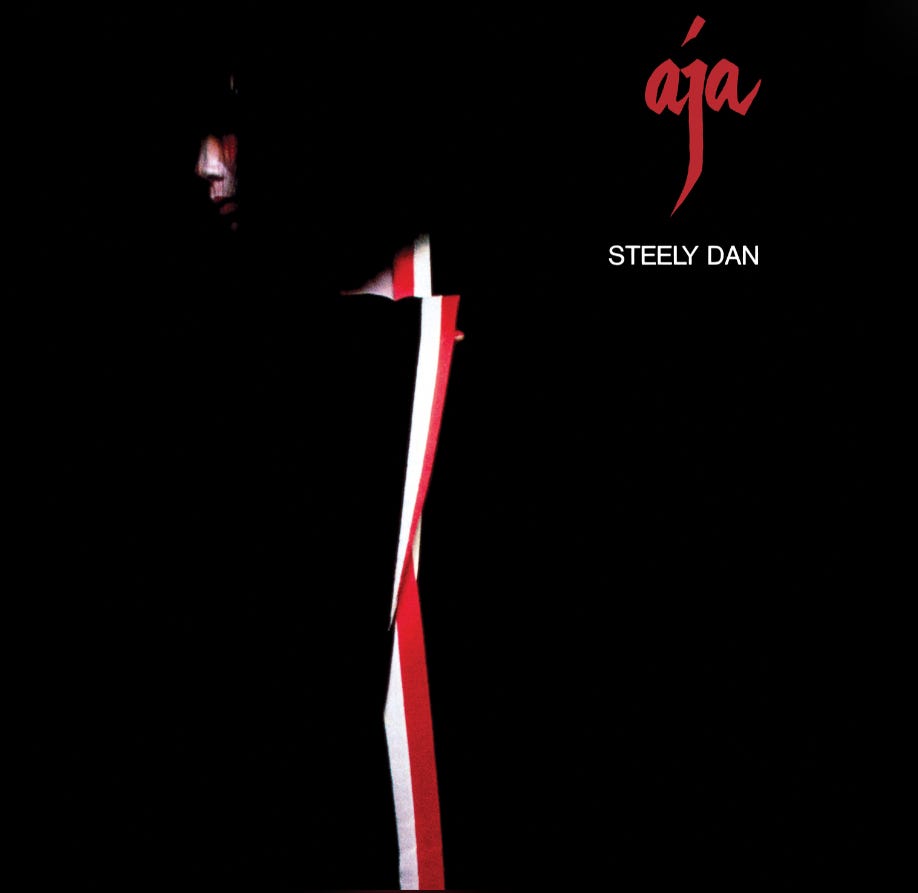
I cannot make anything of that cover, frankly. I was glad to find out that this is pretty much the consensus of all but die-hard Steely Dan fans. Here is a typical query to be found online, from an Audiogon Forum 2024 Thread: The ‘Aja’ Album Cover:
What is that ribbon supposed to be? It looks like a piece of the US flag. Is that what it's supposed to be or something else? I never understood it. I see the profile of the face of the Japanese model, though….
I see the lady’s partial face profile, and what looks like a ribbon or something. I can’t make it out. I wish I could see the partially open robe, but I don’t. I just don’t get what those "lines" are. Cloth? flag? Ribbon? I don't see blue anywhere, just a whole lotta black.
The helpful Dan-iacs on the thread provided links to a FaceBook page with Out Takes from the Aja Cover Photo Shoot: (see also this explanation at r/SteelyDan)
See the FaceBook page with the ‘Aja’ Cover Shoot Out Takes
The red and white are part of the kimono/happi coat/robe the model is wearing. It extends along the front were it opens. It also looks like it trims the end of the sleeve.
Her face BTW is almost full front but veiled.
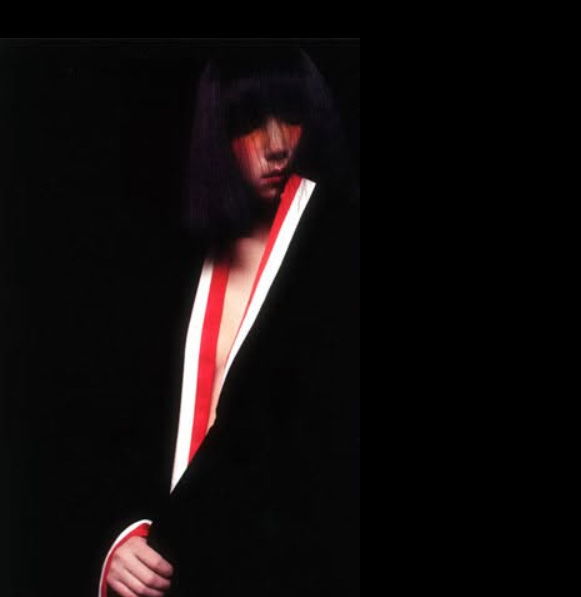
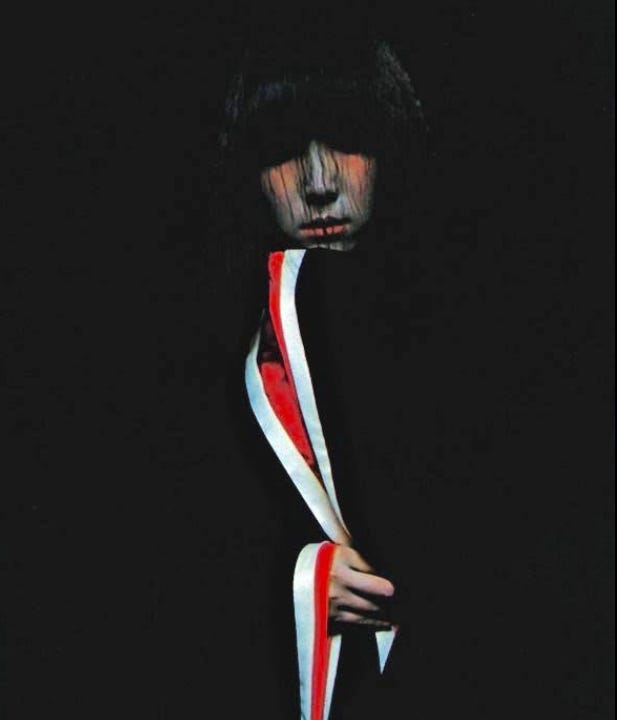
Steely Dave at r/Steely Dan about another ‘Aja’ Cover Shot
There’s also a Japanese promo poster for Aja that uses another shot from this same shoot:
https://dygtyjqp7pi0m.cloudfront.net/i/5409/8463847_1.jpg?v=8CB5C31B34F7AD0
I have one of these and they’re really stunning, printed on really heavy stock with a nice glossy coating, unlike the thin paper the US posters (which just use the album art, with thumbnails for the back catalog at the bottom).
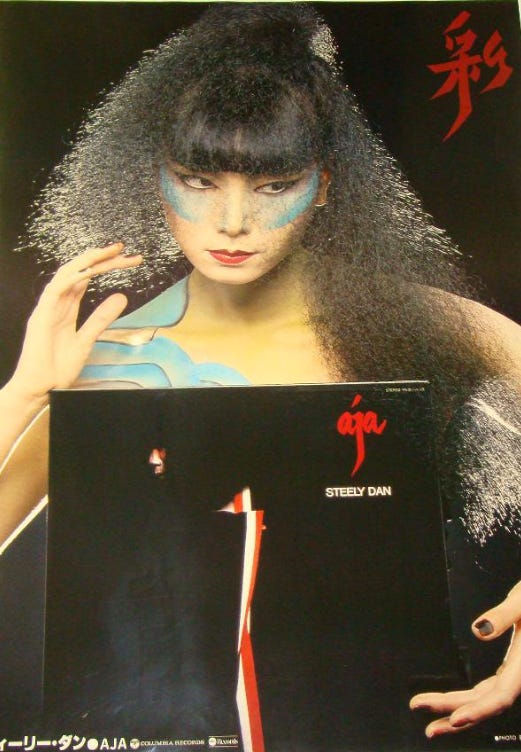
Top-Requirement670 seems to be arguing less from the Aja album cover that was published than from the ghoulish outtakes above, especially the one with ink or blood flowing from the model’s eyes. Combined with the evidence of the ‘Aja’ song lyrics about “DNA” and “Hardware” and the connections that can be made with Career of Evil, there might be something to this idea. Add in the Starkweather/Ransom notes and the Steely Dan name origin in Naked Lunch and maybe it’s a great find.
It certainly works in terms of Rowling-Galbraith’s text within the text Shed tool. If Ian Griffiths, the writer of the false narrative that the Strike-Ellacott team must decipher in Hallmarked Man, then he is in a way the real author’s embedded image in the story; in terms of syuzhet-fabula, he is the writer of the fiction that Rowling’s detectives have to unravel the way that she is the writer of the mystery her readers are struggling to understand. How appropriate, then, for her to make him ‘write’ as she does, with a murder performed to mimic his favorite band’s best-selling album’s cover…
I love that idea, but I acknowledge it’s still a big stretch. I decided to share it with you, nonetheless, both to note the most neglected of Rowling-Galbraith’s signature Shed tools and because of one more wild association between the Aja album cover and Hallmarked Man.
Jake Malooley on his ‘Expanding Dan’ Substack page shared this about Patti Matsui: The woman who shaped the look of Aja:
Without Patti Mitsui, the Aja we know and love would not exist.
Oz Studios, the company she ran with Geoff Westen (former guitarist for California garage-psych outfit the Other Half), was tapped to art direct the cover of Steely Dan’s 1977 jazz-rock tour de force. Next to photographer Hideki Fujii’s enigmatic shot of Japanese supermodel Sayoko Yamaguchi in a kimono, Mitsui added a literal masterstroke: the striking red calligraphic letters of the album’s title.
That’s right. The team that put together the Aja cover was Oz Studios. Ian Griffiths’ alias for his serial killer dealings was music producer Calvin Osgood and, unlike the real Osgood, he went by ‘Oz.’
It’s still a stretch, of course, but the fun quotient went way up for me. I hope you feel the same way. Regardless, hat’s off once again to the Redditors at r/CormoranStrike, especially to Pelican_Girl for her moderation there and to Top-Requirement670 for following the Steely Dan trail of evidence to the Aja cover and the body in the vault.
No posts
Comments
Nothing yet. Say the first thing.
Sign in to join the conversation.