
This is the sixth in a series of posts for Hogwarts Professor Paid Subscribers that introduces the Perennialist interpretation of fiction via a book by Ray Livingston titled The Traditional Theory of Literature (University of Minnesota Press, 1962). I have sent out five chapters thus far in single posts — Prologue, Man, Society, and Art, The Creative Process, The Work of Art, Part One and The Work of Art, Part Two — and we have only Chapter 6: Judgement and Criticism and the Conclusion to send out after the chapter below, The Function of Works of Art.
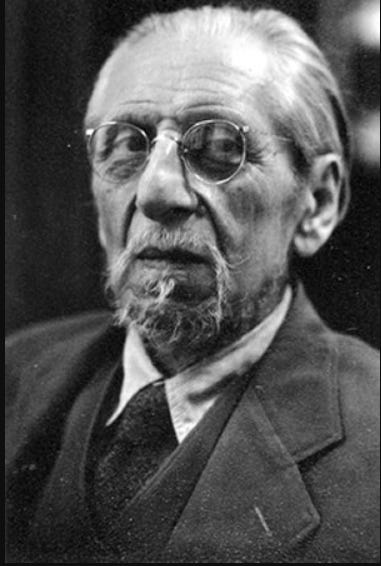
(A. K. Coomaraswamy, Credit: Dorothy Norman)
Livingston in this chapter explains the Perennialist ideas of Ananda Kentish Coomaraswamy (AKC) about the ends or purpose of art in general and literature specifically. If you’re a serious reader of J. K. Rowling and Robert Galbraith, all effort invested in understanding AKC’s traditional wisdom will be richly rewarded.
I’m confident in saying that about AKC and this chapter of Traditional Theory of Literature because in it Livingston lays out the anagogical or spiritual dimension of story, the roots of literature in initiatory rites, the requirement that narrative simultaneously turn the soul right side up (“a rectification of the personality”) and shock it out of its mundane and materialist mind-set, even separating soul from body cathartically, how the proper subject of fiction is myth, which is to say, the life of a God or hero, and, wait for it, why a “thunderbolt” is such a great choice for an orphan’s facial scar.
AKC per Livingston explains that the “end of art is gnosis… the immediate, intuitive, direct knowledge of reality or God;” all of Rowling’s Shed tools as well as her plot points and themes in the end are about her readers’ cathartic transformation and ego-transcendence within the imaginative, hermetic crucible of her novels.
I’ve been reading this week that ‘The End of Reading is Here,’ that the great majority of our fellow citizens do not read long-form fiction, and those who do are incapable of understanding what they’ve read beyond the surface story and the in-your-face moral message of Good Guys and Bad Guys. Sadly, there’s more than sufficient evidence for this contention than there is compelling reason to think it’s over-wrought.
The good news or Silver Lining? Everyone reading this is a Serious Reader who is not only capable of reading 800 page novels in a seven or ten book series but who also is excited about understanding the mythic backdrop, traditional symbolism, alchemical colouration, Big Twist misdirection-shock, chiastic structure, and kathartic soul allegories (psychomachia) that make such stories a life and mind-changing experience.

If you’re a member of this Serious Reader Remnant tribe in a Postliterate Age (and being a Hogwarts Professor subscriber is a marker that you are), reading the Perennialist explanation of why homo sapiens sapiens is less the “rational animal” than the “story-telling animal” will reveal in depth why your oddball hobby is an exteriorization of your species-being, as Marx night put it, of you’re being real-ly human.
Here are five of my favorite paragraphs from ‘The Function of Works of Art’ for non-paying subscribers to enjoy. Paid Subscribers will find after the paywall, in addition to the argument-in-full, all the links to AKC’s and Livingston’s references to hard-to-find publications. Enjoy!
The end of art is gnosis. And if the work of art is to serve effectively in revealing knowledge, “the mental and effective barriers behind which the natural manifestation of the spirit is concealed” must be broken down, temporarily at least. There must be, as we have seen, a rectification of the personality. This transformation of one’s nature comes from a purification or purgation of those elements that would interfere with the intellectual identification with the idea of the work….
If one genuinely and profoundly responds to the thesis of a great work of art – which deals perennially with the subject of God, “whose only idiosyncrasy is being” – he identifies himself with the subject of the work and ceases to be aware of himself as an individual. Each such experience reinforces a man in his realization of who he is, it tends to separate soul from the body – that is to say, one’s consciousness is raised from concern with the body to a higher level….
According to the perennial Tradition, the perfection of man is in knowledge – immediate, intuitive, direct knowledge of reality or God. Works of art are among the best means developed by man for imparting principial knowledge. As we have seen, works of art are reminders, they are supports of contemplation. Their beauty, their power of shock and purification, their capacity for ordering the disparate elements of our natures – all these are qualities that make them very effective with persons with the innate ability or with the training to employ them as they are intended by the Traditional artist….
The imitation of anything and everything is despicable; it is the actions of God and heroes, not the artist’s feelings or the natures of men who are all too human like himself, that are the legitimate theme of art.” Even if one is unable to achieve that gnosis which is the highest end of the aesthetic experience, he will be powerfully prompted to emulate the actions of the gods and heroes he has identified himself with as he has read, seen a play, or taken part in a rite….
Although few even among those consciously aspiring to their perfection as men may achieve the supreme realization, much less experience it as a direct result of reading a poem or viewing a play, many men can advance in the perennial pilgrimage with the aid of objects of beauty designed to satisfy mediate ends and gradually to perfect them. To study deeply the Divine Comedy, to view Hamlet in the theater, to read Blake’s “Tyger,” to see a bronze statue of a dancing Shiva – these and the like may not of themselves be the occasion for that “lightning-flash” of gnosis, but they can and do give men profound insights into the true nature of things, the more so if the rest of a man’s life is generally in accord with the informing spirit of these and similar works. As reminders and supports of contemplation they not only afford marvelous intuitions but also prepare men for those other contemplative experiences with which we are graced, especially if we still retain the sacred view of the cosmos. While works of art in themselves will not save the world or even many souls in any age, much less in our own, they will nonetheless form one important component in the economy of the Traditional existence, which is in all ways ordered to the perfection of persons.
Comments
Nothing yet. Say the first thing.
Sign in to join the conversation.