

The patent was granted on August 11, 1942, under the names George Antheil and Hedy Kiesler Markey. The second name was a married name, and the woman behind it was better known to the public as Hedy Lamarr, who at that moment was among the most photographed people alive and under contract to MGM, which had spent years selling her as the most beautiful woman in the world.
Patent 2,292,387 was titled Secret Communication System. It solved a specific wartime problem. A radio-guided torpedo can be steered onto a target, but the guidance signal sits on a single frequency, and anything on a single frequency can be jammed. The Germans were doing exactly that. Lamarr's answer was to stop using one frequency. If the transmitter and the receiver both hopped between many frequencies in a rapid pattern that only they knew, there would be nothing steady for an enemy to find or block.
The mechanism she and Antheil designed to keep the two ends synchronised came from an unlikely place. Antheil was an avant-garde composer whose most notorious work, Ballet Mécanique, required multiple player pianos to run in step with one another. He knew how to make separate machines follow an identical punched roll. Their patent used the same principle, and the number of frequencies they specified was eighty-eight, the number of keys on a piano.
The Navy was not interested. Lamarr was told, in effect, that she would be more useful selling war bonds than redesigning torpedo guidance, and she went and did that instead, appearing at rallies and reportedly raising millions of dollars in a single evening. The patent sat unused. It expired in 1959, still unused, and neither inventor ever received a payment connected to it.
The idea did not stay buried. Frequency hopping and the broader family of spread-spectrum techniques became foundational to secure military communication and then, decades later, to the ordinary equipment of civilian life. The general approach underlies Bluetooth, contributes to wifi, and sits inside the mobile networks almost everyone now carries in a pocket. By the time any of that was worth money, the patent had long expired and Lamarr was an ageing former star with a complicated private life and no claim on any of it.
Recognition came late and in the usual form, which is to say honours rather than money. In 1997 she received a pioneer award from the Electronic Frontier Foundation. She was inducted into the National Inventors Hall of Fame in 2014, fourteen years after her death.
The obvious question is how a Hollywood actress came to understand torpedo guidance at all, and the answer is not Hollywood. She had learned it years earlier, in Austria, sitting silently through dinners she was not supposed to understand, in a marriage she had to plan an escape from.
1984: "We Begin Bombing in Five Minutes"
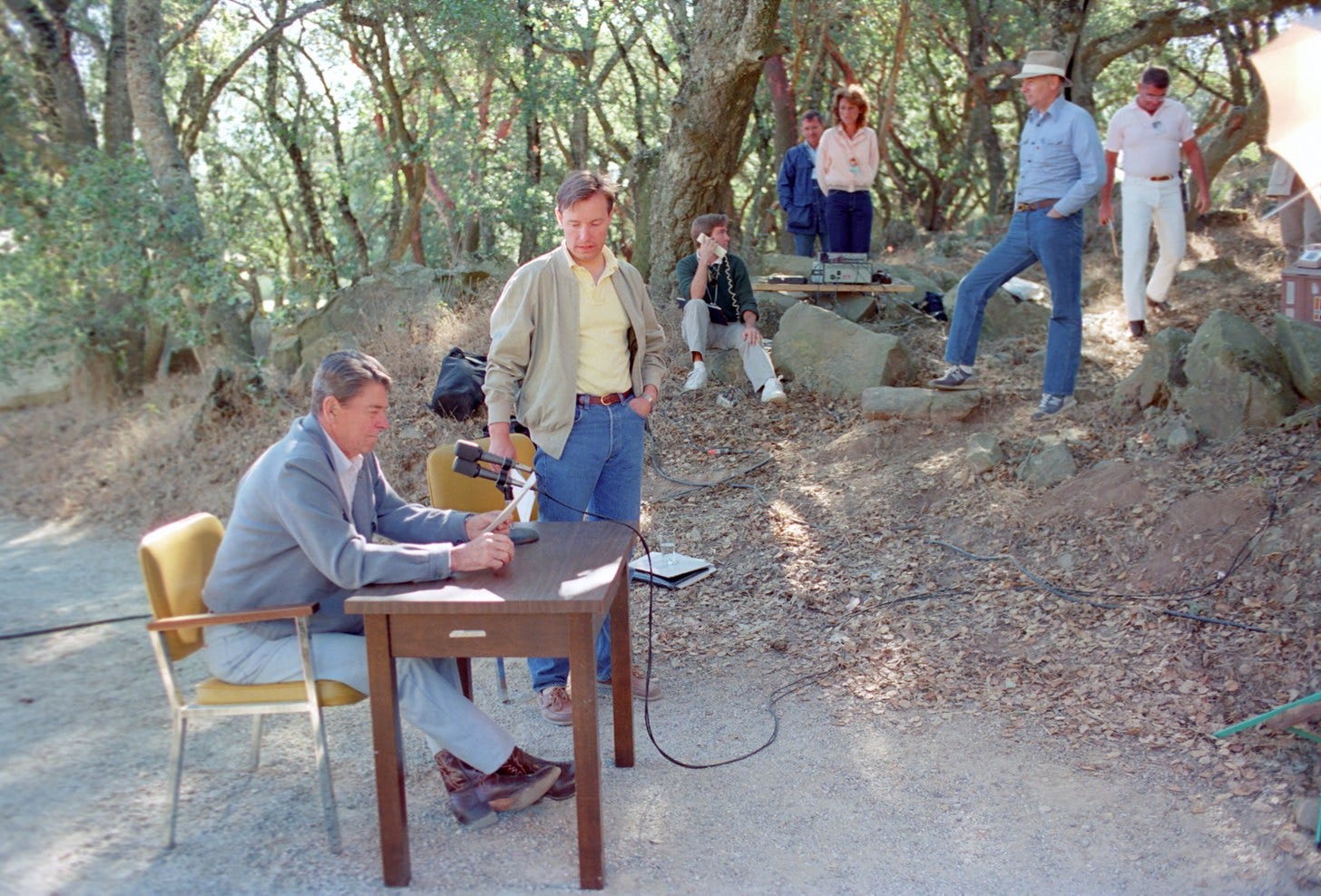
Ronald Reagan spent most weekends at Rancho del Cielo, the ranch above Santa Barbara where he recorded his weekly radio address. On August 11 the engineers needed a voice level, and instead of counting to ten the President said this: "My fellow Americans, I'm pleased to tell you today that I've signed legislation that will outlaw Russia forever. We begin bombing in five minutes." The real broadcast that followed was about fiscal management. The joke was never aired and by the conventions of the day should never have left the room, but it leaked within a day and ran on front pages worldwide. In Washington the argument was about whether it was funny. In Moscow it was not read as a joke at all: TASS issued a formal condemnation and treated the remark as evidence of what the American president thought when he believed no one was listening. Soviet sensitivity had a specific cause, since a NATO exercise nine months earlier had convinced part of the leadership that a genuine first strike was being rehearsed. Reagan never apologised, and in November he carried forty-nine of fifty states.
1973: A Back-to-School Party Invents Hip Hop

Cindy Campbell wanted clothes for the school year, so she rented the recreation room at 1520 Sedgwick Avenue in the West Bronx and charged twenty-five cents for girls and fifty for boys. Her eighteen year old brother Clive ran the music. Watching the floor, he noticed the crowd only came fully alive during the break, the few seconds where the singing drops out and the drums are exposed, and on most records that lasted about fifteen seconds. So he bought two copies of the same record, put one on each turntable, and cut from the end of the break on one to the start of the break on the other, back and forth, until fifteen seconds ran for minutes. The dancers who lived for that stretch were called break boys and break girls, shortened to b-boys, and they invented a vocabulary of moves to fill the time he was giving them. Clive was known on the block as Kool Herc. The technique he worked out that night to keep his sister's fundraiser from dying is the structural basis of a global music industry.
1492: A Spanish Cardinal Buys the Papacy
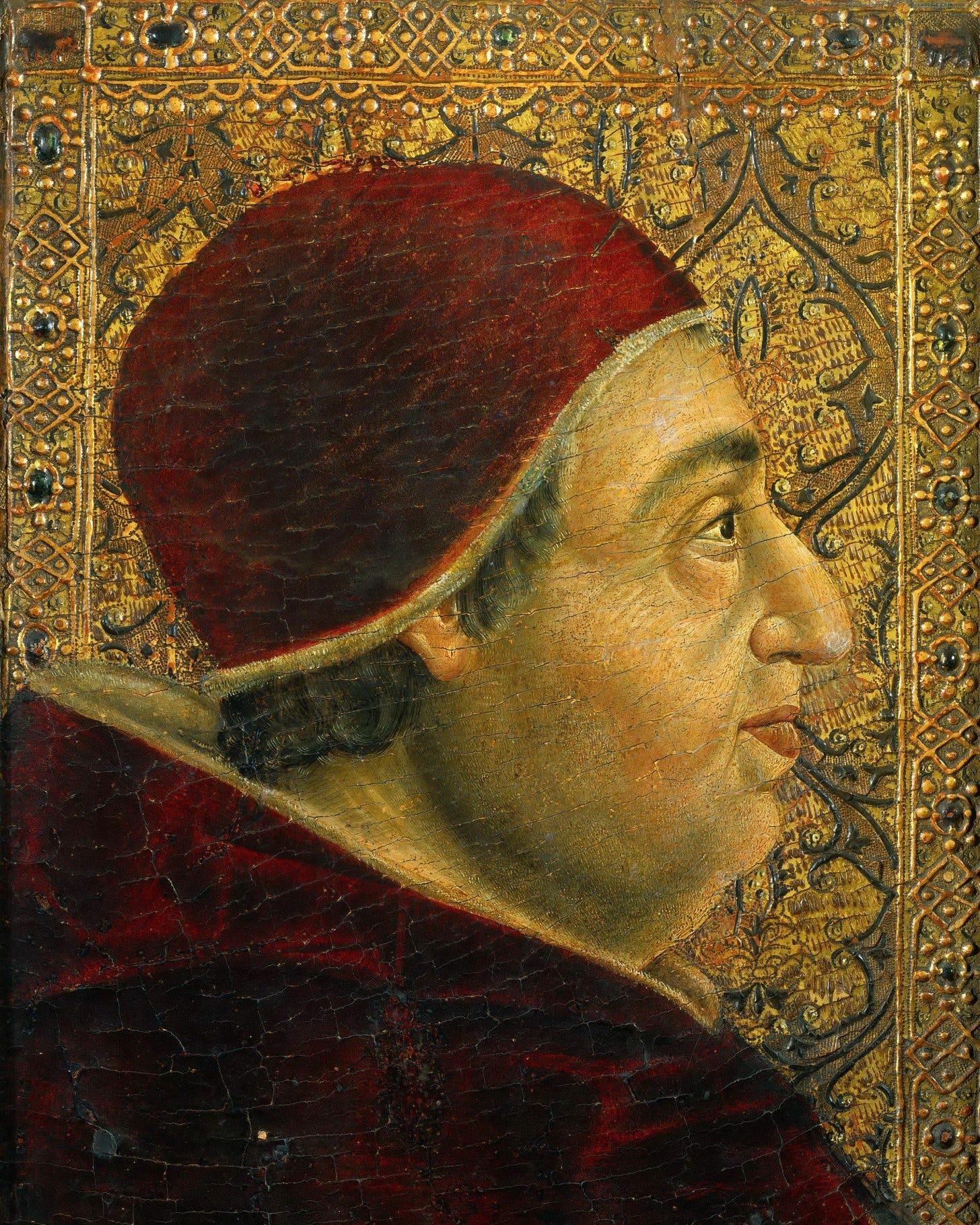
The cardinals locked themselves inside the Sistine Chapel for the first time in history to choose a successor to Innocent VIII. The favourite was Rodrigo Borgia, a wealthy Spanish vice-chancellor with a large family and larger ambitions, and after several days of manoeuvring he had the votes and took the name Alexander VI. Contemporaries were blunt about the method: offices, castles and benefices moved toward the cardinals who mattered. He went on to pack the College with relatives, place his children in positions of power, and run the papacy as a family concern, and his name became shorthand for the corruption that helped provoke the Reformation a generation later. The conclave also fixed the form that has survived five centuries, the locked doors and the Sistine walls and the smoke. Columbus had sailed west from Palos eight days earlier and nobody in the room yet knew that it mattered.
The full deep dive is about where the knowledge actually came from. At nineteen she was married to one of the richest arms manufacturers in Austria, seated through years of technical dinners with his customers, including officers of Mussolini's government, and expected to be decorative and silent. We cover that marriage and the escape she planned from it, how a composer who synchronised player pianos supplied the missing half of the invention, the likelier institutional reasons the Navy passed on it, and why the patent expiring in 1959 meant there was never a moment when the idea was both valuable and hers. Start your free 7-day trial to read it.
Comments
Nothing yet. Say the first thing.
Sign in to join the conversation.