
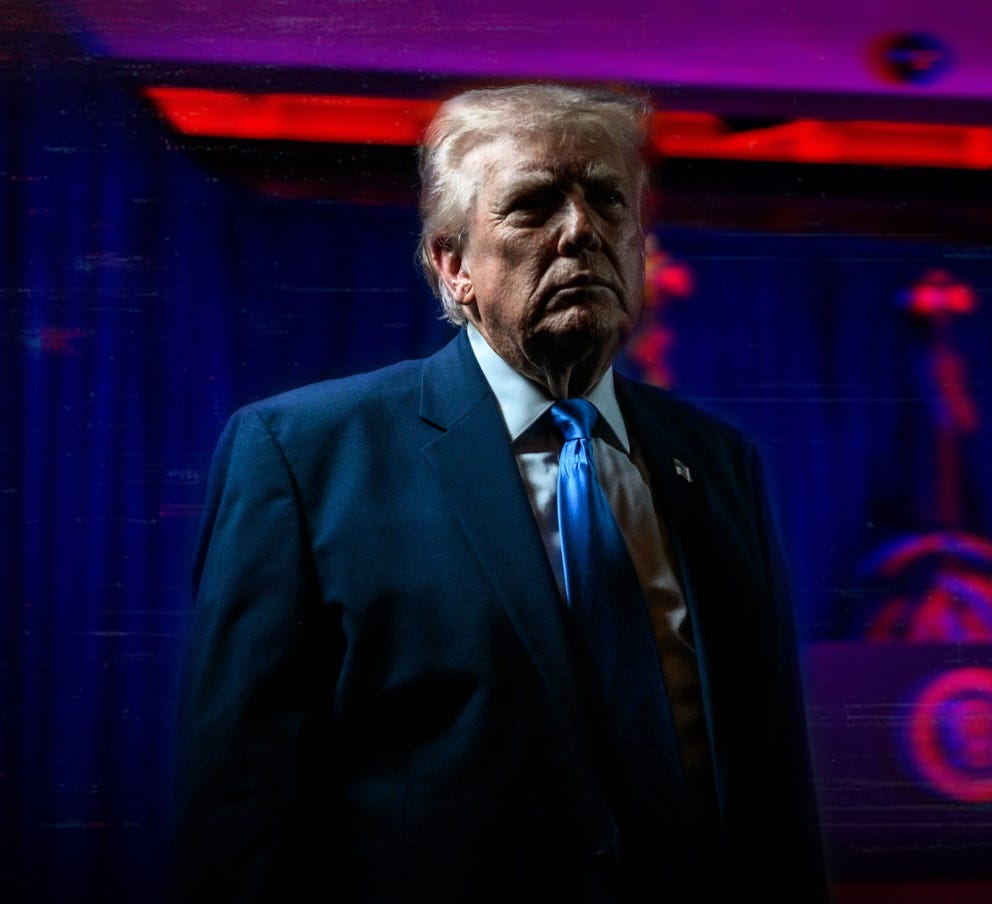
While the focus naturally continues to be on Donald Trump’s war of geopolitical choice with Iran, he is also waging a campaign of domestic political desperation, the ongoing assault on democracy. Let’s call it Project 2026: the scheme being put in motion to interfere with this November’s congressional mid-term elections which are widely expected to end with the Democrats winning back control of the House of Representatives and possibly even gaining a slim majority in the Senate.
Trump, after losing the 2020 presidential election, propagated the “Big Lie,” which ended with the storming of the US Capitol on January 6th, one of the darkest days in 250 years of US history. Ahead of the 2026 midterms, he has been previewing the “Big Fix.”
His latest pre-emptive strike on the midterms came last week in the form of a primetime speech billed by the White House misinformation machine as revealing “bombshell” revelations about election integrity. CNN, NBC and ABC refused to broadcast it live, because they accurately predicted it would be so factually unreliable. CBS and Fox, which are more friendly towards the White House, aired it with disclaimers. Fox News is especially wary. When it amplified Trump's wild claims about the manipulation of voting machines in 2020, it had to pay $787.5 million to Dominion Voting Systems in what is thought to be the largest defamation settlement in U.S. history.
Much of the 26-minute speech sounded like it could have been cut and pasted from 4chan and 8kun, where QAnon conspiracies first flourished. Some of it included statements of the obvious, that foreign countries try to influence elections. Trump singled out China - while failing to mention Vladimir Putin’s Russia - and claimed Beijing had sought to influence both the 2018 congressional mid-terms and 2020 presidential election to harm him and his fellow Republicans. Members of the “Deep State” - who he described, in classic Trump-speak, as “a very, very famous group of people” - had covered up “the extent of China's sinister election meddling.” As a result, the American people had been “blatantly lied to” about vulnerabilities in the U.S. voting infrastructure, especially with electronic voting machines and ballot counting systems.
“Put together, these disclosures reveal an election system so broken and so vulnerable that no one can possibly defend it. It is not defensible. Hundreds of millions of U.S. voter files are in the hands of foreign governments. Our machines and ballot-counting systems are exposed to hacking and manipulation and corruption.”
Trump presented no evidence China had managed to alter a single vote or manipulate a single voter machine. Most of the data Beijing is supposed to have harvested is freely available online. The U.S. intelligence community, in its report on the 2020 election, concluded: “We have no indications that any foreign actor attempted to alter any technical aspect of the voting process in the 2020 US elections, including voter registration, casting ballots, vote tabulation, or reporting results.” Trump did not drop any bombshells to challenge that assessment.
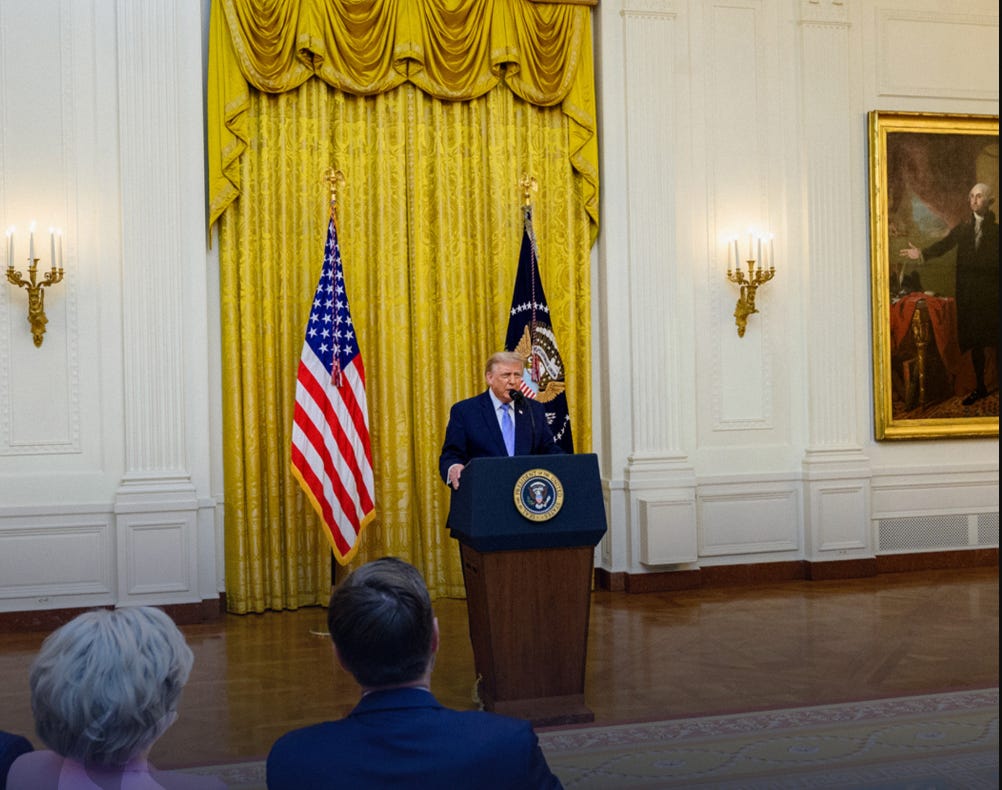
As for his claim that more than 250,000 non-citizens were registered to vote in California, New Jersey, Nevada and Pennsylvania, he produced not a skerrick of documentation. State officials pushed back strongly against these allegations. After the speech was over, all 24 Democratic governors issued a joint statement noting:
“It’s deeply alarming that President Trump continues to try to undermine free and fair elections. No amount of lies and conspiracy theories can change the fact that our country’s elections have repeatedly been proven to be safe and secure. These attacks are intended to intimidate and silence voters.”
Cisco Aguilar, the chair of the Democratic Association of Secretaries of State, put it more bluntly: “That was some bullshit.” Outgoing congresswoman Marjorie Taylor Greene, who was once one of the president’s loudest cheerleaders, described the speech as “just a big shiny object for MAGA to distract them away from the Iran War, Epstein files, and massive failure to deliver campaign promises”.
Trump ended the speech with a plea for lawmakers to pass the so-called SAVE America Act - officially, it is called Safeguard American Voter Eligibility Act - which purportedly is intended to crack down on non-citizen voting. It would require voters to provide documentary proof of citizenship when registering and photo ID when voting. But this is legislation in search of a problem. After the 2016 presidential election, the Brennan Center for Justice uncovered just 30 incidents of suspected noncitizen voting, or 0.0001 per cent of votes cast. Even the Heritage Foundation, which produced the notorious Project 2025, could only find 99 cases of suspected noncitizen voting since 2000.
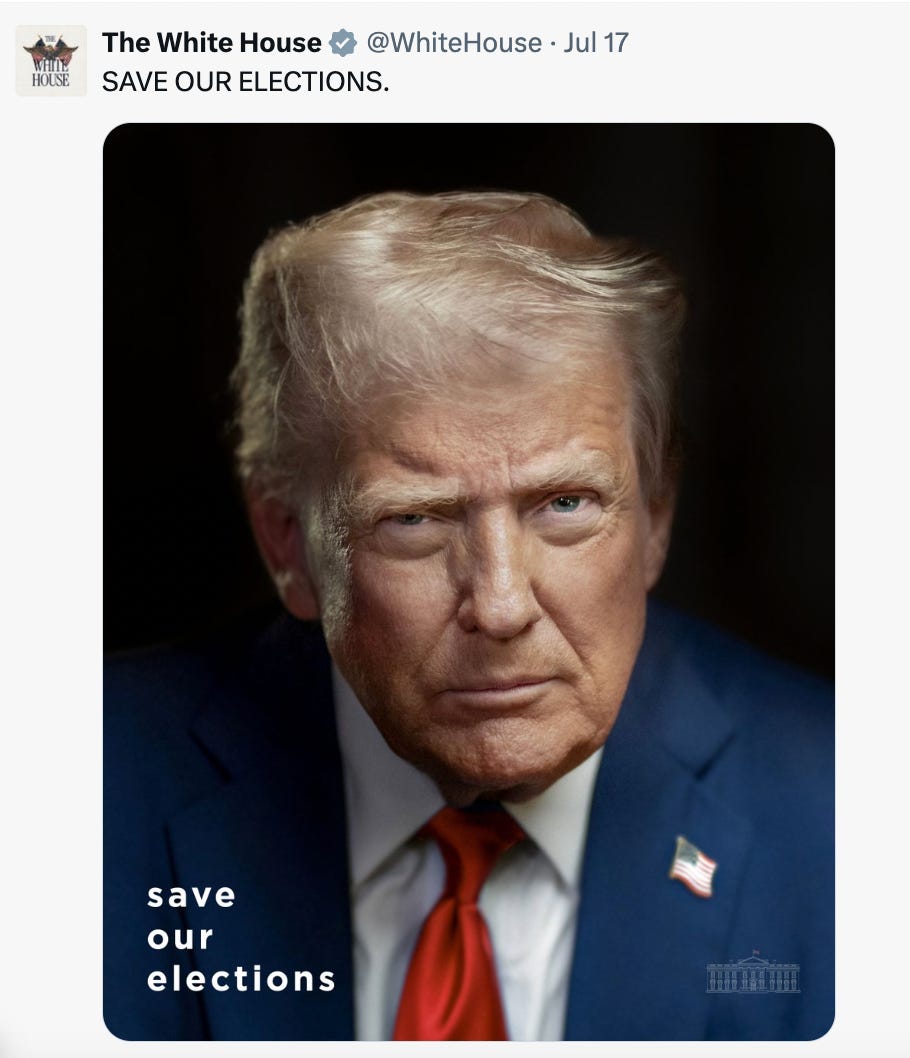
The SAVE Act is a barely disguised attempt to engineer voter suppression on an industrial scale. The Brennan Center for Justice has said it would be “the most restrictive anti-voter bill ever passed by Congress.” More than 9 percent of American citizens of voting age, or 21.3 million people, do not have proof of citizenship readily available. Sometimes these documents are held in safety deposit boxes or the homes of relatives, which sometimes make them hard to access when registering or actually voting. People who have changed their names through marriage often face added complications in providing proof of citizenship. “At least 3.8 million don’t have these documents at all,” notes the Brennan Center, “because they were lost, destroyed, or stolen.”
The SAVE Act has been passed by the Republican-controlled House, but blocked by Democrats in the Senate. Without a change to the filibuster rule, it stands no chance of enactment. Trump’s renewed focus on the SAVE Act, then, is not a serious attempt to win its enactment. Rather it is part of his ongoing campaign to sow deeds of doubt about the integrity of the midterms.
Trump’s entire speech should be seen in the same dark light, as an attempt to provide a pretext for his administration to interfere in the congressional midterms. “I think you will see him doing everything he can to try to prevent the peaceful transfer of power, the election of Democrats, and do whatever he can to remain in power and keep his cronies in power,” reckons Ty Cobb, who served as White House special counsel during the first Trump administration. Its purpose, he said in an interview with PBS after the speech, was to set up “the predicate that he needs to declare an emergency at or about the time of the elections.”
The Washington Post reported in February that Trump allies, with the blessing of the White House, had already drafted an executive order allowing the president to declare a national emergency around the time of the midterms. Now, the report’s opening paragraph, penned by the Post’s Isaac Arnsdorf, makes for even more chilling reading than it did when first published:
“Pro-Trump activists who say they are in coordination with the White House are circulating a 17-page draft executive order that claims China interfered in the 2020 election as a basis to declare a national emergency that would unlock extraordinary presidential power over voting.”
Trump’s assault on democracy is proving to be a multi-phase onslaught. So let’s separate the various lines of attack:
At his urging, the Republican-controlled Texas legislature gerrymandered congressional boundaries with the aim of winning five additional House seats, which set off what has been described as a redistricting arms race. Ten states — Alabama, California, Florida, Louisiana, Missouri, North Carolina, Ohio, Tennessee, Texas, and Utah — have now drawn new congressional maps since last year. This is unprecedented. As the website Ballotpedia notes: “Before 2025, only two states had conducted voluntary mid-decade redistricting since 1970.”
Trump has spoken of nationalising the elections, to exert more control from Washington, even though the U.S. Constitution clearly stipulates states should administer elections and the president has no role. This is a flagrant, not to mention unlawful, attempt at executive overreach.
The Trump Justice Department, since midway last year, has pressured Democratic-controlled states to share voter sensitive voter information, such as copies of voter registration lists and ballots from previous elections, and also to grant access to voting equipment. Understandably, this kind of attempted federal meddling set off klaxons and has ended up being litigated in court. The Justice Department has sued 30 states to get its hands on these records, but, as The Bulwark reports, “they are currently 0-16 in court.”
Trump has been making it harder to vote by mail, a practice which once favoured Republican candidates but which registered Democrats have made more use of since the pandemic. Even though he himself has voted by mail, most recently in February, the president described postal voting in his primetime speech as “inherently corrupt.” In March, Trump issued an executive seeking to curtail postal voting, but his attempts to do so have repeatedly been stymied by the federal courts. Last month, even the Trump-friendly Supreme Court upheld a Mississippi law, challenged by the White House and Republican National Committee, which allows mail-in ballots which arrive after Election Day to be counted.
Another fear is that the Trump administration is already exerting pressure on the US Postal Service (USPS) to slow mail delivery and delay the postmarking of mail. Under Trump, will the USPS remain a neutral carrier of election mail, or will it effectively end up playing a role in deciding and policing who can vote?
Earlier this month, in a move which did not get as much attention as it merited, Trump dismissed all the remaining commissioners on the Election Assistance Commission (EAC), a bipartisan federal agency established to help states run elections. The dismissals followed last month’s landmark Supreme Court ruling granting the president almost limitless authority to sack officials at independent federal agencies. The White House has been exerting pressure on the EAC to alter election rules to effectively implement the provisions of the SAVE Act without it being minted into law by Congress. Now in effective control of the EAC, the elections watchdog Democracy Docket fears Trump will order its executive director to decertify certain voting machines.
A raid conducted by the FBI in February on a warehouse in Fulton County, Georgia, where ballots from the 2020 election were being stored, could be a portent of things to come in November. At first blush, the Georgia raid seemed part of the president’s fixation with his 2020 defeat to Joe Biden. It was after losing this key battleground state, remember, that Trump placed his notorious call to Georgia Secretary of State Brad Raffensperger demanding he “find 11,780 votes”, to overturn the result. Perhaps, though, we were watching a dress rehearsal for what might happen after the midterms. Trump could deploy federal agents, or even the military, to seize ballots on the fake pretext of election fraud. In so doing, he could attempt to shut down counting in close seats which will determine control of the House of Representatives after Republican candidates have taken an early lead. Earlier this year, in an interview with the New York Times, Trump expressed regret that he did not order the National Guard to seize ballot boxes during the 2020 election.
An additional fear also is that the Trump administration will deploy ICE agents close to polling stations in heavily Latino areas to deter US citizens from exercising their right to vote. Federal laws is explicit that the president does not have the authority to deploy armed federal officials to election sites.
All of this raises various nightmare scenarios. Protesters converging on counting centres to protect the sanctity of ballots, which immediately become flashpoints. Clashes with federal agents or troops executing the Trump’s orders, which could provide the pretext for a further presidential crackdown. In these kind of showdowns, blood could easily be shed, as it was on January 6th.
Certainly American democracy faces its more dangerous stress test since Donald Trump lost the 2020 presidential election. Back then, he was a defeated candidate with waning power who was mindful of placing himself in legal jeopardy the moment he left office. Now he is a president with stronger executive powers at his disposal following a string of emboldening Supreme Court rulings, determined to exert maximal authority to prevent the House and the Senate falling into enemy hands.
Comments
Nothing yet. Say the first thing.
Sign in to join the conversation.