
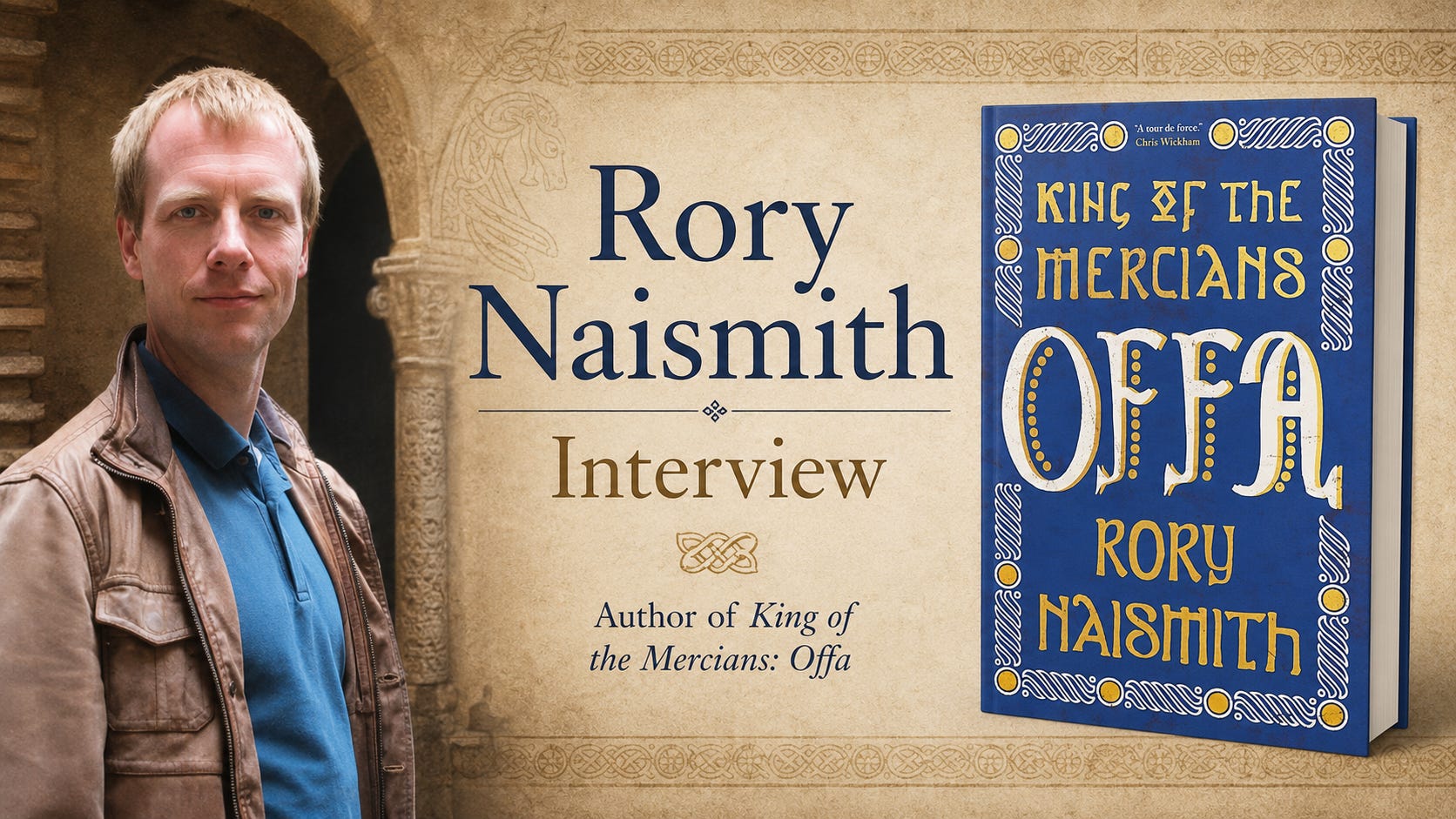
I recently had the opportunity to interview historian Rory Naismith about his new book, King of the Mercians: Offa. Our conversation ranged from Cynethryth’s extraordinary coinage and Offa’s relationship with Charlemagne to the meaning of Offa’s Dyke and the king’s ambitious intervention in the English Church. Running through Naismith’s answers, however, was a larger problem, one that reaches well beyond Offa himself: how do historians write the biography of a medieval king when the surviving evidence tells us far more about kingship than about the man who wore the crown?
Offa is one of those medieval rulers whose reputation seems larger than the individual we can actually recover. He ruled Mercia for nearly four decades, dominated much of southern England, corresponded with Charlemagne, reshaped the coinage, intervened dramatically in church politics and gave his name to the great earthwork running along the Welsh border. Few eighth-century English rulers left such an imposing political footprint, and yet Offa himself remains strangely difficult to see.
In our interview, Naismith described Offa as an extreme example of a difficulty confronting anyone attempting biography in the early Middle Ages. Historians often possess enough evidence to reconstruct how a king performed kingship, but much less that exposes the individual behind the office. Coins can tell us how Offa wanted authority to look, while charters reveal relationships between king, church and aristocracy. Diplomatic correspondence offers glimpses of his standing beyond Britain, and monumental works demonstrate the resources his regime could command. But none of these sources gives us anything resembling a private voice.
Sometimes the clearest glimpses of Offa appear indirectly. Consider his queen, Cynethryth. She occurs prominently in charters and, extraordinarily, had coins struck in her own name. Naismith believes her prominence probably developed during Offa’s reign. Initially her importance may have rested upon dynasty and legitimacy, but the scale and distribution of her coinage suggest that she acquired influence that went beyond symbolic queenship. Cynethryth therefore tells us something about Offa too: his kingship was becoming increasingly dynastic.
Then there is Charlemagne. The Frankish ruler addressed Offa as frater — brother. Mercia was tiny beside the Carolingian realm, yet Naismith argues that the language should not simply be dismissed as diplomatic flattery. The two rulers operated in different political spheres, neither realistically capable of absorbing the other. Recognition between their leading kings therefore made practical sense, even while rivalry simmered beneath the surface. Taken together, these fragments begin to suggest an Offa who was ambitious, status-conscious, dynastically minded and determined that Mercia should be treated as a kingdom of consequence.
Offa’s Dyke is perhaps the most physical expression of his authority. Naismith interprets it as more than a barrier: its enormous scale advertised Mercian resources and established an imposing line between Offa’s power and the Welsh kingdoms to the west. Its resemblance to the great Roman frontier works may also have carried ideological meaning, implicitly placing Mercia on the “Roman” side of the divide.
The monument tells us that Offa could mobilise labour and resources on a remarkable scale, and it tells us something about how he wanted power to be expressed. The harder question is whether it tells us who Offa was.
Beyond the paywall, I look more closely at that problem through one of the most controversial episodes of his reign, the creation of the archbishopric of Lichfield, and at Naismith’s warning that some of the sources through which we see Offa were written by people with reasons to remember him badly. We will also consider what may ultimately have been Offa’s greatest achievement: not the Dyke, but a model of kingship that survived long after his dynasty disappeared.
Get a copy of the book King of the Mercians: Offa
Comments
Nothing yet. Say the first thing.
Sign in to join the conversation.