
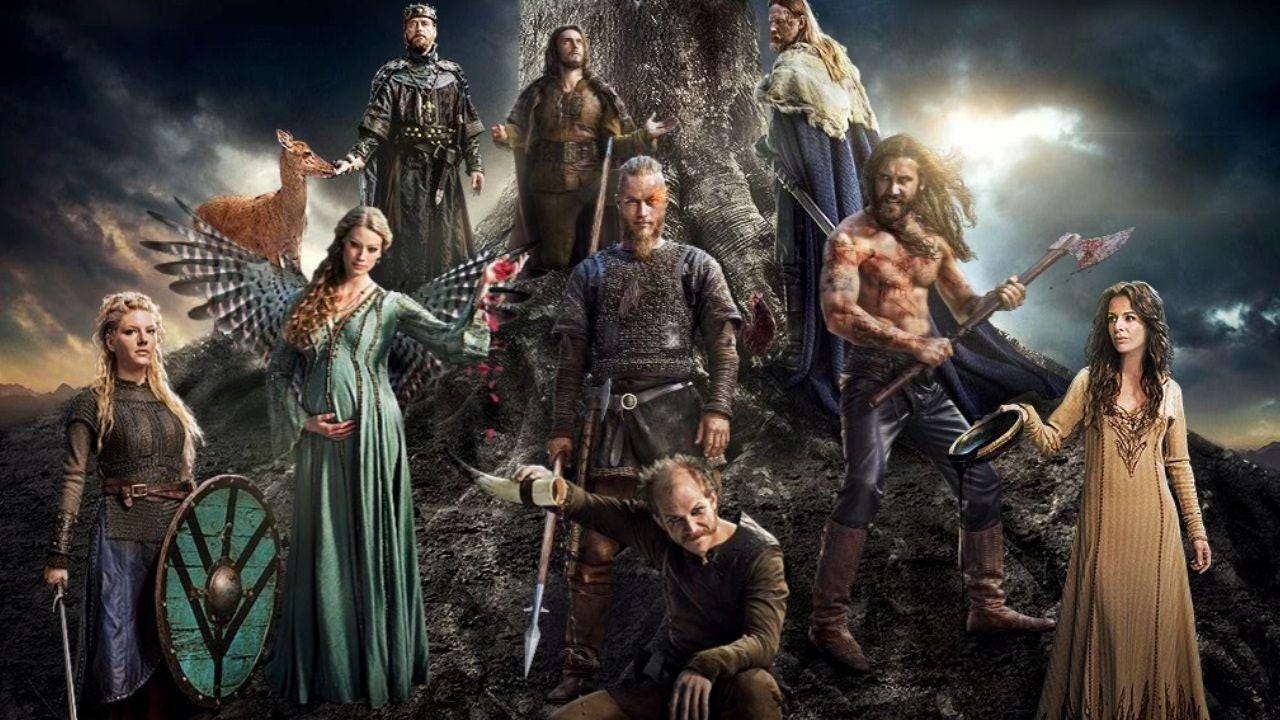
The Vikings TV series was created by Michael Hirst for the History Channel. It premiered on 3 March 2013 and ran for six seasons. The series is set against the backdrop of the Viking Age (often conventionally dated c. 793–1066 AD) and takes its audience across several important events and real milestones, including the raid on Lindisfarne in 793, the Viking attack on Paris in 845, and the invasion of Anglo-Saxon England by the Great Heathen Army in 865–866.
The early storyline revolves around Ragnar Lothbrok, a Norse farmer and warrior, whose ambitions eventually draw his family into raids, exploration and political struggles across the Viking world
Much of the show’s world looks convincing enough that the boundary between historical fact and fiction is difficult to distinguish. The production design, from its ships, settlements, costumes and landscapes, creates a vivid impression of early Scandinavia. The show also effectively portrays elements of Norse society, including blood feuds, shipbuilding, and religious practices. However, it sometimes simplifies and adapts Norse governance, marriage customs, inheritance and gender roles for modern audiences.
My full historical-accuracy review produced an overall verdict of 67%, across three categories: historical setting, characters and culture, and events and timelines. But does that number automatically make the show bad history? Not at all. As a confessed history geek, I have watched the series three times, and I strongly recommend it to my readers.
In the paid subscriber section, we examine whether Vikings succeeds in creating a believable version of the Viking Age. We look more closely at Ragnar, Lagertha, Rollo, Ivar, Ecgberht and Judith, and distinguish relatively harmless historical compression from distortions that materially change what we know about the past.
Comments
Nothing yet. Say the first thing.
Sign in to join the conversation.