
In 2021, the Ohio General Assembly passed, and Governor DeWine signed, a law requiring high school students to receive instruction on “proper interactions with peace officers.” The Ohio Department of Education and Workforce (DEW) was tasked with developing a model curriculum to define how the requirement would be implemented. Districts were expected to implement the requirement only after that model curriculum was completed.
In March 2022, a draft model curriculum was published. The draft included four sections that covered the statutory requirements:
Role of Peace Officers and Their Duties and Responsibilities;
Laws Regarding Questioning and Detention by Peace Officers, Proof of Identity and Consequences for Failure to Comply with Laws;
A Person’s Rights During an Interaction with a Peace Officer; and
Proper Actions for Interacting with a Peace Officer.
It also incorporated scenario-based role play, as required by state law.
The draft appeared to anticipate the tensions that would emerge during the feedback phase. Two pages of guidance on role-play included cautions:
This content can be sensitive and sometimes emotional for students. When using role-playing scenarios and demonstrations, districts and schools should carefully plan strategies and simulations that are developmentally appropriate and designed to protect all students involved.
A broader disclaimer in the introduction noted:
The information and resources in this model curriculum are for instructional use and not intended for legal advice. Anyone with a specific legal issue or question is encouraged to seek advice from a licensed attorney or local counsel.
The state opened a public feedback period and received responses from educators and other stakeholders. Questions emerged about how scenario-based role play involving police interactions could be structured in a classroom setting in a way that remained pedagogically appropriate. Some educators raised concerns about how far instruction could go in scripting responses to police encounters without shifting into behavioral guidance for legal situations, and whether staff had the training or authority to facilitate that kind of instruction.
A revised draft was posted in February 2023, and feedback was again requested. The revised draft continued to caution about possible pitfalls with role-play, adding a new provision to the guidance:
Parents/guardians concerned about their student’s mental health status in relation to any role-playing or demonstrations may obtain an excused absence from that portion of the instruction.
By August 2023, the revised draft was removed from the DEW website. In its place was a notice stating that the curriculum was being finalized. That message remained on the website for a year and a half. During that time, no revised draft was published or timeline for completion provided, even as the department continued to indicate that the work was ongoing.
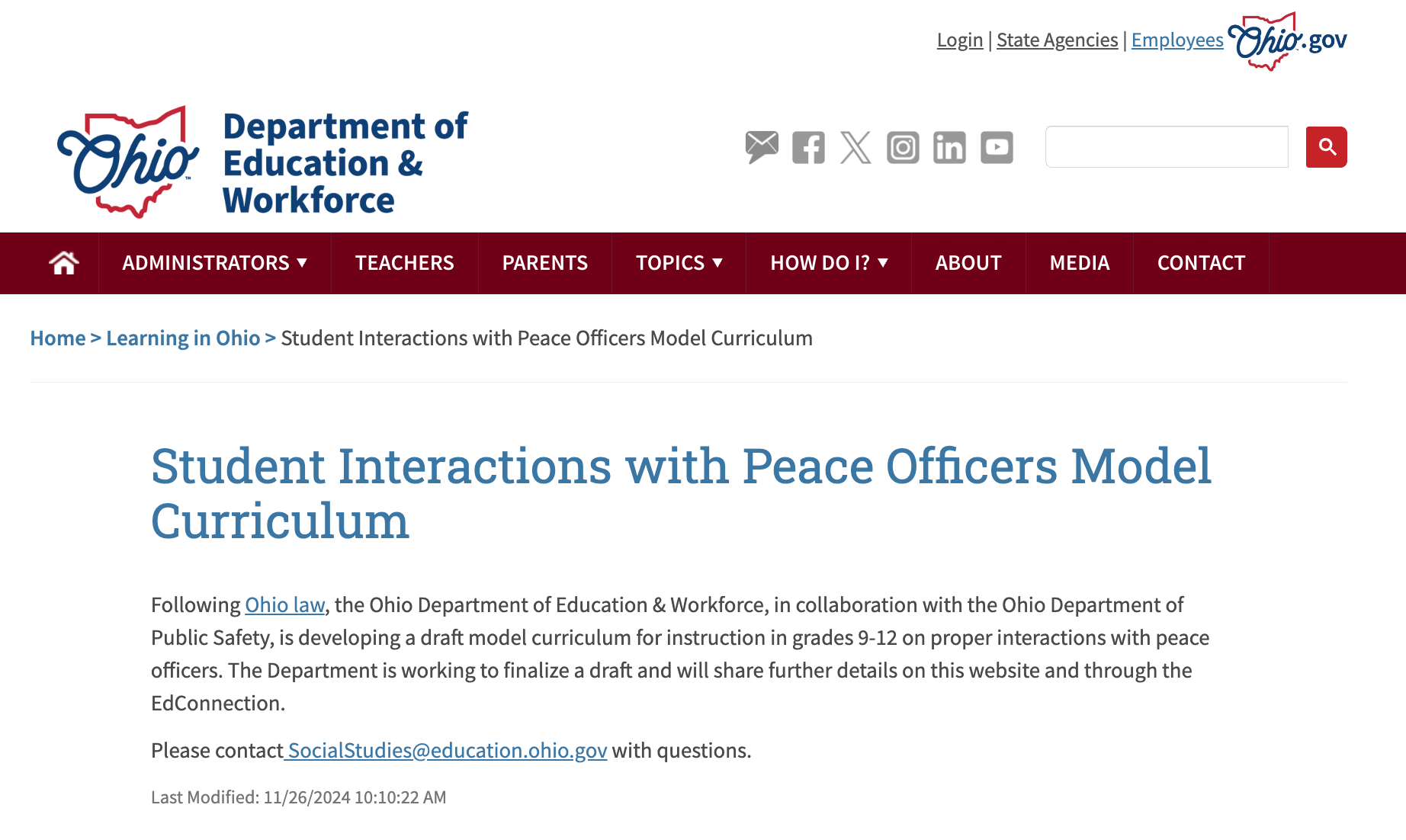
As the social studies curriculum coordinator for an Ohio school district—a position I have held since 2006—I was compelled to navigate these tensions. Honestly, I thought some components of the curriculum offered a fair presentation on civil liberties—even citing sources like the ACLU. But there was always that underlying suspicion that the intent of the law was far more political than pedagogical.
Despite my own misgivings, it was my responsibility to determine where this requirement would fit within the curriculum and how to introduce it to teachers. When the first draft was released, there was some internal discussion, and the concerns echoed what others across the state were raising.
But mostly, we waited. As the draft completion lingered, I sought timeline clarification from DEW, but received no information beyond the same general updates posted publicly on its website.
The context of my district made the concerns more pronounced. I work in an urban district where tensions between law enforcement and the community—particularly the African American community (which makes up a majority of our students)—have been significant. In 2020, following the protests associated with the Black Lives Matter movement, our Board of Education chose not to renew its long-standing contract for school resource officers with the local police department. That decision only heightened the complexity of what this law was asking schools to do.
The difficulty was not simply delay. The draft required the education system to translate a statutory expectation into classroom instruction that touched real-world police encounters, including simulated interactions. As that translation was worked through, the boundary between civics instruction and guidance on conduct in legally consequential situations remained unresolved. The draft never moved past that point into a finalized curriculum.
Many of the concepts included in the draft are not absent from American classrooms. The Bill of Rights, constitutional protections, and Supreme Court interpretations are routinely taught in American Government courses, and in our district, in an elective Personal Law class. Teachers can and do explain what the Fourth Amendment protects, how courts have interpreted search and seizure, and what lawful versus unlawful searches look like in principle. For example, students may study how “reasonable suspicion” differs from “probable cause,” or how case law defines when a search requires a warrant.
But that kind of instruction is fundamentally different from advising students on what they should say or do in the moment during an encounter with police. One is the explanation of legal standards; the other risks dispensing legal advice for real-world behavior in situations where outcomes are immediate and consequential.
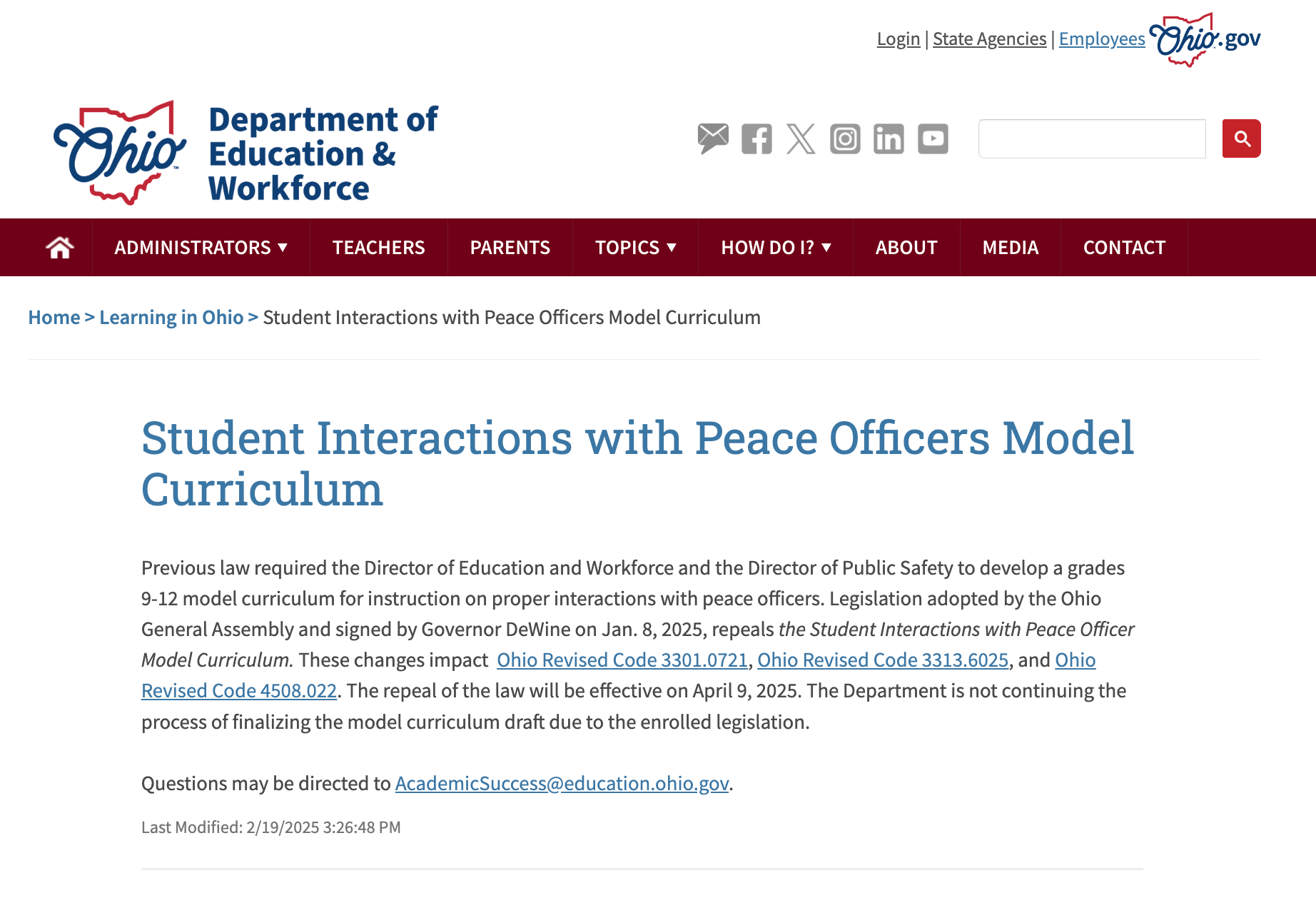
In 2025, the Ohio General Assembly quietly repealed the statutory requirement. The repeal was not accompanied by public explanation and received no media attention. After the law was removed, DEW sent an email memo confirming the repeal and stating that the model curriculum would not be finalized. The website was amended similarly, noting that the department was no longer continuing the process due to the enacted legislation.
What ultimately stands out is that the requirement looks ill-fated from the outset because it appears to have been written as a political gesture without being tested against educational practice. The lack of educator input prior to passage becomes evident in hindsight. The first time the policy met classroom reality was in the draft curriculum—and that is precisely where it began to stall. What followed was not a process of refinement, but a prolonged exposure of the gap between what the statute assumed could be taught and what schools could safely and coherently implement.
What remains unanswered is who ultimately recognized that gap and decided the requirement could not move forward. That judgment does not appear in public debate, legislative record, or media coverage. It is just as plausible that the turning point came not from public pressure, but from internal recognition—perhaps from legal counsel or administrative review—that the requirement raised questions about the role of schools in addressing law enforcement encounters that could not be cleanly resolved in curriculum form. If that is the case, the repeal reads less like a policy reversal and more like a quiet acknowledgment that the problem had already been identified, even if it was never publicly explained.
No posts
Comments
Nothing yet. Say the first thing.
Sign in to join the conversation.