
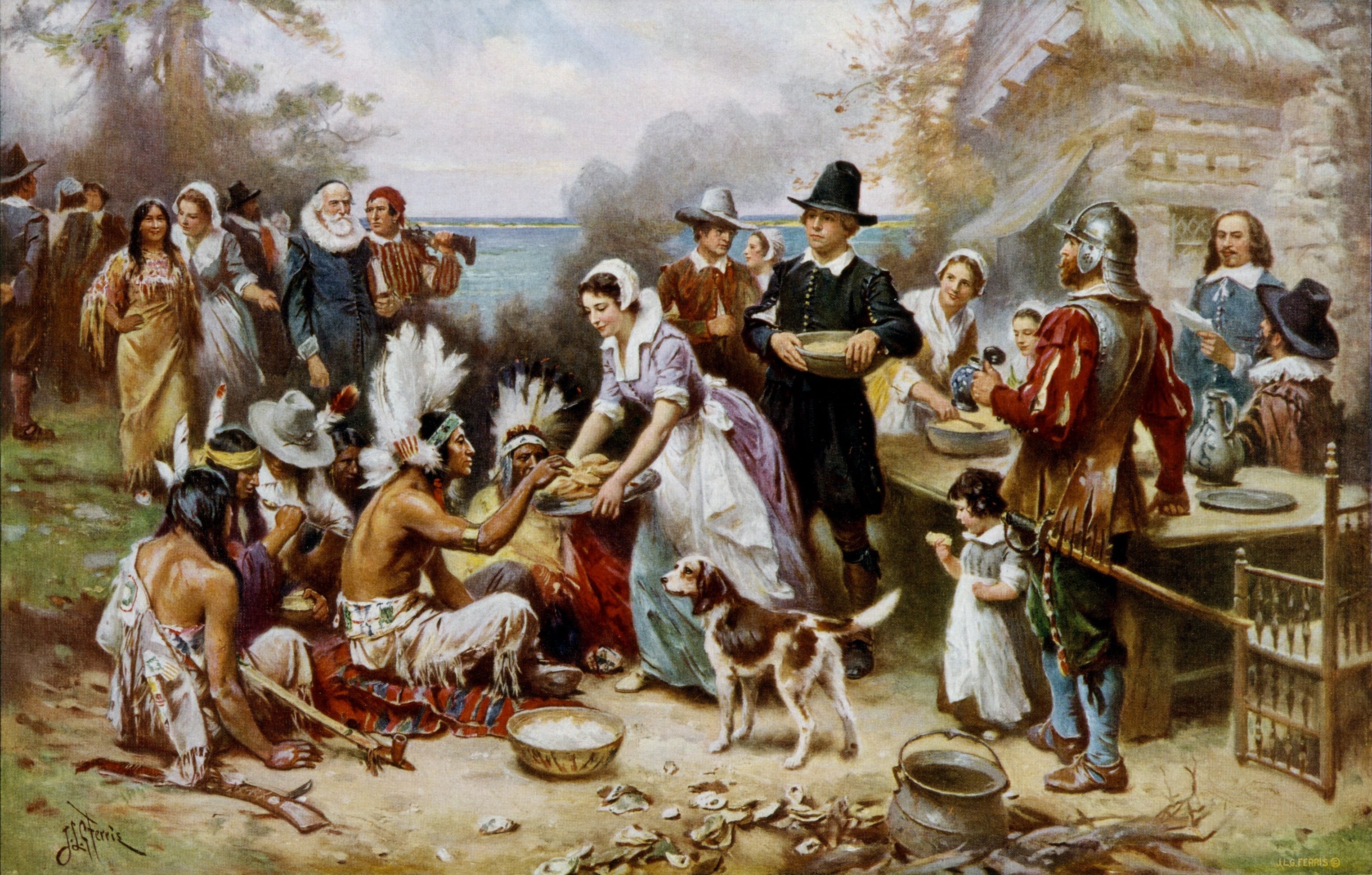
For many Americans, mentions of the “First Thanksgiving” conjure the familiar feasts depicted in early 20th century artwork. Much ink has been spilled (or whatever the digital equivalent of that is) comparing J.L.G. Ferris’s The First Thanksgiving 1621 (1912) to the historical record. The inaccuracies and anachronisms are well known by now: a Plains-style feathered headdress on Wampanoag men who would never have worn one, stone chimneys on log cabins that did not exist in Plymouth, and inaccurate ratios of Native Americans to Pilgrims. And, of course, it wasn’t called “thanksgiving.” As an image of 1621, it fails the accuracy test at nearly every turn.
Created nearly three centuries after the events it purportedly depicts, The First Thanksgiving 1621 is not a primary source. Basic historical thinking tells us it’s a secondary source—an interpretation produced long after the fact. But if we only evaluate it within those categories, it isn’t a very useful account about the past.
True enough, Ferris did include a couple of researched details. He based the man on the far right on the real Edward Winslow, using the only known Pilgrim portrait. He added a spaniel, a nod to the dogs mentioned in William Bradford’s journal. The Pilgrims’ attire is generally depicted with historical accuracy. Beyond those details, the painting can’t reliably tell us what happened in Plymouth in 1621.
And that’s because it was never a source about the 17th century, but instead one about the early 20th century. Once we stop treating Ferris as an illustrator of the 1600s and start seeing him as an artist of the Gilded Age and Progressive Era (1865–1914), the painting becomes far more useful to our understanding of history and historiography (interpretations of history).
Ferris was born in 1863 into a family of artists in Philadelphia. He received early training from his father and other family members who were accomplished painters. He later studied formally at the Pennsylvania Academy of the Fine Arts.
Ferris created The First Thanksgiving 1621 in 1912 as part of a 78-canvas series, The Pageant of a Nation. Other notable works in this series include: The Mayflower Compact 1620, The Landing of William Penn 1682, Writing the Declaration of Independence 1776, Victory Ball 1781, and Franklin’s Return to Philadelphia 1785. The paintings were exhibited at Congress Hall in Philadelphia from 1913 to 1930 and later shown at other venues like the Smithsonian Institution.
Together, these works create a visual narrative of American history presented through the lens of early 20th century patriotism. The First Thanksgiving 1621 shows how early 20th century Americans smoothed over conflict, romanticized Native Americans, and crafted a story of national harmony at a moment when the country was grappling with the ills of industrial capitalism, rapid immigration, and debates over nationality and identity.
To understand Ferris’s work, we need to shift our focus from accuracy to context. What did Philadelphia look like during the height of the Gilded Age and Progressive Era? What cultural anxieties, civic pride, and national myths shaped Ferris’s imagination? How did his work reflect the ways Americans of his era wanted to remember their origins?
Viewed this way, The First Thanksgiving 1621 becomes a primary source—not about the Pilgrims, but about American public memory in the early 20th century. In other words, Ferris may not tell us what Thanksgiving looked like in 1621, but he tells us a great deal about what Americans in 1912 wanted it to look like.
One final note: If you are a classroom teacher, you can check out the History Assessment of Thinking (HAT) lesson on this painting from the Reading Like a Historian curriculum. Using the sourcing heuristic of HATS is one powerful approach to teaching historiography.
Happy Thanksgiving!
No posts
Comments
Nothing yet. Say the first thing.
Sign in to join the conversation.