
I have been studying the American Revolution for nearly 35 years. I turn 48 this week, which means my journey with the Revolution began as an eighth grader, nose buried in historical fiction like Johnny Tremain and Guns for General Washington. Those books sparked something, but I soon moved beyond story into structure—outlining chapters of my history textbook just to understand how the past fit together.
By the end of that school year, I was using a scholarly work—Richard K. Matthews’ The Radical Politics of Thomas Jefferson—for a class presentation on the contradictions of Jefferson’s life and ideas. In high school, I mined the Compton’s Encyclopedia of American History CD-ROM for research. It included Alan Brinkley’s article, “Why Historians Disagree: Facts vs. Interpretations,” which was my first real introduction to history as a discipline shaped by debate and interpretation. Around that same time, I bought a copy of Interpretations of American History by Grob and Billias at a local library sale. In this compendium, I found Daniel J. Boorstin’s case for the conservatism of the American Revolution persuasive enough to build my senior research paper around it.
(And if all of this sounds concerning, rest assured that I also did normal teenage things like football and baseball in high school.)
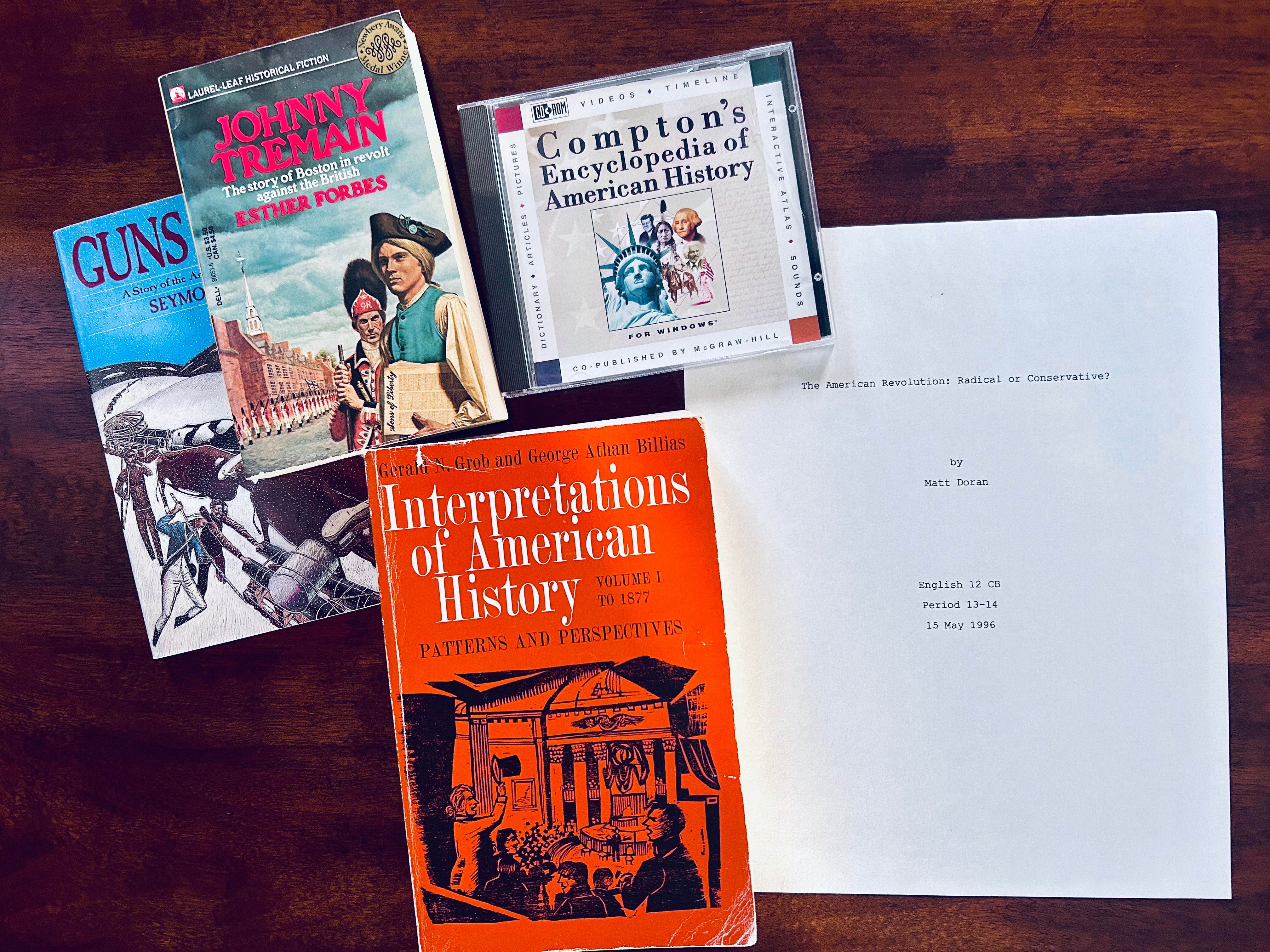
It wasn’t until I became a history major in college that I realized all of this reading, comparing, and debating fell under the field of historiography. I have been hooked ever since. I have completed multiple undergraduate and graduate courses on the American Revolution and have read dozens of books—along with thousands of pages of primary sources—on the Revolution and its interpretations. These include classic works by Gordon Wood and David Hackett Fischer as well as newer interpretations by Holger Hoock and Woody Holton. Most recently, Michael Hattem’s The Memory of ’76 offered an insightful look at how Americans have constructed and reconstructed the Revolution in both scholarship and public memory.
With that background, you can imagine my anticipation for Ken Burns’ long-awaited documentary The American Revolution, which aired this week on PBS. What narrative(s) would Burns choose? How would the film reflect the coming America250 commemorations and the polarized politics of the 2020s?
I watched all six parts the old-fashioned way—live, from 8:00 to 10:00 p.m. each night on my local PBS station. (Restreaming will come later.) I also joined the chat a few evenings on Bluesky, where historians using the hashtag #HATM (historians at the movies) offered running commentary.
The documentary largely delivered what I expected: a film shaped by the sensibilities of the present times. Burns’ signature effects—measured narration, panning stills, and layered voices—shapes the film throughout. He presents the Revolution not as a single unified story, but as a series of interwoven narratives experienced differently by different groups. Native Americans, African Americans, and women—Patriot and Loyalist alike—appear as central actors rather than footnotes. The global dimensions of the conflict receive sustained attention, situating the North American colonies within the larger ambitions of the British Empire.
Burns does not shy away from the violence of the war, depicting battles, brutal campaigns, and the harsh realities faced by soldiers and civilians alike. It also gives significant attention to Loyalists, showing how they navigated loyalty, displacement, and persecution.
Given the recent dust-ups surrounding the 1619 Project’s claims about the role of slavery as a cause of the American Revolution, I was particularly curious to see how Burns would navigate the topic. He handled it about as well as one could reasonably expect—giving due reference to Dunmore’s Proclamation and its galvanizing impact in Virginia, and weaving those insights into the film’s broader effort to show how different groups experienced the Revolution.
The film’s roster of historians and writers is impressively diverse. Familiar scholarly voices like Gordon Wood and the late Bernard Bailyn (the documentary was 10 years in the making) appear, alongside African American scholars such as Vincent Brown and Annette Gordon-Reed, as well as women historians like Kathleen DuVal and Serena Zabin. This lineup reflects a far broader interpretive range than Burns’ early work, especially The Civil War (1990), where Shelby Foote’s commentary downplayed the centrality of slavery and contributed to the “lost cause” narrative.
Interestingly, Woody Holton—whose recent book Liberty Is Sweet aligns closely with many of the film’s themes—does not appear, though elements of his interpretation echo throughout the documentary. I was also surprised not to see historian John Fea among the commentators, especially given the film’s mention of Philip Vickers Fithian, about whom Fea has written extensively.
A few years ago, I read a tweet from a public historian who suggested that the 2026 semiquincentennial would generate little public interest, given declining belief in American exceptionalism and a generally uncelebratory national mood. If that prediction turns out to be true, it doesn’t have to remain so. We can study American history broadly—and the American Revolution specifically—without getting trapped in contemporary culture wars. We can be American historians without being American exceptionalists. We can learn about the Revolution without glorifying it. We can appreciate the founding ideals without sanctifying the founders who often fell short of them. And, importantly, we can cultivate a form of patriotism that does not depend on nationalism.
As America250 approaches, teachers, public historians, and academic historians can help guide the public in recognizing the importance of historiography and the multiple, sometimes competing narratives that shape our understanding of the American Revolution.
For teachers, PBS Learning Media and Ken Burns in the Classroom have already curated key segments from the documentary and developed classroom-ready activities to support instruction. At a moment when schools are preparing for America250, these resources offer an accessible entry point for helping students explore the Revolution beyond textbook summaries. Curated clips highlight diverse voices, global contexts, and contested narratives, while the accompanying lessons provide opportunities for close reading, historical analysis, and classroom discussion.
In the end, The American Revolution feels like a documentary for our time: attentive to complexity, willing to challenge older narratives, and conscious of the many ways the Revolution has been remembered, debated, and claimed. For someone who has spent more than three decades tracing those very debates, the film is both familiar and refreshingly new—and a welcome contribution in these polarizing times.
No posts
Comments
Nothing yet. Say the first thing.
Sign in to join the conversation.