
In recent years, the Digital Inquiry Group (formerly the Stanford History Education Group) has expanded its original focus on historical thinking to include civic online reasoning—the ability to locate, evaluate, and verify digital information about social and political issues. This shift reflects a recognition that the central challenge facing students today is not access to information, but the ability to evaluate information in a digital environment saturated with misinformation, algorithmic amplification, and partisan cues.
DIG’s founder, Sam Wineburg, makes this argument in his 2018 book, Why Learning History (When It’s Already on Your Phone). Wineburg contends,
...[T]ime-honored ways of evaluating information may not be enough to navigate a serpentine digital terrain. Critical thinking and reading remain indispensable. But these interviews [with historians and undergraduate students evaluating online information] show that they are not enough. (p. 153)
When information is instantly available, the core intellectual task is no longer retrieval but judgment: deciding what to trust, what to question, and what to verify. In this sense, the turn toward civic online reasoning is both necessary and overdue.
Still, I have wondered: In what ways are the time-honored thinking skills of the last century relevant today? Seeking answers to this question, I returned to the work of Barry Beyer, a former social studies education professor who published widely on critical thinking in the 1980s and 1990s. I was first introduced to Beyer’s work in my graduate program in social studies education around the turn of the twenty-first century.
When I began teaching world history shortly thereafter, copies of an older textbook Beyer co-authored—World History: Traditions and New Directions (Addison-Wesley)—lingered in the school book room. I made frequent use of Beyer’s special insert sections on critical thinking skills. Over time, I also sought out his earlier works, including Practical Strategies for the Teaching of Thinking (1987), Teaching Thinking Skills: A Handbook for Secondary School Teachers (1991), and Improving Student Thinking: A Comprehensive Approach (1997).
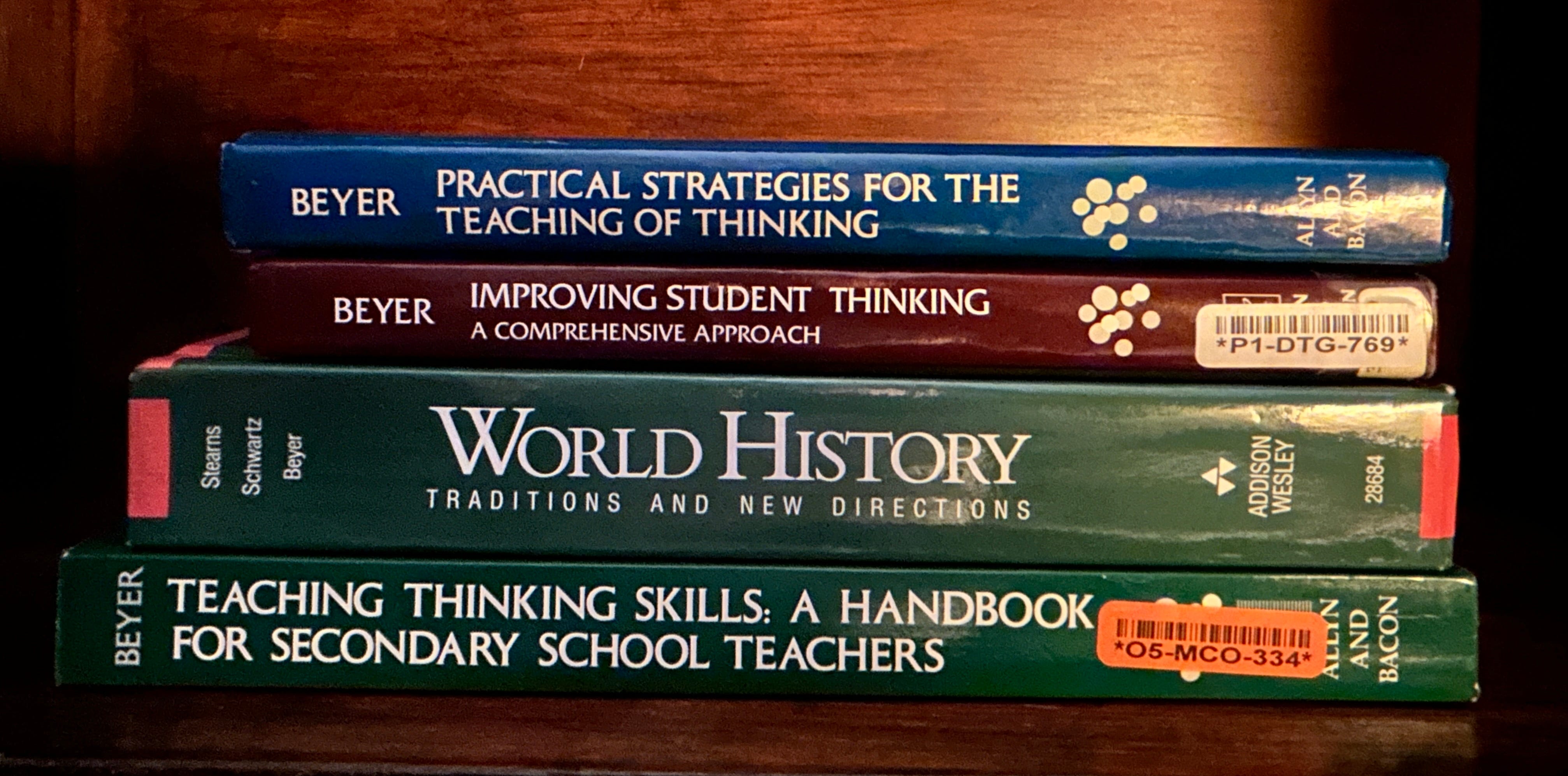
Reading this sentence from Practical Strategies for the Teaching of Thinking was my aha moment:
Critical thinking in its most refined state is a frame of mind and set of attitudes and dispositions as well as a number of cognitive operations. (p. 35)
In this sentence, Beyer highlights an overlooked dimension of civic online reasoning that deserves greater attention. Before students can apply strategies such as lateral reading, source checking, or claim verification, they must be disposed to do so. Skills do not compel their own use. A student may know how to fact-check a claim and still choose not to—particularly when that claim aligns with prior beliefs, group identities, or emotional commitments.
Shortly after the 2020 election, I attended a webinar with Sam Wineburg on the timely topic of evaluating claims and evidence. One participant asked: what about students who show no interest in verifying information and simply believe what they want? Wineburg acknowledged that these methods are designed for those already inclined to pursue accuracy and truth. This exchange illustrated exactly why Beyer’s emphasis on dispositions still matters.
Writing decades before social media, Beyer confronted a problem that remains unresolved today: how to ensure that thinking skills are not merely taught, but actually activated. His work offers a corrective to skills-only approaches by insisting that critical thinking involves both how we think and whether we choose to think in that way at all.
Critical thinking is not simply a collection of analytical techniques—it is the fusion of cognitive operations—analyzing arguments, evaluating evidence, and identifying assumptions—with dispositions that incline individuals to use those operations purposefully.
Beyer identifies several such dispositions in Practical Strategies:
an awareness of the need to evaluate information;
a willingness to suspend judgment;
respect for reason and evidence; and
a desire to consider multiple perspectives. (p. 211)
Beyer’s work has direct implications for civic education today. Democracies depend on citizens who can deliberate, revise their views, and engage seriously with perspectives different from their own. When dispositions erode, public discourse shifts from reasoned judgment to identity defense, and from inquiry to assertion.
For the past few years, I’ve done guest teaching on digital citizenship in an Ed Tech class at a local college. I begin by asking students which domain of objectives—knowledge, skills, or dispositions—they consider most critical for learners today. Predictably, many argue for skills, which makes sense in an Ed Tech context: students need to know how to effectively use technology. But after working through case studies from DIG’s civic online reasoning program, I return to Beyer’s discussion of dispositions. I emphasize that even the most sophisticated skills are of little use in the social media age—or whatever comes next—if students lack the values and dispositions to apply them.
I then share these practical suggestions from Beyer on fostering the development of dispositions:
Model behaviors that demonstrate the desired dispositions.
Insist on student behavior that reflects the dispositions sought.
Engage students in repeated activities that require use of these disposition-based behaviors.
Reinforce behaviors that demonstrate the appropriate dispositions.
I close the class session with a quote from Wineburg’s Why Learn History that reminds us of the civic consequences of failing to cultivate these dispositions:
Tyranny wins when it succeeds in shaking our confidence of basic notions of truth. The challenge for educators is cultivating among the young a commitment to ‘a norm of valuing accuracy.’ . . . The big problem with this new reality is that the ill-informed hold just as much power at the polling station as the well-informed. Reliable information is to civic intelligence what clean air and water are to public health. (p. 158-159)
Revisiting Barry Beyer is not an exercise in nostalgia. It is a reminder that while technologies change, the intellectual and civic demands of democratic life endure. Civic online reasoning may require new strategies suited to digital contexts, but it still rests on an older and more fundamental insight: critical thinking begins not with what students are able to do, but with what they are willing to do.
Several years ago, I posted a brief reflection on my blog about Beyer’s above-cited quote. Shortly after Beyer’s death in 2022, his son Steven Beyer made the following comment on the post:
This is a very succinct and clear summary of my father’s purpose, meaning, and intentions. I just came across this blog while doing a quick search. Dad (Dr. Beyer) passed away August 5, 2022. His passion for teaching thinking skills was a particular favorite. This subject needs a real invigoration given our current vast misunderstanding of facts, judgment, and all the dispositions that the author here (Matt Doran) highlights. I hope the torch is carried on, strong and loudly. Thanks for sharing this.
No posts
Comments
Nothing yet. Say the first thing.
Sign in to join the conversation.