
Do you remember where you were on Christmas Day, December 25, 1991? It was the day Mikhail Gorbachev resigned his position as president of the Soviet Union and recommended that the party’s ruling Central Committee be disbanded. The next day the Soviet Union officially dissolved, effectively ending a more than forty-five-year global rivalry known as the Cold War.
Our family was gathered in our usual holiday spot when the news came down: the basement of my grandparents’ ranch house in a small town outside of Columbus, Ohio. Flipping through the channels of the old console TV, I remember watching news of these events unfold.
I was 14 years old, and although I had never studied the Cold War formally in school—eighth grade American history ended with the Civil War—I knew enough to grasp the significance of these events. Long before I encountered the Cold War as a formal subject in school, popular culture had already taught me its basic ideological script—who the heroes and villains were, and how I was supposed to understand America’s place in the world.
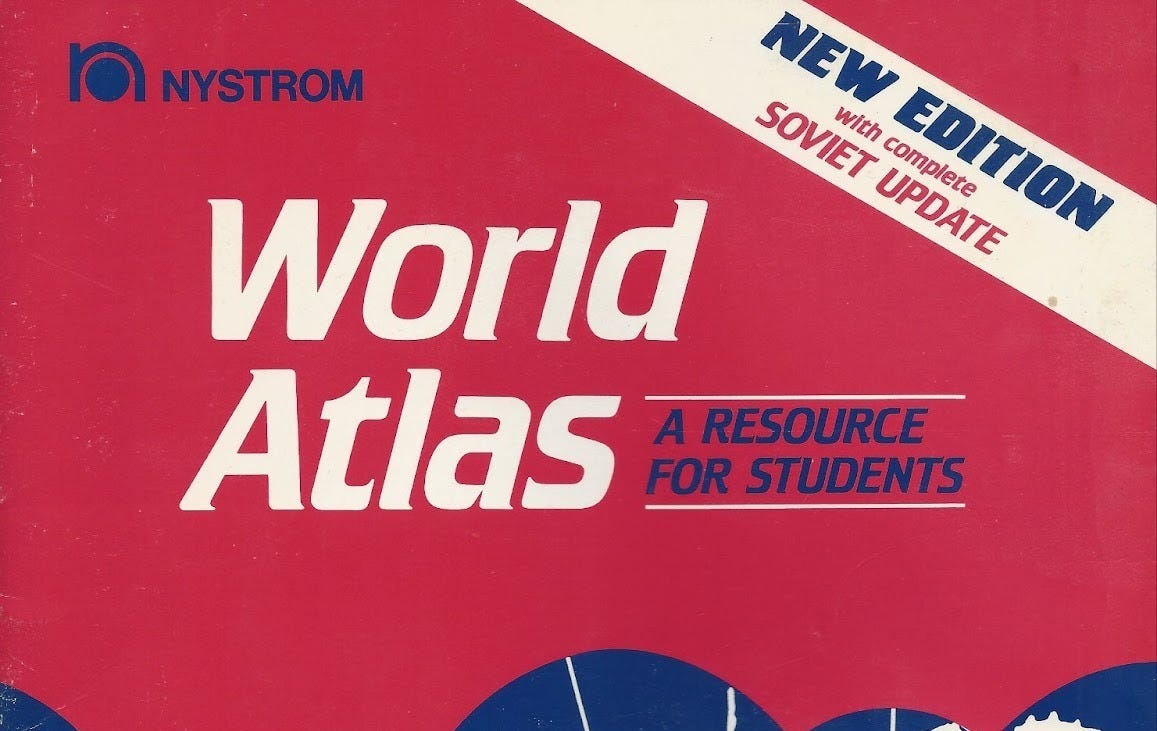
The next year I entered high school, and for my ninth grade world geography class we received the updated edition of Nystrom’s World Atlas—“New Edition with complete Soviet Update.” The former republics of the USSR were now separated by color. Seeing the maps laid out like that was a vivid visual indication that a new historical era had begun.
A decade later, I began teaching high school world history. The Cold War was the final unit in the course, and the only period of history that I could comment on from firsthand experience of living through it. Looking back, I realized that much of what I knew about the Cold War growing up did not come from textbooks or classrooms, but from the movies, television shows, and popular culture that quietly taught my generation how to see the world in stark moral terms.
The movie, Red Dawn (1984) immediately came to mind. I watched it some time in the mid-1980s on the same console TV in my grandparents’ basement where I later saw news of the Soviet collapse. Red Dawn imagines a surprise invasion of the United States by a Soviet-led coalition that includes Cuban and Nicaraguan forces, triggering widespread panic and occupation in rural Colorado. A group of American high school students escapes into the mountains to wage a guerrilla resistance. Rewatching the movie as an adult with a degree in American history, it played like pure Cold War propaganda. Set against the backdrop of the American West, the film leans into classic American exceptionalism and the belief that an armed, self-reliant citizenry could stand up to enemy forces.
Red Dawn was hardly an outlier; its worldview echoed across the broader landscape of 1980s popular culture, where Cold War fears and moral binaries appeared repeatedly in forms far more familiar to children. Two Cold War–themed Hulks appeared in 1980s popular culture—the science-fiction Incredible Hulk of comic books, movies, and television, and the wrestling phenomenon Hulk Hogan.
The Incredible Hulk was first published by Marvel Comics in 1962. Physicist Bruce Banner becomes the green giant known as the Hulk because of a gamma-bomb explosion during an experiment. This parallels the fear of nuclear weapons and their unintended consequences that dominated the Cold War era. The Hulk was adapted into a 1977 television movie and a series that ran from 1978 to 1982, which I watched on reruns in the mid-1980s.
The Cold War created a binary world: good vs evil, democracy vs. authoritarianism, capitalism vs. communism. These themes resonated in WWF (later WWE) wrestling entertainment, where wrestlers were clearly divided into only two camps: “good guys” and “bad guys.” Hulk Hogan was the prototypical good guy, embodying strength, patriotism, and moral certainty. He entered the “squared circle” with Rick Derringer’s “I am a Real American” song playing amidst the cheers of the crowd. Nikolai Volkov was the Soviet heel. He carried the flag of the USSR while the Soviet national anthem played, and the crowd booed. For tag team matches, Volkov partnered with the Iron Sheik, from another U.S. enemy, Iran. Cold War kids like me learned to love America and despise the “evil empire.” WWE owner Vince McMahon later noted that post–Cold War wrestling narratives shifted away from simple binary good vs. evil to more shades of gray.
At a recent conference of the International Society for the Social Studies, Jason Allen of Shepherd University highlighted a Cold War connection I had completely missed: the Transformers cartoon. His presentation showed how the conflict between Autobots and Decepticons can be read as an allegory for the political tensions of the final decade of the Cold War. The National Air and Space Museum made a similar interpretation in a seven-year exhibit (2010–2017), noting that Transformers represented a “good vs. evil” storyline, one that echoed the ideological struggle between the U.S. and the Soviet Union during that period. After hearing Allen’s talk, I found myself rewatching the series on Tubi with a new appreciation for its Cold War subtext.
Today’s students have grown up not just after the Cold War, but after 9/11, amid a global pandemic, and inside a constantly shifting digital landscape. Their popular culture—like mine once did—absorbs these anxieties, fears, and assumptions, often without them noticing. One of our responsibilities as educators is to help students recognize how contemporary politics quietly seeps into the stories they consume and the worldviews they inherit. By examining the popular culture of our own childhoods alongside theirs, we can model how to read the present historically—learning not just what happened, but how it felt, how it was framed, and how it shaped the way people understood good, evil, and their place in the world.
No posts
Comments
Nothing yet. Say the first thing.
Sign in to join the conversation.