
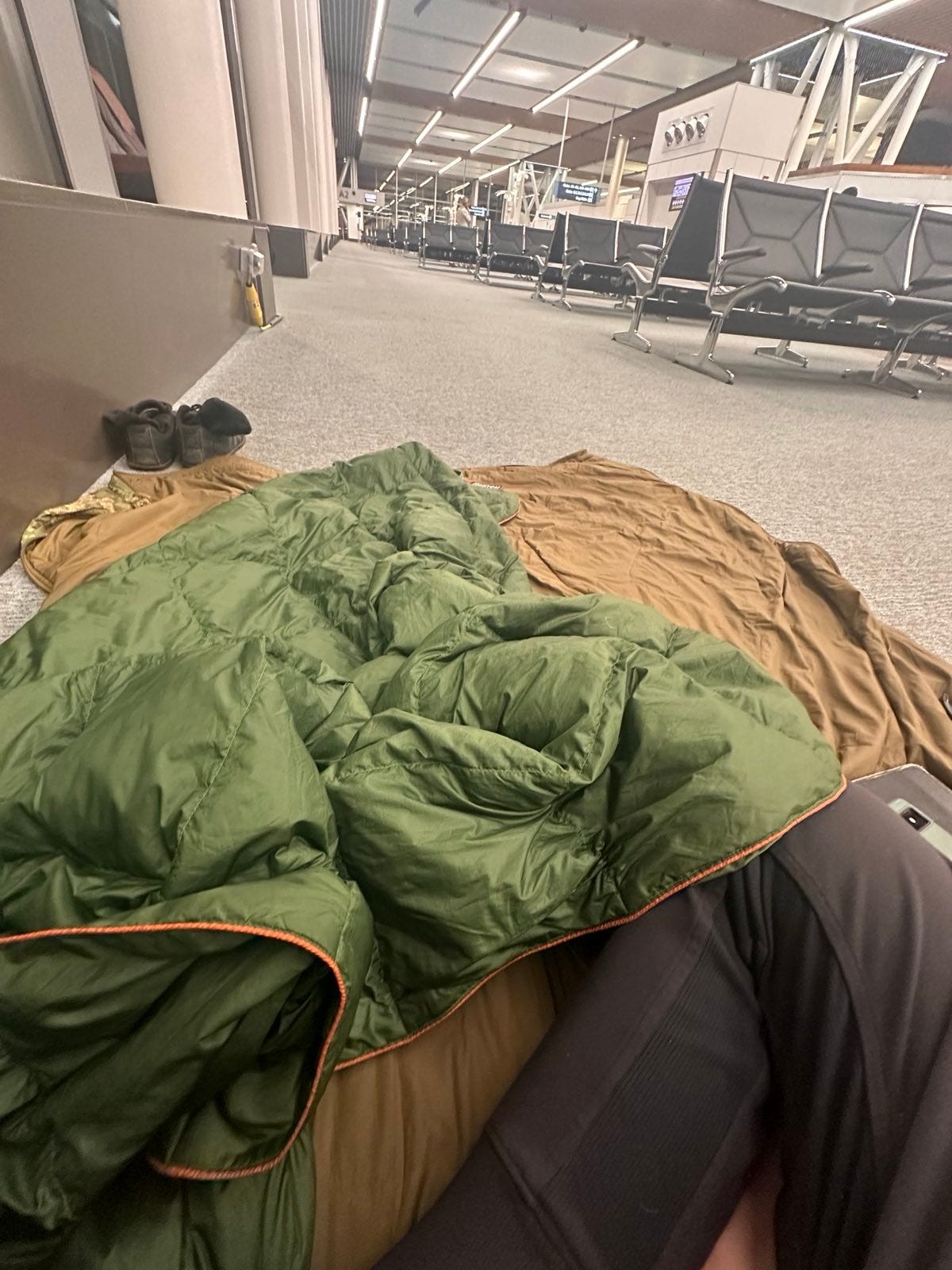
A few months ago my girlfriend Alex bought a car, and she told me, “I want to make the car like your backpack.” She meant the backpack that I’d been living out of for the past couple years, which is now sitting in storage while we settle down to build a house. Over those years, my backpack changed constantly along with the adventures I needed it for, but here’s what it looked like in one of its incarnations:

She didn’t mean we should paint the car camo, or dangle magical charms from it, what she meant is that she wanted the car to be packed with coziness. The coziness in my backpack took on different forms, but there were always certain essentials: a sleeping pad, a warm blanket, and a simple shelter. No matter where I wound up, whether it was an airport, the deck of a ship, the hedges of a city park, or a ruin in the desert, I could pull things out of my backpack to make a cozy nest. Being able to do that comforted my mind, and it also let me adventure more boldly, knowing I could get a good night’s sleep wherever I might wind up.

But this approach works for more than just crazy adventures; a backpack of coziness can come in handy when travelling normally through airports and other public spaces. When Alex and I were coming back from Australia and got stranded in Honolulu (not as nice as it sounds), and even the most expensive hotels were fully booked, my backpack let us nap in a park and sprawl on the airport floor for hours, softening the sharp edges of a stressful experience. The built environment is often hostile to human comfort, and it can be hard to find a bench without armrests to prevent comfortable sleeping, whether this is targeted at homeless people or weary travelers.
Now that Alex and I are in the midst of building a more permanent dwelling, this idea of coziness is on my mind a lot. When I look around at how other people build and furnish homes and public spaces, it makes me think that coziness isn’t given as much attention as it deserves. Maybe it’s not just a luxury but something more primal, an instinct that we’ve started to lose touch with in our modern world of glass and steel and push-button climate control. I’m beginning to think it could even be an essential component of our mental health and by extension our physical health.
But what does it mean for a place to be cozy? Digging into my own psyche, I think of how when I was a kid I always liked small and sheltered spaces. I would move my bed over so I could squeeze into the crack between the mattress and the wall.1 Falling asleep to the sound of a storm drumming on the tin roof overhead, a thrill would pass through my body, imagining how cold and wet I would be outside in the rain, and then feeling the equal and opposite shiver of being warm and dry. This feeling of physical and emotional warmth, which can be evoked both by social connection and by physical surroundings, is well recognized in the cultures of cold and wet northern places, for example we say cozy in English, the Dutch have gezelligheid, the Danish have hygge, the Norwegians say koseleg, and so on. In that kind of climate, being warm, dry, and surrounded by other people is not just a nice feeling but a matter of survival. In my childhood memories, the rain seems like an important element; maybe coziness exists in opposition to a harsh environment.2

I grew up reading a lot of British literature where the contrast between the fireside coziness of home and the cold and damp of the outdoors was a palpable part of the story. The Lord of the Rings is, in a sense, an epic about heroes from the Shire, the very embodiment of coziness, prevailing against the terrible forces of Mordor, the least cozy place you can imagine. These stories touched me on a visceral level because I knew what it was like to battle the elements: in my childhood home there wasn’t, and still isn’t, any climate control but a wood stove. In the winter we boiled water and poured it into rubber hot water bottles that we ordered from England. Slipping into bed with one of these on a cold night is among the great pleasures of life. In the hot southern summer we had no air conditioning, so I learned to love the shade of the forest canopy overhead, a dip in the pond to wash the sweat off, a cool slice of watermelon from the icebox.
At the heart of these simple pleasures is having a bodily need and fulfilling it. Just like food never tastes as good as it does when you’re really hungry, a hot water bottle is best enjoyed in a cold room, and if you took the shade and the pond and the slice of melon into an air-conditioned house, they would become a pale shadow of themselves. Up until recently, our ancestors had to struggle to carve spaces for themselves out of an environment that humans weren’t made for. Most animals are shaped to their habitat: they walk around with all the clothing they need on their backs, all the tools they need in their jaws and paws, and all the materials they need conveniently lying around for the taking. Meanwhile we’ve had to struggle to shape the environment to our needs, from the warmth of a seal-oil lamp in an igloo to a cool desert breeze channeled through massive stone walls into a shady courtyard.
After millions of years of this struggle, it makes sense we’d pick up a deep instinct for it. The same way a beaver can’t hear the sound of rushing water without a strong urge to pile branches and leaves and mud onto it to seal up the breach in the dam, we can’t feel the burning sun or the blowing rain and snow without getting an urge to make a cozy little spot to hunker down in. But what would happen if the beaver was raised in a zoo where the dam was made of fiberglass and the zoo keeper dropped tree limbs into the enclosure every day for it to nibble on? Seemingly the beaver would have everything it needed, but something would be missing. There would be a confused urge, a desire to repair this strange dam that never needed repairing. I think something like this may be happening to us. We’ve solved the problem of comfort so thoroughly that it makes us uncomfortable and we don’t know why.
For most of our history, people have built their own shelters and public spaces. Human thoughts and hands expressed our instinct for coziness directly into every inch of a home. Every piece of material came from nature and was handled, shaped, and placed by the people who would live there and by their friends and neighbors. The scale was fitted to our own bodies and the design was fitted to the demands of the climate.3 I don’t know the history in detail, but at some point it seems like people started paying professionals to build their homes, then paying more professionals to design their homes, and now in most places the process is so regulated by building codes that it’s not practical to do it any other way. From designing and building a home right on the ground where it was going to stand, working directly with natural materials, our homes began to be designed from an air-conditioned architect’s office hundreds or thousands of miles away, constructed in abstract lines on a drafting table or an AutoCAD workstation.
The result was that buildings got decoupled from their environment and the people who lived in them. Houses didn’t need wide porches anymore when they could stay cool with air-conditioning. Houses didn’t need to have lots of windows when they could have electric light at all hours. Houses didn’t need to face the sun when they had central heat; they could face the cul-de-sac instead. A house became an asset to store wealth in, and we started talking about “resale value.” A house became a symbol of social status and we started talking about “curb appeal,” as if the most important observer was out on the street and not living inside. Industrial materials meant we could make houses bigger with the same labor, and so we did if we could afford it, building big impressive rooms with cathedral ceilings too tall to feel sheltering and picture windows so big they made us feel exposed.4 The effect was subtle but, without knowing why, we started to spend more of our time in the kitchen, the bathroom, and the bedroom, where lower ceilings made us feel sheltered and safe.
Sometime around the middle of the last century, modernist architects began to flex their professional and cultural power. They were fascinated with new materials like reinforced concrete, glass, and steel, and with new technologies like ocean liners and airplanes. These hard, uniform materials and technologies that operated on a superhuman scale became symbols of modernity, and their aesthetics filtered down into the look and feel of our everyday spaces. The standard American bedroom has emerged as an expanse of dead flat drywall painted some shade of off-white with a neutral low-pile carpet that’s easy to vacuum. The tiniest strip of simple trim covers any ragged edges around the carpet. These surfaces are so uniform, square, and flat that they don’t even catch the light in interesting ways; they have the look of a computer rendering. The overhead lighting and the hum of the central heating and air hold a constant illumination and temperature through any hour of any day of any season. In the most “well-built” homes, fastidious wrapping and sealing and thick insulation block out all air and sound from the outdoors. Uniformity is the goal and we’ve gotten very good at it. This room could be anywhere at all and you wouldn’t know.
With enough ingenuity, it’s possible to make this room take on a semblance of coziness. Our beaver in the zoo might pile up chewed sticks in imitation of building a dam or a lodge too. But it’s an uphill struggle that can’t ever be completely satisfying, and I think many people don’t even see the need to make the effort. This is a room where there’s not much texture to rest the eyes on or let them wander over. In a room like this, nothing is beautiful unless you make it beautiful yourself, nothing changes unless you change it yourself. Nature never pokes its head in to keep things interesting; it can’t because it’s been systematically excluded. This is a room where the most interesting thing to look at is media on a screen. Without media on a screen, this would be a room where nothing comes in from outside, so we’re left to examine ourselves, not as we might be in a beautiful park having a picnic with friends, but as we are here and now, in this room that is in one sense comfortable, but is in a deeper sense uncaring, impersonal, and isolating. This is a room that forces us to choose between numbing out or stewing in our own loneliness.
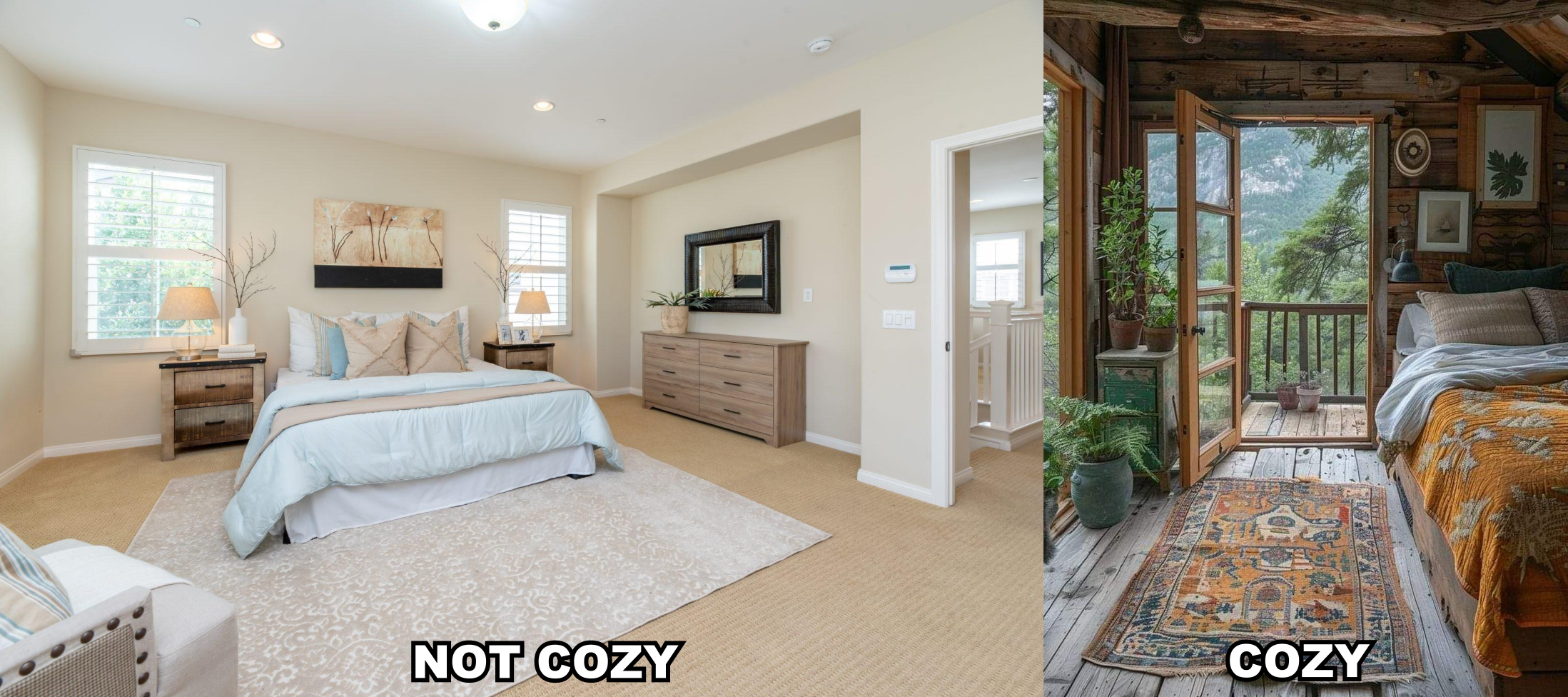
Maybe it sounds like I’m being over-dramatic. Surely normal houses shouldn’t be having this kind of effect on people? I don’t know, I’m coming from an unusual perspective: I grew up in a simple off-grid cabin that my parents built by hand and that’s what I’m used to. I feel subtly or not-so-subtly uncomfortable in most modern spaces. But what I can say is that my girlfriend grew up in the suburbiest suburb you can imagine, and when we moved into the rusty, tilty old bus that my parents lived in back in the 70s when they were building their house, we both started getting the best sleep of our lives.5 Is it the low domed ceiling textured with thick coats of old peeled paint? Is it the 360 degree strip of rounded windows that let in moonlight filtered through tree branches and the sounds of owls and insects? Is it the door that fell off its hinges, keeping us bathed in fresh air? Is it the absence of any buzzing appliances or even the electric fields of wires and wifi? Maybe it’s weight of the giant buffalo skin that we pull over ourselves when it gets a little chilly. Maybe it’s all these things together, it’s hard to say.
Whatever the secret, it’s a sort of opposite to the standard American bedroom. It may seem primitive at first glance—it’s full of spiders and I regularly have to catch wasps and take them outside—and yet it’s also incredibly cozy. So cozy that it’s hard for us to leave, but we’re on vacation in the mountains right now. Last night we stayed in a hotel, and I woke up to find Alex gone. There was a text on my phone from the middle of the night saying she couldn’t sleep and had gone out to the car, where we’d made a cozy little nest with camping pads and a sleeping bag on the folded back seats. The electric fan circulated fresh air and the sturdy frame made a sheltering space overhead even as the glass roof let filtered starlight in. It may be a space-age electric car but, by getting in touch with our ancestral instincts, we were able to make it cozy. I guess what works for a backpack can work for a hatchback, and I think anyone can do this, because it’s deep in our bones. She slept great.
When I read about Temple Grandin’s hug machine, this helped me understand the appeal of it. She was inspired to build the hug machine when she noticed how cattle put into a squeeze chute for injections became very calm, maybe because the deep pressure on their sides reminded them of being squeezed in the middle of a herd where they would be safe from predators. I think even with humans there’s probably a connection between pressure and feelings of social connection and support, hence the warm hug.
My guess is that cultures from other kinds of climates would have similarly important words but for different feelings. For example, I don’t speak Arabic but the word فيء, meaning shade, especially the shade of trees, might have similarly pleasant associations for desert dwellers, for whom being warm and dry isn’t so special. Apparently the same word is used figuratively to talk about rest, comfort, protection, and benefit. Compare to English where “throwing shade” or “being in someone’s shadow” have negative connotations.
Even if you’ve never built a house, maybe you’ve experienced this when camping in a wilderness area, where either you learn to make a cozy place for yourself or you have a terrible time. Yet even here we tend to rely on industrially manufactured tents, sleeping bags, clothing, etc.
I think a good rule of thumb is that a window shouldn’t look like someone could walk in through it. At some deep level our brains don’t know about glass, or maybe do know but also know that it’s not very hard to smash through.
Intriguingly, neither of us snores there, though we sometimes do in hotel rooms. Snoring is usually thought of as a personal bodily issue, so I’m fascinated that it could have an environmental component.
No posts
Comments
Nothing yet. Say the first thing.
Sign in to join the conversation.