
Happy Father’s Day to those who celebrate.
Happy Summer Solstice to those who celebrate.
For the next few minutes I want you to focus more on the later than on the former. Last week I spent some time talking about the various ways we can think about market breadth - this week the focus will be on trends.
For the past six months, days have been getting longer in the Northern Hemisphere. Back on December 21, 2025, sunrise in Milwaukee was 7:19am and sunset was 4:19pm, giving us 9 hours of daylight. Today (June 21), sunrise was 5:11am and sunset is 8:36pm, giving us 15 hours and 25 minutes of daylight. Every day has brought more daylight than the previous day - that is a trend that I have definitely enjoyed. While I will continue to enjoy the ample amounts of daylight that summer in the upper Midwest brings, I know that each day will bring less than the previous until we get to the third week of December and the trend reverses and the cycle begins anew.
Not all trends are so clear cut - but that does not mean they don’t exist. We can predict with certainty with the day and time of the winter and summer solstices for years into the future. We cannot (or at least should not try to) predict peaks and troughs in the S&P 500 or any other financial market index. When it comes to investing, we might not know where we are going, but we can see where we are heading. And we can use that to our advantage.
Let’s return to daylight for a moment of indulgence and then we will get to some charts and market commentary. A careful observer of sunrises and sunsets would have noted that December 22 brought more daylight than December 22 and December 23 brought more daylight than December 22. An especially careful observer would be able to notice that the increase from the 22nd to the 23rd was greater than the increase from the 21st to the 22nd. The pattern of more daylight and increasingly more daylight could be observed from December through March. After March, the amount of daylight continued to increase, but at a consistently slower pace than the day before. That brings us to today and the summer solstice. Momentum peaked in March, the trend peaked in June and every day for the next six months brings less daylight than the day prior, with the rate of loss peaking in September.
These well-defined and regular celestial trends provide a useful context for thinking about financial markets. I don’t need to know in advance when the summer or winter solstice will occur to know whether days are getting longer or days are getting shorter. We can observe, make inferences and act accordingly. There may be uncertainty around peaks and troughs, but most of the daylight gains and losses occur around the equinoxes (not the solstices), once the trend is well underway.
This is a long-winded way of saying the following: don’t try to pick tops and bottoms, but definitely stay in harmony with the underlying trend. It’s not about predicting an uncertain future, but embracing what each day brings. Headlines come and go, trends persist.
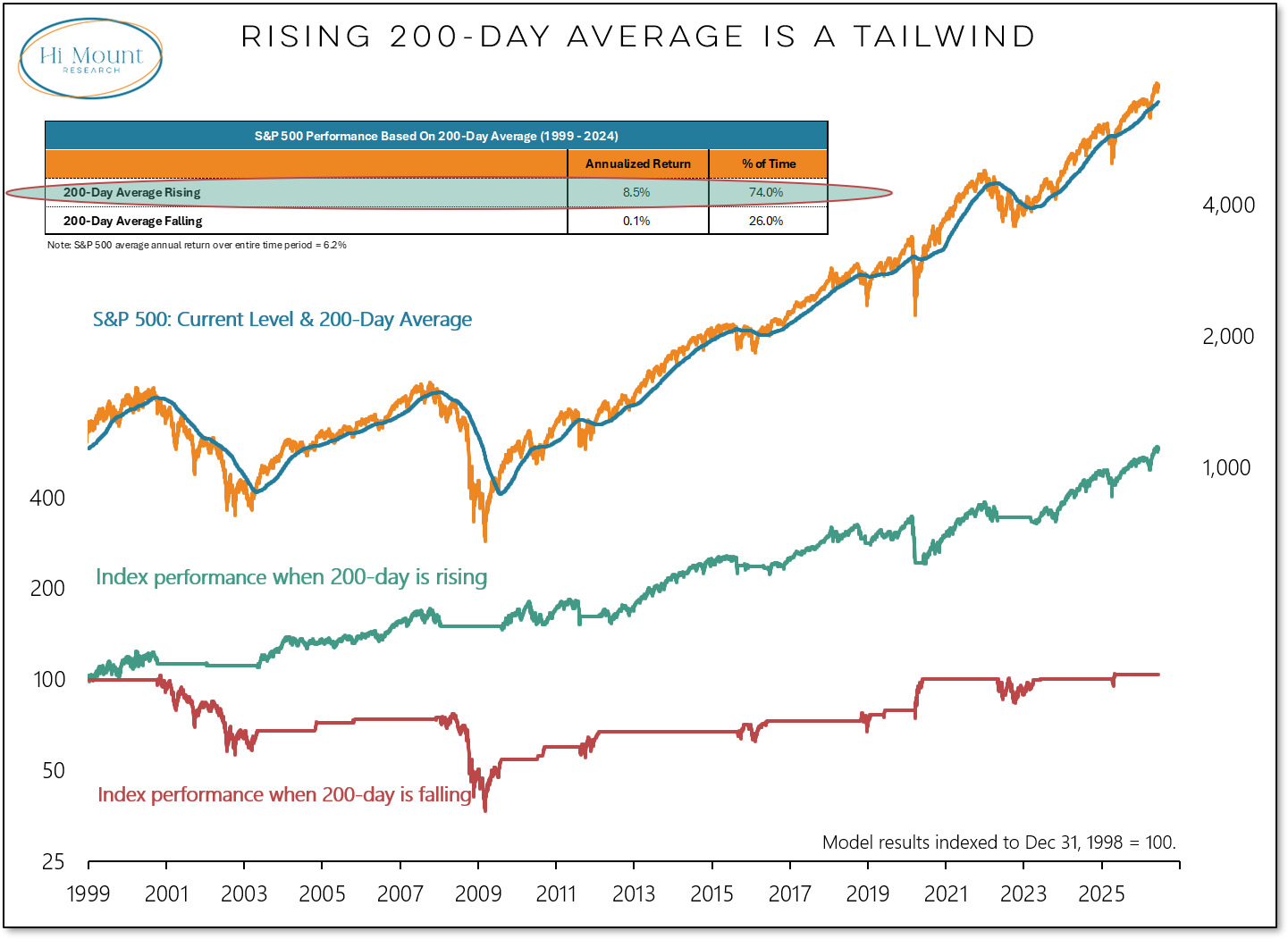
The key (and there is always a key) is in defining the trend. For example, the performance of the S&P 500 when it is above its 200-day average is not meaningfully different vs when it is below its 200-day average. That is not a useful signal. A more useful signal is whether the 200-day average is rising or falling. When the 200-day average is rising (like it is now) the S&P 500 accumulates gains and patient investors are usually rewarded. When the 200-day average is falling, investors endure volatility with little or no aggregate reward.
Comments
Nothing yet. Say the first thing.
Sign in to join the conversation.