
UNDER THE HOOD · Issue 02
The moment where confusion turns into clarity.
Before you use it, understand it.
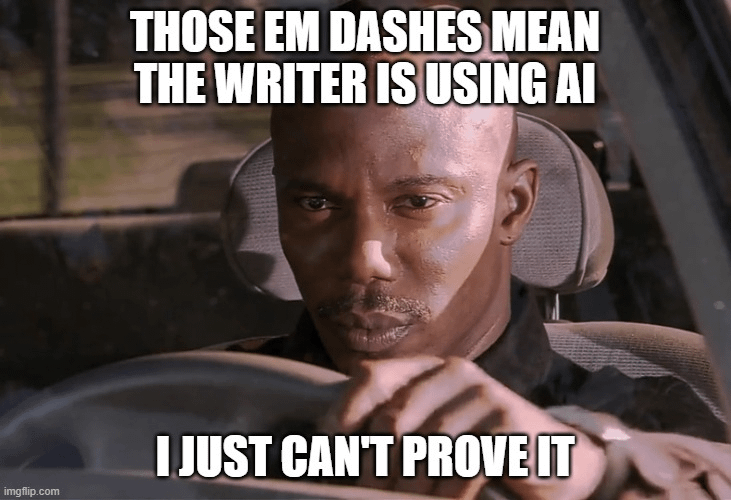
The disproportionate use of em-dashes (—), contrastive sentence structures such as “It is not X, but rather Y,” and highly formulaic formatting (bullet points, bold text, emojis, and repetitive transition words) are among the most recognizable traits of modern AI-generated text.
To help you understand why this happens and how to fix it, this guide breaks down the underlying technical mechanics that drive these patterns:
training
reinforcement learning
token probability
To understand why LLMs write this way, you must look at how they are trained and aligned.
Models do not write like natural humans because they are optimized to satisfy a specific mathematical reward system.
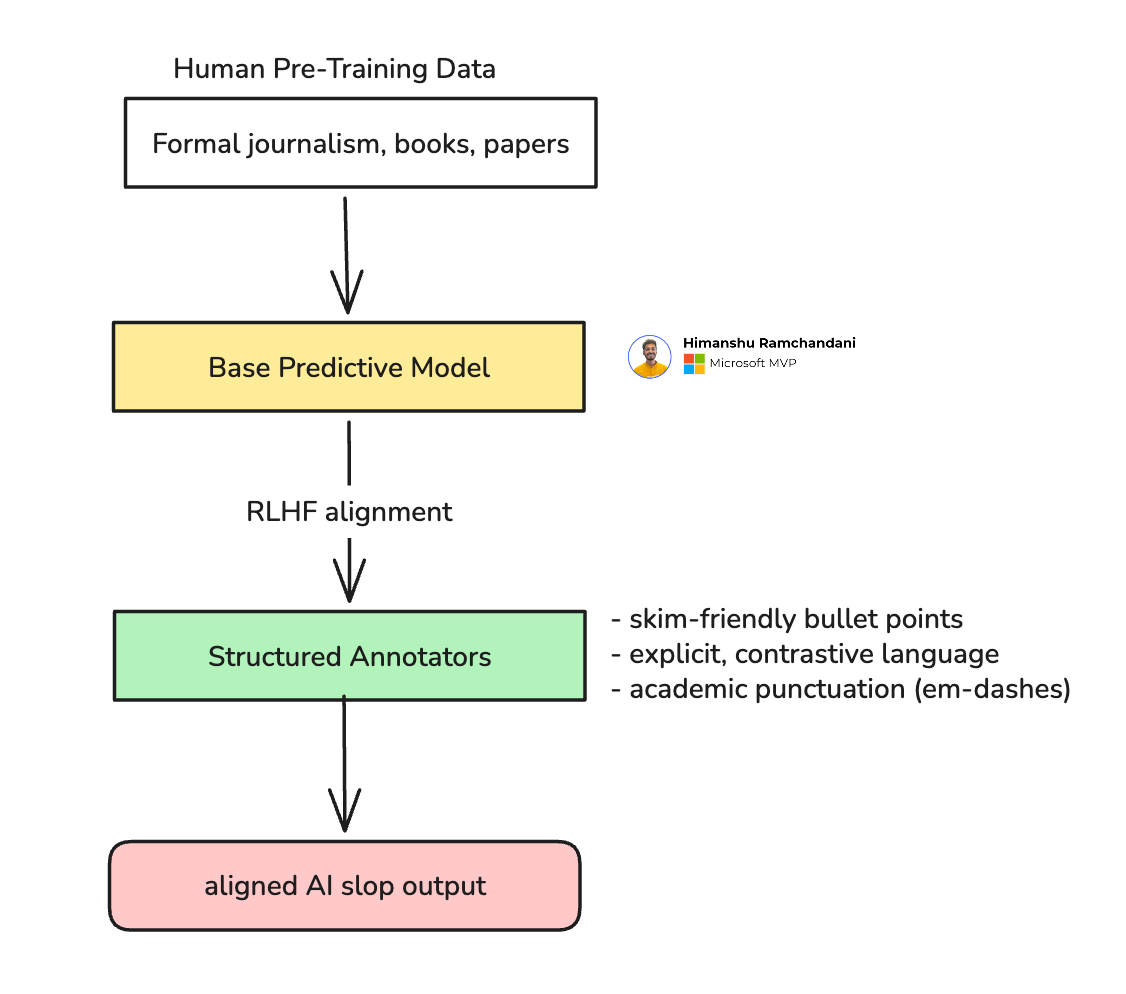
If LLMs are trained on human-written web text, and humans rarely use em-dashes in everyday writing, why does AI text use them constantly?
Here are some common causes for it:
During pre-training, data curators filter the internet to remove low-quality text (such as casual social media posts, chat logs, and unedited comments).
They prioritize high-quality, edited, and formal text, including:
published books
academic papers and scientific journals
professional journalism (like New York Times, The Economist)
structured documentation and Wikipedia
In these formal, heavily edited mediums, the em-dash is a common punctuation mark used to insert explanatory clauses without breaking a sentence’s flow.
Because the model’s pre-training data is heavily skewed toward this subset of formal writing, its baseline token probability distribution favors the em-dash over simpler conversational punctuation.
During Reinforcement Learning from Human Feedback (RLHF), human annotators grade different model outputs.
Annotators consistently reward outputs that look:
comprehensive
authoritative
expertly written
To appear sophisticated, models use nested sentence structures.
The em-dash is a highly efficient token pattern for this task:
Simple: ”The database crashed because the disk was full. This halted our servers.”
AI Style: ”The database crashed—a direct consequence of storage exhaustion—halting our servers.”
Because the nested sentence appears more cohesive and academic, RLHF annotators rate it higher.
Over millions of training steps, the model’s weights adjust to favor the em-dash token sequence, leading to its over-representation in production.
The constant use of contrastive framing (e.g., “AI is not a replacement for human work; rather, it is a collaborator”) is a linguistic pattern driven by the model’s optimization for consensus.
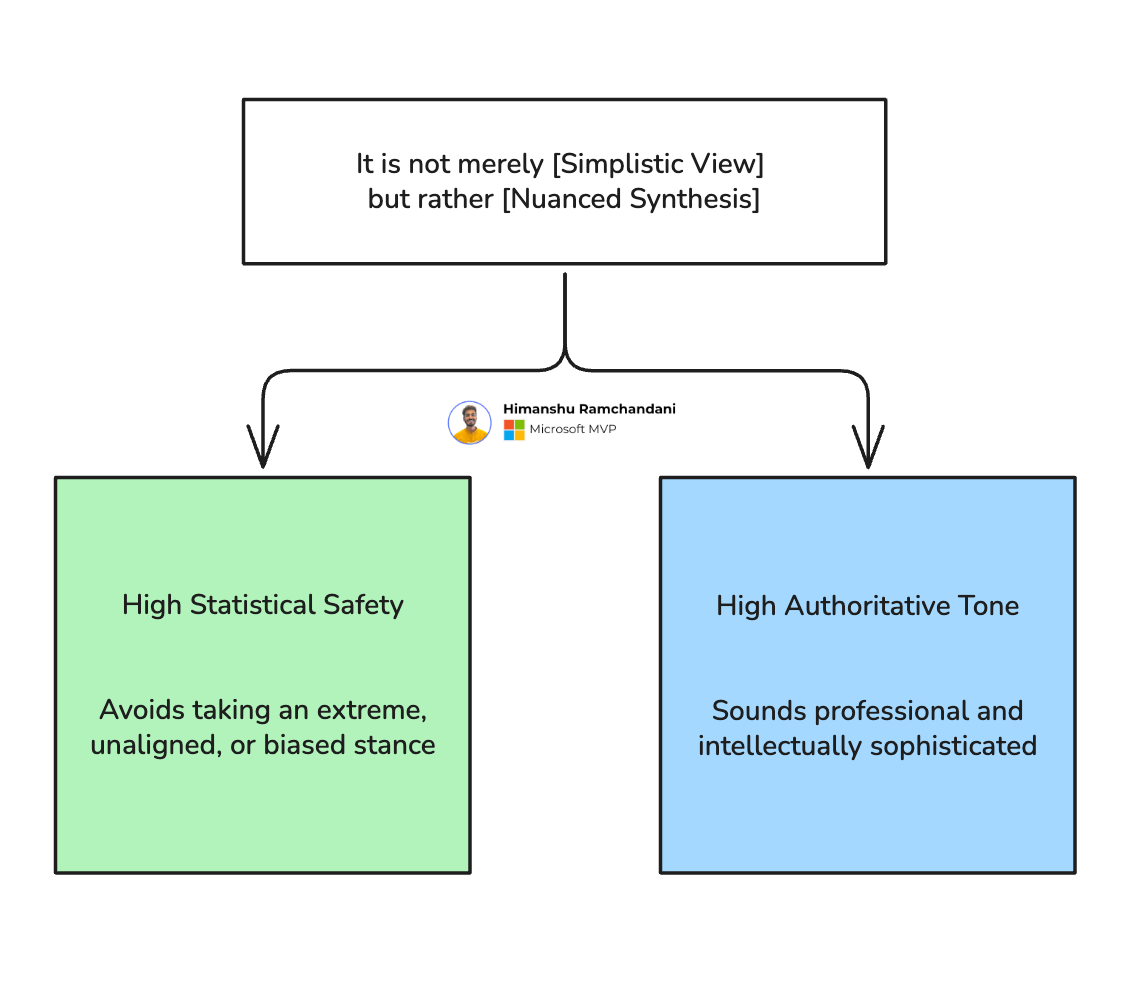
Model providers train LLMs to avoid making overly simple, biased, or extreme claims.
If a user asks a model to define a complex topic, a simple, one-sided answer might violate safety or neutrality guidelines.
The contrastive structure “It is not merely [Simplistic View], but rather [Nuanced Synthesis]” is a highly effective way for the model to generate a safe, neutral response.
It allows the model to address and reject a potential misconception while presenting a balanced, compliant answer in a single sentence.
Because LLMs cannot experience true conviction, they rely on classic rhetorical templates to sound persuasive.
Contrastive structures are common in persuasive writing and public speaking because they establish clear emphasis.
The model uses this template as a shortcut to make its statements sound profound, even when the underlying concept is simple.
To remove these artificial patterns and generate text that reads like natural human writing, you must adjust both your system prompts and your API configurations.
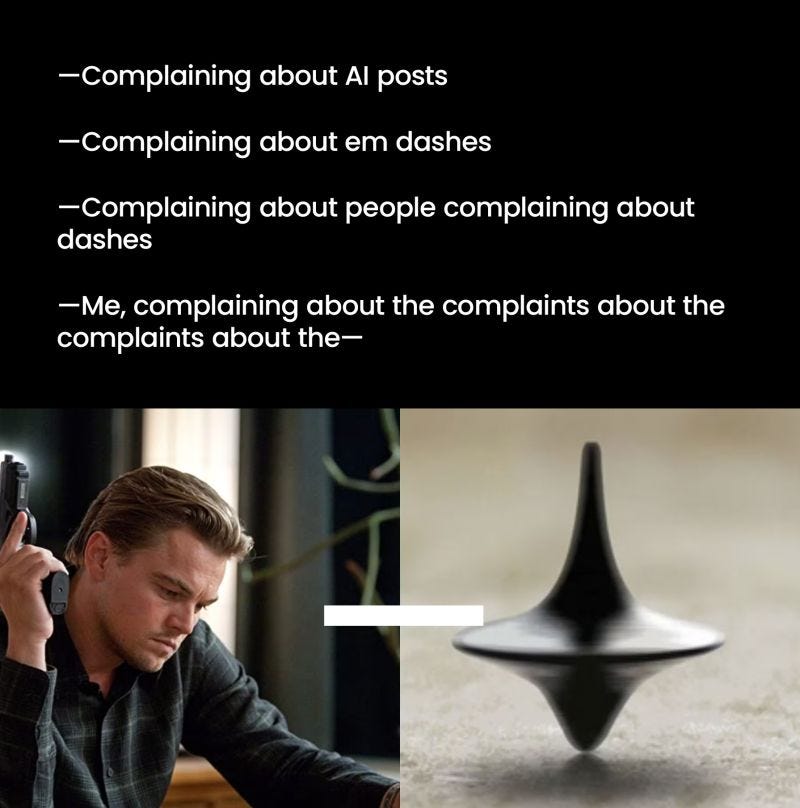
To eliminate artificial patterns, you must provide the model with explicit instructions detailing what styling elements to avoid.
The Anti-AI Slop System Prompt Template
Add this instruction block to your system prompts or custom instructions to strip out the model’s default stylistic habits:
[STYLE & FORMATTING DIRECTIVES]
1. WRITING STYLE: Write in a natural, conversational human tone. Avoid academic pretension, marketing hype, and overly formal transition words.
2. SYSTEM BANS:
- Never use em-dashes (— or --) for parenthetical clauses. Use commas, parentheses, or start a new sentence instead.
- Never use contrastive framing templates like “It is not merely [X], but rather [Y]” or “Not only [X], but [Y].” State your points directly.
- Do not use the words: delve, tapestry, testament, foster, moreover, utilize, key, rapidly, dynamic, landscape, or revolutionize.
3. STRUCTURE:
- Do not default to bulleted lists unless explicitly requested. Write in continuous, varied paragraphs.
- Vary your sentence lengths. Write some short sentences (under 10 words) to establish a natural rhythm.
- Avoid generic concluding paragraphs that start with “In conclusion,” “Ultimately,” or “In summary.” End the text on your final, active point.
The most effective way to teach a model how to write like a human is to provide concrete examples of actual human writing within the prompt.
This is called Few-Shot Prompting.
You are an expert editor.
I want you to write a brief update about our database migration.
Analyze the human-written examples below and replicate their exact syntactic style: shorter sentences, simple punctuation, conversational flow, and a lack of formal transition words.
[HUMAN EXAMPLE 1]
“We migrated the database last night. The process took about three hours. We hit a small snag with index alignment on the user table, but the team patched it quickly. Everything is running fine now and latency is down by 20%.”
[HUMAN EXAMPLE 2]
“The new update is live. We cleaned up the old API routes that were causing memory leaks. You should see faster page loads immediately. Let us know if you find any bugs.”
[YOUR TASK]
Now, write an update about our server security patch following the exact style, length, and rhythm of the examples above. Do not use bullet points, em-dashes, or formal transition words.
If you are calling LLMs programmatically via API (e.g., using OpenAI, Anthropic,
or vLLM), you can adjust the model’s generation parameters directly to disrupt
these repetitive patterns.
temperature=0.9 & top_p=0.9 standard models default to a conservative temperature (e.g., 0.7 or lower), which forces them to choose the safest, most predictable words (like “delve” or “tapestry”).
Raising the temperature to 0.9 forces the model to select slightly less common, more natural word combinations.
frequency_penalty=0.5 this setting applies a mathematical penalty to tokens that have already appeared in the text.
This prevents the model from repeating its favorite transition words, punctuation marks, or sentence templates during generation.
You join me and 50 other builders.
We build these 10 Artifacts in 8 Weeks.
You leave with a deployed portfolio that makes recruiters drool.
I am not selling information. Information is free.
I am selling Execution.
If you want to stop building wrappers and start building systems...
[CLICK HERE TO SECURE YOUR SPOT - COHORT 2]
Build 4 new artifacts Live and get 6 instantly. Total 10 Artifacts.
Let’s build.
Comments
Nothing yet. Say the first thing.
Sign in to join the conversation.