
The AI Field Report | Every Quarter
What the people building AI actually disagree on, and why that’s your opening.
The smartest person in AI right now might be the one who told you he has never felt more behind.
Andrej Karpathy said that earlier this year.
The guy who coined vibe coding.
If he feels behind, sit with that for a second before you decide you understand where this industry is going.
I pulled these ideas from research papers, podcast transcripts, funding filings, and a few uncomfortable admissions from people who run the labs.
Some of these will contradict each other.
Good.
The industry itself has not agreed on anything yet, and anyone selling you certainty is selling you something.
Skip to the list at the end if you want the fast version.
Read the whole thing if you want to actually use it.

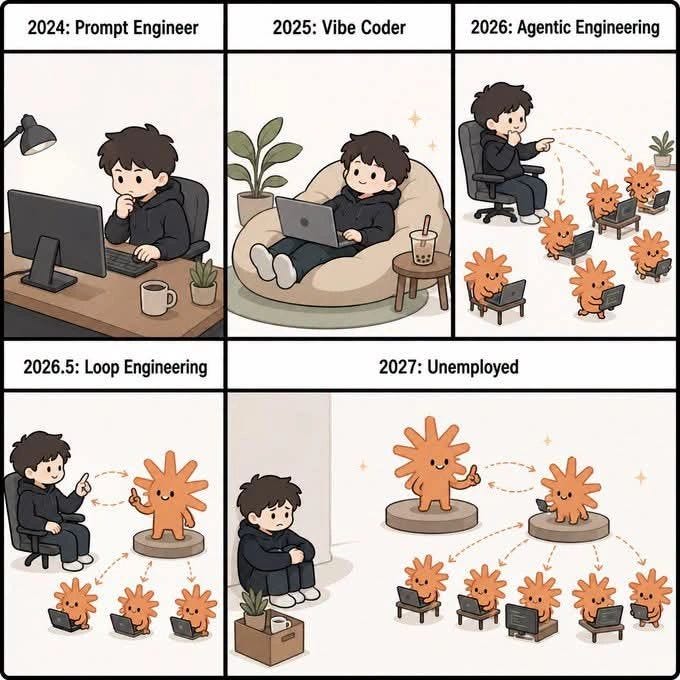
For 30 years, a programmer’s ceiling was how fast they could think and type at the same time.
That ceiling is gone.
Through late 2025 and into 2026, Karpathy was spending 16 hours a day directing coding agents instead of writing code by hand.
In his own words, he had to “express his will” to his agents, not his fingers.
What replaced typing speed is judgment.
Task decomposition.
Knowing which output to trust and which to throw away
Verification
The stuff that used to be a small slice of a developer’s day became the whole job.
Here’s the twist that makes this idea sharper, not weaker: in May 2026, Karpathy joined Anthropic to run a research team inside its pretraining group.
The person who built his reputation on staying independent, directing swarms of agents solo, walked back inside a frontier lab within months.
He’d already said the honest part out loud before he did it: staying outside means your judgment drifts, because the models are opaque and you need to be inside to really understand how they work.
Even the person most convinced that management-of-agents was the whole future decided he needed the lab’s raw materials to keep that judgment sharp.
If your team is still hiring for typing speed, you are hiring for 2019 (Check AITalentStudio.co - vetted AI talent)
Ilya Sutskever, the researcher who built GPT-3’s architecture, said in late 2025 that the “age of scaling” is over.
From 2020 to 2025, the industry ran one recipe:
more data
more compute
bigger model
better result
It worked so well that, in his words, it sucked “all the air out of the room.”
Every lab did the same thing because it kept working.
Now compute is cheap enough that it’s not the constraint anymore.
New ideas are.
And here’s the part that stings: there are more companies than ideas by quite a bit.
A hundred startups, one thesis, copy-pasted.
If you’re building something and your pitch sounds like everyone else’s pitch, you don’t have a company.
You have a seat at a crowded table.
Yann LeCun spent 12 years as Meta’s chief AI scientist.
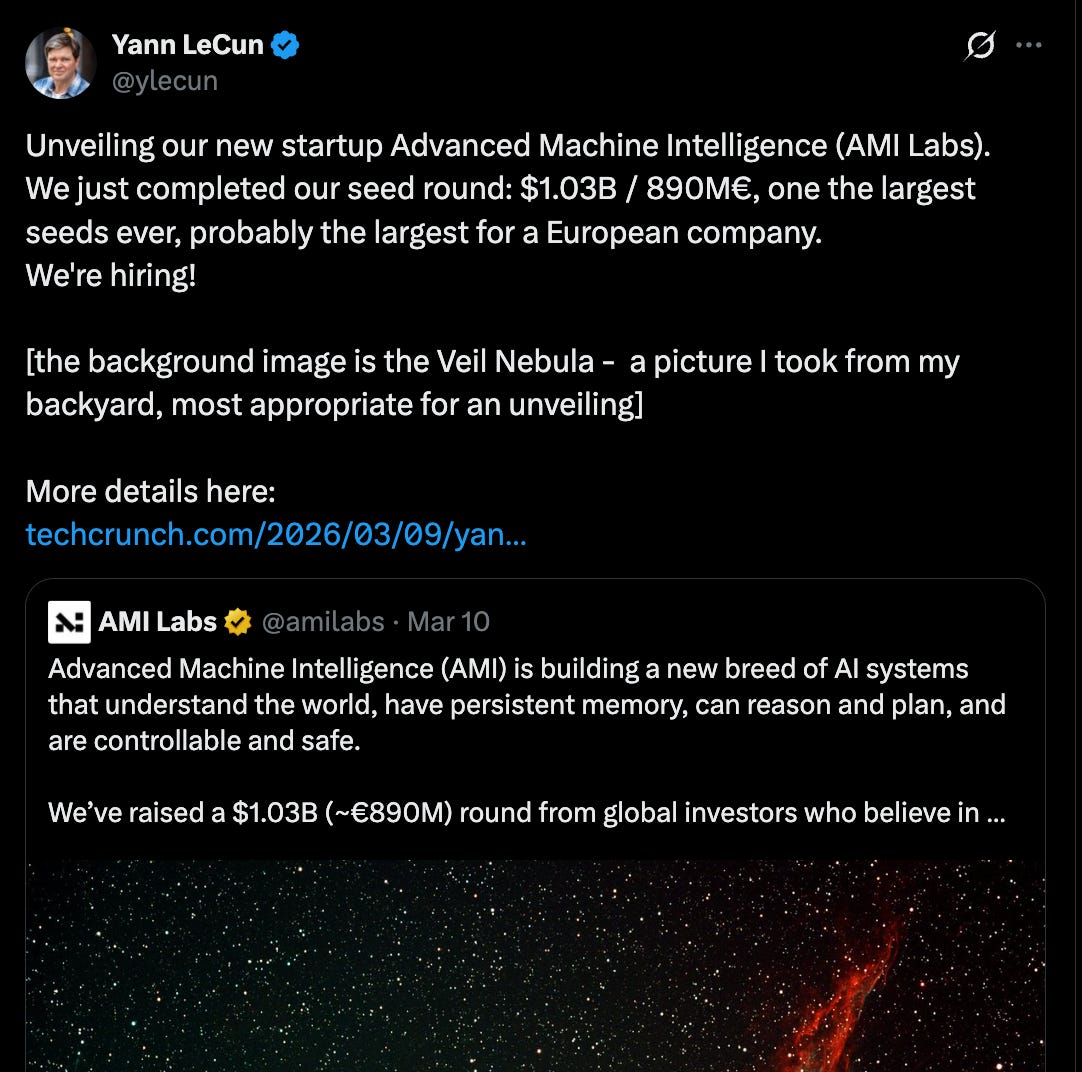
In November 2025 he told Zuckerberg he could move faster outside, then left to build a company betting that large language models are a dead end for real intelligence.
His startup, AMI Labs, raised $1.03 billion in March 2026, the largest seed round in European history, backed by names like Nvidia and Bezos Expeditions.
As recently as this month, at a conference in Seoul, his co-founder was still making the same case:
LLMs don’t understand physical reality the way an embodied system needs to.
Here’s why this matters more than the drama.
LeCun has been early and right before, back when neural networks were a punchline.
He might be early and right again.
Or he might be the smartest person in the room chasing the wrong decade.
Nobody knows yet, including him.
The lesson is that the people building the actual frontier don’t agree on what the frontier even is.
Turing Award credentials do not buy you certainty.
If the inventors are split, you don’t need an opinion this week.
You need optionality.
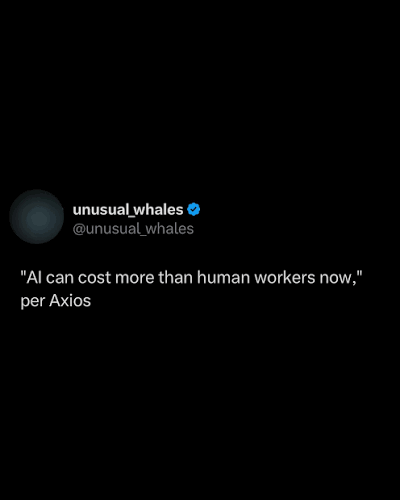
GPT-4 to GPT-4o made inference roughly 100x cheaper.
Usage went up by roughly 1000x.
That’s not a rounding error, that’s the Jevons paradox doing exactly what it did to coal in 1865:
cheaper fuel doesn’t mean less burning, it means more machines built to burn it
Every time a model gets cheaper, the market doesn’t shrink to fit the old budget.
It expands to eat the savings and then some.
If your business plan assumes AI costs will flatten out and stay flat, you are planning for a world that has never once existed since ChatGPT launched.
MIT looked at 300 enterprise AI deployments in 2025.
95% percent delivered zero measurable P&L impact.
Not because the models were bad.
Because the tools were generic, brittle in real workflows, and couldn’t retain feedback or adapt to context.
Here’s the detail that should reshape your roadmap:
buying from a specialized vendor and building a real partnership succeeded roughly 2x as often as building it in-house, alone.
the highest ROI was in boring back-office automation nobody puts on a conference slide
By mid-2026, enterprise buyers had gotten sharper about it, not softer.
Surveys of IT decision-makers this year show direct financial impact nearly doubling as the metric companies actually hold AI to, while it saved us time fell out of favor as an excuse.
Uber burned through its entire 2026 AI tooling budget in 4 months and responded not by cutting AI, but by capping spend per tool per employee and tracking it on a dashboard.
That’s a company finally treating AI spend like a real budget line instead of a hype line.
Boring wins.
Flashy gets funded, then gets capped.
Karpathy has a phrase for why AI can write a working web app in one shot and then fail at something a 10-year-old could do: jaggedness.
Labs train these systems with reinforcement learning against things you can verify, math answers, passing unit tests, and benchmark scores.
So models get frighteningly good at anything with a clean scoreboard, and stay rough everywhere else.
Traditional software automated what you could specify.
This generation of AI automates what you can verify.
That single idea tells you where the next few years of automation land first.
coding
math
structured compliance checks
anything with a pass/fail signal
It also tells you where it lands last: judgment calls, nuance, taste, anything where two experts might reasonably disagree.
A 2026 study tracking over 100,000 GitHub developers found coding agents drove a 741% jump in lines of code and a 65% jump in pull requests, but actual shipped software releases only rose 20%.
The issue was humans reviewing, testing, and deciding what was safe to ship.
Verification didn’t disappear, it just moved to the reviewer’s desk.

Karpathy built something he calls AutoResearch.
He let an AI agent run continuously for 2 days, testing changes to a small language model’s training process.
700 experiments later, it had found 20 optimizations that sped up training.
Applied to a slightly bigger model, those tweaks delivered an 11% speedup.
Shopify’s CEO tried the same approach on internal data overnight and got a 19% performance gain from 37 experiments.
Karpathy’s own description of where this goes next: spin up a swarm of agents, let them tune smaller models in parallel, promote whatever works to bigger and bigger scales, and let a human step in only at the edges, if at all.
Read that again.
If at all.
The hottest new programming language is English, Karpathy said and by now it’s not even a hot take, it’s just the weather.
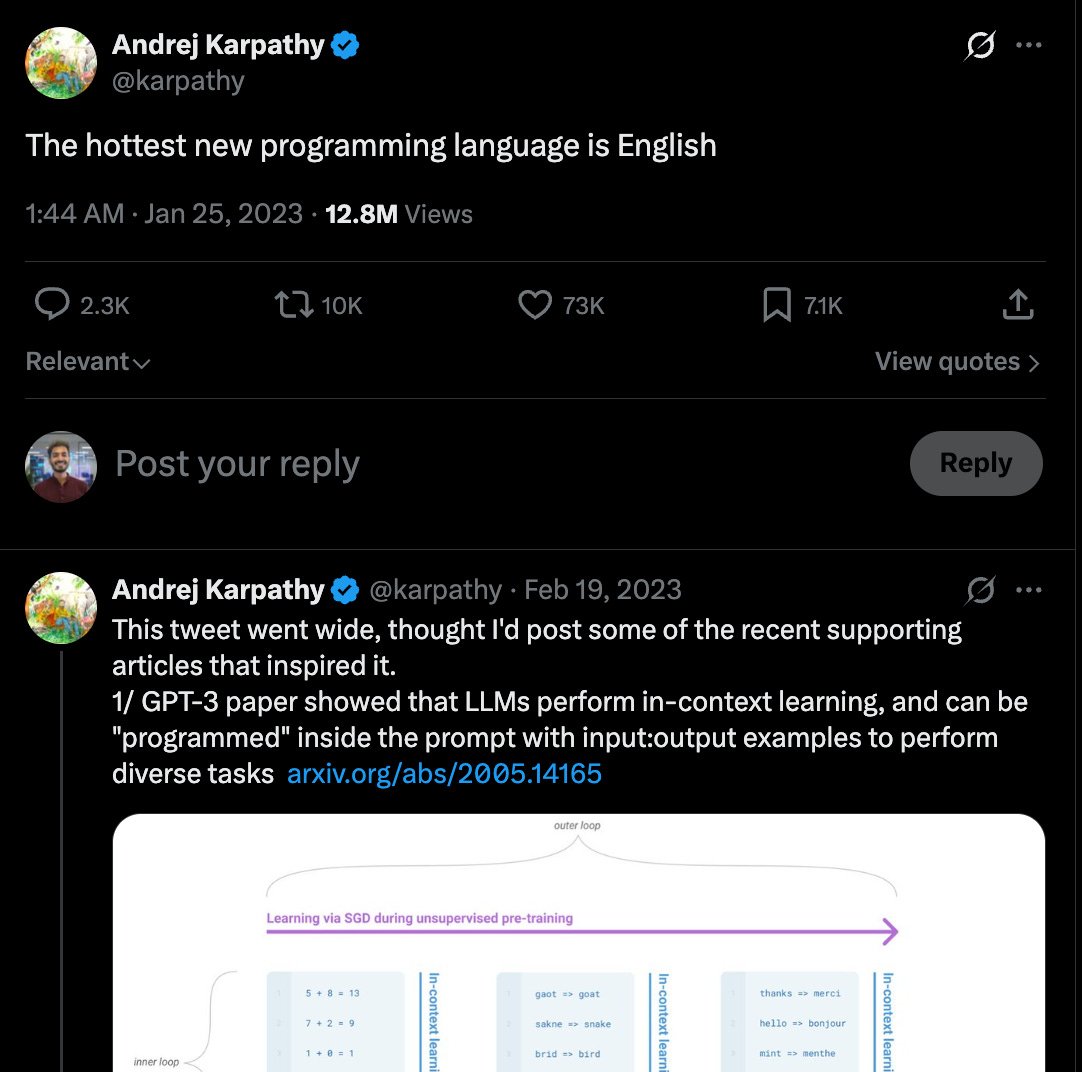
Syntax stopped being the skill.
Prompting well, thinking clearly, and knowing what a correct answer looks like before you see it, that’s the skill now.
Which means the advantage shifts to people who were always good at clear thinking and bad at semicolons.
If you spent years feeling like the “non-technical” one in the room, this is your unlock.
If you spent years being the best at syntax and nothing else, this is your warning.
For years people argued about whether a 10x engineer was a myth.
Karpathy’s take: agentic engineering doesn’t just confirm the 10x engineer, it blows past it.
The ceiling on what one well-directed person can ship went up by an order of magnitude nobody has fully measured yet.
But the floor also rose.
Anyone can generate a working prototype in an afternoon now, that’s vibe coding, and it raises the floor for everybody.
The ceiling only rises for people who add judgment on top:
knowing what’s actually good
what will break in production
what to throw away
Raw output stopped being the differentiator months ago.
Taste is the differentiator now, and taste is exactly the thing you can’t prompt your way into.
Karpathy tells a story about building a home automation app.
The deeper point is that the most software exists because humans need a screen to navigate:
menus
dashboards
onboarding flows
An agent doesn’t need any of that.
It needs a clean API, good documentation, and reliable permissions.

Google and Microsoft are already co-authoring a new web standard for exactly this.
It lets websites expose their functions directly to agents, instead of forcing agents to guess at pixels on a screen.
Early numbers on it: close to 98% execution accuracy versus roughly 70% for agents that have to visually parse a page, with up to 89% fewer tokens burned doing it.
The next wave of valuable infrastructure won’t be user-native.
It’ll be agent-native.
Most founders are still building the old kind.
You can check the web for agents by parallel.ai (founded by Parag Agrawal, the former CEO and CTO of Twitter)
Here’s a thought that should worry anyone in a safe regulated profession.
Traditional computers automated what you could code explicitly.
This generation automates what you can verify.
A lot of professions people assume are protected by complexity are actually protected by nothing more than the fact that nobody has built the verification loop yet.

Once someone builds it, the moat disappears fast, not gradually.
This cuts both ways for anyone building in energy, healthcare, defense, or law enforcement.
The domains without a clean scoreboard yet are exactly where deep domain expertise still beats a generic model, because nobody outside the industry knows what correct looks like well enough to build the reward signal.
That’s not a permanent moat.
It’s a lead.
Leads close.
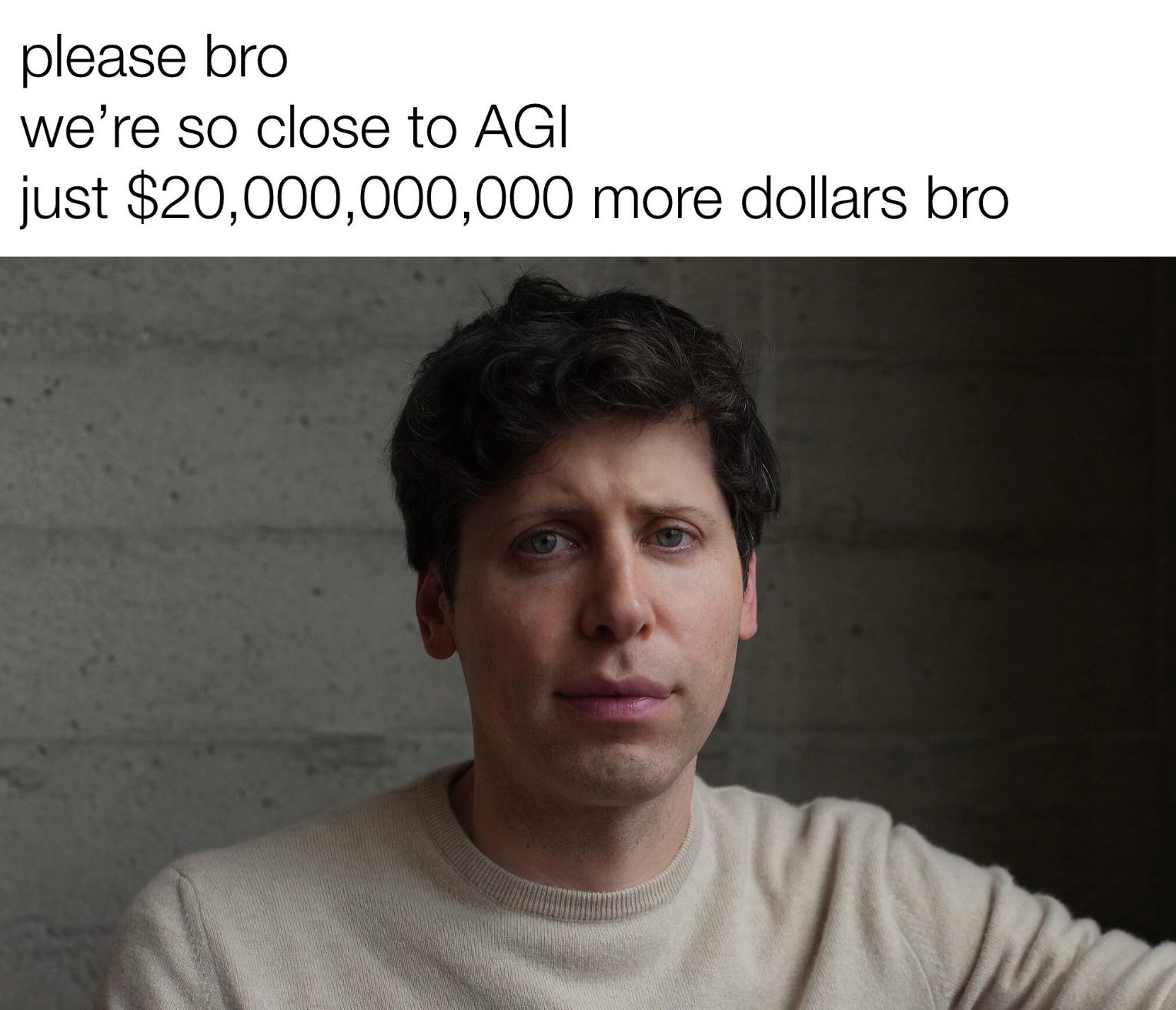
Sutskever says the scaling era, and with it the old timelines, is over.
Geoffrey Hinton says scaling still has room to run because models will start generating their own training data.
Dario Amodei has said scaling alone gets us there.
Demis Hassabis gives AGI a 50% shot by 2030 and says push scaling as hard as possible anyway.
LeCun calls the entire premise complete bullshit, and this year Anthropic separately published research claiming to have found something like a structured internal workspace inside Claude, which reignited the same argument from the opposite direction.
These are not fringe voices.
These are the people who built the field, disagreeing in public, on the record, at the same moment in time.
Anyone in your feed who states a confident AGI date, in either direction, is doing marketing, not forecasting.
Open weights, cheap APIs, and shrinking price-per-token mean the raw model is becoming a commodity faster than most roadmaps account for.
What doesn’t commoditize as fast:
the workflow it’s wired into
the proprietary data it sees, the vertical-specific verification loop that tells it whether it got the answer right
the trust built up with a regulated buyer who can’t afford a wrong answer
MIT’s own data backs this up sideways.
The pilots that worked were the ones wired tightly into a real back-office workflow, usually through a vendor partnership rather than a from-scratch build.
Whoever owns the workflow owns the customer.
Whoever only owns the model is one price cut away from irrelevance.
The instinct is:
AI gets cheaper
companies need fewer people
jobs vanish
That’s half the Jevons story.
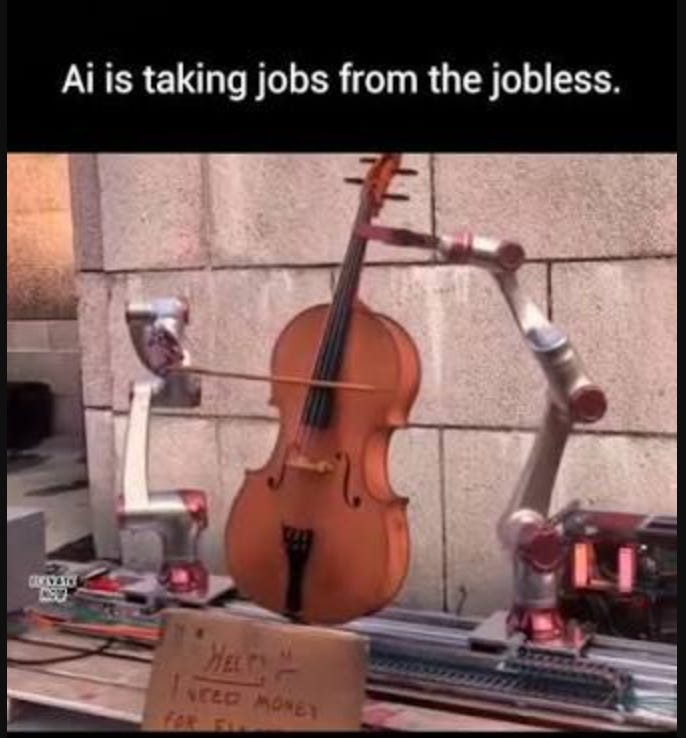
The other half:
enterprise AI bills have kept climbing even as per-unit cost dropped
because falling prices unlocked entirely new use cases nobody was doing before
data center construction alone is creating steady demand for electricians
civil engineers, and facility managers who have nothing to do with prompting anything
The jobs that vanish are the ones sitting entirely inside a verifiable, narrow task.
The jobs that multiply are the ones adjacent to the infrastructure boom, or the ones requiring the judgment a model still can’t fake.
Same technology, two opposite outcomes, depending entirely on which side of the verification line your work sits on.
If agents start transacting with each other, hiring each other, paying each other, you hit a wall humans never had to think about:
an AI agent isn’t a fixed, continuous entity the way a person is
it can be cloned in seconds
its behavior shifts with a prompt change
it has no memory once the context window closes, and it feels no cost when its reputation gets destroyed, because there’s no one home to feel it
Every mechanism that keeps human reputation systems honest
the fact that a criminal record follows you
the fact that a bad review costs you future business
the fact that shame is a real deterrent, breaks down the moment the actor isn’t a continuous being
Researchers are now proposing staked collateral and cryptographic identity to patch this.
Nobody has solved it in production yet.
Whoever owns a piece of infrastructure that the entire agent economy will need.

Everyone’s excited about vibe coding because it made building look easy.
And it did make building look easy.
That’s the floor moving up:
a non-technical founder can now ship a working prototype over a weekend.
But agentic engineering, coordinating multiple agents while preserving professional-grade quality, is a completely different skill, and it’s the one that actually compounds.
Most people chasing the AI gold rush right now are optimizing for the floor.
Faster prototypes, more demos, louder LinkedIn posts about what they shipped in a weekend.
Very few are optimizing for the ceiling:
the judgment layer that turns a fast demo into something that survives contact with real customers, real edge cases, real regulatory scrutiny.
The floor is crowded.
The ceiling is nearly empty.
This is the problem I am solving at masterdexter.io
Every pitch deck this year uses the same words:
agentic
autonomous
transformative

MIT’s data says the actual money sits in back-office automation, the least glamorous category that exists:
document processing
internal workflows
compliance checks
It got the least funding and the highest return.
And in 2026, enterprise buyers went further:
they now hold every AI purchase to a P&L standard
not a we saved some hours standard
If your pitch deck sounds exciting, that might be the problem, not the selling point.
Exciting pitches compete for the same investors chasing the same thesis.
Boring, verifiable, workflow-embedded problems compete for almost nobody.
Step back and look at what you just read.
The co-founder of OpenAI felt so behind that he went back inside a lab.
The architect of GPT-3 says the entire recipe that built GPT-3 is exhausted.
A Turing Award winner staked his legacy on the opposite bet from everyone still funding LLMs at scale, and a billion dollars says he might be right.
95% percent of enterprise pilots using the current technology still produce nothing, a full year after that number first got published.
That’s an industry where the map hasn’t been drawn yet, and the people usually paid to draw it are openly arguing about which direction is north.
Every genuinely early market looks exactly like this from the inside:
confusing
contradictory
and full of very smart people who are all convinced they’re right
Pick one thing you’re building or selling and run it through 4 questions:
Does it live in a domain with a clean scoreboard (verifiable), or a domain with no scoreboard yet (judgment)? That tells you your real timeline before you get automated or before you get an opening.
Is it wired into someone’s actual back-office workflow, or is it a shiny demo sitting next to their workflow? MIT already told you which one gets funded and which one gets forgotten in six months.
Are you optimizing the floor (how fast you can prototype) or the ceiling (the judgment layer nobody can copy)? Pick one on purpose instead of drifting into whichever one felt easier this week.
If the smartest people in this field can’t agree on the next eighteen months, what are you doing holding a strong opinion about the next five years? Build for room to change your mind, not for a forecast.
None of this is settled.
That’s the whole point.
Next post, I’m going deeper on what agent-native infrastructure actually looks like for regulated industries specifically, the gap the big generalist players still haven’t touched.
Subscribe if you don’t want to miss it.
The AI Field Report | Every Quarter
What the people building AI actually disagree on, and why that’s your opening.
The next report will be after 90 Days.
Comments
Nothing yet. Say the first thing.
Sign in to join the conversation.