
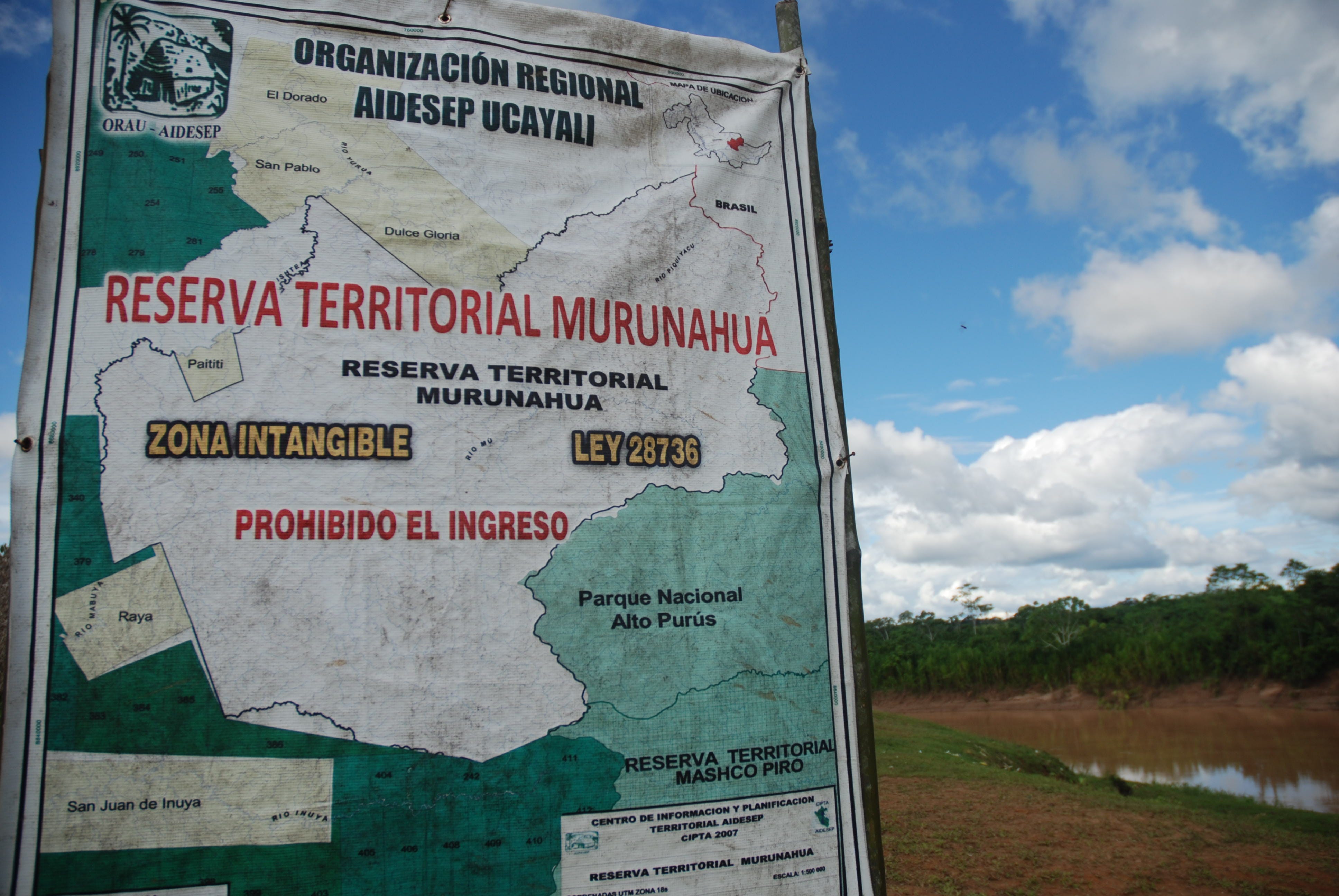
20 years ago Peru introduced a law explicitly recognising the existence of indigenous people living in “isolation” (IPI) in the remotest parts of the Amazon rainforest, sometimes misleadingly described as “uncontacted.” It was effectively the first country in South America to do so. Among other things, the new law recognised the IPI’s rights to life, health and culture, and established a process to create “intangible” reserves for them.
Despite constituting a significant advance and making Peru something of a pioneer, the law was fundamentally flawed. Most immediately obvious: a loophole permitting the exploitation of natural resources - oil, gas, timber, gold etc - in the reserves if deemed to be in the “public need”, thereby undermining their supposedly intangible character.
In addition, the law only recognised the IPI’s rights to their land temporarily, i.e. for as long as they live in isolation. Proper ownership, it stated, would only be possible if the IPI changed their way of life and became “sedentary” - a requirement that the Peruvian NGO Instituto de Defensa Legal (IDL) calls “inherently integrationist and contradictory.”
Furthermore, the process to establish the reserves was made arguably overly-onerous, almost as if it was designed to be as difficult as possible, and there was nothing - not in the law itself nor the secondary legislation introduced the following year - about what to do if contact was made. This was despite contact with IPI, no matter how brief or furtive, always being potentially dangerous because of their lack of immunological defences.
I was in Peru just a few weeks after the 2006 law came in and, in my capacity at the time as a researcher and campaigner at the NGO Survival International, spoke to many indigenous leaders, other members of civil society and state functionaries about it. No one was unreservedly enthusiastic, most were guarded, some downright scornful. Haroldo Salazar Rossi, an Ashéninka man who until recently had been president of the national indigenous federation AIDESEP before joining the newly-established state agency responsible for indigenous peoples, could hardly have been more critical: “It’s a law against their rights.”
Two decades later, how much progress has Peru - home to more IPI than any other country in the world except Brazil and soon to have a new President, Keiko Fujimori - made towards protecting their land? The most obvious achievements: the establishment of three reserves totalling 1.75 million hectares and the consolidation of three previously existing reserves - created under a different legal regime before the 2006 law - which together extend for 1.3 million hectares.
Perhaps the clearest testament to this progress is that, since 2006, there has been no new sustained contact with IPI leading to epidemics and mass fatalities, as in the 1990s with the “Chitonahua”, the 1980s with the Nahua, and every decade going back to the 1950s, despite more and more pressure on their land. Although there has been increasingly sporadic, well-publicised contact with some of the so-called “Mashco-Piro” along the upper River Madre de Dios, the only IPI to have officially entered into “initial contact”, as the 2006 law calls it, were one man and three women who were contacted in the early 2000s by Christian missionaries before being murdered in mysterious circumstances in 2020.
Things remain extremely serious, though, with indigenous federations like AIDESEP warning of potential “extinction”, “ethnocide” and even “genocide.” Whatever the progress made - mainly the result of efforts by AIDESEP and other federations such as FENAMAD, ORAU and ORPIO, supported by certain Peruvian and international NGOs, particularly IDL and Rainforest Foundation Norway - it has been excruciatingly slow.
For example, none of the reserves - eight in total, extending for 4.6 million hectares - are properly protected on-the-ground, 1000s of hectares of forest in the reserves have been cleared, and an unknown number of IPI have been killed. The very oldest reserve, created in 1990, has the Camisea gas project in the middle of it, bizarre as that might seem, while the expansion of the Madre de Dios Reserve has been blocked for a decade, principally by logging interests. In addition, two reserves proposed pre-2006 haven’t ever been established, and another three proposed subsequently remain pending too.
Moreover, two “territorial corridors” for IPI have been proposed by AIDESEP et al, but neither established. One would include four of the IPI reserves, the Manu National Park, the Alto Purús National Park and other conservation areas - ultimately extending for almost nine million hectares across south-east Peru and over the border into Brazil. The other would include three reserves and two proposed ones in the north-east of the country - over 16 million hectares in total, more than half of it in Brazil.
Meanwhile, as the government drags its feet, pressure on the IPI’s territories continues to mount. Although there are far fewer active hydrocarbons concessions in the Peruvian Amazon than 20 years ago, gas has been pumped from the Camisea fields in the Kugapakori-Nahua-Nanti Reserve since 2004, and until a few years ago UK-French company Perenco was exploiting oil from inside the proposed Napo-Tigre Reserve. According to a 2024 report by Perupetro, there were 10 active concessions overlapping IPI reserves or other areas considered to be part of their territories - more than half a million hectares in total.
Not only that, but the IPI are threatened by possible future oil and gas operations too. According to that same 2024 report, 55 of Perupetro’s “Potential Exploration Areas” included IPI reserves or other areas inhabited by them - an astonishing 9.5 million hectares. That document makes it clear any part of the Amazon inhabited by IPI, even if in an existing or proposed reserve, is considered fair game.
Then there’s the timber industry. The number of active logging concessions overlapping IPI reserves or proposed ones, the possible Madre de Dios Reserve expansion or other IPI areas totals several dozen approximately, while there are other huge areas where regional governments can create new concessions in the future which include IPI territories too. For years, indigenous federations have been lobbying national agency SERFOR to re-draw the boundaries of those areas, called “Permanent Production Forests” (PPFs).
There are other threats as well - particularly the cocaine trade, as I highlighted earlier this year, plus gold-mining, new roads and highways, Christian missionaries, hunters, even tourists. A recent report, titled Vanishing Footprints, by AIDESEP, ORPIO, Brazilian indigenous federation COIAB and the US NGO Earth Insight, about one of the proposed “territorial corridors”, dubbed “Yavari-Tapiche”, illustrated just how complex things are in certain parts of the country.
“On the Peru side, the Corridor is a puzzle of national parks and protected areas that overlap with Indigenous reserves,” ran that report. “While Peru has recognised PIACI [the popular Peruvian acronym for Indigenous People in Isolation and Initial Contact], including the Matsés, Isconahua, Remo, Kapanawa, Mayoruna, Matis, Korubo, Marubo, Kulina-Pano, Flecheiro (Tavakina), the process to approve all the lands for the Yavari-Tapiche Territorial Corridor has been mired in bureaucracy for decades.”
“At the same time,” the report continued, “oil, gas, logging, and mining, along with road and highway projects, and criminal networks that use illegal hunting, fishing and gold-mining to launder drug money, pose existential threats to the region’s ecosystems and those who depend on them.”
Worse, there are now also threats to IPI who, over the last 20 years or so, have generally managed to escape the oil, gas and logging etc because they live in national parks or other kinds of “protected natural areas” (PNAs), as Peruvian law calls them. Congressman Jorge Flores Ancachi has proposed a bill to modify Peru’s PNA legislation so parks and certain other PNA categories are open to oil, gas and other extractive operations, while another Congressman, Eduardo Salhuana Cavides, has proposed a bill specifically allowing gas companies into the Manu park, the Alto Purús park and the Amarakaeri Communal Reserve. Those two bills remain live, although the Environment Ministry has come down strongly against both of them, as have many indigenous federations and other civil society organisations.
Further legislative initiatives threatening Peru’s IPI have also been made in recent years: two bills trying to modify the 2006 law itself by giving greater powers to Congress and regional governments. AIDESEP et al dubbed the first of those the “Genocide Bill”, proposed in 2022, and the second the “New Genocide Bill”, arguing there was a risk all IPI reserves could be annulled and none of the proposed new ones would ever be established. Both bills have now been shelved - a testament to the strength of the indigenous federations and their supporters.
Looking back on the last 20 years, one of the strangest things is that some people still claim the IPI don’t exist. This is despite all that has happened over those two decades - not just government recognition of the existence of 25 IPI groups or sub-groups, or the new reserves being established and the older ones consolidated, or the ongoing efforts to create further reserves and all the research and documentation that has involved, but the vast amounts of media coverage too, both in Peru and internationally, as well as as numerous Peruvian court rulings or pronouncements from international bodies, like the United Nations and Inter-American Commission on Human Rights. Are such people being deliberately disingenuous, or do they just have no idea what they’re talking about?
Only recently, as part of their 20+ year lobbying for the Napo-Tigre Reserve, AIDESEP issued a furious statement condemning the “media disinformation campaign organised by well-known groups of political and economic power to deny the existence of our brothers living in isolation.” The motive for that campaign: to ensure no reserve is ever established so the forest can be plundered for timber, game and oil.
“Ever since the Napo-Tigre Reserve was proposed in 2004, people connected to oil companies and other sectors, as well as regional authorities, Members of Congress for Loreto and Executive Branch functionaries interested in exploiting the natural resources in the region, have tried to stop the creation of the reserve,” AIDESEP charged. “Those obstacles explain the unjustified 22 year wait for the reserve to be established.”
I remember in 2006 a taxi-driver in Madre de Dios confidently proclaiming to me that the “calatos” - literally the “naked people” - were just a “myth”, but perhaps someone like that could be forgiven for not having eyes on the most up-to-date information. All these years later those people in positions of power and responsibility - you know who you are - still saying the same sort of thing have no such excuse.
Sign Survival International’s petition to Members of Congress urging them to shelve the two bills threatening Peru’s national parks and other PNAs.
Comments
Nothing yet. Say the first thing.
Sign in to join the conversation.