
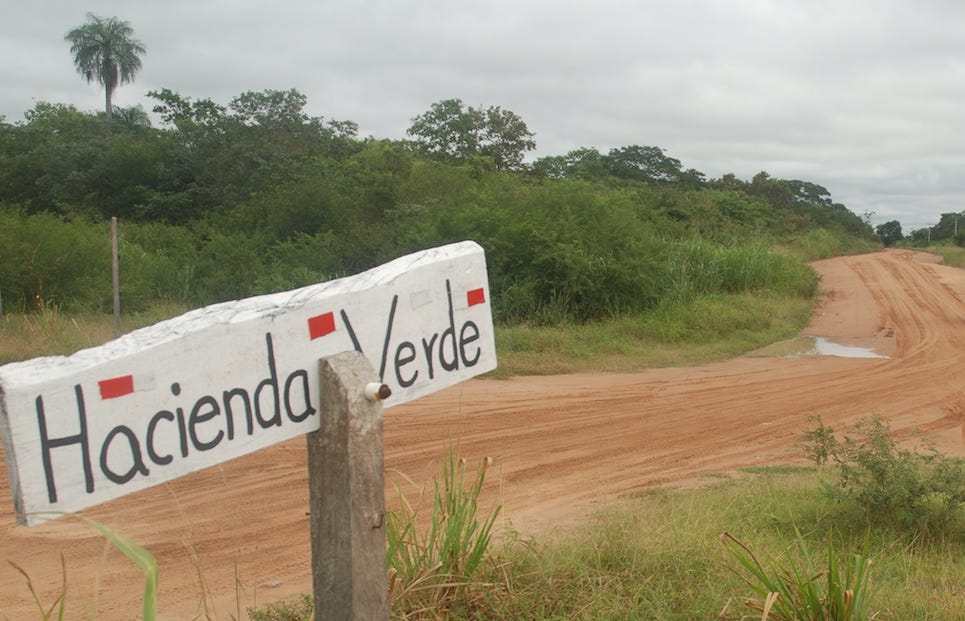
Johann Wieler, a young Mennonite farmer wearing a bright orange t-shirt and black spectacles, was saying how difficult the last few harvests had been. It was a typical refrain in that part of Bolivia: not enough rain, genuine drought. In front of him stood a giant flask of Tereré - a kind of herbal tea made of yerba mate leaves which he had picked up the habit of drinking while living in neighbouring Paraguay.
“The last two harvests have been very poor,” he said, speaking Spanish with a marked German inflection, since among themselves the Mennonites speak a “Low German” dialect. “Because of the drought. It didn’t rain.”
He had planted soy in the summer as usual, he said, but then hadn’t bothered harvesting it because there wouldn’t have been enough to cover the costs of paying the contractor.
“I don’t know how much I’ve lost,” he continued. “At least $1000 a hectare,” after previously saying he farmed nineteen hectares. “I sowed my field, it rained once, and then that was it - it didn’t rain again.”
Wieler was sitting at a computer in the tiny air-conditioned office of a farmers’s cooperative where he worked when he wasn’t out in his fields. It was the only cooperative in the colony, as the Mennonites called their settlements. Just outside was a truck scale where soy, corn and other crops were weighed before being transported to silos or other storage facilities.
“The trucks come here, they go on the scale, the weight in kilos is recorded, and then they go to the silos to be sold,” he said.
Others in the colony, named Hacienda Verde, had done somewhat better than Wieler. “Some people managed to harvest,” he acknowledged, “although it was barely enough to pay for their expenses, the machinery and the inputs.”
The previous year, a report by the NGO Global Witness (GW) had revealed that the giant US company Cargill had bought soy from several Mennonite colonies in eastern Bolivia, including Hacienda Verde, where 1,000s of hectares of forest had recently been cleared. This was despite Cargill, one of the most powerful operators in the global food industry, making noises for years about eliminating deforestation from its supply-chains. In 2014 it had committed to doing that by 2020, before postponing to 2030 and then changing its mind again by bringing the target date forward to 2025 for certain - but not all, not Bolivia - crops, biomes and countries.
According to GW, for whom I had worked as a consultant on its report, almost 3,500 hectares of primary forest were razed in Hacienda Verde between 2017 and 2021. Prior to publication, the NGO had given Cargill the opportunity to comment on its findings and the company responded by confirming it had indeed purchased soy from Hacienda Verde recently, but that colony and the four others identified by GW were all “in compliance with our “Police [sic] on Sustainable Soy.”
In addition, Cargill pointed out that those five colonies are in the “Chiquitano dry forest” and “Tropical and Subtropical Dry Broadleaf Forests Biome”, rather than the “sector roadmap priority biomes, that cover the Amazon, Cerrado and Chaco”, as laid out in a 2022 “roadmap” launched by Cargill and other companies that was fiercely criticised by civil society and even a group of its largest customers, including McDonald’s, Nestle, Unilever and Walmart. This was as if they were saying: “It’s only the Chiquitano, so who cares?”
What several of us - making a film for the UK-based Gecko Project - were doing in Hacienda Verde, in late 2024, was to see if Cargill had continued to buy soy from the colony, even after GW had gone public with its allegations. Already one of the other farmers there, a man named David Rempel, had said that was the case. According to him, the colony had been selling soy to the US company as well as a Bolivian firm, Nutrioil, and he showed us a July 2024 receipt from Cargill on his mobile phone, although that particular one turned out to be for sunflower seeds, not soy.
Indeed, it was Rempel who had directed us to the cooperative, where Wieler confirmed the colony’s ongoing links to Cargill.
And it was Wieler who mentioned the US firm first, not us.
“There are several silos where we sell soy,” he said. “For example, mainly in Puerto Quijarro [a town on the Brazilian border] - Cargill, Nutrioil too sometimes. That’s where we sell.”
Would he say Cargill, reportedly the largest private company in the US, was one of the colony’s most important clients?
“Yes, yes,” he said, nodding vigorously. “I’ve been farming soy and working for three years at this cooperative and every year we always sell to Nutrioil and Cargill. And a little to Alicorp, another company.”
In other words, according to both Rempel and Wieler, Cargill had bought soy from Hacienda Verde even after GW’s report was released. That might not have been particularly significant if the company could guarantee it had been grown on land that hadn’t been recently deforested, but the receipts issued by two of Cargill’s silos that I and GW colleague Alvaro Bozo Garcia had seen or copied, as part of our research for the NGO’s 2023 report, suggested that wasn’t likely.
That was because those receipts didn’t say exactly where the soy came from. They didn’t record any geolocation data, or the name of the farmer who grew it, or the colony, or even the province where that colony was located.
Instead, the receipts - one of which was published by GW in its report - were hopelessly vague. Either they just said “Santa Cruz” - a 370,000 km² region, constituting roughly a third of Bolivia - or nothing at all.
Wieler clarified that, despite the cooperative obtaining receipts from Cargill, they themselves didn’t deal directly with the company. That was left to at least one intermediary firm run by Mennonites from another colony, he said, and Cargill personnel had never visited.
“I’m yet to speak to them,” he said. “We always work through another company - for example, Agro Dale - and it is they who are in charge of communicating with Cargill. . . But ultimately, it’s Cargill we sell to.”
Hacienda Verde was one of an estimated 30 new Mennonite colonies established in Bolivia in the 2010s, according to Canadian geographer Yann le Polain de Waroux and colleagues at McGill University in Montreal. As I’ve highlighted in recent articles, increasing numbers of Mennonites - members of a pacific Anabaptist Christian denomination - from a rapidly increasing number of colonies have been playing an outsized role in the country’s soy trade and deforestation crisis. With the exception of Brazil, Bolivia - which for the last seven weeks or so has been mired in a political and economic crisis - lost more tropical primary forest in 2024 and 2025 than any other country in the world, according to the US NGO World Resources Institute.
Although right in the heart of the Chiquitano Dry Forest, Hacienda Verde was nowhere as remote as many other Mennonite colonies. Indeed, it was just a short drive from San José de Chiquitos, a well-known town owing its foundation to Jesuit priests in the late 17th century where the mission is now part of a UNESCO World Heritage Site.
Hacienda Verde was unusual for another reason too: it was a “modern” colony - what a sentry at the entrance called “civilizado.” That meant the Mennonites there could drive cars and ride motor-bikes, or use computers and mobile phones, like Wieler and Rempel, whereas conservative “Old Colony” Mennonites, like those I reported on earlier this month, eschewed such technology and would only get in a car if someone else was driving. Either that, or they got around by horse-and-trap, known as “buggies.”
It also meant the Mennonites in Hacienda Verde could wear whatever clothes they wanted - hence Wieler in his orange t-shirt or Rempel in jeans, whereas “Old Colony” Mennonite men and their sons all wore dungarees and checked shirts, as if it was a uniform, and the women sported ankle-length dresses. In fact, until only a few years ago Rempel himself had lived in a conservative colony, Nueva Esperanza, but left and made a new life for his family there in Hacienda Verde.
“[I left] mostly because of the religion,” he told us. “Very closed-minded.”
Coincidentally, Nueva Esperanza was one of the four other colonies linked to Cargill by Global Witness. Almost 3,000 hectares of forest had been cleared there between 2017 and 2021, according to the NGO’s analysis.
“Civilizados” or not, Mennonites like Rempel, who told us he was farming 70 hectares of soy, and Wieler still had to clear the forest if they wanted to farm.
“It was all forest,” the latter told us, referring to his nineteen hectares, having moved to the colony about five and a half years previously. “I was lent a Caterpillar to knock it down and then cleared it up with a tractor. I did it myself. Hard work. And it takes a while.”
The first year he planted nothing but corn, he said, which is hardier than soy and grows taller.
“I couldn’t do soy because the ground was still too rough,” he told us. “You can start with soy, but it isn’t recommended.”
Wieler was clear that he, like other Mennonites, thought it better to acquire land where the forest was still standing, rather than already clear-cut.
“The land is always better when it has just been cleared because it is more fertile,” he said.
As a modern Mennonite, it seemed fair to ask Wieler if he had any concerns about the amounts of forest that Hacienda Verde or other colonies had been knocking down, or if he was aware of other people being concerned about that or deforestation more generally. Trying to put those questions to “Old Colony” Mennonites elsewhere across the Chiquitano, or even to David Rempel in Hacienda Verde, had usually met with blank stares and/or confused replies about the windbreaks they left standing, as required by Bolivian law.
“Have you ever heard the term “deforestation”?” my colleague Alvaro asked slowly.
“No,” Wieler said, “I haven’t heard of that.”
Climate change he was with familiar with, though. That was because he was taking a crash course at a local German educational institute and had learned a little about it, he said, although as a farmer in a Mennonite colony he acknowledged it would be extremely helpful to receive some kind of proper training.
“In truth, I don’t know much about that issue,” he told us, laughing, “and I can’t explain it to you very well.”
But does he think it’s important?
“Yes, very important.”
Rempel seemed to feel similarly. He said he heard about climate change “all the time” on social media and that it was “good to care for the environment”, especially given the fires that swept across so much of Bolivia that year. According to the Bolivian NGO TIERRA, more than 12.5 million hectares were impacted in 2024, making it the worst environmental catastrophe in the country’s history.
“I would say that it would be good [for Mennonites to be more informed about climate change],” Rempel said. “That kind of information doesn’t reach the [other] colonies. They don’t teach that. Here, yes, the children learn that kind of thing.”
But did he think the “Old Colony” Mennonites would be open to that sort of teaching?
“I wouldn’t be able to say,” he said, smiling. “They’re very closed-minded. That would be a little difficult.”
The Gecko Project’s film Bolivia Burning was released in September 2025.
When asked about continuing to buy soy from Hacienda Verde after Global Witness’s report was published, Cargill provided a statement to me referring to its “prior analysis” of that report and said it hadn’t found “evidence that the soy we sourced came from the areas identified as recently deforested. We map 100% of our direct soy suppliers in Bolivia and use satellite data, polygon mapping, and other tools to monitor land-use change.” However, the company did not explain how it knows who its “direct suppliers” are, or how it records that information.
Comments
Nothing yet. Say the first thing.
Sign in to join the conversation.