
If your student is applying to college this year, they’ve probably got a lot on their plate right now. Here are a few things to be aware of as we approach October:
The FAFSA and CSS Profile open on October 1 (more on this below)
Early Action (EA)/Early Decision (ED) considerations & dates
Nov 1, Nov 5, and Nov 15 are common EA/ED dates, but there are some schools (e.g., Clemson, Georgia Tech, University of North Carolina-Chapel Hill) with dates as early as October 15.
SAT dates coming up:
Sat Oct 4 (last test date for Nov 1 Early Action)
Tue Oct 21 (at Salem High, for seniors, must register by Oct 1; it’s cutting it close, but history suggests that scores should be available for Nov 5 UMass Amherst & Lowell Early Action)
Sat Nov 8
I’m maintaining a college application schedule with more info on my website. If you’re aware of anything that I should add, please let me know.
Build a balanced list: Your student’s college list should be balanced in the sense that it includes schools where they are likely and nearly assured of being accepted.
Establish a budget: Decide how much you want to spend on college to inform the search for schools. There’s no need to spend time and emotional energy applying to schools you cannot afford.
Estimate costs: Every college is required by the federal government to offer a Net Price Calculator (NPC). Some are long and painful, others are easier. (Here’s an easy one, the quickie NPC for Boston University.) They are not always accurate–federal law requires colleges to have Net Price Calculators, but not to keep them updated–but they can give you a ballpark estimate of what you can expect to pay given your financial situation. (And an amount that you can reference in an appeal if your financial aid package doesn’t match the estimate.) College Aid Pro and GradBetter are also useful websites that can help you estimate the cost of college.
The English department at Salem High School is offering college essay workshops in class and after school on Thursdays from 2:40-3:40 in Room 304. Ms. Parker, Ms. Kalinowski, and Ms. Celli are the teachers involved in this effort. Annie has had classes with all three and I can vouch that they are wonderful.
If you haven’t already, it’s a good idea to comb through the Common App for supplemental essays beyond the Personal Statement. These can be tricky to find as essay questions may show up in different places. For a given school, I suggest checking Writing Requirements under the College Information section in the menu ...
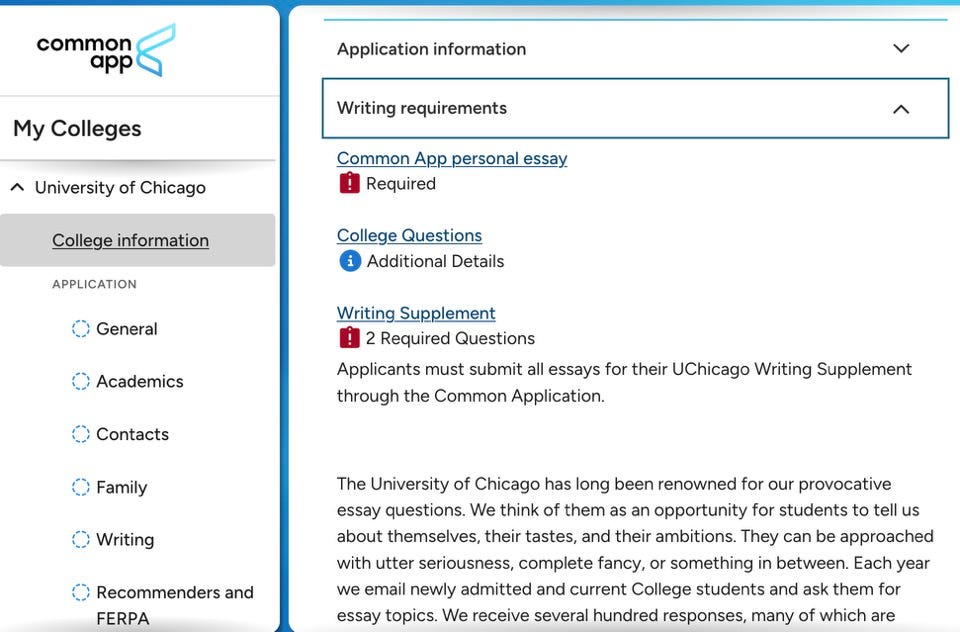
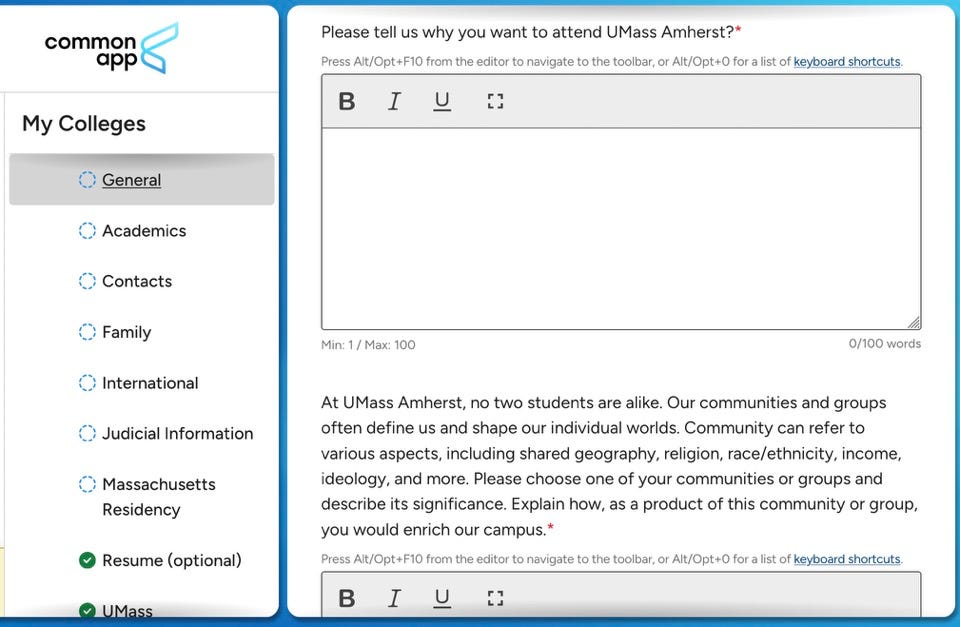
… and also looking at the questions within the General section. E.g., UMass Amherst lists its essay questions here:
Also, check the Application menu under a given school for a writing- or essay-related section:
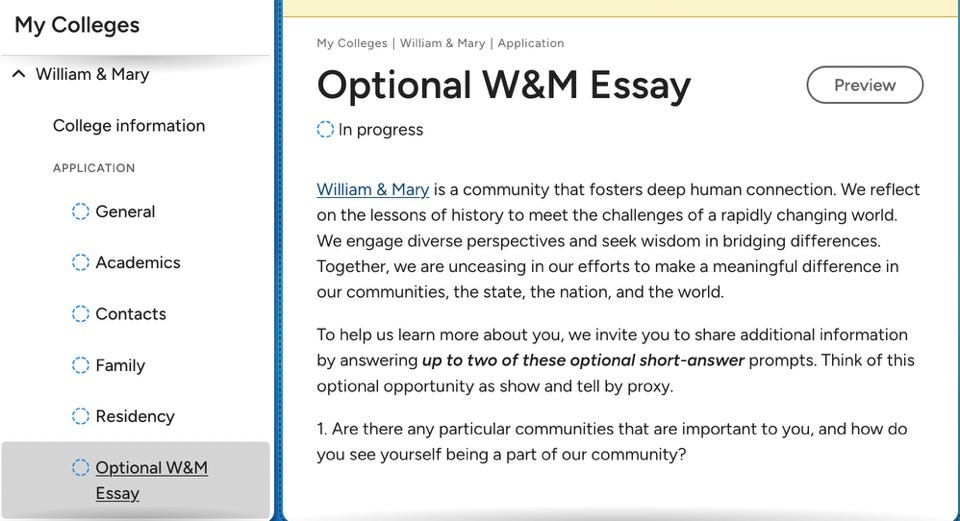
In this case, William & Mary has an Optional W&M Essay section, which brings you to their supplemental essays.
No idea why this is so convoluted and why supplemental essays can’t be found in a single, standard place. But I highly recommend going through the Common App now to identify all supplemental essays that your student may have to write. You don’t want them to be surprised by writing requirements, particularly near a deadline.
One area where parents can help a lot is by getting familiar with the financial aid process and preparing to fill out the necessary paperwork. This is the subject of today’s deep dive.
To cover my own ass[ets], I have to begin by disclaiming: The information that follows is to illustrate how the FAFSA works and demonstrate how one might maximize eligibility for financial aid. It is not financial advice. Please consult a qualified professional before making financial decisions.
Colleges use two main forms to determine a student’s eligibility for financial aid: the FAFSA, required by all schools for federal aid, and the CSS Profile, used by some schools to award their own institutional aid.
The FAFSA and CSS Profile open soon (October 1) for the 2026-27 school year and are often due with a student’s application to a school. For more background, I’ve written in detail about Financial Aid, the FAFSA, and the CSS Profile, but in this missive, I want to offer thoughts on financial planning as it relates to these forms.
The FAFSA is used to calculate your Student Aid Index (SAI). The lower your SAI, the greater your calculated financial need, and the more likely you are to qualify for need-based aid. To calculate your SAI, family income and assets are assessed.
Income is considered on a prior-prior year basis: For a student matriculating in the fall of 2026, 2024 tax return information is used. For now, I’m going to punt on the topic of income (too late to make adjustments to 2024 income) and focus on how financial assets are treated by the FAFSA. There is still time to maximize eligibility for aid in 2026-27 by reducing your assets, which are counted on the date the FAFSA is submitted.
Here’s what the FAFSA expects your family to contribute toward college (for one year, not all four) from your assets:
Parents: 5.64% of non-retirement assets (e.g., bank accounts, brokerage accounts, 529s owned by the parent). Do not include IRAs and 401(k)s!
Students: 20% of student assets (e.g., student bank accounts, custodial bank accounts, any savings in their name)
So for purposes of financial aid eligibility, it benefits a family to to have a) fewer assets and b) assets in the name of the parent v. child, as the child incurs a higher contribution rate.
If you are divorced: These considerations apply only to the parent who is filling out the FAFSA, i.e., the one “who provided more financial support during the last 12 months”. See Reporting Parent Information to learn more about which parent(s) should file the FAFSA based on your circumstances.
If there are easy ways to reduce your assets prior to FAFSA submission, they may be worth considering. For example, if you are already planning to do any of the following:
Contribute to a Roth IRA
Buy a car
Pay down some of your mortgage
Pay down credit card debt
Doing so prior to submitting the FAFSA would reduce your assets and thus lower your SAI. For example, a $5k contribution to a Roth IRA that reduces non-retirement parent assets by $5k lowers your SAI by 5.64% * $5k = $270.
I am not suggesting that you make moves simply for the sake of lowering your SAI. (If contributing $5k to a Roth IRA puts you in a financial bind, that doesn’t help your cause.) But if moves that reduce your assets are already on your radar, consider making them before you submit the FAFSA versus after.
On the flip side: If you are expecting to receive any cash gifts in the near future, consider delaying them until after you submit the FAFSA if possible. And if the gift is to pay for college, note that it will be assessed at a lower rate if given to the parent(s) v. student.
Regarding student assets: Consider spending down student accounts (sorry, kids!) before parent accounts, as student funds are assessed at the higher rate (20%, v. 5.64% for parents). For example, if your student is getting a shiny new laptop for college that costs $2,000, paying for it from student-owned funds would bring the SAI down by 20% * $2,000 = $400. Whereas buying the laptop from parent funds would only reduce the SAI by 5.64% * $2,000 = $112. So using student money results in a net gain of $288.
Even more fun: Say your student has $5k in a checking account, earned at least that amount this year through employment, and is not relying on those funds to pay expenses. You could open a Roth IRA in their name and contribute the $5k from their account. This would reduce the SAI by 20% * $5,000 = $1,000. (Plus the Roth IRA money can be invested and distributed tax-free upon their retirement for a double win.) Just be sure you understand the rules for Roth IRA contributions before making a move like this!
It’s important to note that good financial planning considers context and trade-offs (e.g., do the current year tax savings of contributing to a Traditional IRA outweigh the benefits of long-run tax savings + financial aid with a same-sized Roth IRA contribution; it depends). I’m not going to tell you what you should or shouldn’t do, but if you can use help learning about options or modeling scenarios, I’m happy to chat.
If you don’t have upcoming payments or other easy ways to reduce your assets prior to submitting the FAFSA–no worries, it’s not a big deal. My hope is that walking through the FAFSA’s treatment of assets will help you better understand your SAI and stay vigilant for low-hanging fruit that might save you money.
Finally, a few other college finance notes:
American Opportunity Tax Credit (AOTC): You can get a maximum annual credit of $2,500 per eligible student for each of the first 4 years of their higher education. Hopefully your tax software or accountant will prompt you to claim this credit, but if you’re doing your own taxes, check out Form 8863.
John & Abigail Adams Scholarship: If your student scored well on their 10th grade MCAS, they may be eligible for scholarship funds at Massachusetts state schools. (E.g., this scholarship was worth $1,714 at UMass Amherst in 2024-25.)
Massachusetts College Savings Tax Deduction: MA residents can claim a state income tax deduction for contributions to a 529 college savings plan: up to $1,000 for single filers and $2,000 for couples filing jointly each year. Even if you don’t have a 529 today, you could create one to “launder” (in a legal way!) up to $2,000 of tuition payments per year through a 529. The savings would be
5% MA tax * $2,000 = $100per year. Not huge, but perhaps worth considering, particularly if it spurs you to hold college funds and accrue gains tax-free in your 529.
That’s it for now. If you have questions or topics of interest, please let me know and I’ll consider writing about them in subsequent newsletters.
Thanks so much for reading and best of luck in your college journey!
Comments
Nothing yet. Say the first thing.
Sign in to join the conversation.