
Welcome to the second edition of Higher Edward. Since the last issue, I’ve moved the newsletter to Substack to make publishing, sending, and subscribing (or—gasp!—unsubscribing) easier. Thanks again for agreeing to try this out. Without further ado, let’s talk college …
If you don’t think your grades or SAT scores are likely to change much over the current semester, consider applying Early Action (EA) to get responses from colleges sooner, sometimes before the holidays. But balance the desire to meet early deadlines against your schedule and what it will take to get applications done by the due dates.
It’s unclear whether there is any admissions advantage to be gained by applying EA. The Early Action acceptance rate is higher at some schools, such as the University of Virginia, but this may be a function of self-selection; the early applicant pool likely skews toward more organized, informed students with stronger credentials.
ℹ️ Early Action is non-binding and not to be confused with Early Decision, in which you make a binding commitment to attend a college if they accept you. Early Decision does convey an admissions advantage in nearly all cases. (I’ll talk about that in a future newsletter.)
Area schools with Early Action dates coming up include:
Nov 1
Nov 5
Nov 15
Not all schools offer early action, however, including nearby Boston University and the University of Connecticut.
It’s important to check your schools’ admission plans and deadlines, which you can do from this list of first-year deadlines (published by the Common App), within the Common App itself, or on the admissions page of college websites.
My daughter has been working on her activities for the Common App, so I made a Google Sheet to use as a space for writing, editing, and feedback, along with prompts, links to helpful resources, and character counts for activity descriptions.
If you’d like to use it for your applications, just copy (File | Make a Copy) and have at it:
The actual price that your family will pay for college—known as the Net Price—is often difficult to decipher. Here’s a primer on how to gauge your net price and how net price varies based on your financial circumstances:
Every college is required by federal law to have a Net Price Calculator. Families can input their financial data, and the calculator spits out an estimate of what net price they will pay. Not all calculators are created equal–some are more accurate and up-to-date than others; some are easy to fill out while others can cause physical pain.
UMass Amherst (aka UMass) is an excellent school, affordable (as colleges go)—particularly for in-state Massachusetts residents, and has an easy-to-use net price calculator:
🛠️ Net Price Calculator for UMass Amherst
(The first page asks for name and email, but you don’t have to provide this info; select “Start your estimate” to proceed with or without those fields entered.)
Filling out a few brief forms about your income and assets will generate a net price estimate like this one:
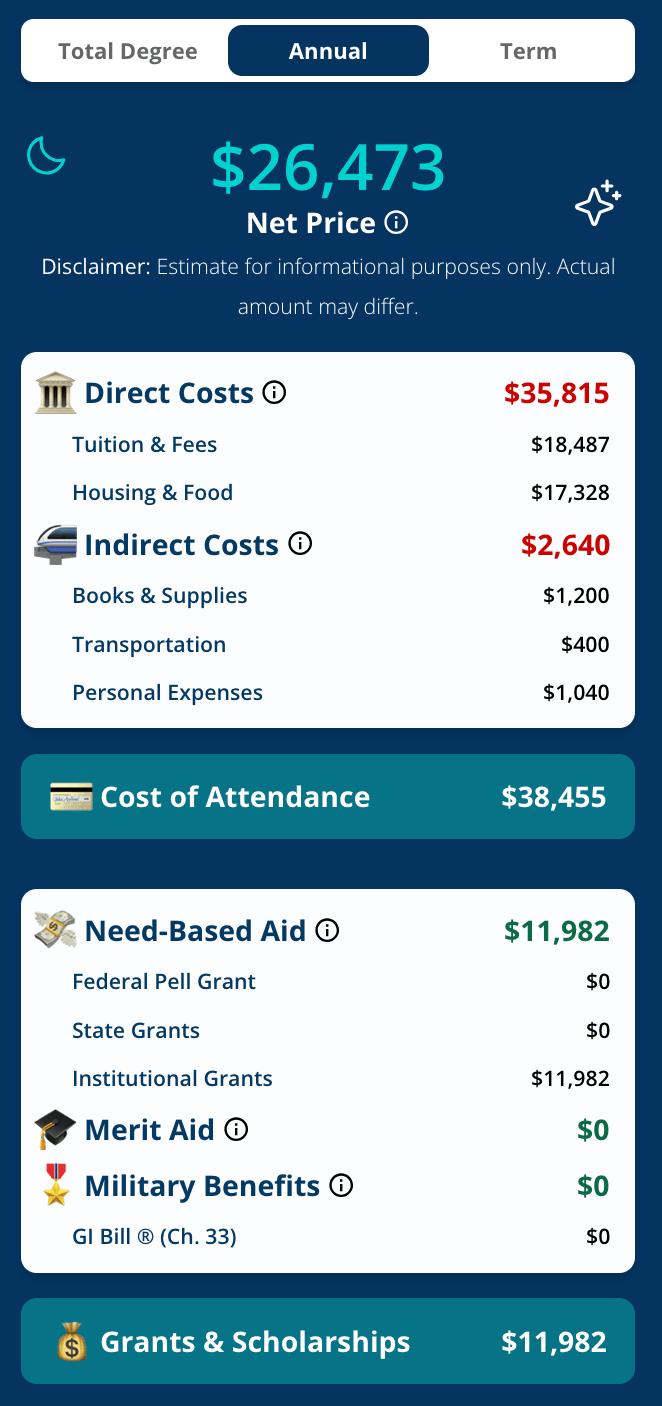
Going through this exercise for schools of interest gives you a) valuable information to use in your college process and b) grounds for appeal should a financial award you receive from a school differ dramatically from the estimate. I can’t recommend filling out at least a few of these calculators out enough.
Now that we know about net price calculators, let’s use them to compare prices at UMass to another school: Boston University (BU), a private college.
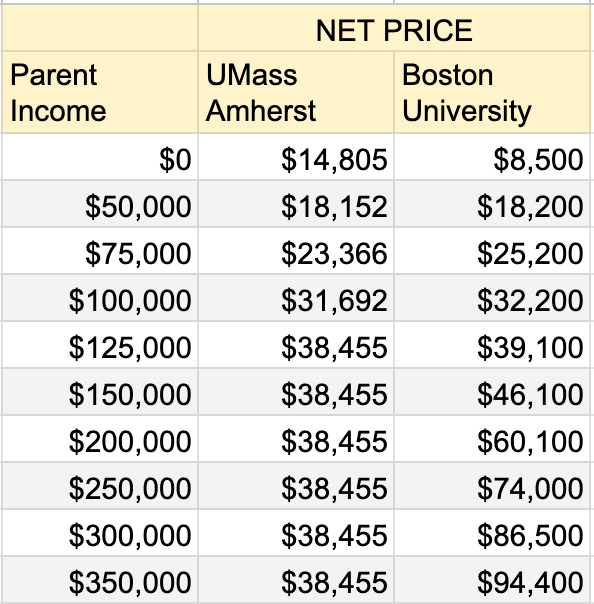
Assuming parent assets of $200,000 (chosen arbitrarily), plugging in different values for parent income shows how the net price at each school changes across the income spectrum.
First, here are the raw results:
Here’s a prettier view that graphs the net price you pay for each school at different levels of parent income:
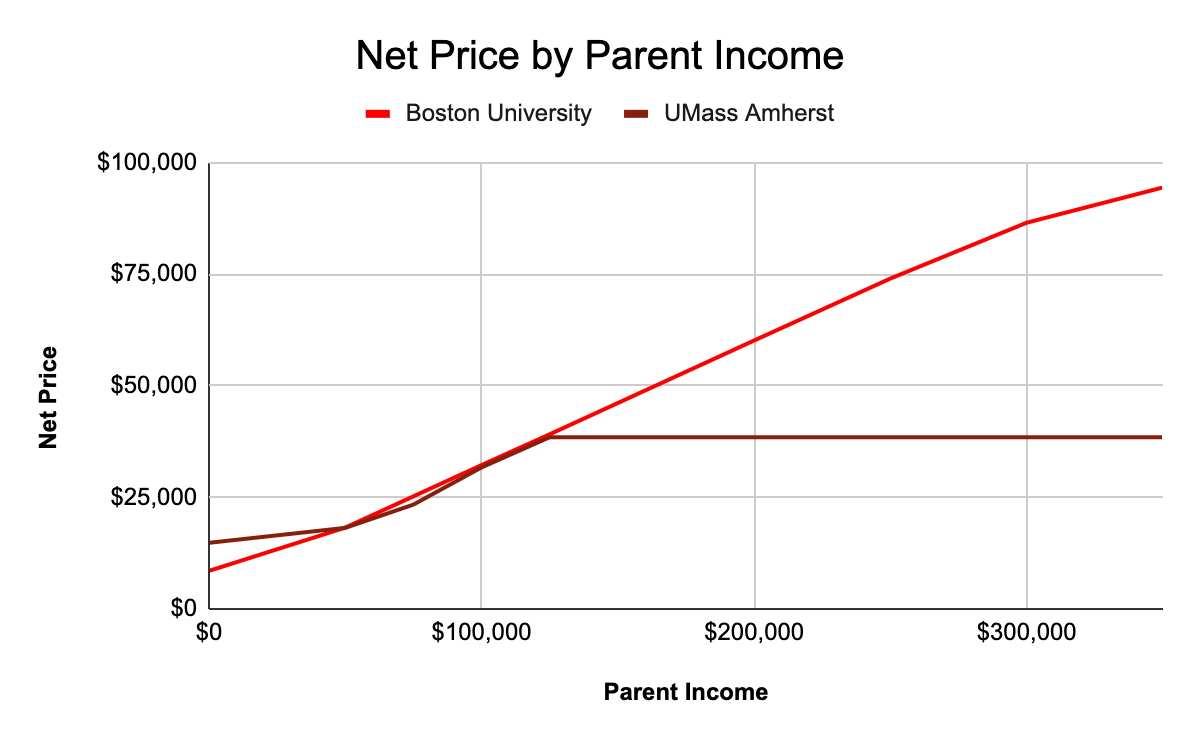
What does this tell us? For parent income up to $125,000, the price of both schools is approximately the same. In fact, at low levels of income, BU appears to be less expensive than UMass. (My calculator experiments indicate that UMass has a price floor of $14,805, regardless of your financial situation.)
ℹ️ UMass is need-blind, meaning they do not consider an applicant’s financial situation as a factor in deciding admission. BU is need-aware. So while BU states that they meet 100% of demonstrated need for accepted students and appears to be less expensive than UMass at low income levels, they might also reject an applicant due to financial considerations.
Back to our net price story: At parent income levels around $125,000, the net prices of the two schools begin to diverge. From this point on, a family is paying the maximum tuition at UMass, $38,455, so that line stays flat. At BU, however, the Cost of Attendance (the published “sticker” price) is much higher—$94,400—and the net price of college continues to climb the more a family earns. (Approximately 28% of each additional parent dollar earned is expected to go toward college until the slope flattens a bit at the $300,000 income level.) At roughly $350,000 of income, the net price (mercifully) reaches the full cost of attendance and can go no higher.
Remember our initial assumption of $200,000 of savings, however. With greater parent assets, a family would likely pay full freight at a lower level of income than in the scenario above.
The moral of the story is: The net price—the actual price you pay for college—depends on both the school (tuition and aid policies) and your financial circumstances (mostly income and assets). The same school can offer wildly different prices to different students, and different schools may offer the same price to the same student despite having wildly different cost of attendance figures.
Revisiting the right side of the graph, you can see that the price of BU reaches $50,000 for a family with just over $150,000 of income, $75,000 around $250,000, and eventually $94,400. These are big bills and not always feasible or desirable, even if the financial aid formula indicates that you can “afford” them.
More families are falling into the college affordability donut hole—earning too much to qualify for need-based aid, but not enough to comfortably pay full tuition.
—Jeffrey Selingo, author of Dream School
If you don’t want to pay sums of this size for college, what is a family in the donut hole to do? In-state public schools such as UMass are one option. Another is to seek schools that offer merit aid (also known as merit scholarships): discounted prices for students that colleges are eager to enroll, regardless of need.
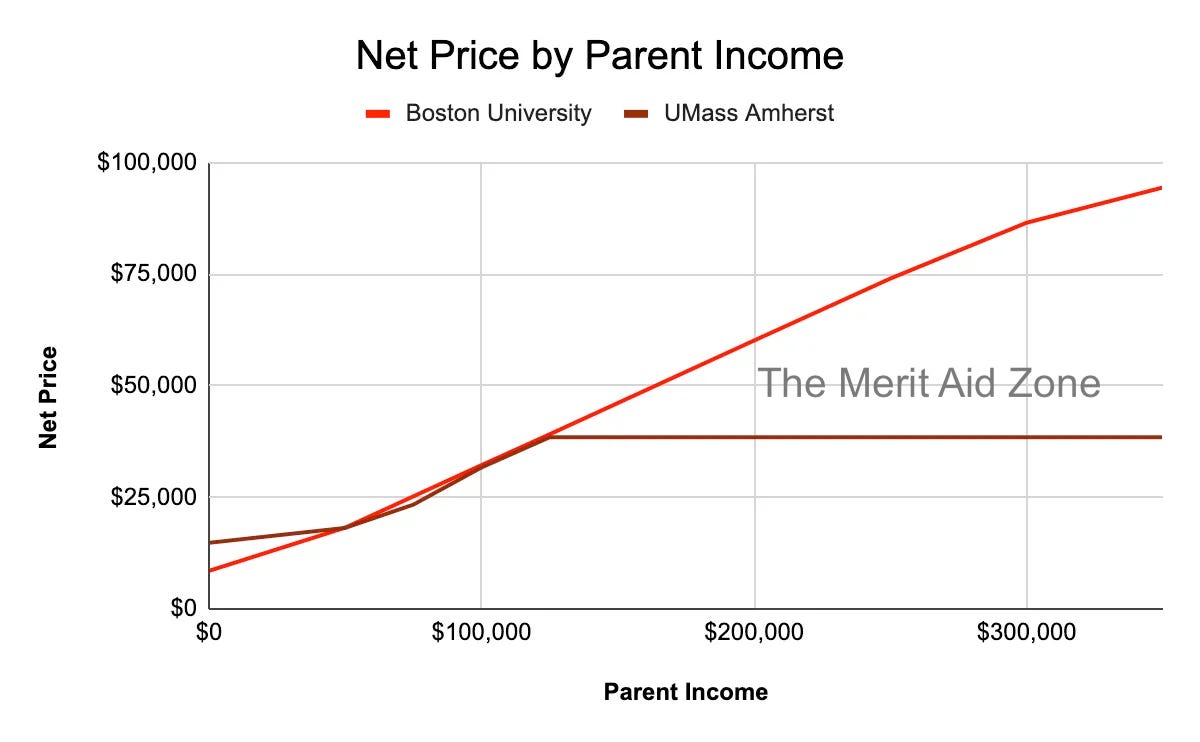
Highly selective schools tend to offer little or no merit aid, but there are plenty of fabulous schools where it’s available: the University of Richmond, Dickinson, Franklin & Marshall, the University of Rochester, Lafayette, the University of Vermont (offered to out-of-state students), and others. If your family’s parent income is over, say, $200,000, and you want options that don’t require paying $60k-100k annually for college, consider schools offering merit scholarships with net prices in The Merit Aid Zone (pictured below) that tends to fall between the price you’d pay at a need-aid-only private school (like BU) and an in-state public flagship (like UMass).
How do you find schools that offer merit aid? I’ll cover that in the next newsletter. 🤑
The New York Times published a piece on the academic culture at Harvard this week. It’s distressing, to say the least:
Harvard Students Skip Class and Still Get High Grades, Faculty Say
Many students don’t do the reading and don’t speak up in class, according to a report. Now, professors are trying to change a campus culture they say hurts achievement and stifles speech.
The story’s author, Anemona Hartocollis, followed up in the comments:
I spent some time in Cambridge sitting in on a huge (but engaging) lecture class and talking to students about a recent report from Harvard’s faculty. Turns out that professors worry that students are skipping class. But students told me that they were just conforming to demands that they do as much as they can to stand out, as they look toward internships, graduation and careers. Which often means doing as many extracurriculars as possible. So I wondered: Is it the students, or is it the system?
Elite college admissions has gone haywire; it’s bad for students and schools. (“The system” alluded to by Hartocollis includes parents and college rankings as well.) For an antidote to the world of high-stress admissions, I encourage you to read Dream School by the aforementioned Jeffrey Selingo:
Ditch the “Top 25 or bust” mindset and look beyond the usual suspects. Hidden-gem schools with incredible value and rich opportunities are waiting to be discovered.
You can get a taste of Selingo’s thinking in these recent articles:
Don’t Fall for the Rigged College Game at The New York Times
The ‘Best’ Colleges Aren’t the Best Forever at The Atlantic
It’s been a few years since I helped my son with the Common App, so I’ve been getting reacquainted and learning how it links to Naviance to enable high schools to send supporting documentation such as transcripts and teacher recommendations. This short video shows you how to link Naviance to the Common App and waive FERPA rights (necessary to permit your high school to send transcripts and recommendations). It also shows how to waive your right to review recommendations (which is common practice to convey that recommendations are candid and unbiased).
Colleges that you add in Common App are synced to Naviance and visible from the Colleges | Colleges I’m Applying To page:
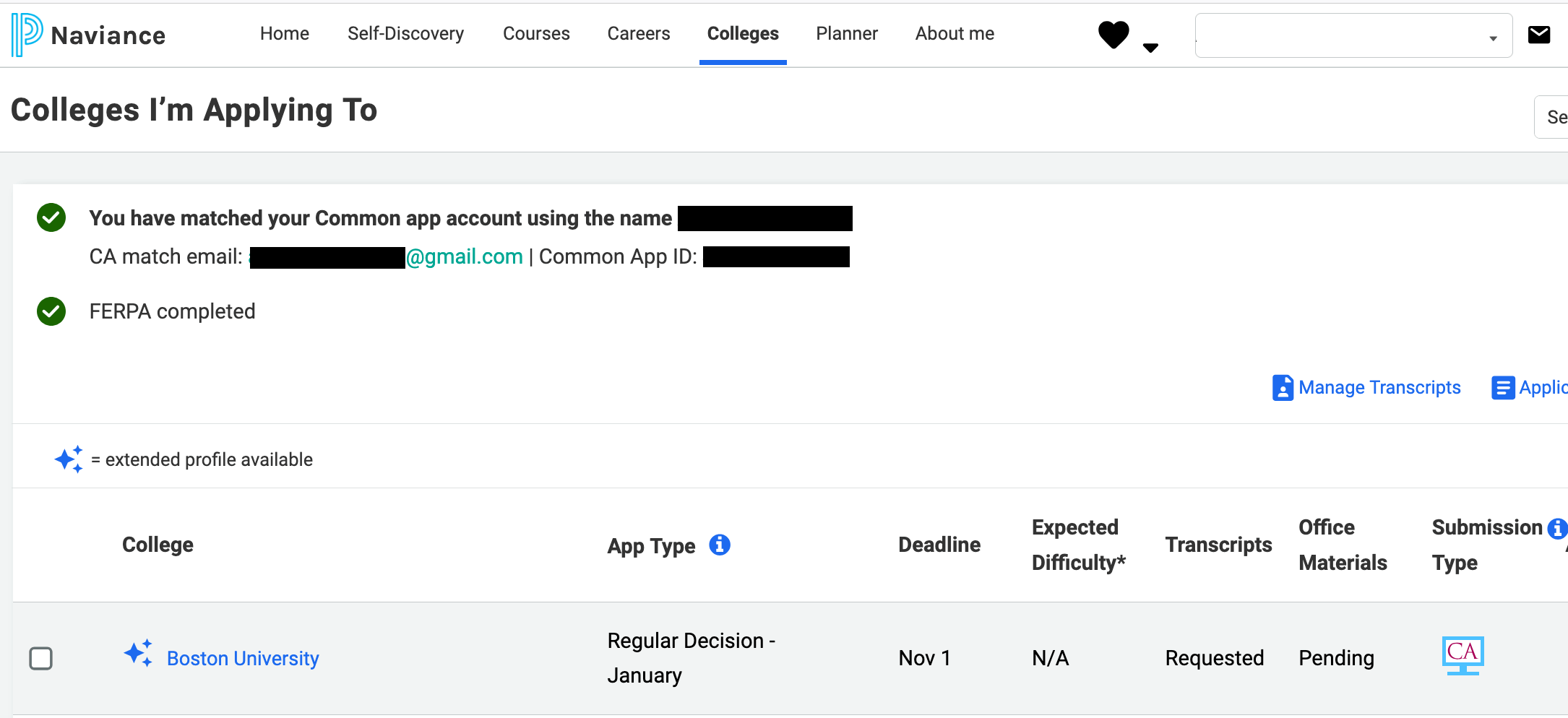
Note that the sync is one-way from Common App to Naviance. Colleges added in Naviance are not added to Common App.
While I had trouble locating answers on the Common App and Naviance websites, my best friend ChatGPT tells me that when a college application is submitted via Common App, Naviance does not automatically send your transcript and teacher recommendations. Apparently, counselors manage the sending of supporting documentation manually, so be sure to track the status of your applications on this page and communicate with your counselor to make sure your colleges get the documents they need.
Previously I wrote about the FAFSA and how assets impact the resulting Student Aid Index. Need more details? I highly recommend this deep dive from college finance author Ann Garcia: The FAFSA Formula Explained.
Fun (?) FAFSA Fact: The student income allowance for the 2026-27 FAFSA is $11,770. So a student with a summer job in 2024 earning $11,770 or less would not have any of that income counted toward their college contribution. After that? A 50% contribution from income is expected. 💸
Though it gets less attention than the FAFSA, the CSS Profile also opened recently for 2026-27.
Do you need to fill out this form? See if your college is on the list of 2026-27 Participating Institutions and Programs.
I tried my best to interpret replies to my initial outreach about subscribing to this newsletter. If I mistakenly added you to the mailing list (sorry) or you’re not interested (no worries), you can use the Unsubscribe link below.
If you know anyone going through the college process who might benefit from this newsletter, I’d be grateful if you share it with them.
If you have specific questions or topics you wish to see covered, please send them my way—I’m always collecting ideas for future newsletters.
That’s it for issue two. I’ll talk further about merit aid in the next edition. Thanks for reading!
Comments
Nothing yet. Say the first thing.
Sign in to join the conversation.