
Launders, the wooden channels that bring river water into mill buildings, are a recurring theme in the Near Far Heron project funded by the Pilgrim Trust and the National Lottery Heritage Fund. A while back a team of volunteers from Gayle Mill at Hawes visited the Heron Corn Mill to look at our launder. Like all launder owners, they are having trouble with leakage, and they wanted to pick Stuart’s brains about it.
So Mrs T and I decided to return the compliment and have a trip out to Gayle Mill and take a look at theirs. It turns out there is a lot of history to take in at Gayle Mill and we had a thoroughly interesting guided tour. Then of course there’s the scenery on the way, and the Wensleydale cheese factory next door, so an enjoyable day out is practically guaranteed. Just make sure you go on Thursday though, as that is the only day Gayle Mill is open!
Like Kirk Mill which I wrote about last time, Gayle Mill aimed to exploit the new cotton spinning machinery and factory system that Richard Arkwright had invented in the 1770s. Those were turbulent times, with new technology revolutionizing working practices and workers’ conditions. Does that sound familiar at all?
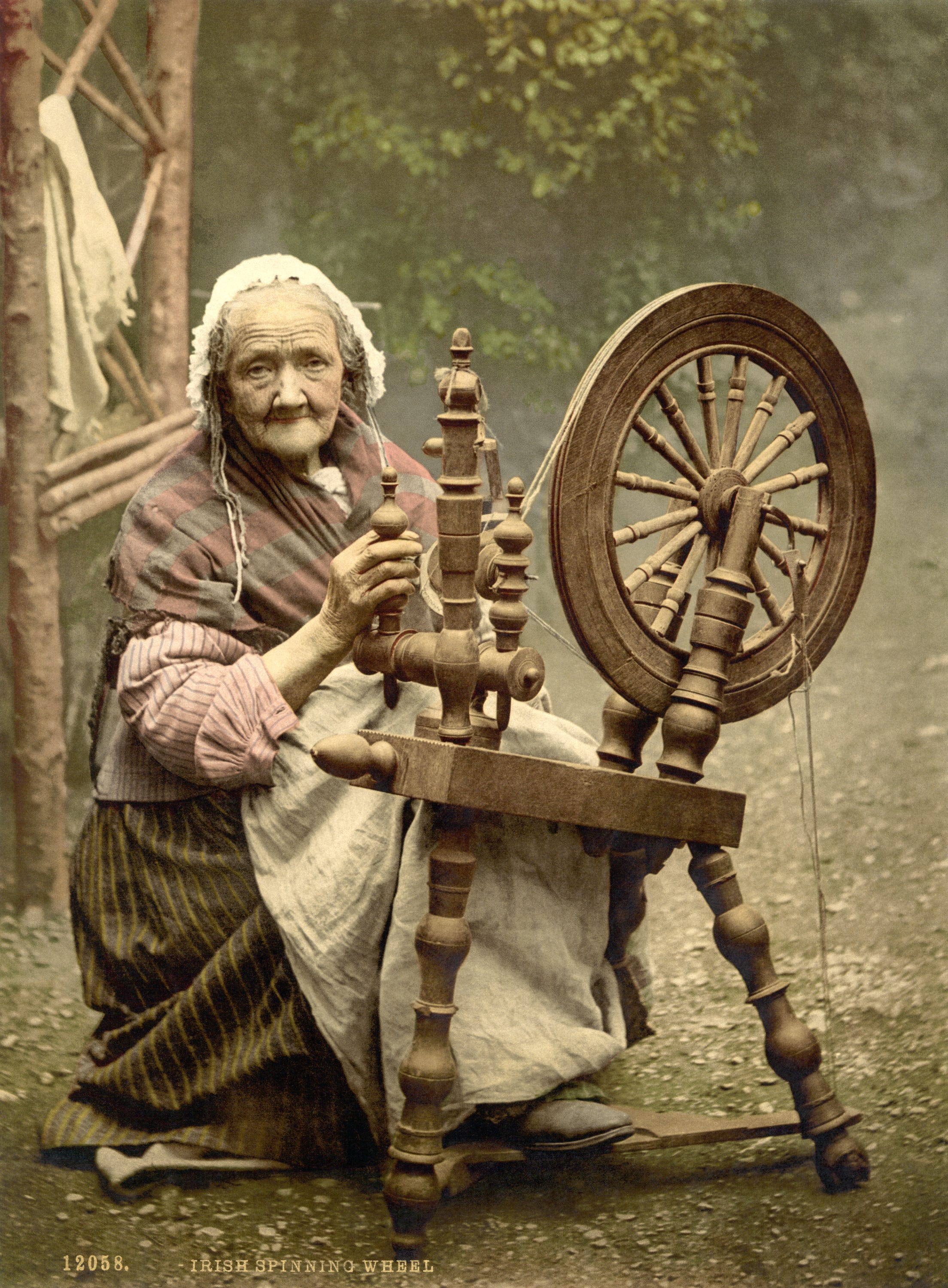
The workers round Hawes weren’t just cotton spinners. The “terrible knitters” of Dent and round about were a household name and knitting was done alongside other jobs and even when on the move.
Arkwright’s 48-spindle water-driven spinning frames allowed one worker to produce as much spun cotton as any number of spinning wheel operatives working at home. This was the 1770s equivalent of the invention of the internet, the “dot.com boom” or today’s AI revolution.
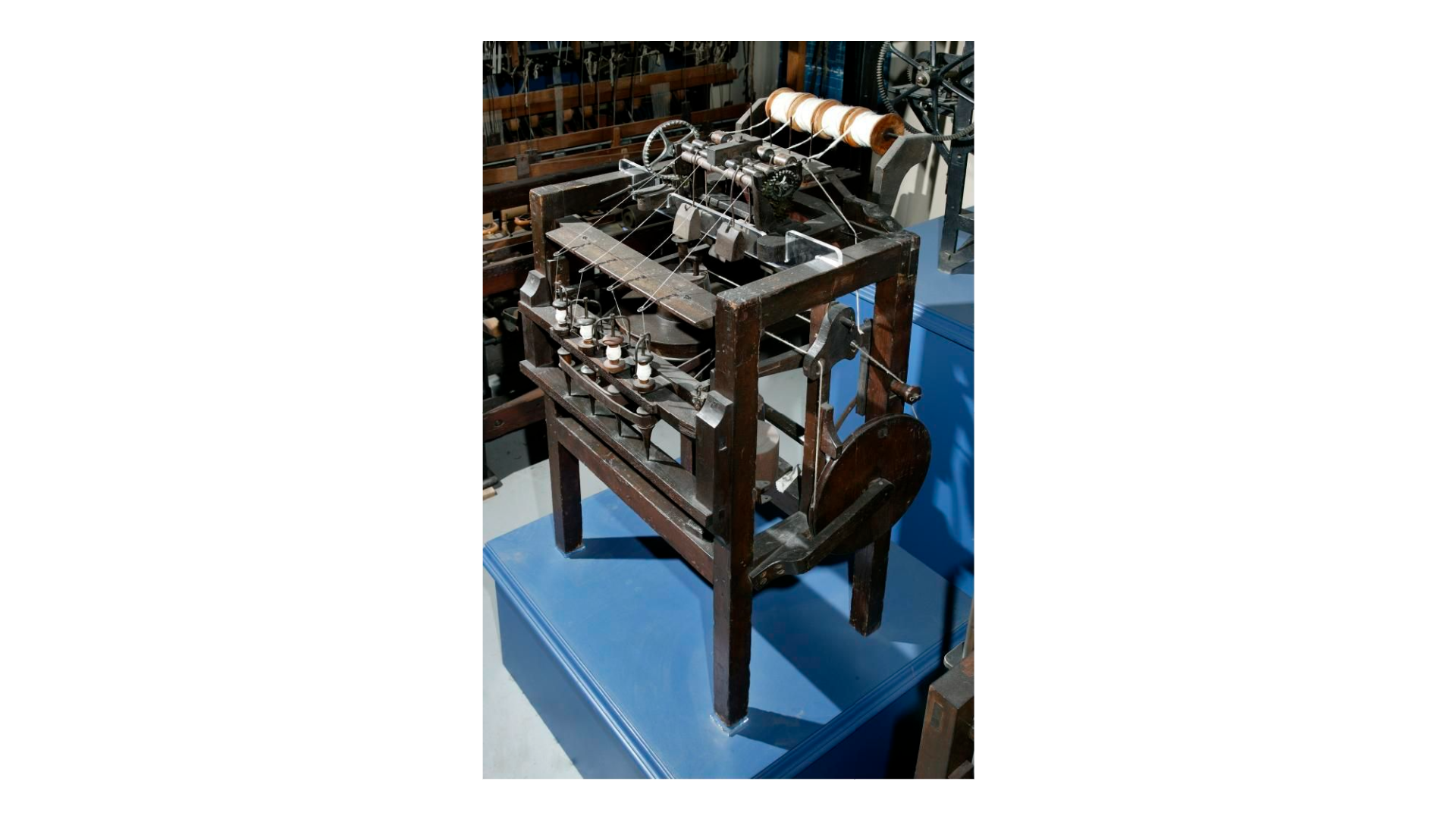
With some 30,000 competitors risking prosecution by copying his work, Arkwright struggled to maintain his patent, finally losing control over his inventions in 1785, the year after Gayle Mill was built. The first American cotton had arrived in Liverpool in 1784, and it seems that Gayle Mill’s Quaker owners could see the way the wind was blowing when they chose to invest in cotton.
The whole cotton industry was closely bound up with the slave trade, an awkward fact which appears not to have greatly troubled the Quakers of the time or British people generally, come to that. There was a lot of money to be made from the “triangular trade” of cotton, enslaved people and finished goods.
Over time, with new supply routes and improved technology making larger industrialized locations more attractive, Gayle Mill eventually became uncompetitive in cotton and converted to flax in 1810, and wool in 1820 before becoming a saw mill some time between 1860 and 1867. The water wheel was replaced with a water-driven turbine in 1879 and the mill continued in business till 1988.
After the saw mill closed, the buildings inevitably fell into a state of considerable disrepair, and it has taken a great deal of work on the part of the hard core of nine mill volunteers to recover the situation as we see it today. Everything in the heritage world relies on hard work and determination!
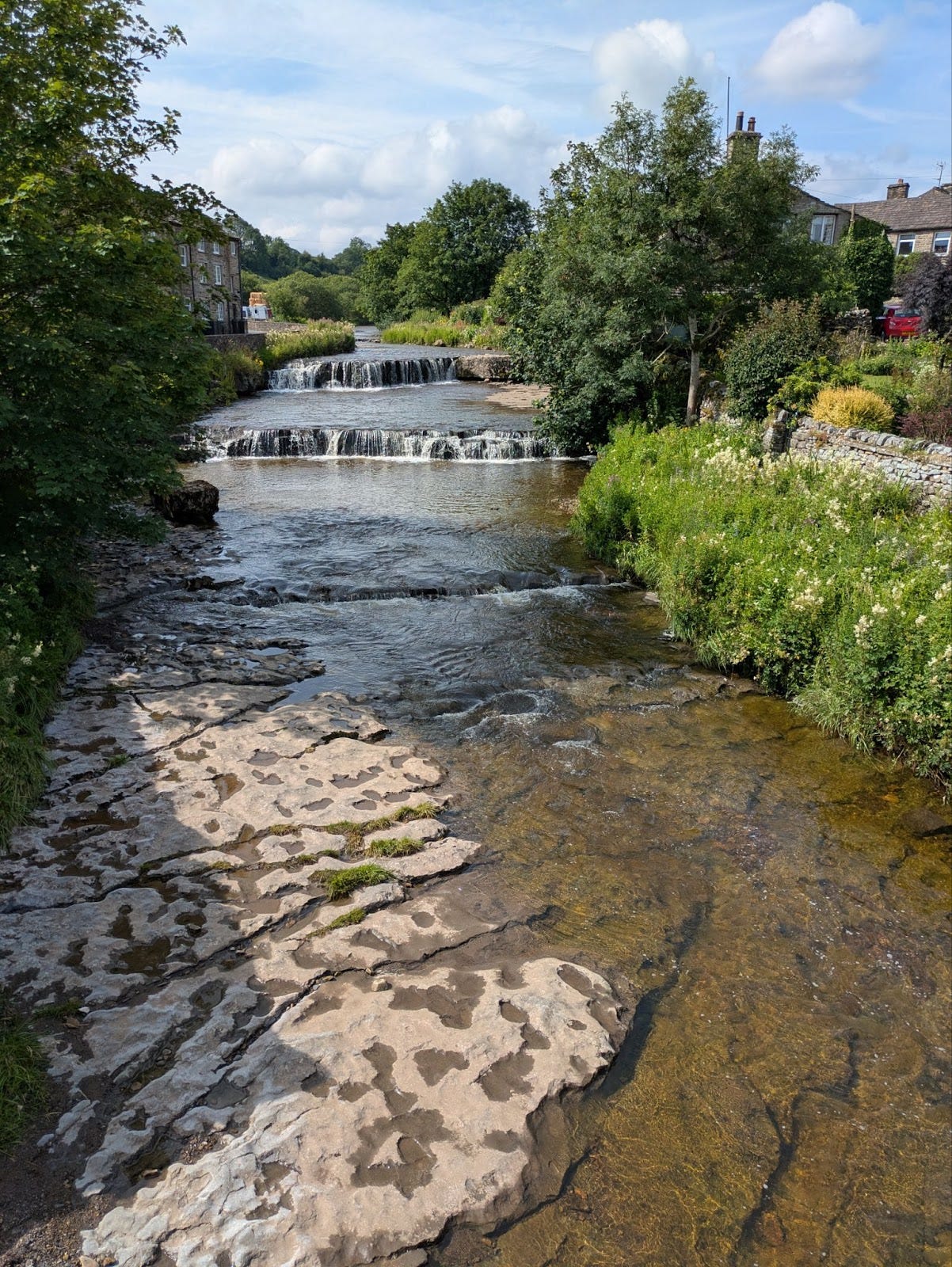
This is the view upstream from the mill: -
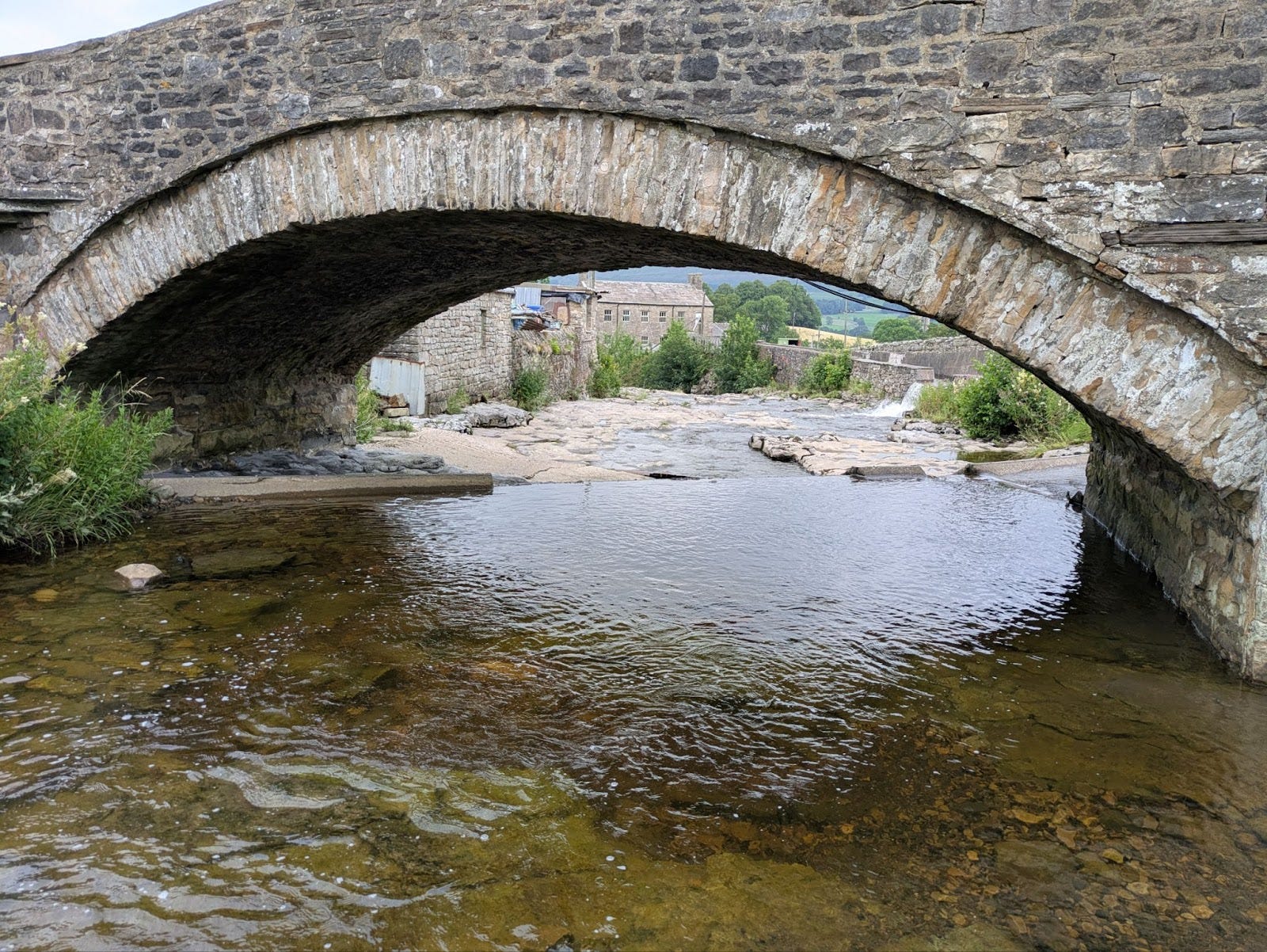
And this is the view downstream to the mill: -
This is the sluice gate at the top of the headrace or leat leading to the wooden launder: -
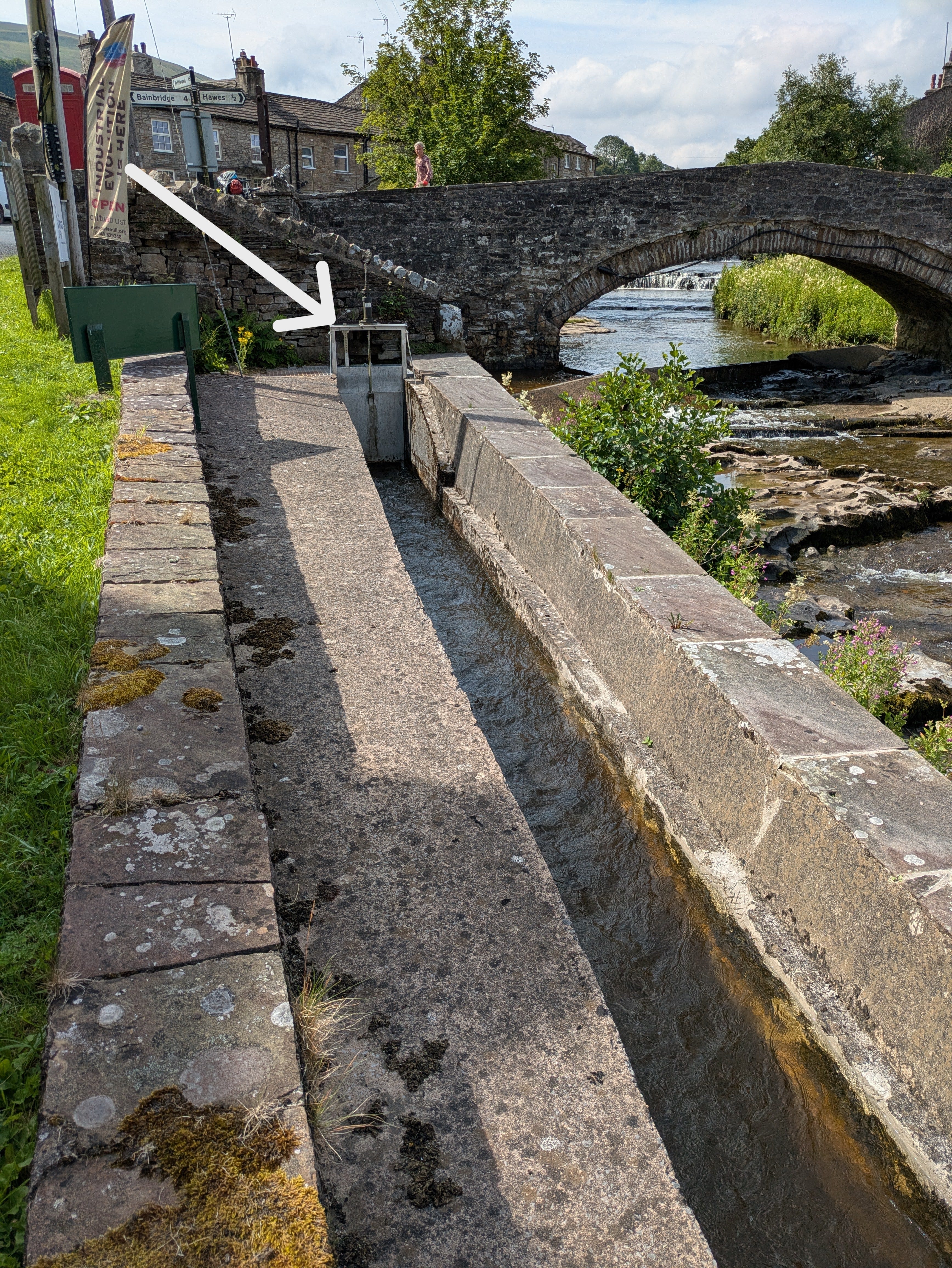
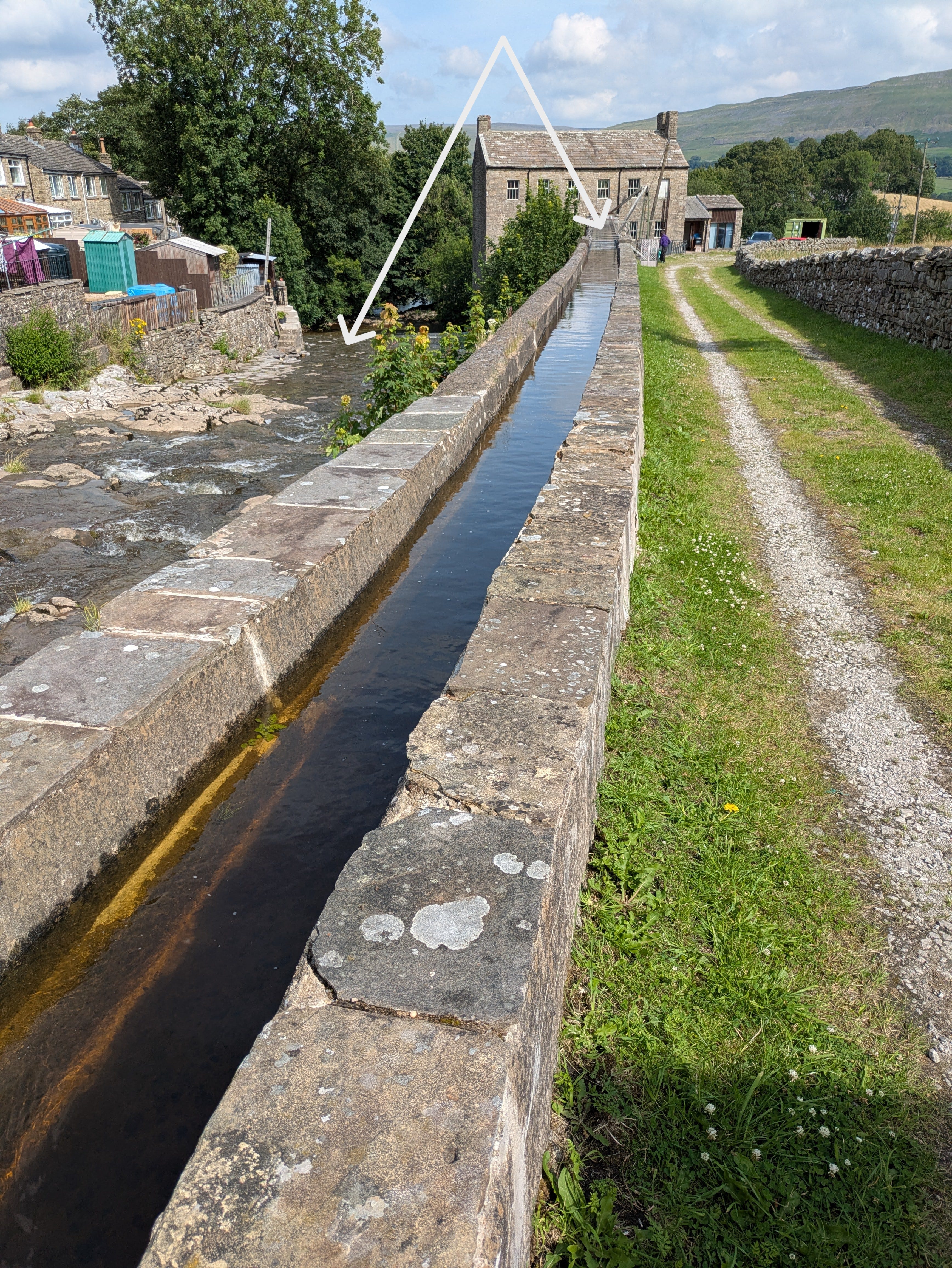
Notice how much higher the water in the leat is than the water in the beck as you get nearer to the mill. That’s the “head of water” that provides the potential energy to run the mill, or in this case the turbine: -
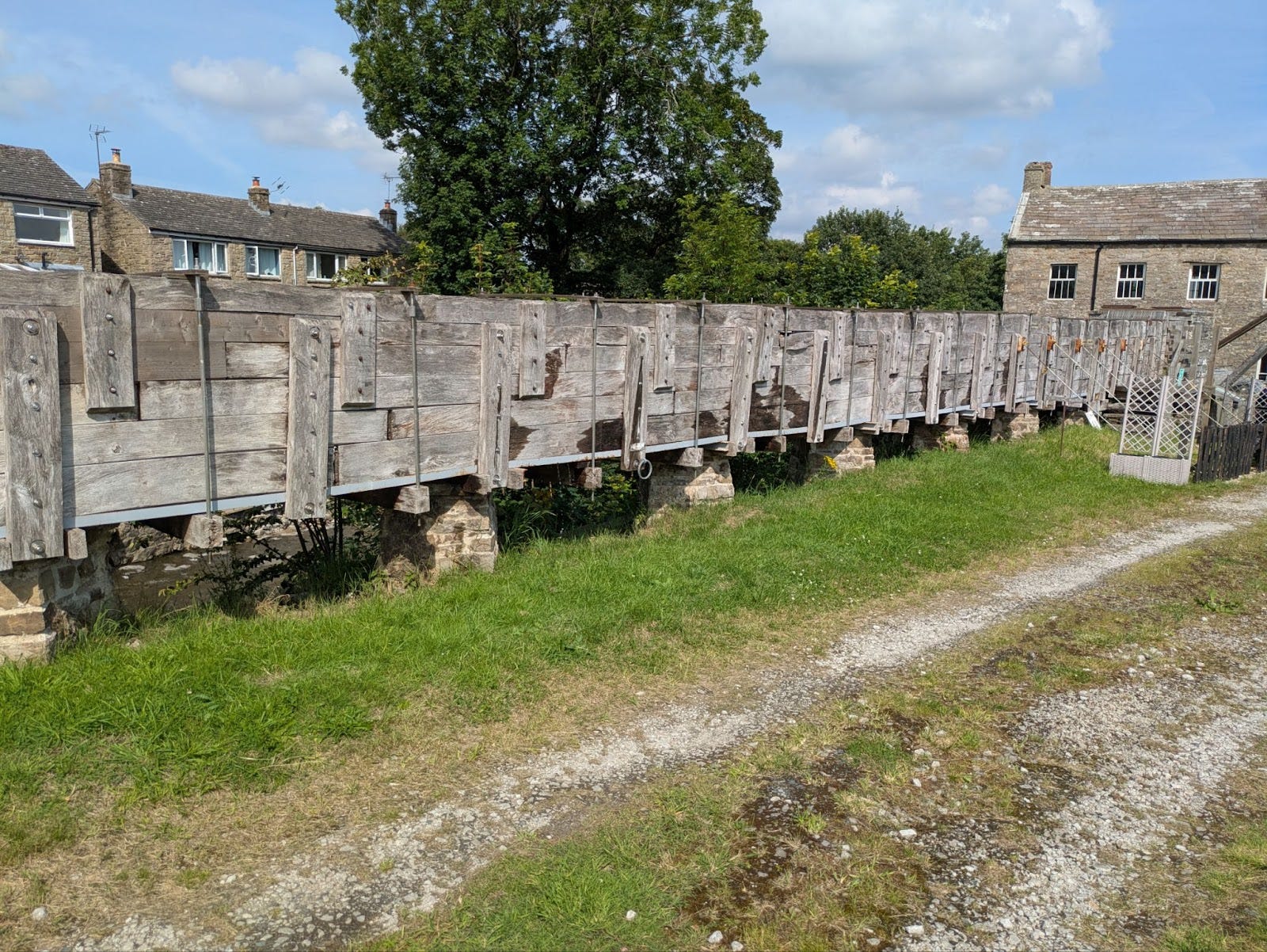
The wooden launder has been rebuilt, but there are ongoing problems with water leakage because elm has turned out not to be the best wood for the job. Any wood will always suffer from rotting and shrinking, so no launder is ever as dry as the miller would like. This is the launder as it looks now: -
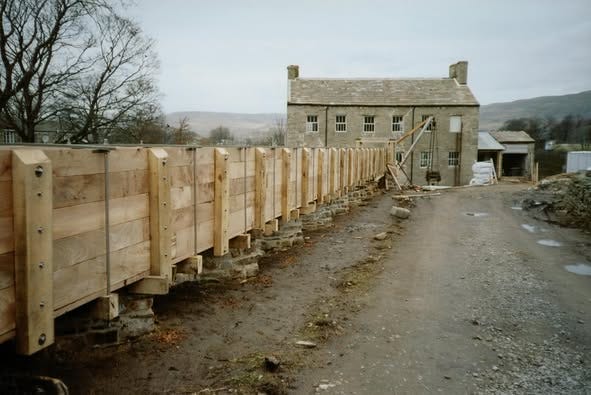
And this is what it looked like when it was finished about 20 years ago: -
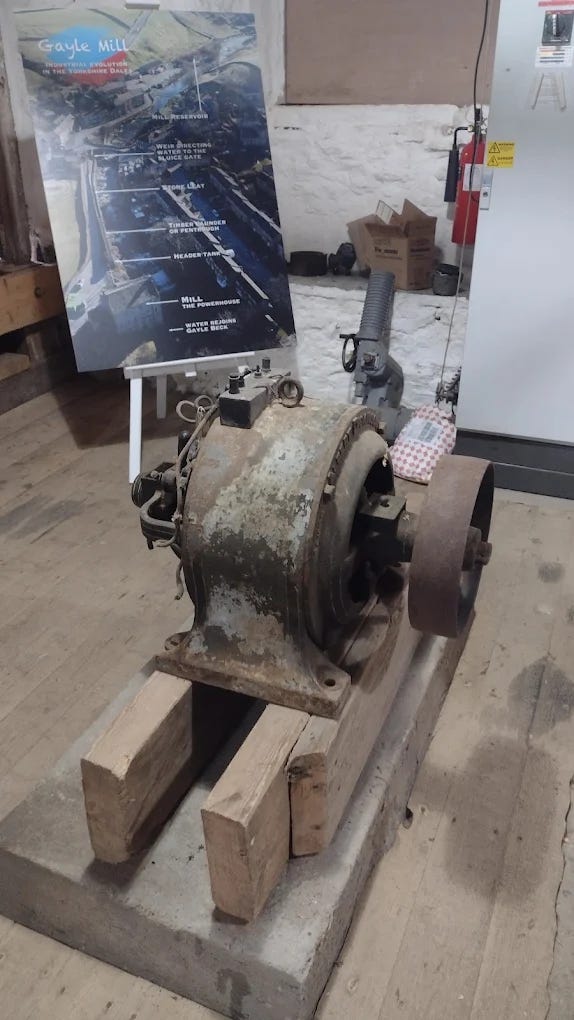
I think this little chap was generating electricity for use inside the mill: -
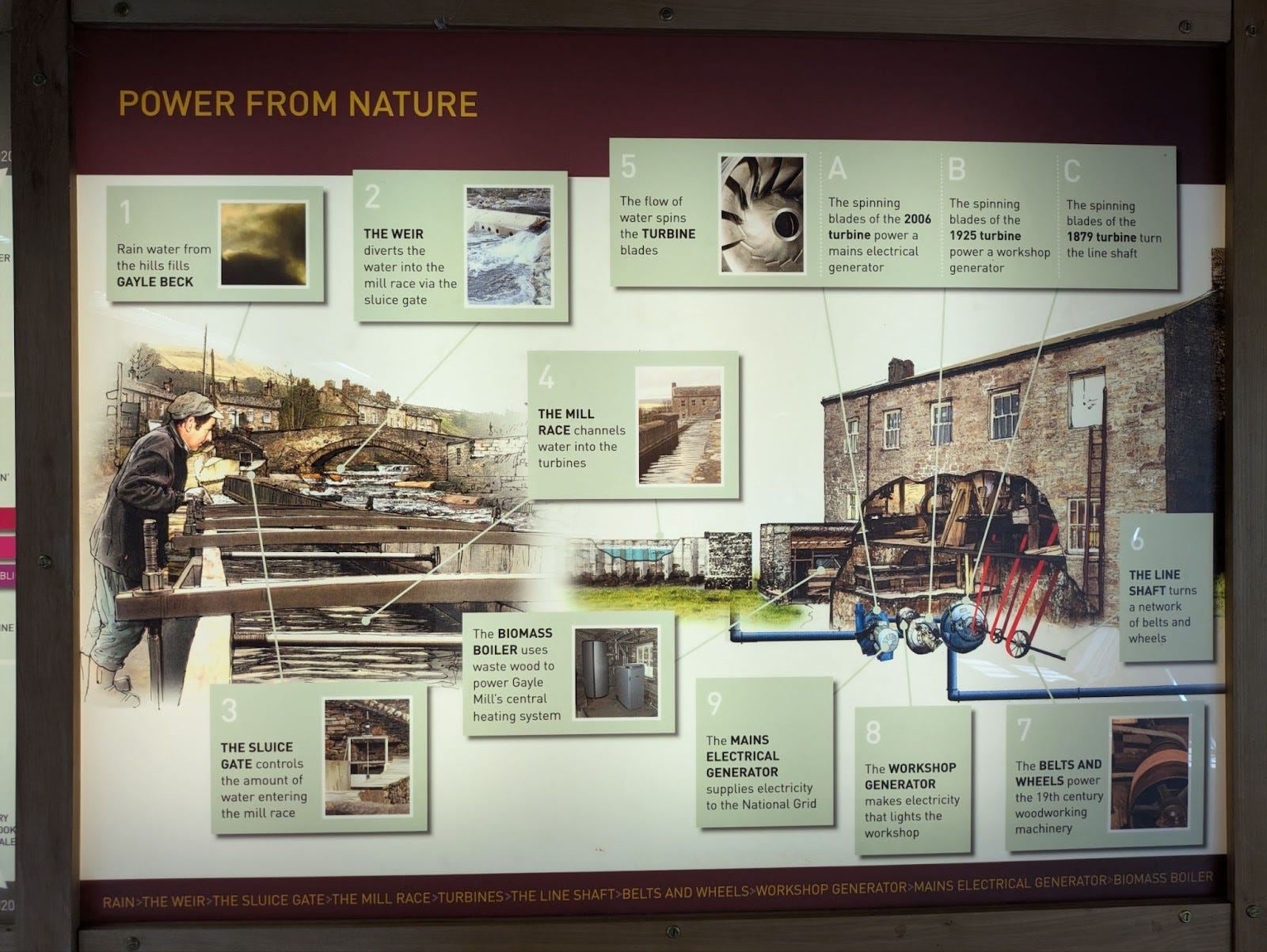
This poster from inside the mill shows how it all fits together: -
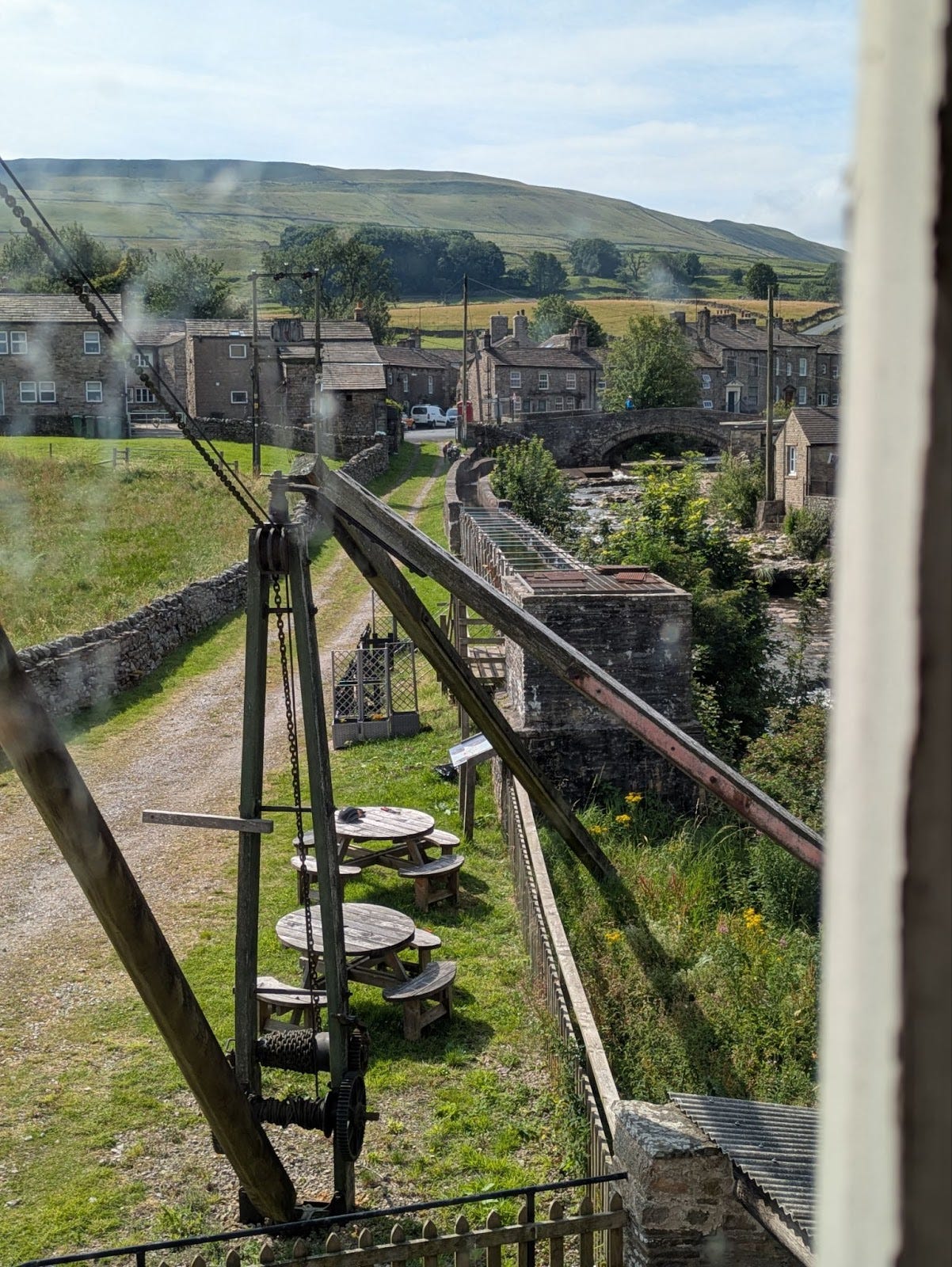
When your raw material is trees, a crane comes in useful. The picnic tables are a later addition: -
This is a good view of the crane as it used to be, from a poster inside the mill: -
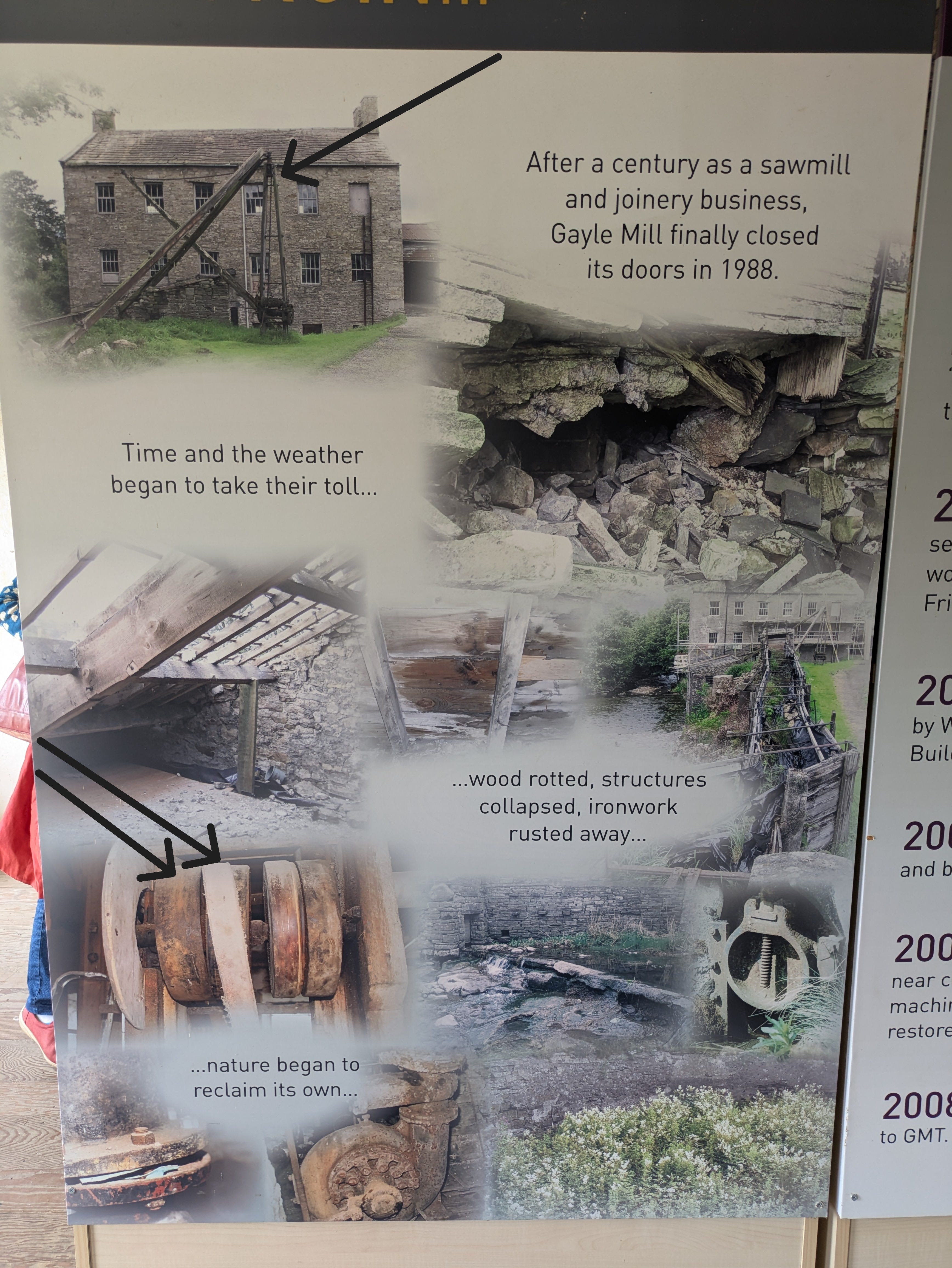
Notice also, in the picture above, the pairs of wheels driving the belts: flipping the belt from the larger wheel to the smaller wheel is the equivalent of going into neutral in a car. The larger wheel keeps the belt tight and so the machinery runs fast. Moving onto the smaller wheel lets the belt go loose, so the machinery slows down. Hence the term “running fast and loose” for someone who can’t decide between action and inaction. Perhaps the steam age equivalent might be “blowing hot and cold”.
The launder ends abruptly at the header tank, which feeds down into the turbine under the mill: -
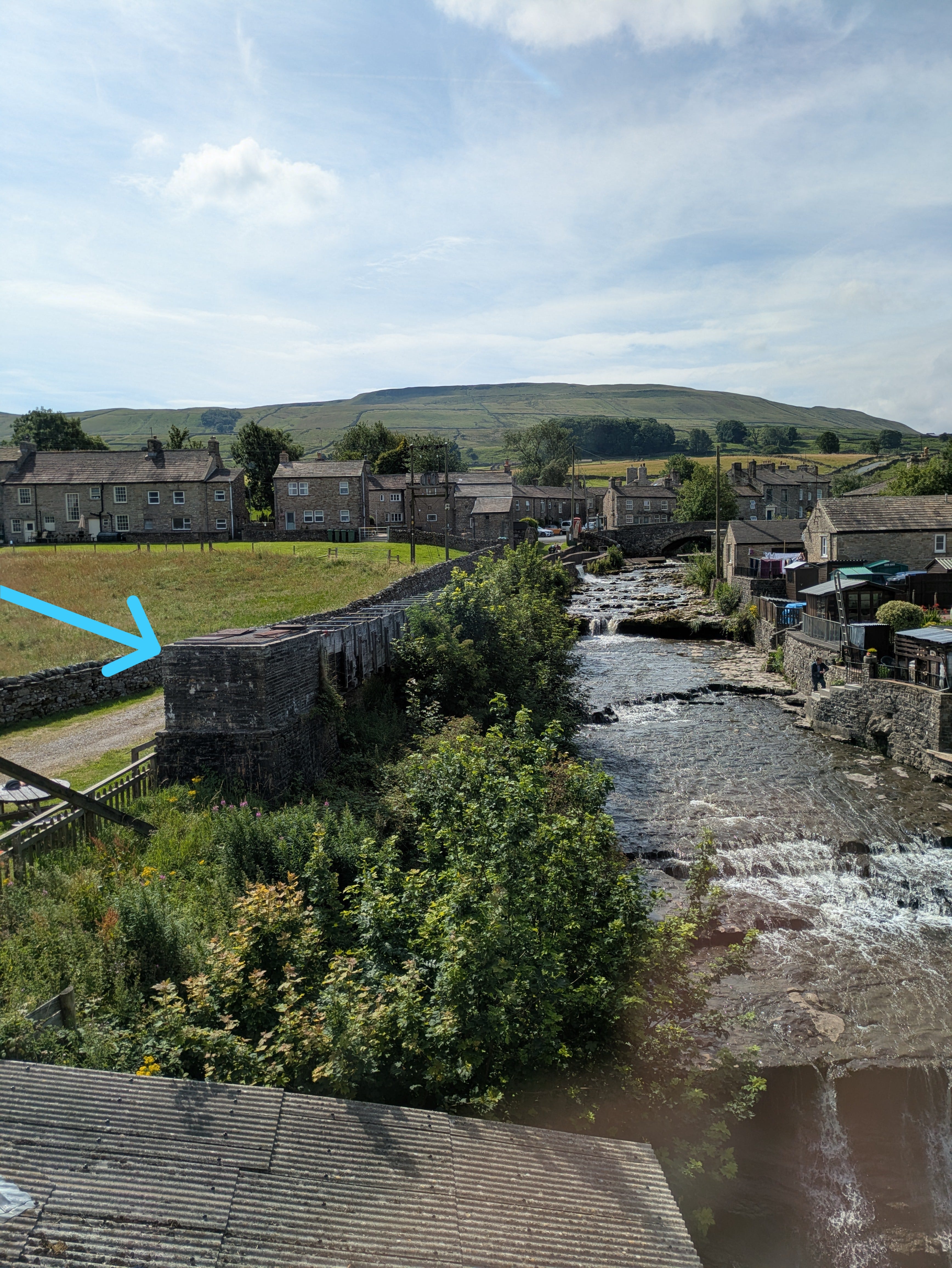
When the water wheel was in use, the launder would have continued right into the mill, like at the Heron.
The mill is surrounded by flood plains which soak up and hold flood water when the river bursts its banks, reducing the risk of flooding further downstream causing serious damage. Unlike other areas where the temptation to build on flood plains gets the better of planning authorities, the locals near Gayle Mill appreciate what their flood plains do for them, and jealously guard them as a matter of principle. So the flood of November 21 1963 must have been something really exceptional to be commemorated with this graffiti on the mill wall: -
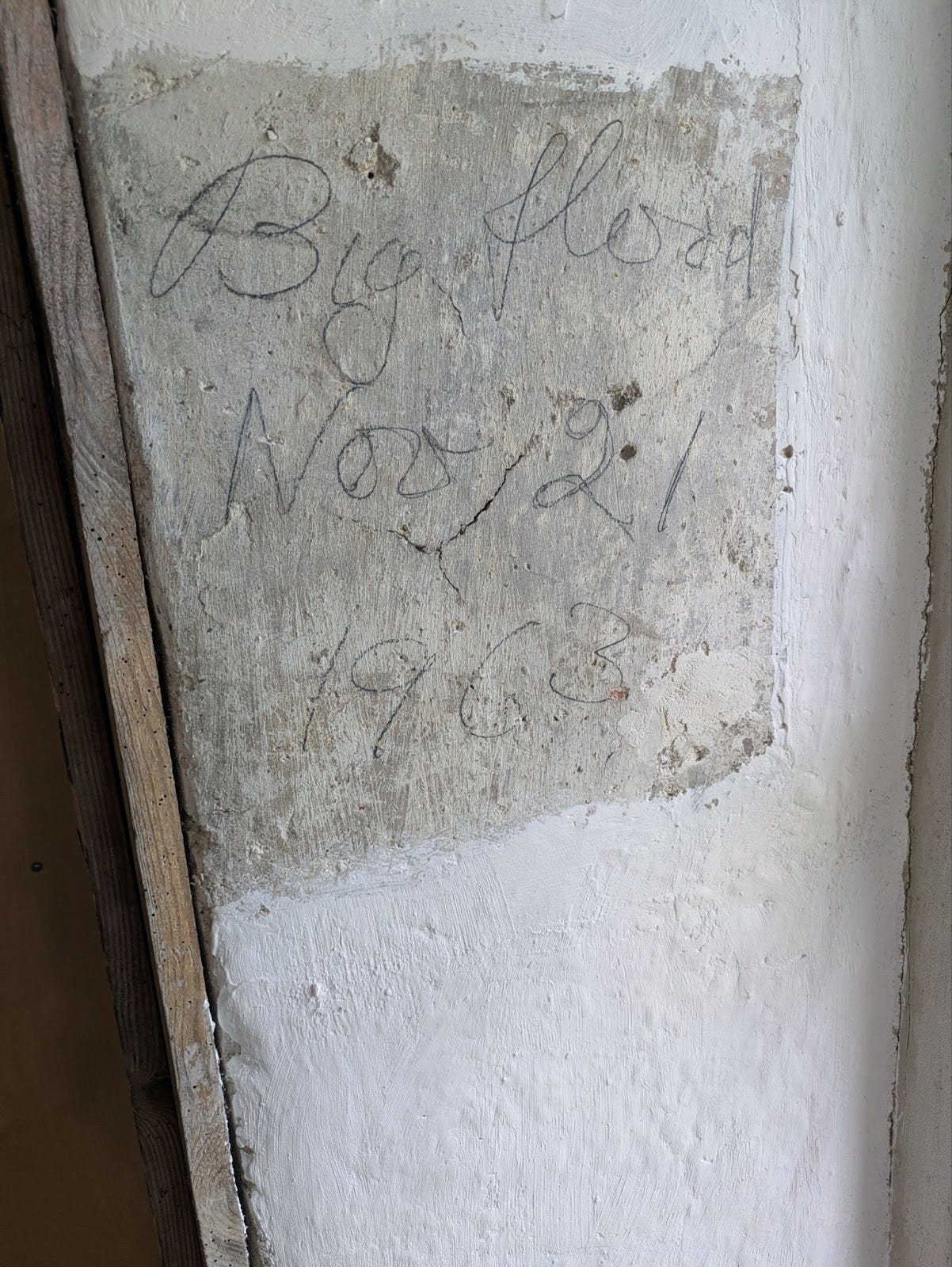
The next day, President John F Kennedy was assassinated.
The mill had an important role in WWII: the mill pond was used to test how tanks would perform in the sea off the French coast on D-Day. Soldiers billetted here were not trusted round the machinery in the mill, and had to climb this ladder to get into their top floor accommodation through the window: -
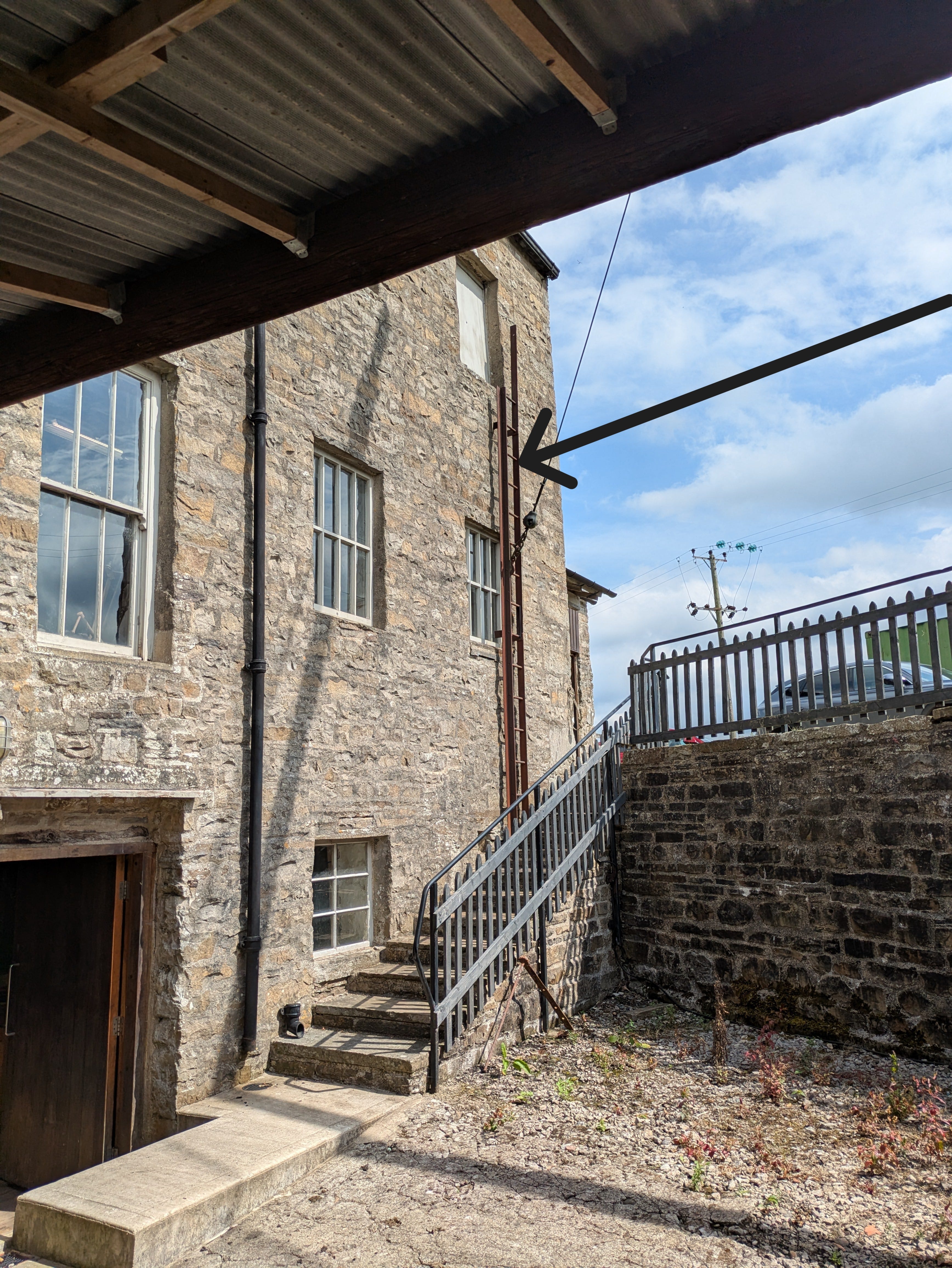
Being essentially open-plan, the mill buildings are attractive to birds. Here a wren made a nest to show to his mate. Unfortunately she didn’t like it and it was not used: -
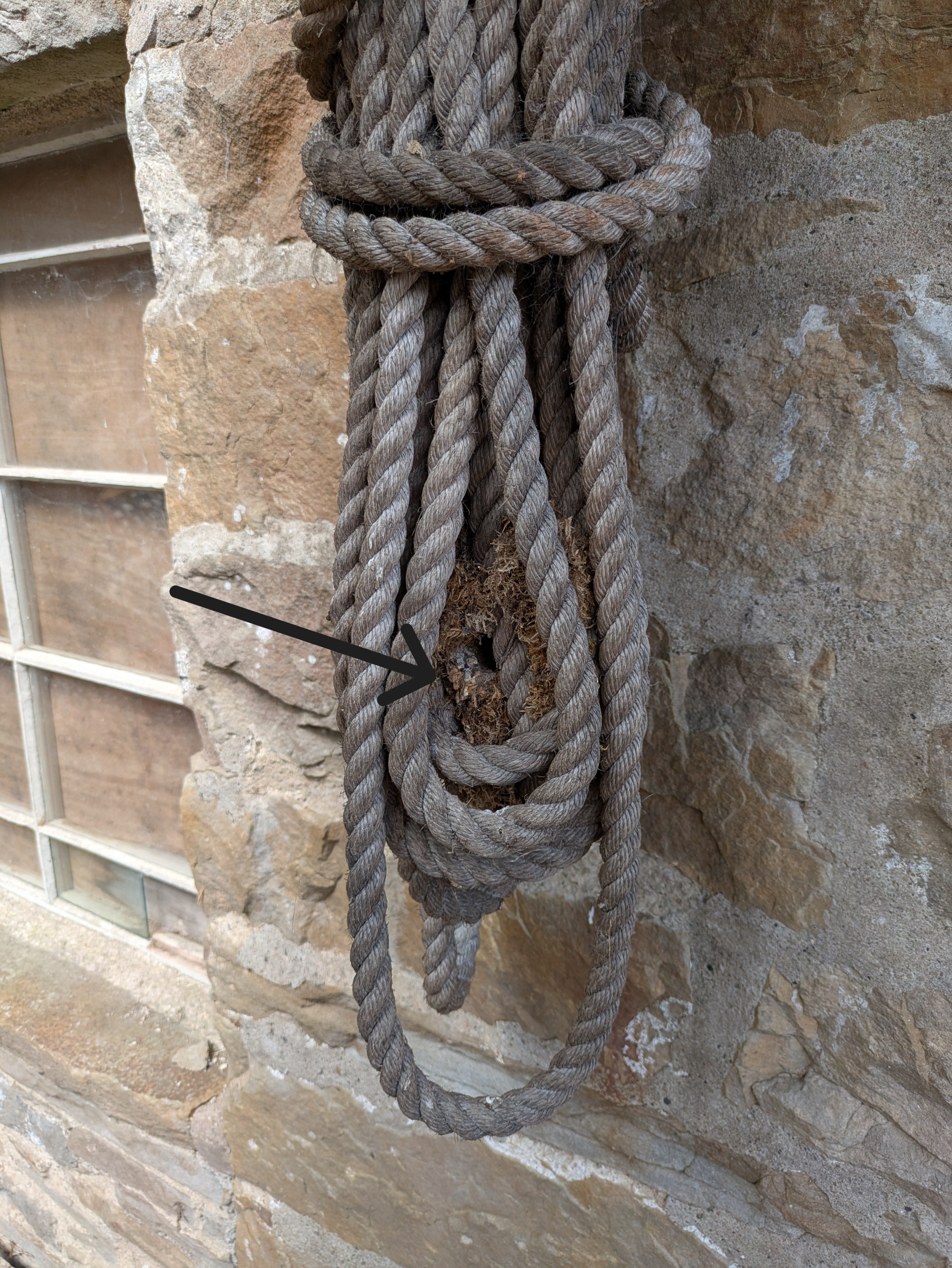
The circle drawn on the wall shows where the old water wheel used to be: -
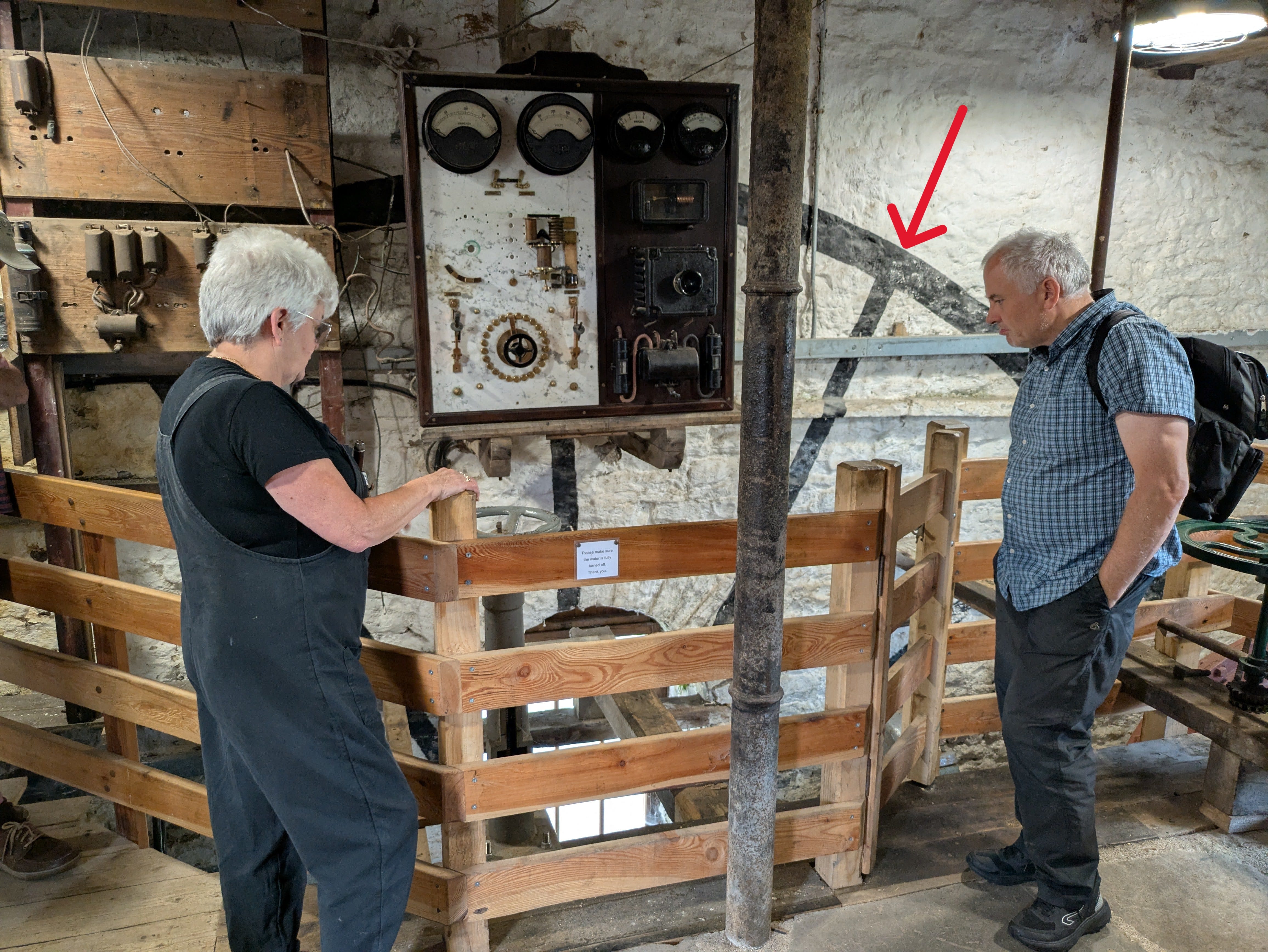
The “double vortex” water-driven turbine which replaced the water wheel was state of the art in 1879 and could easily generate enough power to run the saws and electricity to light the mill. Like the Heron, Gayle Mill sold excess electricity to local businesses before the national grid arrived at Hawes in 1948.
Despite appearances, the saw in the picture below was not turning - you wouldn’t want your fingers near a blade like that! A whole tree would be sent back and forth across this beast, taking off a plank at a time: -
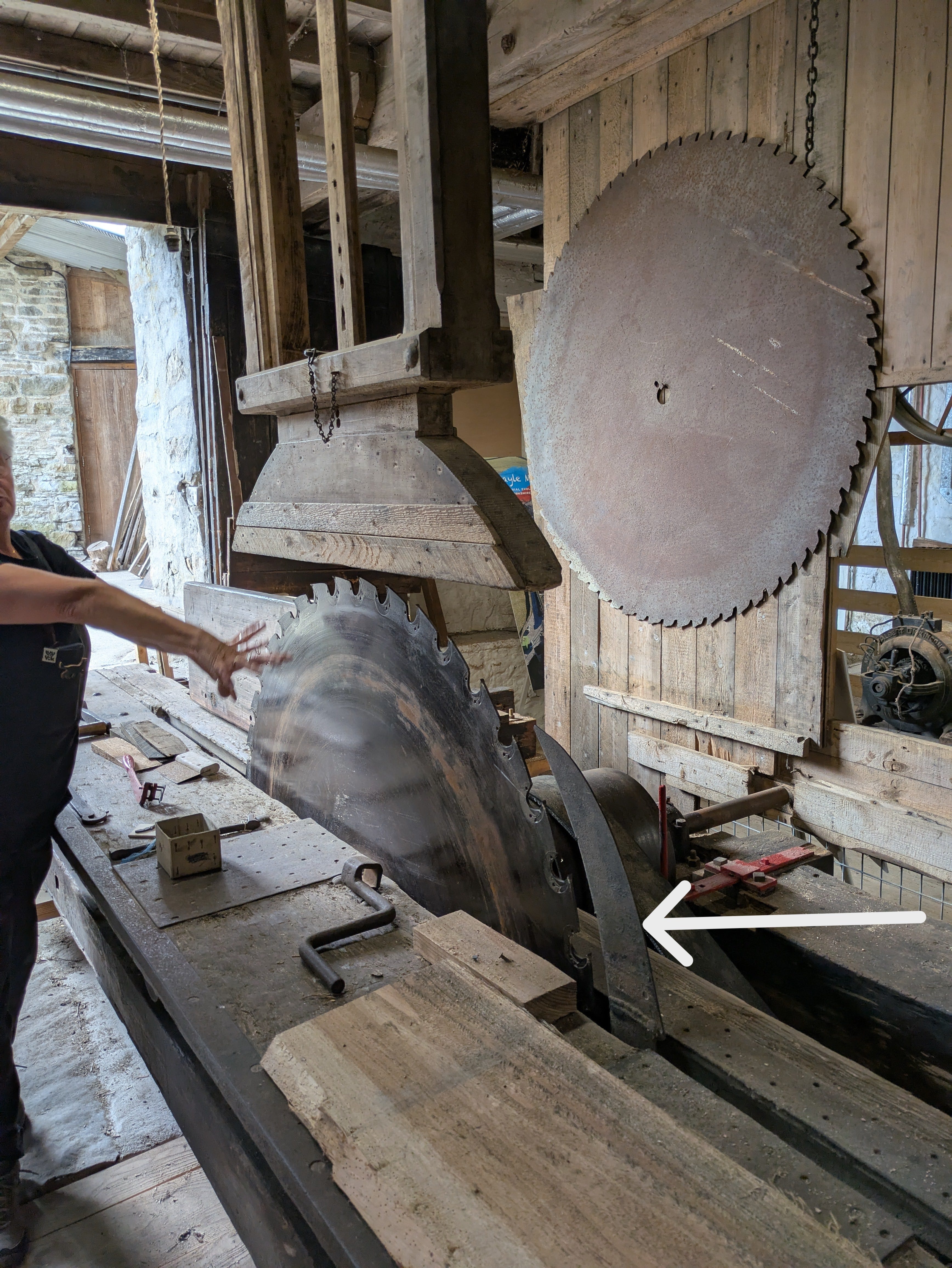
The thing that looks like a shark’s fin encourages the plank to separate from the tree. Without this cunning device, the plank would tend to touch the tree again, and the whole thing could get snagged on the blade, or worse.
The cog wheels at the Heron have wooden teeth as it’s easier to replace a single broken tooth than to mend a whole metal wheel. Similarly, the teeth on this great big saw are detachable and a broken tooth can be replaced: -
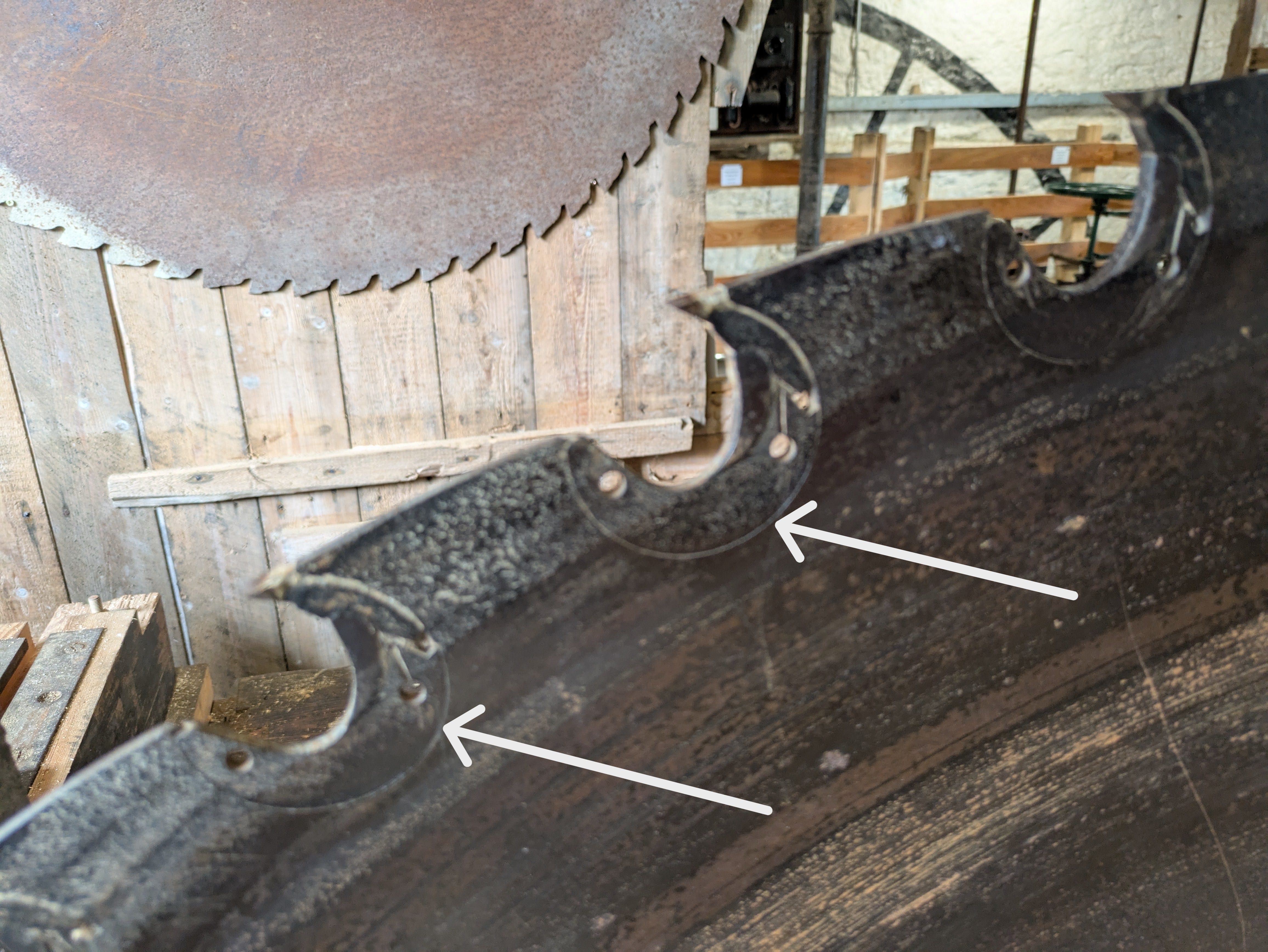
The trouble is, the teeth heat up quicker than the wheel, and tend to pop out of their own accord when things get hot.
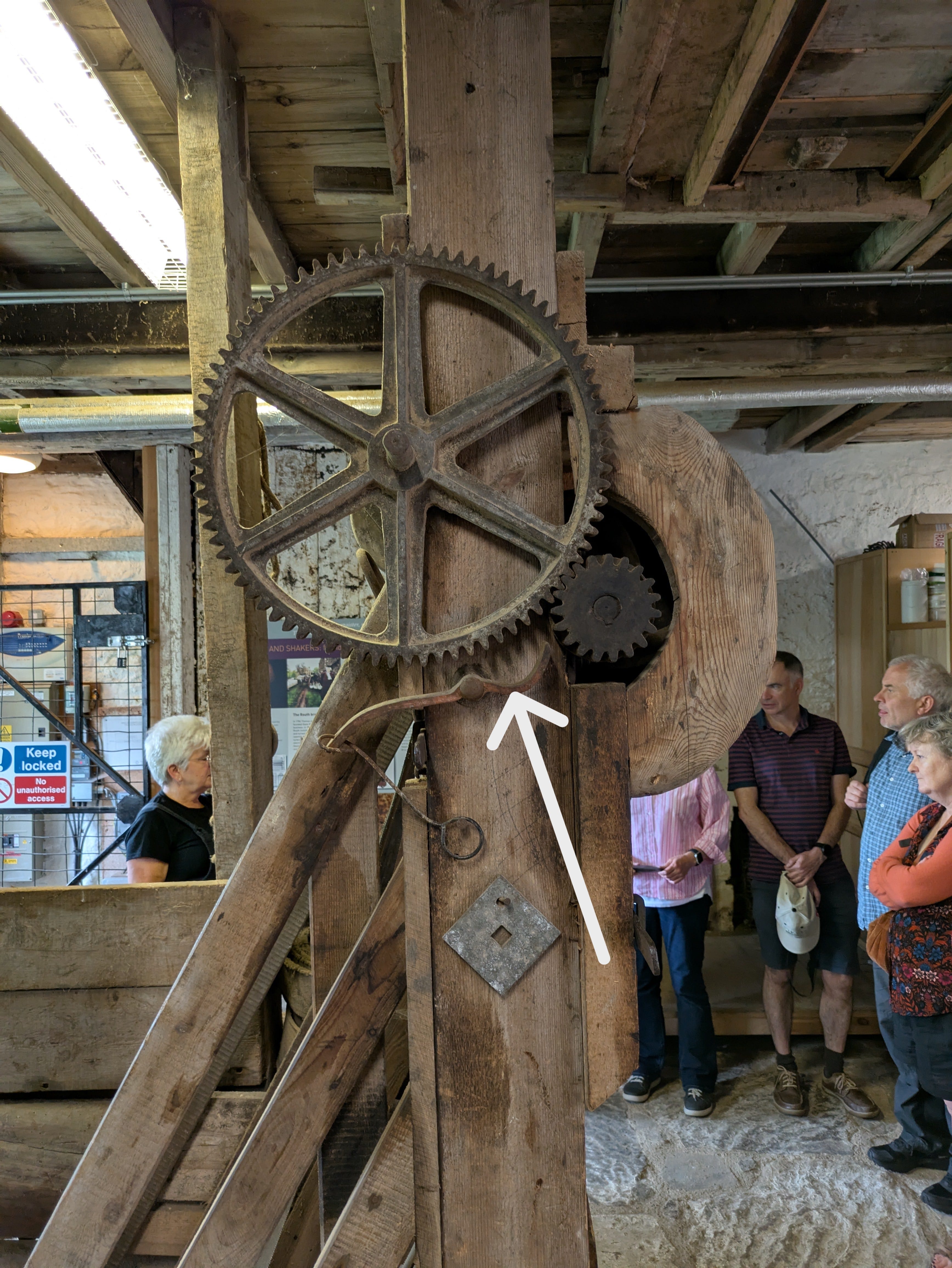
The simple lock on these gears is very similar to the one on my secateurs: -
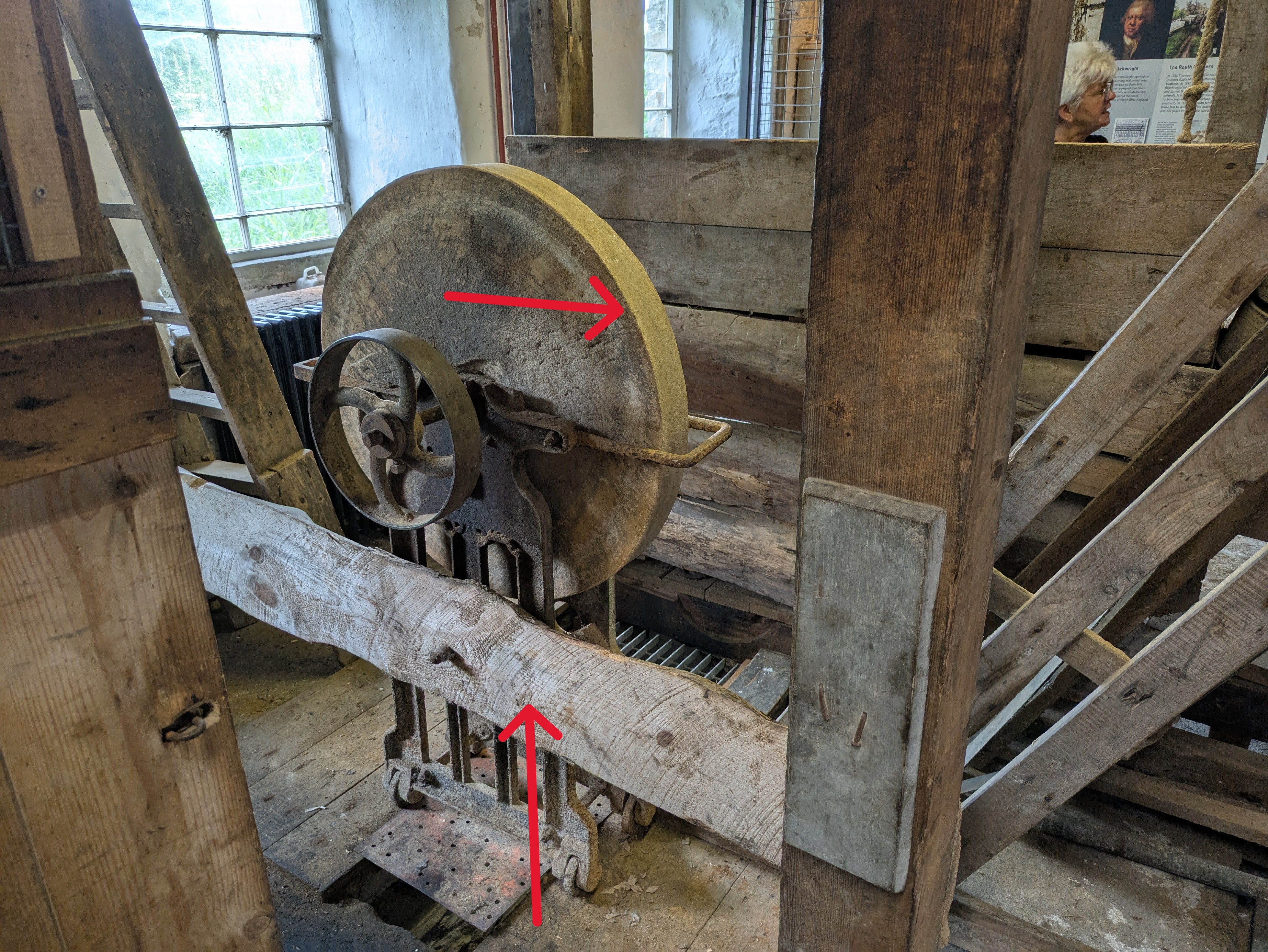
This blade sharpener on wheels tended to slide around when used, so someone had the simple idea of fixing it in place with a plank: -
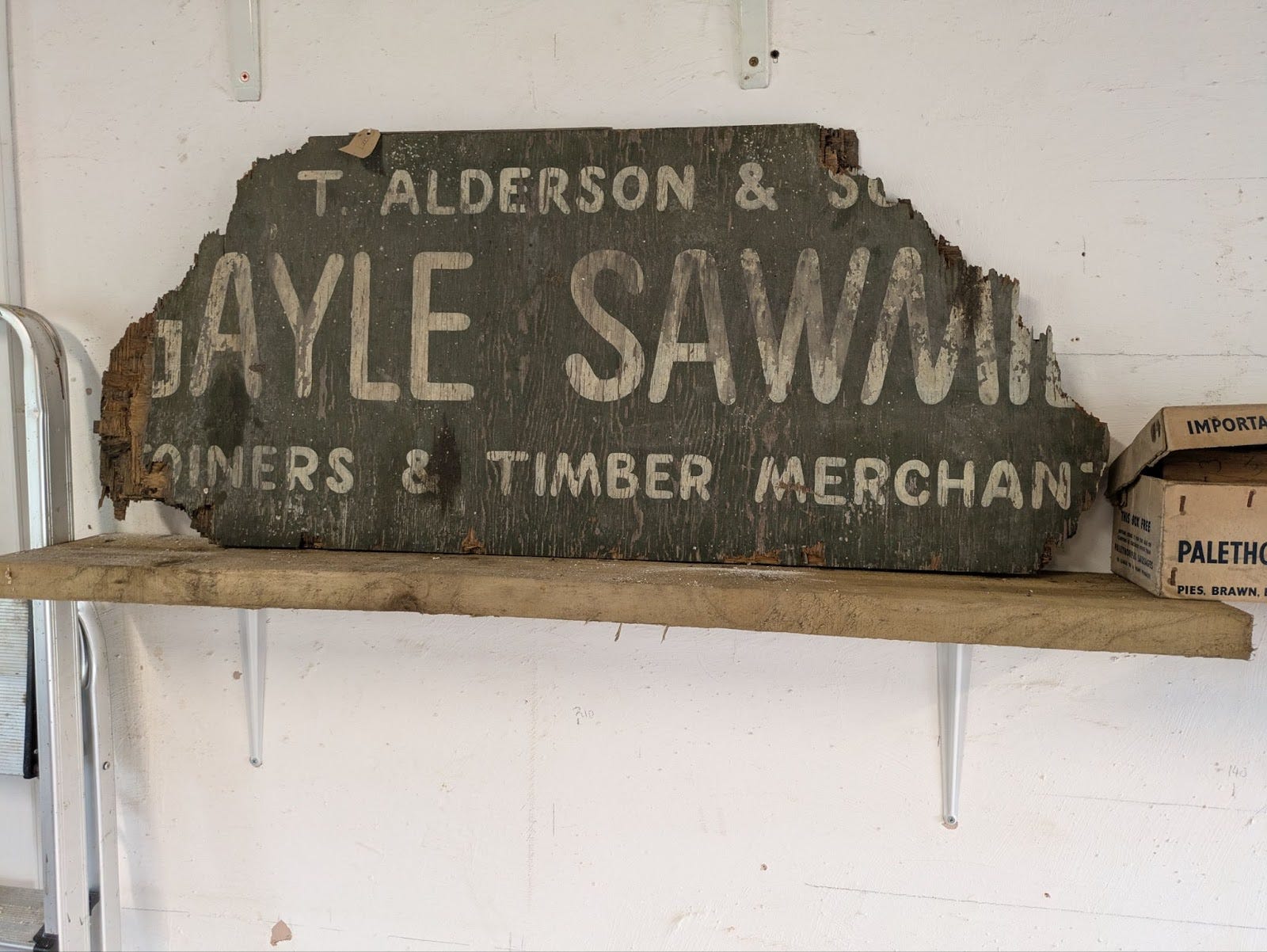
I can understand why this sign is in the mill: -
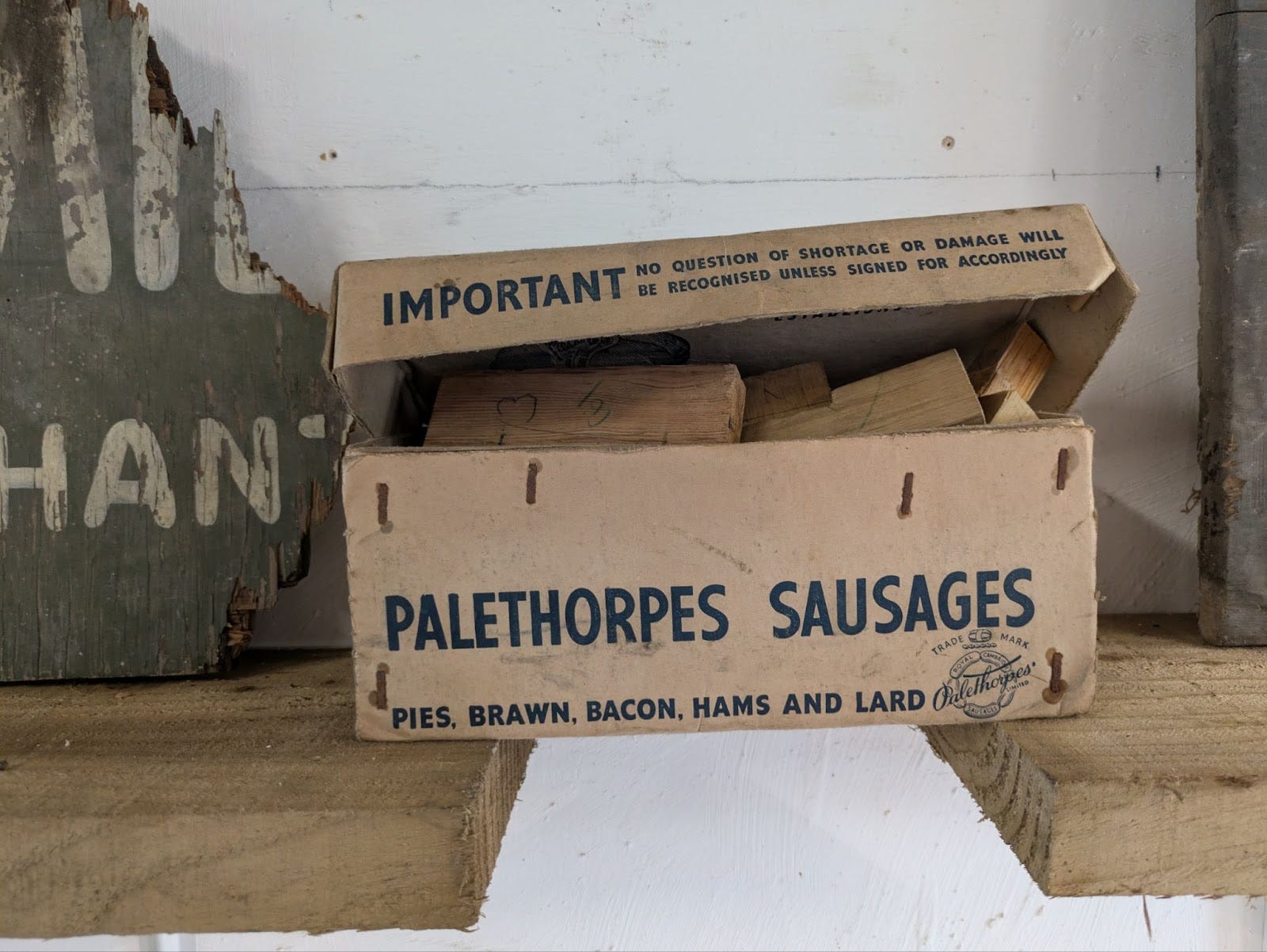
But I have no idea why this sausage box is there: -
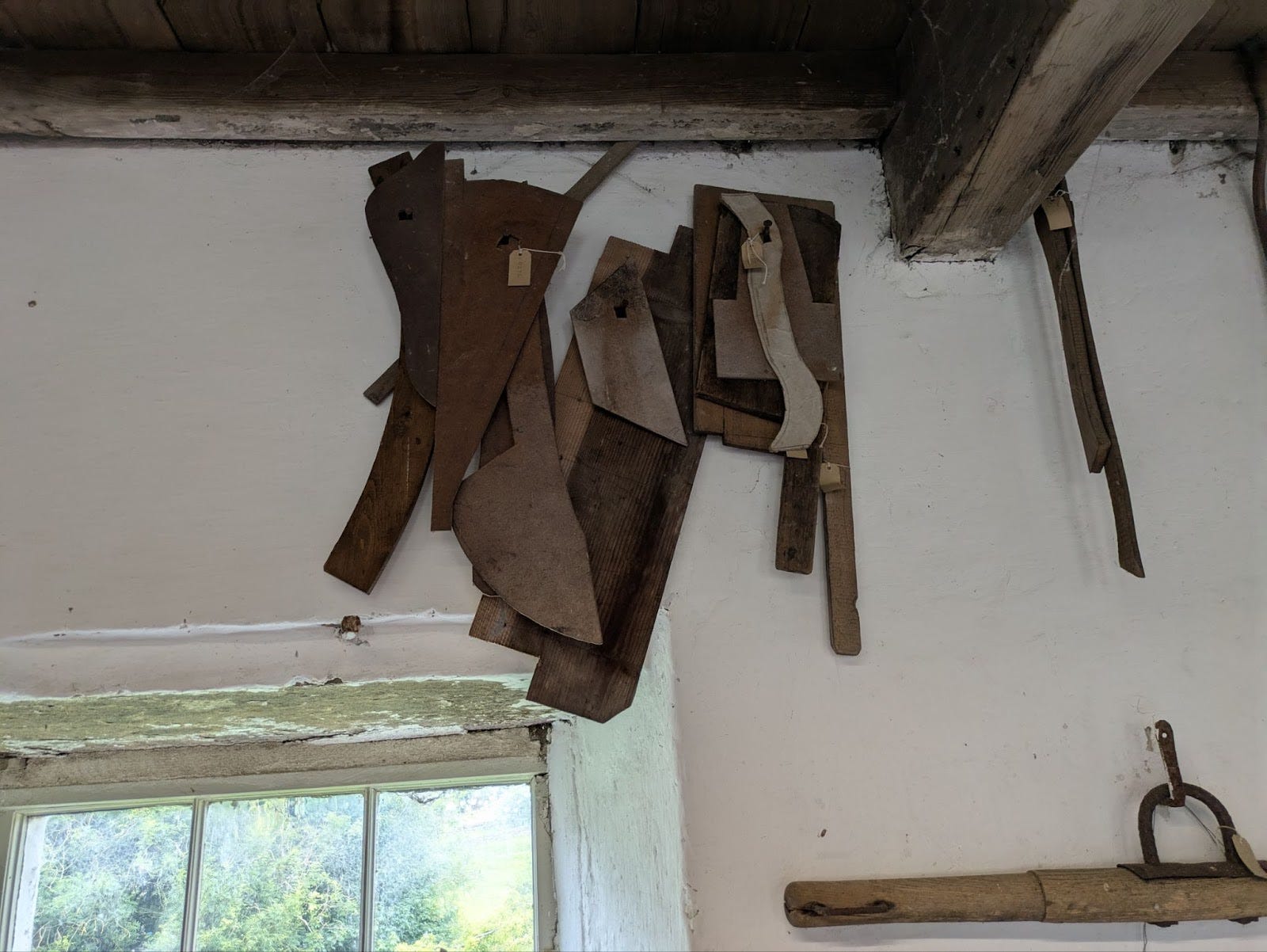
The woodworkers at the mill could be asked to produce anything and they kept wooden patterns hanging on the wall for the commonly requested things like saw handles: -
With Hawes cheese factory just up the road, it was not surprising to find a few truckles (cheese moulds) on display, but the mill was more interested in the wooden discs called followers that are put on top of the curds in the truckles: -
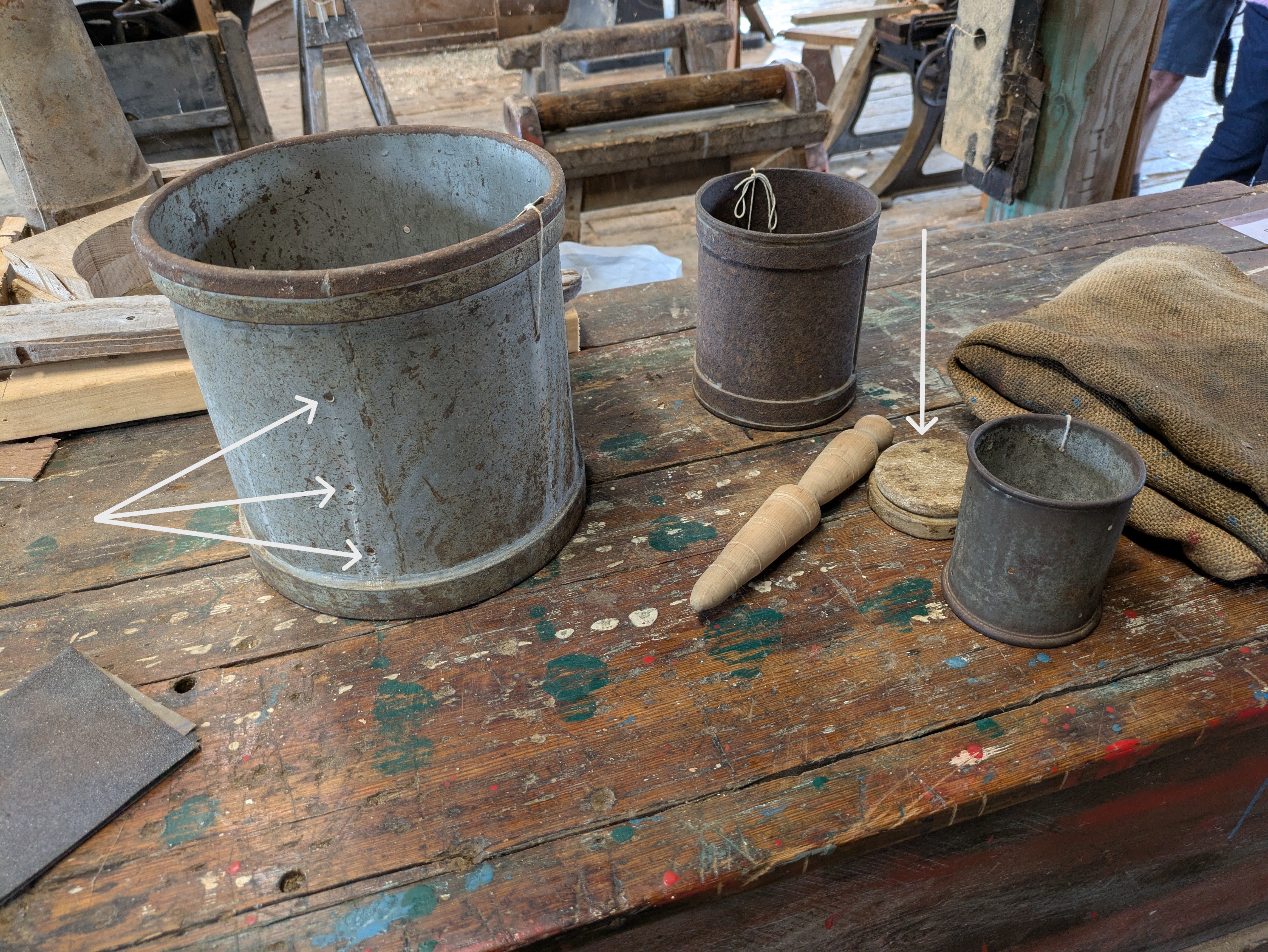
Heavy weights are placed on top of the followers to squeeze the whey out through the holes in the sides of the truckles. The mill used to quietly use up any scraps of waste wood to make followers because they knew that the cheese factory would need a few hundred every now and then.
Along with everything else a saw mill needs to provide, there is always a market for coffins, so Gayle Mill made those as well. And coffins are very much made to measure: -
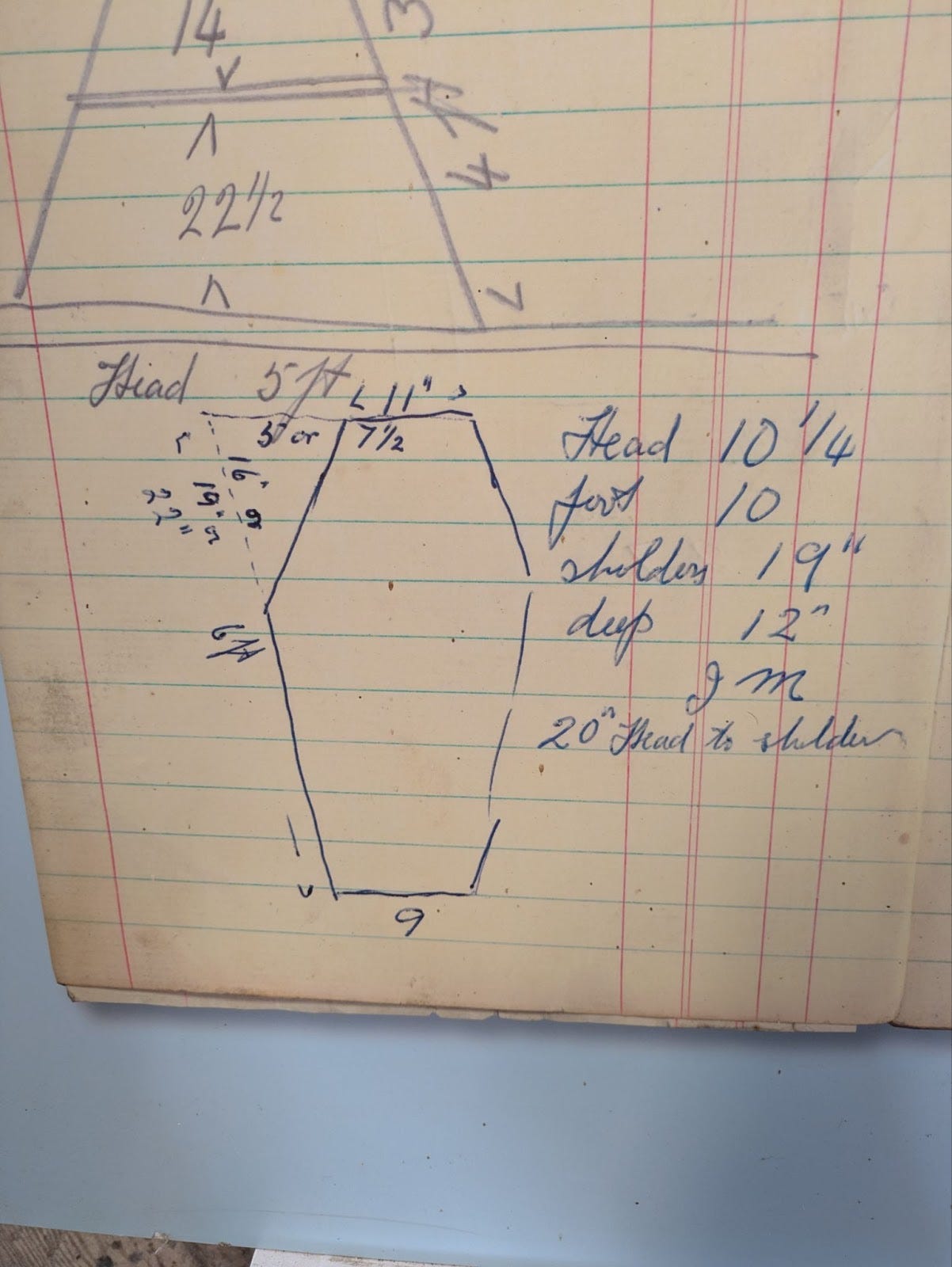
This is literally a case of cutting corners: coffins are made the shape they are to save a bit of wood. Everything has to be measured, side to side, end to end and top to bottom to make sure the coffin is big enough - just.
I’m glad to say that the Gayle Mill is definitely alive and kicking, and well worth a visit… on a Thursday!
Comments
Nothing yet. Say the first thing.
Sign in to join the conversation.