

We’ve covered genres that were once, and still are, challenging fare: Trance, Smooth Jazz, New Age, IDM, and more. The shifting of canon is a forever interest.
What’s in a name? Well, a lot. Artists already take a lot of shit across the board, but the industry has a way of pigeonholing them too. ‘New Wave’ was apparently popularized by Sire Records’ Seymour Stein, whose roster, including Talking Heads, supposedly rejected it as a catch-all.
Electroclash was the name of a festival/event in October 2001 booked by Larry Tee (more on this next week) which brought together some of the leading lights of the electronic music moment, including Berlin’s Chicks on Speed and Detroit’s ADULT., putting a wrapper around a diverse sound that had been gaining steam since the mid-late ‘90s.
Electronic music has always needed a label to ascend the ranks in America (Electronica, EDM). The truth is, there was no true Electroclash scene to my knowledge, apart from club nights (a key nug here and there) and maybe its original form, at Tee’s berliniamsburg (these Getty Image galleries are awesome) and other parties at Williamsburg’s Luxx club (I made the journey only once as a Michigan visitor) wonderfully documented by Queer Happened Here: NYC and via DJs like Roxycottontail.
If anything, even if derided by many purists, the Electroclash moment spawned great parties (London’s Nag Nag Nag, etc), a good press angle, a handful of great remixes, and a few major label signings (revisiting Shiny Toy Guns when I get a second). But for fans at the time, there was no name, just a loose global affiliation of electro-centric and '80s-inspired artists with no top-line banner. Montreal’s Tiga, from The Guardian, 2002: “The people who are into it tend to find each other…it reminds me a little bit of the rave and techno scene in 1990 - that same kind of camaraderie." The handle on the suitcase sufficed, and the name made it into all major culture mags and even an MTV News segment, not to be heard from much again that decade.
As we enter the 25-year culture arc, we’ve arrived at Electroclash again, and the name stuck, much to many’s chagrin. The critical take is much more positive this go-round, even Paste and The Guardian have all agreed on it, and the Pitchfork list got people worked up this week. I’ve been heartened by the goodwill towards Electro. When Pitchfork’s Walden Green called out 1998’s “1982” (a mission statement for New Electro, as it were) in a deeply poetic Tracks post, I felt venerated for having loved their music long ago; the masterful LP the song came from was never even reviewed on the first go-round. I can’t wait to see who writes the Sunday review.
Why it feels right in 2027, when it was mostly derided in 2022, is that the idea of a single person on stage pantomiming over Electro-Pop backing tracks is normal now. As Cassidy George wrote for Resident Advisor: “aspects of the sound and style lived on in the music of household acts that straddled the front lines of pop and electronica in the mid-’00s, such as Goldfrapp, Kylie Minogue and Madonna, then Lady Gaga and Charli xcx in the early ‘10s.”
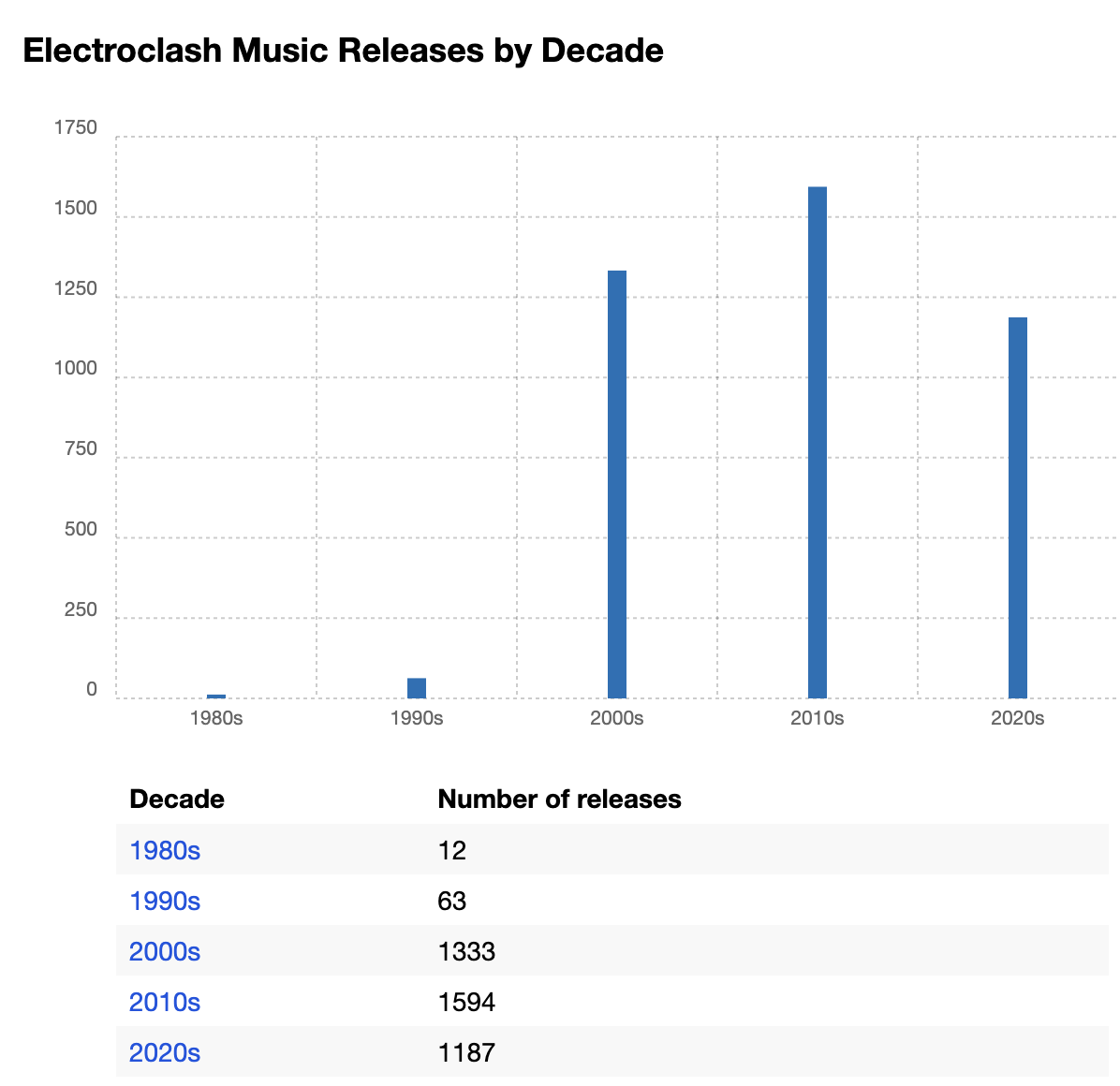
It’s almost that Electroclash has been more useful as a phantom genre than in its own moment. By the time the decade is through, there will have been more “Electroclash” releases in this decade than in its original era, meaning that younger artists have embraced the concept more than its original contemporaries.
The Pitchfork list yielded some diverse responses. Shawn Reynaldo (Herb 175) was nonplussed about the continued looking back that electronic music and the music press is doing, and given the amount of work he does each week reviewing new music (his process is detailed in his Herb post), he if anyone has the right to be peeved. Other folks felt more passionate about it all, unexpectedly, Nick Sylvester shared a workout-enhanced (Matthew Barney 1.0 was pretty Fischerspooner/Electroclash if you think about it) list of omissions, and even Philip Sherburne, not one to roll around in nostalgia or espouse maximalism, apparently submitted 40 songs for the Pitchfork list consideration (post the list, sir!). Maybe we all liked this era more than we let on.
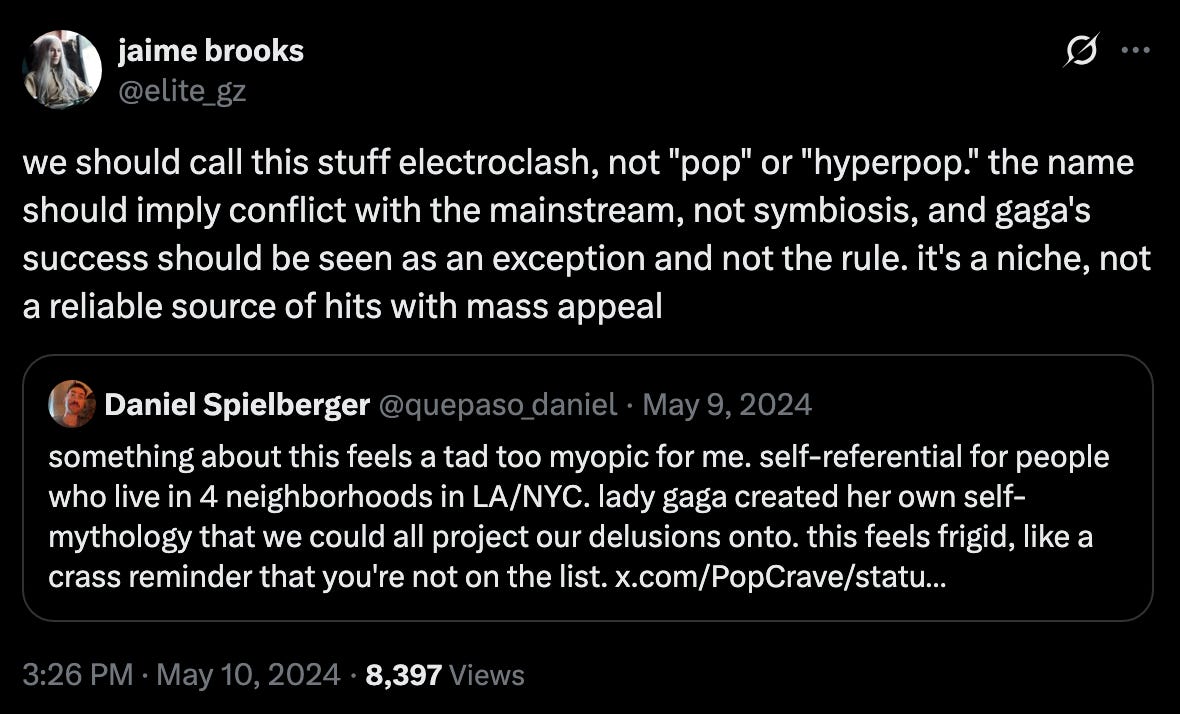
So what was/is Electroclash, other than marketing? jaime brooks has been consistently on record saying we should have kept the name all the way through instead of starting over with Hyperpop, a compelling concept to actually build a bedrock about homemade aspirational electronic pop.
It’s helpful to think of electronic music microgenres as DJ styles, more than genres in themselves, more operating system than sonic template. My own memories (again, more next week, from me and others) of this time were of the confluence of culture and music. Somehow, Andreas Gursky, Andrew WK, Tom Ford, Hedi Slimane, The Face, i-D, Sleaze Nation magazine, WMF club, Cookies, Matthew Barney, Peaches, and the rest of this music formed a global whole.
I-f not only created the stone tablet of the sound with “Space Invaders Are Smoking Grass” but also lit the fuse of the DJ style with “Mixed Up In The Hague” which is discussed heavily in the Italo 2 Herb post. DJs were given the blueprint to a form of DJing that was both forward- and backward-looking, with Street Beat original Electro (Man Parrish, Mantronix) rubbing up against Dutch electro (I-F, Legowelt, Clone, Creme and Viewlexx crew), NRG (Patrick Cowley, Sylvester), and, of course, Italo. Other songs came into the fold as DJ staples: Yello’s relentless “Bostich,” and The Clash’s “This is Radio Clash.” Detroit’s Brenden Gillen (aka BMG of Ectomorph) playing Prince’s “Erotic City” in an Electro context was a revelation.
Myriad international labels contributed their local varieties to the global market. Ellen Allien’s Bpitch Control was a freight train of Electro-edged Techno forecasting the new “Minimal” sound that would eat Berlin ahead; Köln’s Kompakt had a few cheeky Electro hitters that worked here (Justus Köhncke truthers rise up), and Montreal’s Turbo picked up from Sweden’s SVEK and married Rave to Pop, ushering in artists like Chromeo (see Dave 1’s Herb 29 for a clinic of tasteful 2000s Electro) whose debut LP is all jutty street beat Electro and still moves me.
As an aside, it’s been nice to finally see Tiga get his critical flowers after being fundamentally misunderstood for decades. If anyone has carried the torch for sincere but delightfully goofy, alongside Peaches, it's him. Proof that humor is indeed the highest form of intelligence. The man was built for it, literally born into it, partying in Goa as a kid, like how other Canadians breathe hockey. His short-lived podcast (episode with DJ Hell is a good start here) is one of the best things I encountered in lockdown and maybe to this day.
The actual beauty of the New Electro moment was that all these new records were backward compatible: EBM, Italo, dance punk, Belgian New Beat, dubbier 80s b-sides, which is what gave the era its charge. It was colorful, and perhaps also more non-male than traditional DJ scenes, a welcome shot of character. You could play Kylie’s “Can’t Get You Out of My Head” into The Rapture’s “House of Jealous Lovers”
There’s a commonly held belief that DFA and house band LCD Soundsystem were the main bridge between electronic music and rock, part of which is true, but the sauce was already on the stove; it just needed a kick, just like Murphy’s famed E pill granted via David Holmes/Tims Goldsworthy, would be the the Creation of Adam moment for DFA. DFA needed Electro as much as it needed them.
Music not only reflects the times but also predicts them. Reality TV was already off and running in the early 2000s. American Idol debuted in 2002 (the idea of circumventing the industry is inherent), and Paris Hilton and Nicole Richie’s The Simple Life debuted in 2003, with the One Night In Paris sextape soon to follow in 2004. By October, the heiress had a song dedicated to her. Pre-social media, music had to do the heavy lifting.
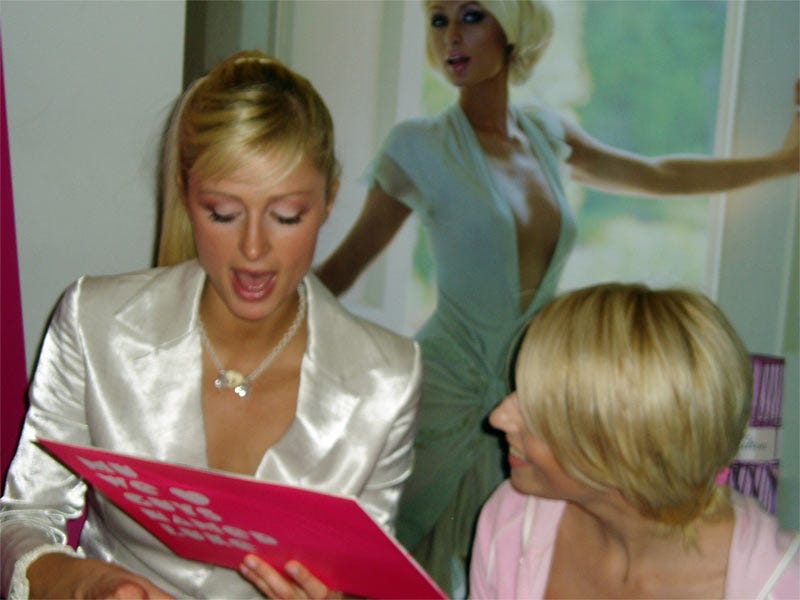
About the 12”, In Sheeps Clothing site says: From the wonderfully twisted minds of Japanese performance artist Mutsumi Kanamori and Sheffield via Baltimore house music producer Maurice Fulton, Mu is an electronic pop outfit that released some of the most idiosyncratic dance-floor fillers of the early ‘00s. “Paris Hilton” rides on a crispy 808 groove and acid bassline that breaks down into squelching chicken noises from Mutsumi as she regales in the “natural beauty” and “silver spoon champagne baths” of reality tv star Paris Hilton. While the track might seem like a piss take, in actuality it’s more of a playful homage: “She’s beautiful and has a style,” says Mutsumi. “I’ve been a fan for a long time.”
The more I’ve thought about the era, the more I've realized the mores of “Electroclash” were a fun bid for celebrity in the pre-smartphone world, a way to make DIY feel exciting and prosperous, a rejection of drab ‘90s slackerdom and sincerity, but also a send-up of the nascent Reality TV world. Through a modern lens, it looks thirsty, but playing these games was subversive at the time.
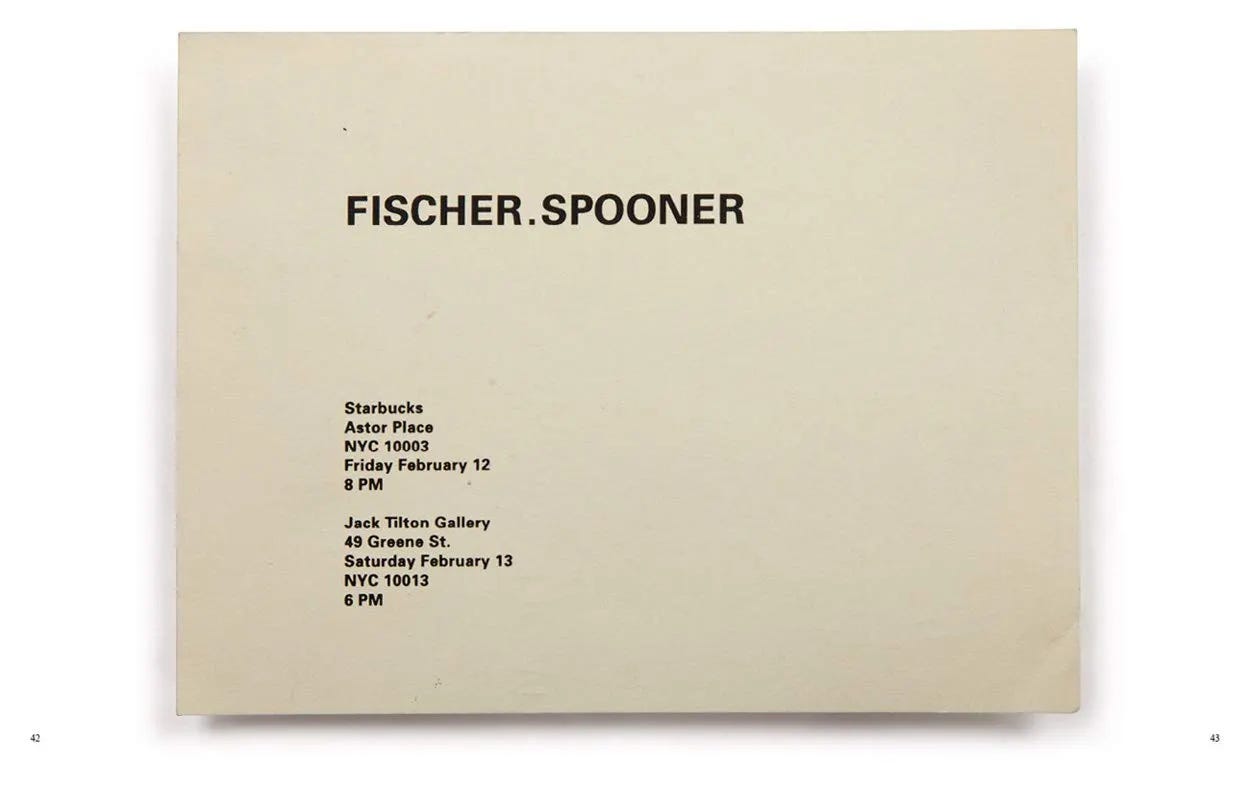
The biggest act of the -Clash world, Fischerspooner, was actually a downtown art world fixture, more Dash Snow than Scissor Sisters, cavorting with dealers and curators like Gavin Brown, Jeffrey Deitch, Klaus Biesenbach, etc., before ever cutting a record (eat your heart out Charli! who is attempting the other way round, a la Kanye), and even staging performances at the now-lost Astor Place Starbucks. “We really tried to dive in head first into this empty swimming pool that is the space between art and entertainment, pop culture and ‘high’ culture, and to try and make something meaningful and lasting.” - Warren Fischer (from the FS book) from a Cut retrospective.
From a Vulture interview with Nick Catucci for Vulture, Casey Spooner opines:
NC: Early on, you were associated with the electroclash scene—
CS: I don’t know what you’re talking about.
NC: Is there a cohesive group of musicians that you feel you belong with now?
CS: I don’t know. I just look at that period as such a moment. Everyone was so terrified of Y2K. If I’m gonna die at the strike of midnight, and the whole infrastructure of the entire Western Hemisphere is going to implode, I’m going to be dancing in a motherfucking jockstrap to bad dance music, covered in sweat and glitter.
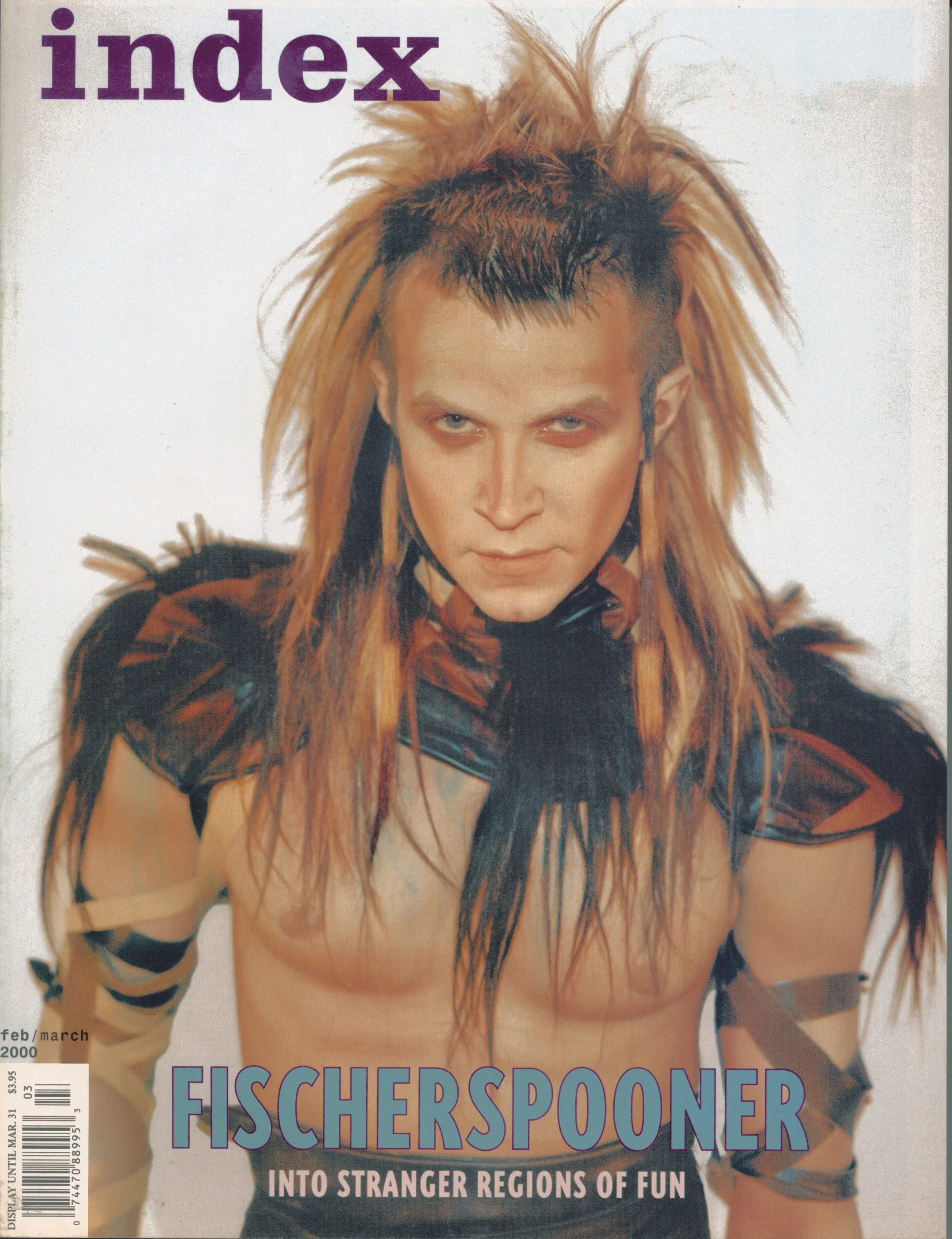
From Index Magazine, 2000, Fischerspooner on spanning DJ culture:
STEVE LAFRENIERE: Everyone's from the midwest lately. Artists, writers, performers ... STEVE: That sounds idyllic, to be allowed to dance without going to some trendy hangar and handing over twenty-five bucks.
CASEY SPOONER: ... Peanuts. Well, I also lived in Chicago from '92 to '95, which was an incredible time and place. I'd go out to all the black, gay house clubs, and there'd be live drummers and guitarists performing with the DJs. Dance was totally different there. It was a language. People would have their styles. Not group styles, individual styles. I would steal, and every week I'd do a variation on that movement and keep building on it. It was a huge influence.
CASEY: At that level New York has been very frustrating to me. People are so not expressive. One of the ideas with Fischerspooner is hopefully to create a movement back towards dance.
WARREN: I was almost going to say that we hope to transcend those issues. Audiences are so splintered nowadays.
As the great Tricia Romano reported on for RBMA:
In March of 2000, they staged their first solo gallery exhibition in New York for Gavin Brown. It was five nights of six hour-long endurance performances, and featured an elaborate set with platform stages that jutted into the crowd. The shows were rumored to cost anywhere from $10,000 to $100,000 or more a night, bankrolled by sponsors like the Arts Council of New York – but mostly underwritten by Brown himself.
In the audience at one of the shows was New York nightlife fixture Larry Tee. “I thought it was going to be a live show,” said Tee. “I went there, not really knowing what I was in for, just thinking, ‘Fischerspooner: That’s the worst name ever.’ So I go and it was these platforms all around this dark room. I thought, ‘I’ll just stay out of the way.’ You couldn’t, because you were in the middle of the show. It was totally mind-blowing. I’m going ‘What the fuck?’ and loved every second of it.”
In 2001, Gavin Brown and Art Production Fund took the show to Los Angeles. The performance was a large site-specific installation that took place in the construction site of what would later become the Downtown Standard Hotel. Wearing costumes designed by Elise Fife and Peter Soronen, they performed three nights to crowds including actress Rose McGowan, rocker Courtney Love, and promoter Bryan Rabin. The audiences alternated between being nonplussed and fascinated. “That was the best crowd for the lamest show I’ve ever seen,” the Los Angeles Times quoted one partygoer.
"Emerge” was released no less than four times in three years, each time both gaining and losing gravitas, starting with John Selway’s modest Serotonin, then Gigolo, then Ministry Of Sound (in a whispered "million pound deal”), and finally Capitol Records, in some sort of nesting doll psychodrama of that weird era as piracy threatened to upend music writ large. “Eventually, Capitol Records bought out Fischerspooner’s contract, and #1 was finally released in the States in May 2003. By then, Fischerspooner and the record were old news. “All the tastemakers or people that would write it up were like, ‘We’re not going to review this, it’s done,’ said Db Burkeman.”
Electro has roots in Black and Latin music, German and Japanese, a welding of funk onto the rigidity of the electronic grid inside Roland instruments. It’s the subtext of the reason Carl Craig (Herb 08) apparently said something like So Stiff they’re funky about why Kraftwerk worked in Detroit.
Electro gets short shrift in the pantheon of genre, fearfully because of racial erasure (this Dan Charnas Sabrina Carpenter article comes to mind), or maybe cause of the lack of a central narrative or the aforementioned “handle.” Electro is perhaps the most consequential electronic genre in its influence. Cybotron’s “Clear,” a foundational Detroit Techno text, is in fact more Electro than Techno, and the origins of Hip-Hop have a number of train stops there with West Coast Electro (Egyptian Lover, early Dr. Dre projects, etc.) as well as the production work ot Arthur Baker, Michael Jonzun, and John Robie at Tommy Boy, etc., fusing Kraftwerk samples with an 808’s adamantium frame.
Saying Electroclash is “back” is funny in that the first go-round barely made an immediate dent in the global culture, apart from some great remixes and setting the stage for other microgenres with names people didn’t like from Nu Rave and Blog House. Nevertheless, the fingerprints of the era are now felt, maybe most noticeably a few years back with The Dare (Herb 83), who I stood up for as I saw a kindred Electro spirit. That a school teacher could don the suit (it’s available to all) and make a go at it felt right to me, a sign that the thing was still working. NYC still exists, even if it is different or less than the shadow created.
The feelings of the era have also been raised for me with acts like dance arts center, Touching Ice, and others. Pitchfork followed their Electroclash list with a “Hyperclash” primer (Herb 192 CFCF quoted) including a batch of ascending acts I’m looking forward to checking out.
I asked Trevor Jackson (Herb 17) for his thoughts on the Electro matter, knowing he’d throw a heater, him being one of the great producers/djs/designers/quote machines in electronic music history whose label, Output (1996-2006) was a cliear bright lights of the new electro era, and his own Playgroup project, an “anti-pop” self-styled producer alias, made for one of the best electronic LPs (and DJ Mixes) of that era.
‘Honestly I don’t really give a shit about Electroclash or Indie sleaze both terms for music that kind of offend me, I made, released, listened and played electronic & live dance records at the time that had personality & attitude, shortly before the birth of these movements the dance floors we were swamped with bland progressive house, generic techno & dumb big beat, all testosterone fuelled absolutely sexless lad music. I was dying to hear some new club music that was as exciting as the kind of things I heard on a dancefloor as a teenager, made by artists who I wanted to fuck or be like.
Suddenly a few things started to appear, like minded DJs started playing the records, a few great clubs popped up. It was a lot of fun, colourful, diverse, creative, smart but soon imploded in on itself and became a joke. Larry Tee named it, DJ Hell delivered it. I tried to escape it, end of. Now of course predictably there’s a revival and I’ve been written out of a movement I didn’t really want to be part of anyway. So I’ll leave it to the ones still stuck in the past and embrace my sordid memories never to be repeated.”
- Trevor Jackson for Herb Sundays, August 2026
The truth is, anything intentionally made to be Electroclash was runoff, the best stuff was already in circulation, so the title perhaps hastened its innovative decline. From the Resident Advisor feature: According to DJ Hell and The Hacker, the golden age ended in 2002. “After that, electroclash—like every musical movement—became a cliché, a parody of itself,” The Hacker admitted.
The architecture of what we perceive as the Electroclash image indeed starts with Munich-bred DJ Hell, and the founding of his International Deejay Gigolo label in 1996. Gigolo’s louche image, its spiky personalities and graphics plus Hell’s Bavarian machismo, and the appropriation of Arnold Schwarzenegger (maybe akin to what Shepard Fairey did with Andre the Giant), ethos-grabbing a titan to set a mood. Apparently, Schwarzenneger allegedly served cease-and-desistt but Gigolo rolled on, using Sid Vicious and then Amanda Lepore as their mascot. The image was clear: This was raw, sexual, unpolished music, not bashful or faceless.
I was on tour with Jeff Mills—we traveled the world together many times and became, and still are, very good friends. One day, on a flight to New York, we were playing at the Palladium, Jeff said to me, “Hell, it’s time for you to start your own label.” He joked that we were all like “DJ Gigolos,” traveling the world, staying in five-star hotels, flying business class, and getting attention everywhere we went. That “Gigolo” idea stuck with me. When I eventually decided to follow his advice, I thought about what to name the label, and the phrase “International DeeJay Gigolo Records” came to mind. That’s how it all started." - DJ Hell for NR, 2025
The Gigolo roster was a rogues’ gallery of some of electronic music’s best, the rookies (Tiga, The Grenoble duo Miss Kittin and The Hacker), the all-stars (Jeff Mills, Gerald Donald of Drexciya as Dopplereffekt and Japanese Telecom, The Advent), arpeggio-crazed Frenchmen (Vitalic and David Carretta) and the singular transgender artist, Chris Korda, atop a mountain of hopefuls and elegant reissue projects.
Then there was Fischerspooner, a high-art downtown project of Casey Spooner and Warren Fischer, who had gotten the bug after hearing I-f’s “Space Invaders Are Smoking Grass” fired up Rebirth and made an homage, part of their wonderfully pomp theater act, a clear send-up. The irony is that “Emerge” sort of sounds like shit when played loud, thin, and of its time compared to I-F’s grotty and fat original, maybe why Pitchfork chose the Junkie XL remix for their list. The connective tissue between “Emerge” and “Frank Sinatra” isn’t just blippy serrated synths; it's that they are both fantasies; they attempt pop from an impossible place: the underground.
Fischerspooner was art but also queer and camp, elements that had been sanded out of dance music, heresy to its roots. The idea of overdoing it was exciting, doing with your friends, all trying to make it: ecstasy. When Miss Kittin, apparently engaged by Michel Amato (The Hacker) to make their own M/F electro-pop duo, coos about “drinking champagne in the VIP area” its clearly put-on, but it feels good to dress up and pantomime in the mirror. The difference now in culture is that these are the default modes, making “Frank Sinatra” one of the most prescient songs of its era.
There are songs on the list that belong to different canons completely (positive), like Green Velvet’s “La La Land” that Jesse Dorris totally nails: Like every other fucking trend, electroclash was a blindingly white movement built on Black geniuses—in this case, Curtis Alan Jones. As Green Velvet, he made “Flash,” an enduring ’90s techno masterpiece, and then followed it up with his biggest hit, “La La Land,” an evisceration of the city of dreams. Its mid-tempo swagger was dry as Death Valley. Its percussive bridge was the kind of ground LCD Soundsystem made a mint strip-mining. And its lyrics, spat with a lysergic fury twisted by mind-bending effects, were no tribute to the kids who sang along with them. “Has anyone seen my brain today,” Jones jeers. Not within city limits.
The irony is that Green Velvet had already given himself over to God, rescinding hedonism, according to Matt Unicomb at Resident Advisor: Facing death while also high on weed and mushrooms, a combination he was familiar with, Jones turned to God. "I told him, 'If you spare my life this time, I promise I will turn my life around.'" He did. Jones would soon produce what might be electronic music's most famous (and perhaps only) anti-ecstasy track.
The pushback on the Electroclash name was near-immediate. In the RA interview above with Kittin, she likens how the name took the steam out of things, almost how Malcolm McLaren co-opted “punk. In a July 28, 2002 LA Times piece, New Songs, Old Beats by Susan Carpenter, the stage between “Electroclash” is already set:
“Synthcore, retro-electro, tech-pop, nouveau-disco, the new new wave, electroclash. Call it what you will, there’s a fresh sound percolating in the dance underground, one that builds on the Luddite beat that is techno, draws from the synthetic sounds popularized by such groups as Human League in the ‘80s and wraps it all together with a flamboyant touch of performance art.
Most pop fans have never heard of artists such as Peaches, the foul-mouthed and campy Canadian whose Casio beats could whip even the most die-hard couch potato into a dance frenzy, or Fischerspooner, the two-man band from New York whose live shows involve elaborate costumes, pyrotechnics, wind machines and gargantuan videos.
But to a growing community of dissatisfied indie rock and dance fans, such artists provide a welcome reprieve from what has become an increasingly static musical universe.
“People are getting tired of seeing a DJ play records,” says Felix Da Housecat, the Chicago mix master and electroclash pioneer who was tabbed by Rolling Stone magazine as one of 10 artists to watch this year.
After 15 years as a DJ specializing in house music, the 30-year-old “got bored with it” a few years ago and began adding ‘80s electronics and vocals to the mix. “I just wanted to make normal songs.”
Songs, as in verse-chorus-verse. Songs, as in people actually singing. But songs that can still pack a dance floor till the disco ball stops spinning and the lights are turned up.
Last fall in New York, he coordinated the Electroclash Festival, a showcase that featured 30 bands, including Peaches, Fischerspooner and lesser-known acts such as WIT, a sexy girl duo whose rendition of the Cars’ “Just What I Needed” drove the crowd wild…
...but it wasn’t until 1999 that this emerging genre started getting underground attention, and only last year that it was slapped with the electroclash label. Although giving the genre a name might make the records easier to find in record stores, which currently place them in the existing indie rock, techno, house and electronic bins, most artists reject the name “electroclash.”
Adult [SIC], a highly regarded minimalist electro band from Detroit, has “had a subconscious resistance [to the term] since the beginning,” says Adam Miller, the husband half of this husband-and-wife duo.
Miller, 31, and Nicola Kuperus, 27, have been creating “the forgotten sounds of tomorrow” since 1997. They object to the term electroclash because they don’t want to be lumped in with a genre they see as gimmicky and faddish.
When they performed at last year’s Electroclash festival, they were disappointed to follow a woman who did a “Flashdance” routine, stripping off her top and pouring water on herself.
“It would be like somebody putting on a punk rock festival, but in between each band you have a clown--the Clash goes on, then it cuts to a bunch of midgets getting out of a beat-up car, and then the Dead Kennedys. We have a sense of humor, but we’re very serious about our music,” says Miller, who declined an invitation to participate in this year’s festival.
Kuperus adds, “When you’re just a band who wants to play music to give people a different choice in the horrible music scene that’s out there, it’s just really frustrating.”
For my money, the best electro/clash compilation came out before the genre name was pegged, Gigolo’s CD Five, as in their fifth compilation, dropped in 2000 and is too good to be true: Tuxedomoon rubs up against the Industrial of Terence Fixmer, there’s “Emerge” and of course, “You and Us,” my fave Kittin and the Hacker song.
I DM’d The Hacker (who contributed to Herb Italo), professing my love for “You And Us” (2000) by Miss Kittin & The Hacker, aka a travelogue in song form. While most ‘80s M/F duos were “fire and ice,” with big female vocals over icy synths, K&H updated the formula in deadpan (like ADULT.), more Cold Wave than New Wave), where the Hacker’s beats provide the warmth, with big, chromatic Italo Disco chords, in contrast to Kittin’s monotone.
It’s no less sinister for all this varnish, though, all 303 basslines and overdriven drum computer. Kittin is hot-mic’d, not sampled or “punched in” to the track. All the better to deliver one of the most perfect odes to The Techno Life, a hostel-dwelling update on “Autobahn.” The lyrics describe a weekend of gigging, leaving their native Grenoble for some imaginary town to share their wares. When The Hacker pops the clutch and opens the hi-hats at 1:30, it’s off to the races, the majesty of the French countryside whizzing by. It’s the Eurostar dream, a moment before Minimal and Easyjet Techno. Hop on a train with a box of records and a friend. Dare to dream. Change your life forever.
To Be Continued.
Would love your fave songs of the time, memories, and notes below too. Sound off!
Comments
Nothing yet. Say the first thing.
Sign in to join the conversation.