
Copper earned its medical degree honestly.
No other commodity touches as much of the real economy. Copper is in the wiring of every house that gets built, the plumbing behind every wall, the motor of every washing machine, every car, every air conditioner. It runs through power grids, factories, ships, electronics and telecommunications. Roughly speaking: when an economy grows, it builds – and when it builds, it buys copper.
That is what makes copper different from gold. Gold is a monetary metal; it responds to fear, to real rates, to currency debasement. Copper has no such psychology. It is a purely industrial input. Nobody hoards copper under the mattress. Demand for copper is economic activity – construction, manufacturing, capital investment – expressed in tonnes.
This is why traders long ago gave the metal its nickname: “Dr. Copper – the metal with a Ph.D. in economics.” The joke being that copper, without a single economist on staff, has historically diagnosed the health of the global economy better than the profession itself. When the world economy accelerates, copper rises early. When the world economy rolls over, copper is often among the first to break – ahead of the equity market, ahead of the payroll data, and years ahead of the official recession call.
The track record is real. Copper peaked ahead of the 2001 slowdown. It sniffed out the 2015–16 industrial recession while equity indices held up. And in the textbook case – 2008 – copper collapsed roughly 65% in six months as the Global Financial Crisis hit, confirming what the leading indicators had been saying for more than a year.
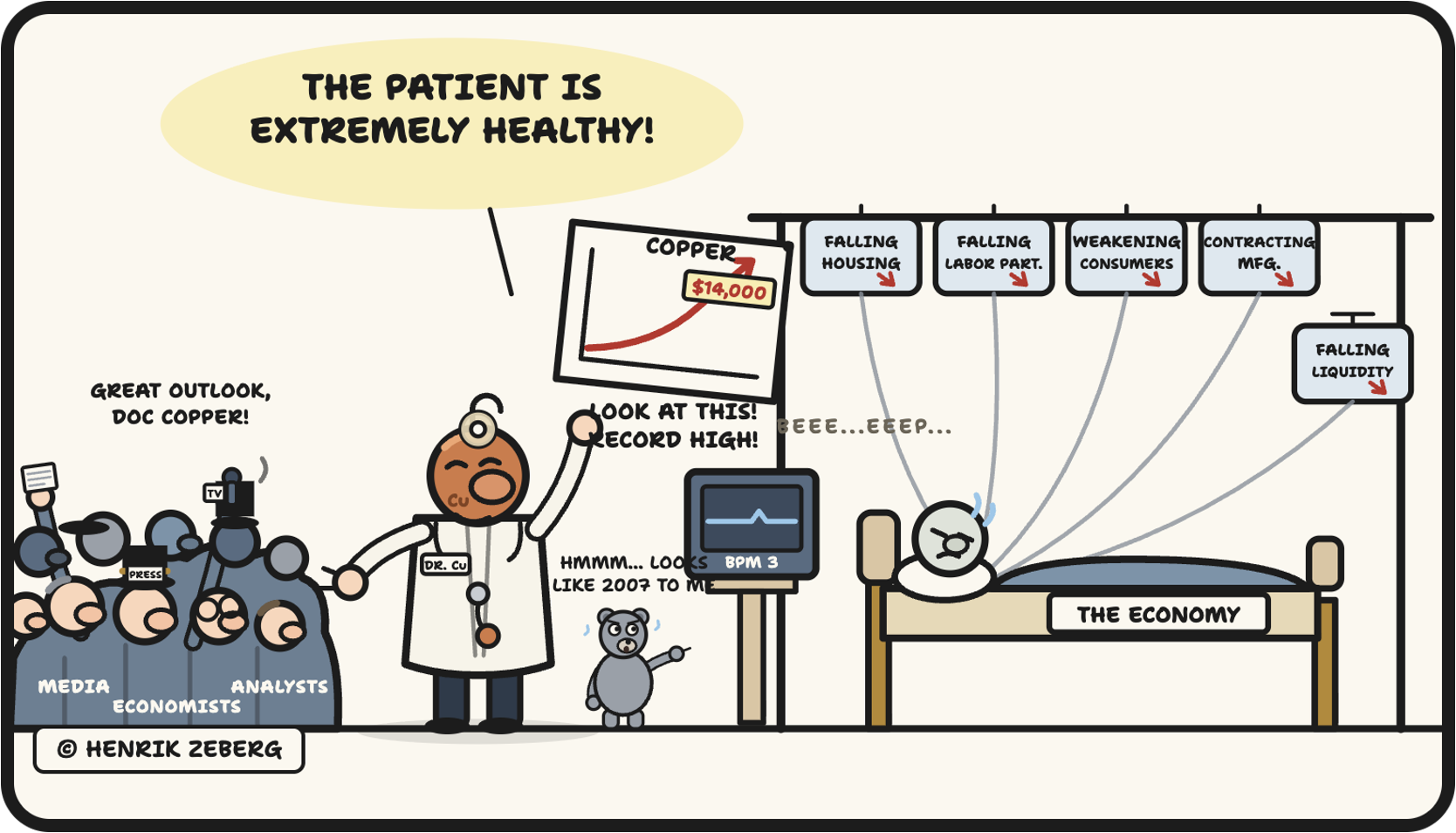
The consensus, August 2026: “The patient is extremely healthy!” Meanwhile, on the monitor: falling housing, falling labor participation, weakening consumers, contracting manufacturing, falling liquidity.
So the logic the analysts are using today is not, in itself, foolish: copper at record highs? Then the patient must be extremely healthy. Book the boom.
But notice what has quietly happened to the bull narrative. It no longer claims the economy is strong. It claims the economy no longer matters – that AI, electrification and the grid have severed copper from the business cycle. Copper is supposed to be Dr. Copper. Yet today, everyone is telling you to ignore the patient.
Maybe. But if copper has genuinely stopped responding to the business cycle, the burden of proof sits with the bulls – against sixty years of evidence. And the nickname conceals one more thing its fan club never mentions: Dr. Copper’s diagnosis is at its most dangerously wrong at cycle tops. In July 2008 – with the US economy already seven months into recession – copper stood at an all-time record high, and the banks were racing each other to raise their targets. The patient was already on the operating table. The doctor was giving press conferences about record health.
That is precisely the setup we see today.
The forecast pages read like an auction.
Goldman Sachs: $13,735 per tonne. UBS: $14,000. Macquarie: $13,165. And Citi – turning bullish for the first time this year after months of neutrality – now sees $14,500 within weeks and $15,000 within the year.
Understand what these numbers are. They are not forecasts leading the price. They are forecasts chasing it. As recently as December 2025, Goldman’s official view was that copper would spend 2026 trapped in a $10,000–$11,000 range, capped by a global surplus. Then price broke out – and the “structural deficit” was discovered shortly afterwards. The supply models did not change first. The price did.
The price action itself has been historic. LME copper printed a record $14,455 per tonne on August 6. COMEX futures touched $6.7045 per pound on August 5. Six consecutive weekly gains – the longest winning streak since 2020. Copper is up more than 50% year-over-year and has now spent an unprecedented run of sessions above $14,000.
And with the records has come the language. This rally, we are told, is “structural rather than cyclical.” A “regime change.” Citi has even published the arithmetic of the dream: if global refined inventories were rebuilt to three months of consumption, the required copper price would be $27,885 per tonne. When banks start publishing prices implied by hypothetical scenarios stacked on hypothetical scenarios, you are no longer reading research. You are reading euphoria with a bibliography.
This is the same euphoria that grips analysts at every major top, and it has the same two roots: they do not understand the Business Cycle, and they do not use technical analysis. Those are the two tools this article will apply. They tell one story – mutually, and clearly. The top in copper is in, or very close. And the path ahead looks nothing like $15,000.
Let me first concede the bulls’ case – all of it. Because it is real.
The Democratic Republic of Congo – the world’s second-largest copper supplier – banned exports of copper and cobalt concentrates under a June 29 order. The war in Iran has kept the Strait of Hormuz closed, strangling the Middle East sulfur exports on which Africa’s copper belt depends; China then banned sulfuric acid exports on top of it, and Ivanhoe slashed guidance at Kamoa-Kakula by roughly 90,000 tonnes as acid ran short. A boiler failure took the Gresik smelter offline in Indonesia. Chile suffered its worst multi-mine storm in years. And US tariff uncertainty has vacuumed refined metal into American warehouses, draining LME stocks roughly 46% from their May peak and pushing the cash-to-three-month spread above $150 – genuine, physical tightness.
Comments
Nothing yet. Say the first thing.
Sign in to join the conversation.