
I’ve been watching cranes my whole career. Where they show up tells you everything — where capital is confident, where the math still works, where someone ran a pro forma and didn’t throw it in the trash.
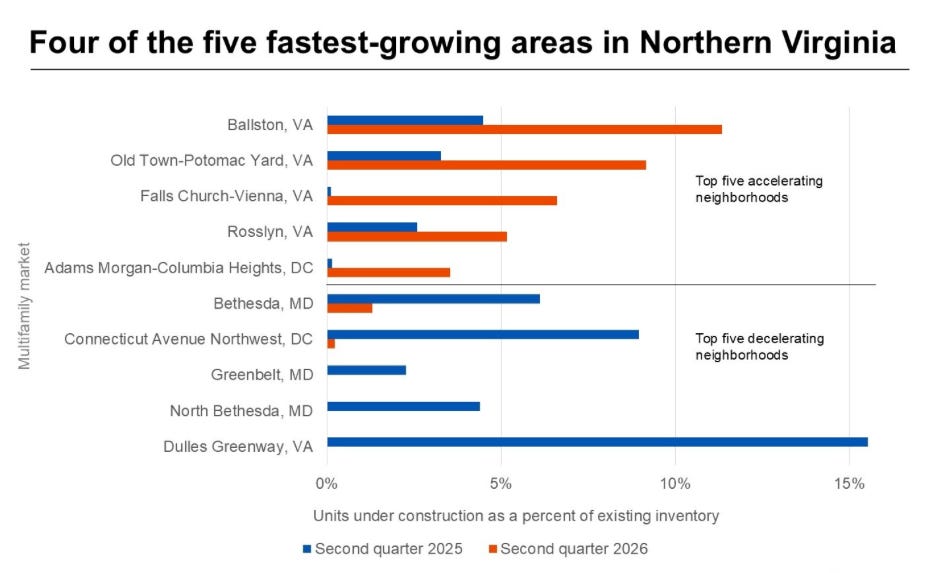
The latest regional multifamily numbers are worth sitting with. The Washington area has roughly 13,500 apartment units under construction right now, up from about 12,500 a year ago. On the surface that sounds like momentum. Dig one level deeper and a clearer picture emerges: construction isn’t growing broadly across the region. It’s concentrating. And it’s concentrating in Virginia.
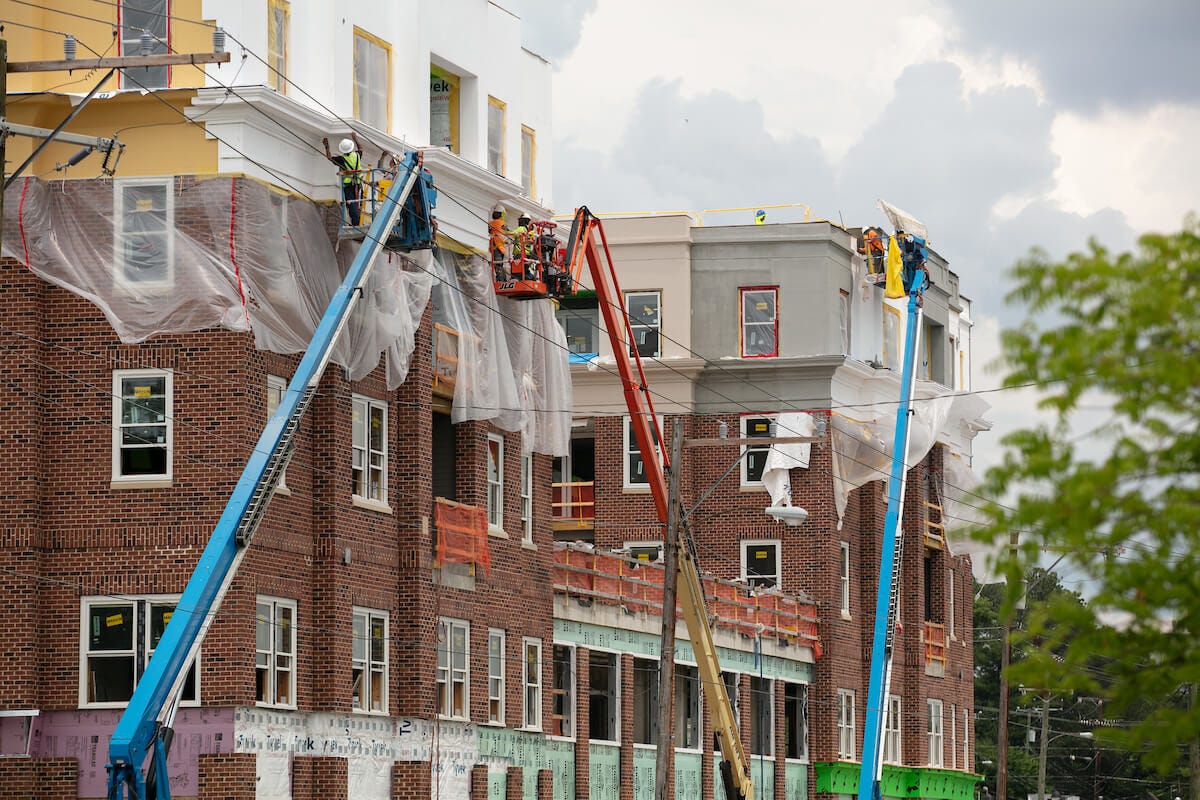
Ballston, a tech-anchored neighborhood in Arlington, has more than 1,000 units underway — that’s 11.3% of its existing inventory, up from 424 units this time last year. Old Town-Potomac Yard is pushing past 1,090 units. Falls Church-Vienna is expanding. Rosslyn is picking up. Fairfax City-Oakton and the Woodbridge-I-95 corridor are both moving. The further west and south you go in Northern Virginia, the more active the pipeline gets.
Maryland tells a different story. Bethesda and North Bethesda contracted significantly. Gaithersburg slowed. South Prince George’s County — where I have a land listing on Gallahan Road, so I’m watching this corridor as closely as anyone — has seen construction largely halt. Even Silver Spring-White Oak, which stayed active longer than most, has moderated.
Developers aren’t avoiding Maryland because they don’t believe in the market. Some of these are fundamentally strong submarkets with real population and real demand. They’re pulling back because the math stopped working. Rent control is the clearest culprit. When policy caps what a stabilized asset can earn, it changes the return projection on every deal in the pipeline. The crane doesn’t show up because the spreadsheet says don’t. That’s not a complicated sequence of events.
Washington DC has its own dynamic. The “flyover market” label is getting thrown around — developers citing slow eviction timelines, rent collection friction, and a regulatory environment that makes the path from groundbreaking to stabilization longer and less predictable than it used to be. There’s something real in that criticism. But flyover implies nothing’s there, and that’s not accurate. Lower Northeast DC is quietly building momentum, with more than 400 units underway at rents averaging $1,660 a month — still meaningfully below the $2,260 DC market average, which means there’s runway. Southwest-Navy Yard remains one of the most active pockets in the entire region. The opportunity in DC is real. It’s just narrower than it was, and you have to be capitalized to move fast when something surfaces.
Virginia didn’t get here by accident. This is a decade of work showing up in a single data snapshot. Tech sector anchors pulling in a younger, higher-earning demographic. A regulatory environment where a developer can see a clear path from site control to certificate of occupancy without losing two years to process. A business climate that didn’t treat capital like a problem to manage. The pipeline shift isn’t a reaction to last quarter — it’s the result of decisions made a long time ago finally showing up in the numbers.
South PG County isn’t a closed chapter. A construction pause isn’t the same as a verdict. The corridor has the land, the proximity to Joint Base Andrews, and the infrastructure bones to support growth. What it needs is a policy environment that makes the math work again — and patient capital paying attention when that window opens.
If you’re sitting on a site, rethinking a lease, or watching a corridor go quiet and wondering whether to wait or move — what does it look like from where you’re standing?
Until next time — Ed
No posts
Comments
Nothing yet. Say the first thing.
Sign in to join the conversation.