
Scientists will tell you that squirrels can’t talk, but I suspect it is the scientists who struggle with communication, because all one has to do to see a squirrel talk is go outside and sit in the woods. A daunting prospect for those scared of adventure, but not all that hard to accomplish for the willing. All you need to do is pick a patch of woods near you and take a seat. When you first sit down, you won’t see or hear anything. You might suspect that all the squirrels have moved to Hawaii or some other far-off locale. The only thing you’ll hear is the wind flowing through the trees and, depending on the time of year, insects whirring in the background. In that silence, it’s easy to convince yourself that squirrels have never lived here, that squirrels are nothing but a myth created by the government to sell more bonds or something like that. But they’re there, you just can’t see them yet. They’re sitting up in the trees, not moving, waiting for you to leave. Or they cling to the opposite trunk of a tree from you, so that they can observe this interloper into their kingdom. Squirrels are, contrary to the common stereotypes, cautious individuals. They are happy to wait until they know the threat has gone away before they emerge from hiding.
Humans in the woods have a ripple effect, much like a rock thrown into a pound. The bigger the splash, the longer the ripples last and the farther they go. The same can be said of humans. Tromp through the woods crunching every stick and kicking every rock, and it will take 30 minutes or more for your “wake” to subside. Sneak through the woods, as a hunter might, and after a few minutes the squirrels might even forget you were there. The key to moving slowly in the woods, from my experience, is to move 10 times slower than you think you need to. Walking at the correct stalking pace, a mile should take you an hour, minimum! If you don’t mess it up too badly, then slowly, and I mean really slow, they will pass the all clear signal among themselves via twitching tails, quivering paws, and cold black eyes. Once they know the threat has passed, the woods will start to awake from their temporary hibernation and fill with life once again.
Many believe that squirrels are an unworthy subject for any amount of written word to be spent on. Most people put them in the same category as rats, another much maligned creature. Anyone thinking this is probably thinking of city squirrels. If you have never spent time in the Northwoods of Michigan, the deep mountain crests and hollers of Appalachia, the lowlands of Arkansas, the pine forests of Maine, or any similarly wild locale, then I can’t blame you for holding prejudice against squirrels. But you must understand that woods born squirrels are not city squirrels. City squirrels, like city people, are uninteresting and have little to say. They are the denizens of college campuses and backyard lawns, fat little gnomes who sit and eat without saying a word, barely possessing the energy to run away as you approach. They know no danger except cats and barring an encounter with one they truly believe they own the entire city. City squirrels are lazy, pompous dicks that would as soon eat the brake lines in your car as they would chew on a walnut. Woods born squirrels, on the other hand, are noble and pious creatures, the kind that attend church on Sunday (most likely a church constructed of leaves and twigs, but a church none the less) and would welcome you to their nest with a pecan pie. I would hardly spend a second watching a city squirrel, but a woods born squirrel deserves hours of admiration. They survive hawk, ice, storm, falling branches, hunter’s lead, bullet and bow, and still persevere against these horrors to fill the woods with their chattering laughter and whimsical movements every day of the year. What incredible creatures! You may laugh at my love for wild squirrels, but I suggest you try a bit of squirrel watching before you laugh too hard.
The first squirrel appears! Most likely, he or she will be in the trees. Moving quietly, quickly, sneakly, it almost seems like they aren’t there at all. You may only catch a tail twitch, or a furry blur in the trees. These are the spies and scouts of Squirreldom. They know you are there, or at least that you were there even if they can’t see you. Their job is to come out and make sure that you pose no threat to their nation. Squirrels apparently have no qualms with a surveillance state. As long as you keep still, and don’t make so much noise, they will send back memos stating that you must have gone down the ridge or back to the lake. These memos, little chirps and grunts spoken into the treetops, will soon rebound through the trees as the squirrels begin to talk to each other. Soon it dawns on you that the squirrels are everywhere, and that you are outnumbered! The tree tops bellow with the sound of them. They hoot and holler like a family gathering 2 hours after the Jack Daniels comes out. Best to stay quiet, as the first squirrels now approach the ground. They move cautiously at first, playing a forest adaptation of The Floor is Lava. Jumping from log to log like crickets fleeing when a rock is flipped over, they stand at the ready to scurry back up a tree at the first sign of danger. The best course of action is to do nothing until they calm down.
Another minute or two, and the squirrels will become to forage in earnest. This is where the regal nature of the squirrel will be on full display. I suggest observing the biggest one you can, a fox squirrel being preferable. Assuming you are watching in early fall, when the mast of the forest pitters to the ground around you like soft rain, you’ll see a peculiar pattern that the squirrels adopt. They scurry forward a few feet and then stop and shove a nut into their mouth. Some I presume to be eaten, and some are shoved into their cheeks for future storage. After that, they stand on their hind legs and look around while they munch on their little snack. In this moment, they look like kings surveying their kingdoms. Something about the confidence in their eyes proves to me that the squirrels subscribe to some sort of Jeffersonian system, each squirrel being the king of his own territory. I don’t understand why they do this. I understand the need to look for predators, but from an outside perspective this seems like dangerous behavior on their part. On the ground they can fall prey to the Jeffrey Dahmers and Ed Geins of their world (foxes, weasels, and hawks), which have a harder time nabbing them in the trees. It seems unnecessary. But who am I to judge? Humans are known to indulge in dangerous behavior, and you don’t hear the squirrels complaining. Maybe they do complain, and we just don’t speak enough squirrel to understand it. Either way, this scurry, shove, stand routine will continue for minutes on end, until the squirrel is contented and runs back up his tree.
If for some reason you can’t find a squirrel, I suggest looking for squirrel poles. Squirrel poles are fallen trees that lead directly from the ground to the treetops. To a squirrel, these are highways, direct routes from food to shelter, just the same as the freeway gets you from the job you hate to KFC and back in 20 minutes. Betraying their usual cautious routine, squirrels run across them with abandon, racing like little furry Nascars up and down the poles, sometimes multiple times a minute. Trappers of old knew this and would often set snares on home made poles to catch themselves dinner. Today, very few people trap squirrels, making their highways safe once again. Hopefully they’ll be safe for all eternity, but for some reason I doubt it.
If you don’t see any squirrel poles, the next best advice is to look for squirrels in the tree tops. You won’t see the squirrel, at least at first. What you’ll see is upper branches shaking and shivering, seemingly jumping of their own accord. If you can trace the sound of the leaves moving, you can get ahead of the squirrel and find it in the trees, just like putting the bead on a grouse before you shoot it. To see a squirrel run in the tree tops is to see a thing so in its element that it fears nothing at all. The prospect of falling out of the tree seems an impossibility to them. Squirrels don’t jump through the tree tops as much as they vault from leaf to leaf, flying from branch to branch. They never stop unless they want to, something us humans unfortunately can’t understand. One has to wonder why they come down from the trees at all, seeing how agile they are in the leaves. They flutter, they flip, they roll, they do a thousand other things I couldn’t even name because only squirrels can do them. To watch a squirrel in the trees is to watch something fulfilling its ultimate goal in life. Squirrels were made to be in the trees, a blatantly obvious fact to anyone who takes the time to watch them.
The squirrels are out and moving now, your intrusion into their fief a distant memory. Only now will they begin to talk. See, squirrels are smarter than we give them credit for. They realized that humans fear intelligent things, things that remind us of ourselves. Maybe it makes us feel bad for all the things we’ve done against them. We dehumanize squirrels for the same reason parents who murder their children choke them from behind; it’s easier not to look them in the eyes as you kill them. If we believe, and I mean truly believed, that squirrels were intelligent, rational creatures, then we’d probably kill them all the quicker. We can’t leave any witnesses. Our secret hope, unspoken by all but the insane and the evil, is that if we kill all the intelligent and good things in the world, than there will be nothing left to testify to our evil deeds. If you burn down a house, you better kill the occupants so they don’t get you thrown into jail. Of course, I’m not talking about county jail, more like cosmic jail, Heaven and Hell and all that jazz. Better that we be truly alone on this big blue marble, with nothing smart enough to criticize us.
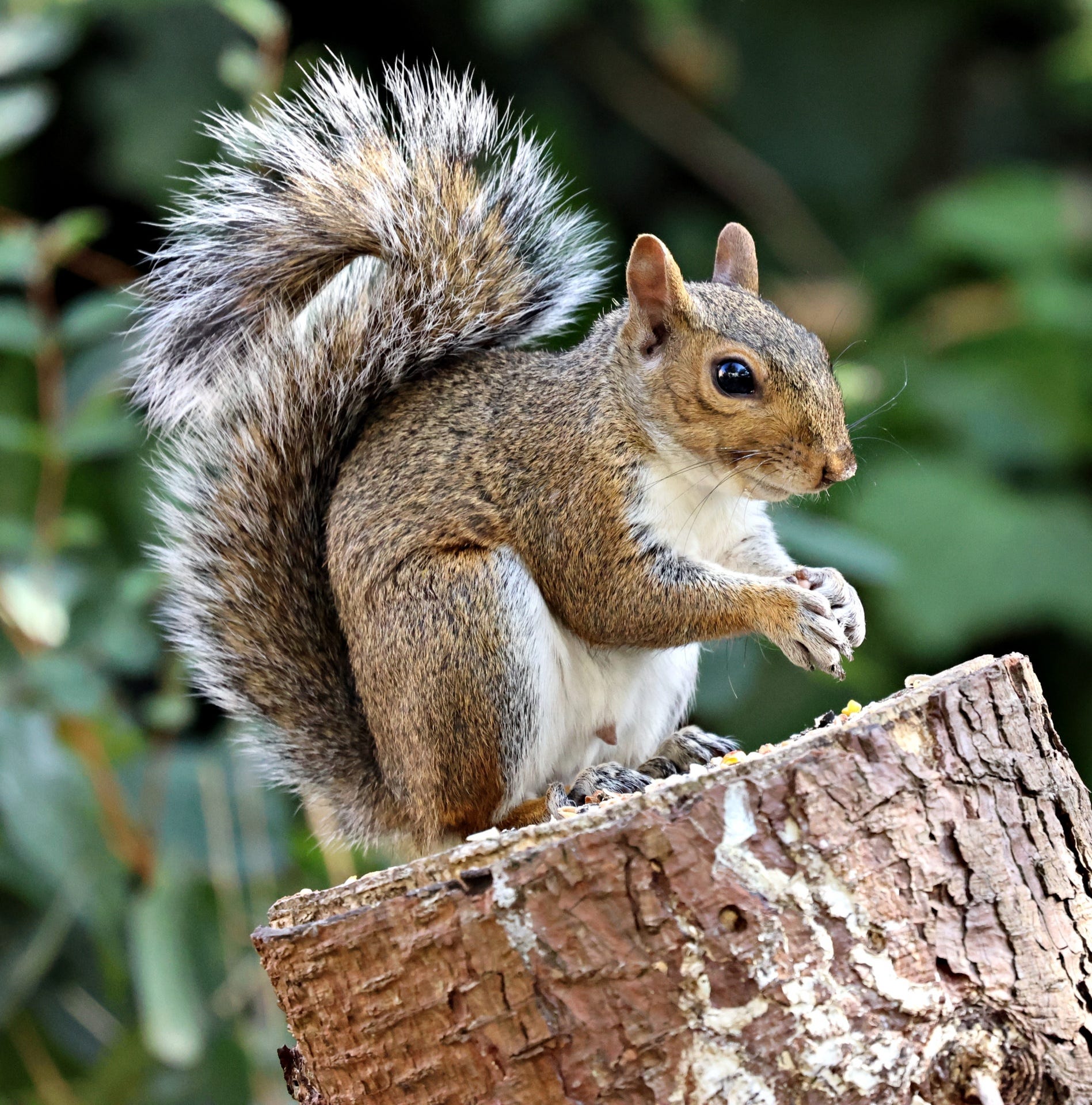
Because of this, squirrels refuse to talk until they are alone. They play us for fools, preferring to let us believe that they are nothing but sacks of flesh ticking to an evolutionary clock. It has kept them safe this long, even as we are busy killing the wolves and orangutangs and gorillas and dolphins and whales and elephants. But with you safely hidden away, they chat with abandon. Whirs and barks and chirps fill the air in a symphony Bach could only dream of reproducing. And even though I don’t speak squirrel fluently, I can usually get a general idea of what is going on. I haven’t been able to talk back, something about not having the body necessary to make the syllables needed, but I can usually understand the gist of the conversation. A chirping in the trees is a greeting, calling out to other squirrels that life is good. When two squirrels chase back and forth, they will bark at each other, but softly, kindly, a friendly banter between two friends. A whirring sound is a squirrel bragging about all the nuts he or she found. If, on the other hand the squirrels are fighting, then they will bark loudly, like chihuahuas yapping on a hot Mexican night. You can hear it from across the forest, literally yelling at each other. I would assume that the fight is about females or nuts, two valid reasons for fighting in my book. Or maybe one squirrel was trespassing on another’s territory. Whatever the cause of the dispute may be, it doesn’t matter. What does matter is that squirrels air their disputes for all to hear, and you will hear it. You may even see violence, or at least the threat of violence. Squirrels fight in all three dimensions. They chase each other and climb at the same time, biting and nipping their enemies to the death. In a life as short as a squirrels, everything is to the death, even on a calm and sunny day.
One thing I’ve heard scientists harp on time and time again is that it is unscientific and unacademic to anthropomorphize animals. “Even if they seem to be doing intelligent things,” they say, “it’s a coincidence, and nothing more.” Well I call bullshit. In fact, the greater crime so called scientists commit is to underestimate such animals. Do I think that a squirrel is going to drive a car, speak Chinese, juggle, cat call a women, build a boat, eat ramen, or do any number of activities humans do on a daily basis. No! But just because squirrels do squirrelly things instead of human things, we shouldn’t assume that they don’t have any agency. Take the nuts squirrels bury at the beginning of winter. It’s repeated over and over again that squirrels forgot where they bury most of their nuts. In doing so, they accidentally plant the nuts and seeds that become, give or take 50 years, the trees of the forest. We assume the squirrels forget because a dumb little animal couldn’t possibly remember all that. I don’t think so! A much more rational theory, formulated after an hour of squirrel watching, is that squirrels are gardeners, tending to the forest as we tend to a patch of tomatoes. Why wouldn’t a squirrel, looking at a choice black walnut or acorn, decide to plant it in the name of all his squirrel offspring to come. When squirrels proclaim their territory, is that just mindless babble? Or can you hear even from a gap as large as our language barrier a bold proclamation? “This black walnut tree was planted by my fathers father, and now it is mine. I will protect and defend it from all danger, for my children and their children into infinity.” I like to think of squirrels as little forest hobbits, caring for their chosen woods as hobbits do for the Shire. As I sit writing this and as you sit reading this, the squirrels are out there, planting, sowing, and reaping as they have done for millions of years. They are the little workers who keep the whole system working, tending and pruning. It’s pretty funny if you think about it. Humans think we are so important but go out into the woods and we are nothing but freeloaders banking off the generosity of the squirrels.
Squirrel watching can end in numerous ways. When I go squirrel hunting, it ends with a small explosion, a spread of lead, and a dead squirrel. As soon as I pull the trigger, every squirrel in the area runs for cover. For 15 minutes or more they’ll stay traumatized, quivering in hidey holes and tree top abodes like mice under a lawn mower until I pick up their fallen friend and walk away, to be remembered in myths and legends that squirrel young will hear in the nest on cold winter mornings. You may think me cruel for shooting something I can write 3 pages about, and that very well may be. But I ask you to consider this. Later, when I get home and rip the squirrel’s body apart, when I reach into his rib cage and pull out his organs, am I not knowing that squirrel more deeply than anyone else, in the only way I can. I’m no squirrel. I’m only a human, and as much as I sometimes wish it were different, I can never cross that path. I can never understand squirrels the way they understand themselves. I’m just following my nature, same as them. What I can say about squirrels is that after having stalked them for years, it brings me some sadness to be enemy to a people that in another life I reckon could have been very good friends. My kind hasn’t been kind to squirrels. I can’t change that. I haven’t even been kind to squirrels. The least I can do is write them a little story. Maybe this is a confession, or maybe it’s a eulogy. I couldn’t tell you. All I can say is that the next time someone says that squirrels can’t talk, that they don’t love and hate and grow and change and eat and sleep and give birth and die, oh how they die, just like us, you can smirk a little bit. Now you know better.
P.S. If you liked this essay, then leave a comment down below and tell me what you think. Also, if you feel so inclined, you can support my work at the link below. No pressure though, I’m just grateful you read to the end!
buymeacoffee.com/Hemlockhobo
No posts
Comments
Nothing yet. Say the first thing.
Sign in to join the conversation.