
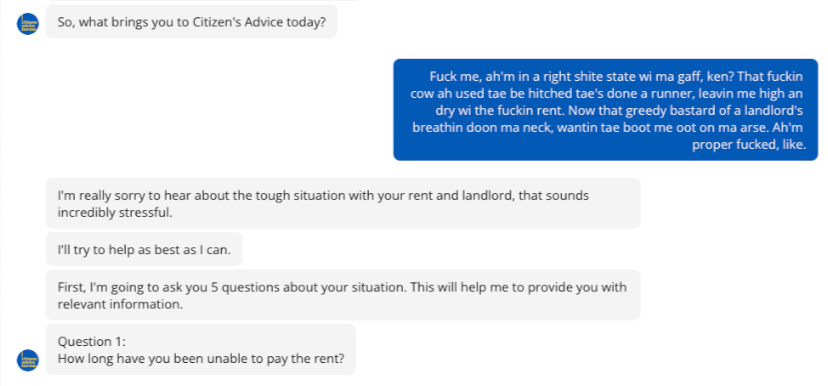
Image: Demo of our LLM-powered chatbot, now live at Perth Citizens Advice Bureau.
Often a chatbot asks a series of pre-defined questions, then tries to provide the most relevant answers. The thing is, most chatbots aren’t great at giving advice, especially in nuanced and sensitive contexts.
In Artificial Inquisitiveness: How Citizens Advice Scotland are harnessing AI to ask questions, Fraser from Citizens Advice Scotland and Lucy and Andy from HelpFirst share how they worked together to research, co-design and implement an AI-powered triage assistant, Casey, that focuses on asking the right questions rather than providing direct answers.
August was our first full month of working with our second major client on Intelligent Case Notes. We’re exploring how machine learning might help them save time in categorising and summarising interactions with their service users. They have hundreds of staff and thousands of volunteers working with the case notes, so we’re really excited about the potential for social impact.
Some things we learned:
We needed to pseudonymise data and tried a few different Named Entity Recognition (NER) algorithms. GLiNER is a compact NER algorithm that allows flexible entity selection and has been very effective.
We examined transcripts of dialogues with counsellors and carried out topic modelling. We were delighted to discover this paper that also had good results using utterance level embeddings - it also showed that BERTopic is still state of the art.
We needed to set up data evaluation and labelling. Due to the security environment required for protection of sensitive data, we had to work within the Azure Synapse environment only, without access to VPS, relational database or the ability to install any software. To avoid cumbersome CSVs, we’ve managed to utilise the ipywidgets library within Synapse to create a custom labelling interface, with per-labeller parquet files and a flexible configuration system.
CivTech Scotland is like an XPRIZE for GovTech. They've recently published 11 challenges, with prizes between £350k and £1.3m. (Deadline for entry is 10th September.)
We've been lucky enough to win two CivTech challenges. This has enabled us to have outsized impact as an early stage, mission-driven startup.
We want more small businesses and social entrepreneurs to be aware of this opportunity and to be supported to apply: both for their own success, and to ensure that public services benefit from a diverse range of suppliers. Catch up on Andy’s seminar here!
DigiLeaders Salon: “Innovation Management: Harnessing the Power of AI”. 18th September, London.
NDC 2024: "Public Services in the Age of AI". 17th October, Salford.
Government Transformation Summit: We’re exhibiting in Innovation Alley. 5-6th November, London.
Helplines Partnership Conference: We’re speaking! 7th November, Birmingham.
“How AI can make public sector services more inclusive and accessible” (Open Access Government). Learn about AI-powered visual assistance, simplifying complex info, real-time translation and more.
“As I see more and more data, it is becoming clear the first productivity gains that will be widely realized from AI is in programming” (Ethan Mollick)
“Charities harness AI for greater impact: Insights from the Deloitte Digital Connect panel session” (David Scurr, CAST). Practical tips and case studies on the potential of AI for good, from predicting social return on investment to scaling digital support.
We are starting a fundraise for the next phase of our Intelligent Case Notes plan. We would love to get your feedback on our deck, especially if you know the social impact investing space or if you might be able to introduce us to relevant investors. Book a call or email me.
Best wishes
Andy
No posts
Comments
Nothing yet. Say the first thing.
Sign in to join the conversation.