
Hello book friends! It’s the start of June, and suddenly the weather has turned from damp rain and chilly mornings into bright sunshine and blue skies. How did I miss this transition of the seasons? My husband would say it’s because my head is always buried in a book. He’s probably right.
Here are the books I read and loved last month. I offer them to you, with the hope that one or two might strike you as an interesting read. If it does, let me know! (And please, just read this Substack, subscribe if you like it — but don’t pay me any money.)
May was the perfect time to read (well, listen to) Tana French’s The Keeper, the last of her three novels about an ex-Chicago cop, Cal Hooper, who retires to a fictitious small town in Northern Ireland named Ardnakelty. You might know Tana French as the author of the “Dublin Murder Squad” books, good reads for those of us who like gritty characters and mysteries with some sharp twists and turns. But this series? Even better. And this book? The best of them all.
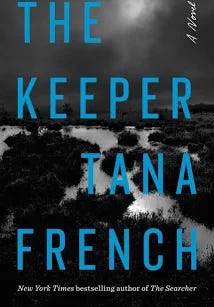
In these three books, we watch Cal navigate the unspoken rules and complicated relationships that exist in this tightly knit rural community. Cal moves to this remote location to escape people, but he is quickly drawn into various connections, including with his neighbor, Mart; a young teenage girl, Trey; and, of course, a woman, Lena. And in each of the books, there is a conflict that brings various unspoken tensions in the town to the surface, moving the plot forward ever so slowly. Because the plot really isn’t the focus here. It’s the place itself.
This is what makes French’s writing so good. The landscape of this remote Northern Ireland town isn’t just a setting: it’s its own character, both the protagonist and antagonist of the novel. It is a brutal and foreboding place, filled with rain and mud, howling wind, dark skies, and treacherous mountains that loom over the town. It is a place steeped in history, myth, and inheritance. Even on days when the sun shines and the trees glimmer in the light, the narrator will remind you that these moments are short-lived. And the joy of reading these novels is watching Cal navigate this setting.
The books in this series are entitled The Seacher (2020), The Hunter (2024), and The Keeper (2026); all of these titles refer to Cal’s changing relationship with the town. You don’t need to read the first two books to appreciate The Keeper, but if you have read them, you will appreciate this last book even more.
In The Keeper, we have a death in the town, along with a plan to buy up farmland to use for development that forms the basis for the plot — and allows French to explore the ways land and culture are bound together. We also get to watch Mart, Cal’s irreverent and clever neighbor, take a central role in personifying the town and its surrounding landscape. It’s not often I finish a series and feel like the ending hits the perfect note. But this series? It rings true.
Oh, and if you can, listen to it as an audiobook. The narrator, Roger Clark, pulls off the Irish accent impeccably (at least to my American ears.)
Tastes Like War by Grace M. Cho
I read a lot of memoirs. Tastes Like War has to be one of the most interesting memoirs I’ve read in a long time.
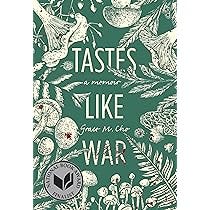
Cho tells a story centered on her Korean mother. It’s a simple story, at least on the surface. She met Cho’s American father when he was stationed in Korea during the war. They married, and Cho’s father took her and her young son back to his small town in Washington state. Later, Grace was born. Cho tells the story of how her mother tried to acclimate to the United States: learning English, cooking hamburgers and hot dogs, dressing like an American woman. But when her mother reached her mid-40’s, she became mentally ill, eventually unable to leave her small apartment for the last several years of her life. So Cho would visit and cook Korean dishes to connect with her mother — and to help her mother connect with her own harrowing past. The book explores transgenerational trauma, acculturation, and gender roles as its major themes, and it does this work well.
How so? Cho has a PhD in Sociology and Women’s Studies, and her academic research focused on the effects of the Korean War on women. Cho integrates quotes and footnotes throughout the book, adding testimonies of other women’s experiences similar to her own mother’s. It’s as if Cho is attempting to prove her mother’s story of trauma and loss. In essence, she recreates her missing portions of her mother’s life through others’ words.
But there’s another side to this story. Cho’s brother, Neville Cho, and several other family members dispute the veracity of Grace’s memoir. While this can happen (our memories are, after all, subjective creatures, and seldom do our memories match perfectly with someone else’s), Neville has been clear that much of this memoir is simply not true.
I have to say, I suspect that Neville is correct. There were moments when I stopped reading and shook my head in disbelief—since some of what Grace writes seemed implausible. It was only later that I discovered her brother’s ongoing online discussion of the ways she omits or misleads the reader. (And I should note other comments online attack the author for the way she depicts her mother as “crazy,” noting these descriptions perpetuate the stigma of mental illness, another valid concern.)
This book and the backlash around it raise important questions – ones that have been raised before. Think of A Million Little Pieces by James Frey, who was publicly shamed by Oprah Winfrey in 2006 for fabricating pieces of a book he claimed was a memoir. What is a memoir, and what is fiction? What does the memoir writer owe to the reader? In memoir, what is truth, what is perception, and what is simply a lie? And in this current social climate, where the truth itself seems so malleable, does any of this matter?
While we can debate the first few questions, I think the answer to the last question is yes. Truth in memoir, as far as we can portray it, does matter. We need the ability to tell the truth for the people who appear in our writing and to ourselves as well.
Near the end of Tastes Like War, Grace’s mother dies, and Grace eats kimchi, alone. It is the only way she can find to feel close to the woman she felt she never understood, and now never will. I cried reading this scene. The loss is palpable in this book, and this emotion felt true to me. The other parts, perhaps not. But Tastes Like War is worth a read—and some careful thought and discussion.
ALSO READ AND RECOMMEND:
The Night Watchman by Louise Edrich
This novel, whose main character is based on the author’s own grandfather, is yet another book where Edrich creates vibrant, intelligent, and resourceful characters with humor and grace. Set in the 1950s on a reservation in North Dakota, it focuses on the tribe’s attempt to avoid being “terminated” (stripped of their land and rights) by the American government (which is the “true” part of the story). This book is timely, insightful, and utterly enjoyable.
Still Come Home by Katey Schutz
I read this fiction book years ago, and reread it again last week. I’m so glad I did. Schultz tells the story of Nathan, an army officer in his last week in Afghanistan, alongside the story of an Afghan couple and a young child. Schultz sets up the tension of the external war zone and the internal conflict for these characters slowly, but each page builds on the next with such careful intensity, the book almost sizzles.
The Financial Lives of Poets by Jess Walters
In this short novel, Matt is an unemployed and flat broke reporter who needs money desperately to keep his house, his wife, and his two kids right before the financial crash of 2019. Sounds dark? Not at all. Jess Walters is a fun writer. This book is no exception: there are laugh-out-loud moments and witty observations that make it worth the read.
No posts
Comments
Nothing yet. Say the first thing.
Sign in to join the conversation.