
Across the Mediterranean, heat was always there and has long shaped daily life. People learned to cope, adapt, adjust. An awning unrolls. A shutter closes before noon, or remains shut all daytime. Chairs constantly move to the shaded side of the street. Work begins earlier, pauses, and returns after sunset. Neighbours improvise first and regulation catches up later, if at all. By then, the chair is already in the shade.
Self-organisation should not be romanticised. Often, it is simply what people do when official help is too slow, or never comes. But it is also a form of design knowledge. Unofficial. This is a speculative piece and although it uses visual language, it shouldn’t be misinterpreted. London + “Mediterrapunk” doesn’t mean a terracotta makeover, or blue shutters with white walls. It is Mediterranean in its reflexes and the way people react and adjust to the heat. This “knowledge” has been in London all along, catalysed by the people whose families come from warmer places, one of which is the Mediterranean region.
The words on a noticeboard at a tube station entrance. The first time I saw it was 2023 and I took a photo of it. Now nobody looks twice and it only took a few summers.
By the middle of the century, the Greater London Authority expects an average summer’s day in London to be around 3°C warmer. The Met Office has developed a scenario for 2056 in which temperatures could reach 45°C in England — scientifically plausible and an illustration of what could become hard reality. That’s their projection. These are my notes from an ordinary hot day in a London that’s arrived at this future ahead of schedule:
The Junction is busy. The city starts even earlier than it used to, while London still has two rush hours. Only not the ones we used to know. Before the heat and after it. I’m late for the first.
It’s already too hot. No way I’m getting the tube. I’ll cycle to the Barbican this morning, not too far anyway. Need to move quickly before the tarmac turns to lava. SPF 80 applied. Heat repellent outfit, in reflective silver. My water bottle, frozen overnight.
Straight down Kingsland Road is the fastest and most direct route. I could do the “cool” route which goes behind the estates but it’s ten minutes longer even if it’s four degrees cooler, according to the HeatApp.
Four degrees is a lot. Ten minutes is even more when you’re late…Kingsland Road it is.
Buses ahead already look slightly liquid, their red edges bending in the heat above the road.
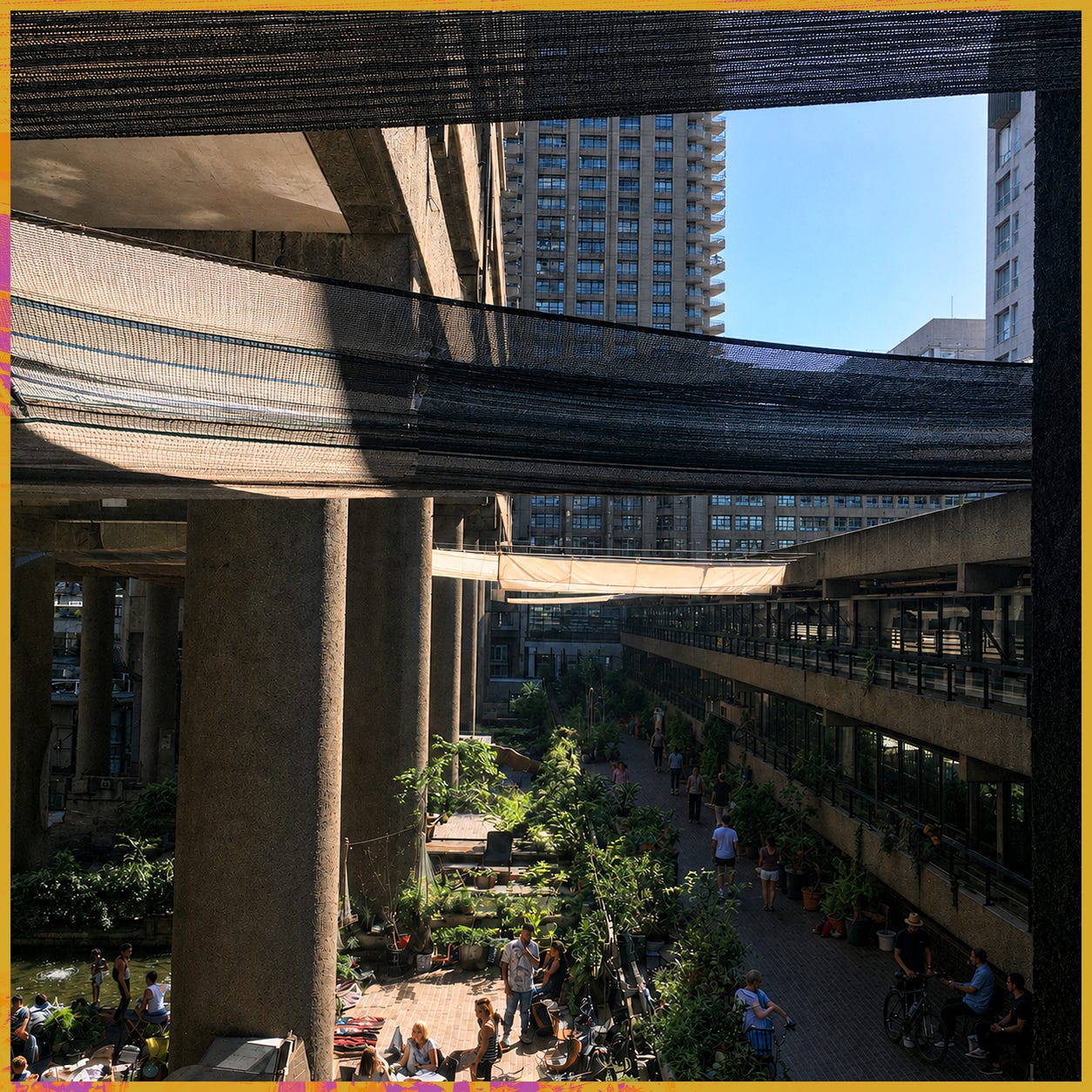
The Barbican. Listed concrete. Mega sails across the public space — not listed. But necessary. Shade. Nice.
The residents filled the walkways with pots and plants. Conservation officers still call it visual clutter. Residents call it July. I think of it as a kind of displaced Brazilian Modernism. It shouldn’t suit London but somehow it does.
The Barbican always had the bones of a hot-climate urban complex. Heavy concrete, deep thresholds, shaded walkways, water. Cars pushed below and life lifted above. None of the sails really match. Some are woven, some stripped, some repaired with old advertising banners. Each is “technically” still temporary, but they’ve been temporary for eleven years now.
Farringdon to Bond Street, air-conditioned. Elizabeth Line all the way. Sweet.
A continuous awning, the next step from the pedestrianisation that happened almost 20 years ago. It began with three neighbouring shop owners ignoring the design code. Now every building unrolls its own section at noon: striped, branded, repaired, sometimes mismatched. It runs almost continuously from Marble Arch to Tottenham Court Road. Selfridge’s section is always a bit extra.
At 40°C, people followed the shade, not only the shop windows. The brands, always chasing footfall, learned to provide both.
The gates of Bedford Square are open on all four sides. Unimaginable back in the day. The garden was laid out in the 1770s for the residents of the Georgian houses around it. Shared green space, provided you belonged to the right community. And you had a key.
During the heat emergency of 2038, someone cut the first lock. Six hundred people squeezed beneath the trees that afternoon. After that, the argument for locking it again became difficult to make.
Private access to green space was once one of London’s most recognisable status symbols. That was in ordinary weather. At 42°C, a tree makes a stronger claim. Though it became fully public, the garden lost none of its beauty, and became useful to more people.
Ridley Road always understood that a street is something assembled each morning and taken apart each night. Now there is a second ceiling to that understanding. Literally. Tarpaulins, reed mats, old sheets and photovoltaic fabric overlap above the stalls, forming a patchwork roof negotiated each morning.
Barbers bring their chairs outside. Fruit crates become tables. Fans push air through open shopfronts. The market has expanded vertically because there is no more pavement left to claim. The shade footprint is bigger that way too.That didn’t happen through a consultation board and obviously no pilot was needed. Unlike Oxford Street, Ridley Road never needed “activation”. It was always ready.
This street is shaped by people who already understand that shade is social infrastructure.
By 21.00, the worst of the heat has passed, usually. Chairs and tables move back out, music rises and the street begins to grow sideways again.
Outside, the temperature has finally dropped below thirty. Across the city, Londoners have rearranged time, opened gardens, stretched shade across streets and turned inherited memory into infrastructure.
Back at the flat. The freehold owner however still hasn’t replied about the external shutters. Facade, leasehold, listed building, conservation area and 42 degrees. The flat has perfectly stored every degree of the day.
I point the remote at the Toyotomi.
ピッ
Comments
Nothing yet. Say the first thing.
Sign in to join the conversation.