
Twenty years ago I moved to the Mediterranean, and it felt like a homecoming to a place I’d never lived. An avid people-watcher, I had decided to make something of my love of street life and study a Masters in design for public space. Torn between the bright lights of London and brilliant-blue Barcelona, I called my father for advice.
“Quando sentirai il profumo del Mediterraneo, saprai cosa fare.”
When you smell the scent of the Mediterranean, you’ll know what to do.
I knew that scent already. My brother and I grew up spending redolent summers in the heat of Napoli, winding down through Europe from the south coast of England to the city where most of my parents’ family still lived. Naples in the eighties was wilder than today. Hanging off Nonno’s cool balcony, watching street life heat up below, I became an eight-year-old expert in Neapolitan theatrics: flirtations and fights, caresses, gestures, jokes, insults, sleights of hand and downright trickery. Naples is an expressive city, every corner holds a shrine: to Maradona, to someone’s mother, to a patron saint, a votive of devotion. Every wall says something: a threat graffitied, a poem of heartbreak, a declaration of love. Anyone who knows Napoli understands that what’s private elsewhere is public here; stories of birth, life and death fill the vicoli. The streets and piazze were filled with language that showed people cared passionately for the place, and loved each other.
So before I spoke Italian or Neapolitan, Spanish or Catalan, I learnt the love language of place. Places spoke to me before words ever could.
The Mediterranean is a region of extremes: beauty and hardship, romance and treachery, and its cities run the full emotional spectrum. Whether or not people feel more here, they certainly show more. As Mediterraneans we pour our hearts out on the streets: grief, celebration, argument, desire, drama performed in the open. Nowhere taught me this like the street I landed on in Barcelona.
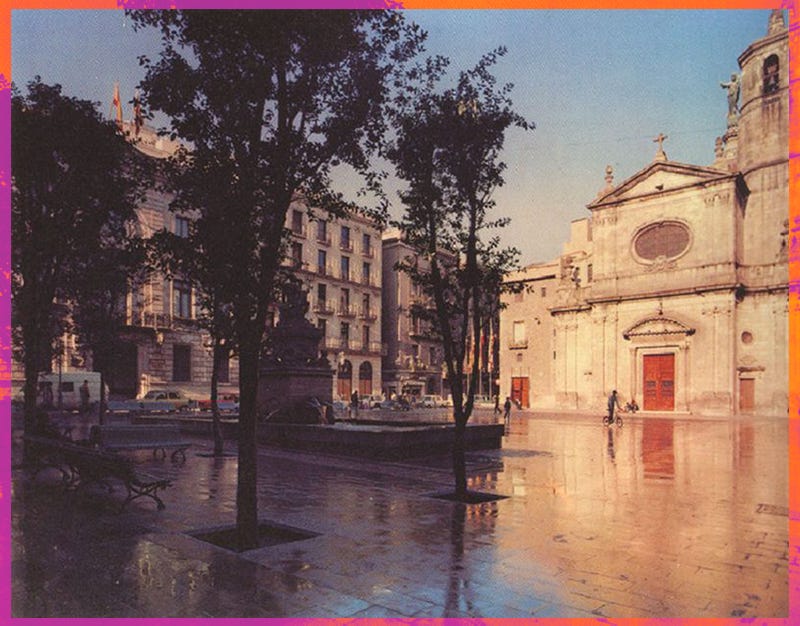
I took a room in Ciutat Vella, the old town, on a carrer so narrow I could touch the buildings on both sides, a medieval warren, close and dark, cool at midday. It was a street of two halves, to paraphrase the urbanist Charles Landry, a place that said yes, and a place that said no. On one end, the dark, dank warren had hardened to a ‘No‘: junkies, pickpockets, tourists chasing or being chased, the 4am drama of muggings and worse. The other end beckoned with a ‘Yes‘. The street opened, the sun poured down, and there was the Plaça de la Mercè (pictured above), anchored by the church of the city’s patron saint, framed by a university, a government office, and a bar selling bad coffee and sweet, greasy ensaïmades. One block from the port, its backdrop was the occasional boop boop of a ship’s horn and its colour derived from jacaranda trees.
It wasn’t the prettiest plaza, but that didn’t matter. It was the light we all needed after a day in dark streets. At golden hour it filled: kids playing football, gaggles of grandmothers gossiping, students flirting outside the university, tourists pausing to photograph the saint. Mercè had blessed the square.
On that street I met Marcus, my flatmate and future research partner in understanding these public spaces. He worked in designing out crime, which gave our shared obsession an edge: we understood love of a place in the context of neglect, trust created on the streets in the context of fear. The street’s two ends, one that welcomed, one that warned, became our first case study. How does a place say yes? How does it say no? That question grew into twenty years of research we called Urban Lexicons: how places speak to us, and how we speak back.
When I met Christos, my partner, born and raised in Athens, one of the first places he took me was the ancient Agora, the OG of public space. Over 2000 years ago this was the place to participate in public life: gossip, trade, ritual, politics, all colliding in the open, with the shade of the stoas to sit back and watch it all unfold.
The word derives from the ancient Greek ageirein, meaning to gather. First came the people, then came the place; only later did agora come to mean the ground where they gathered, with the space named after the act. The agora endured precisely because it multi-tasked, holding many activities, meaning many things to many people, a chameleon of a place that was never master-planned, but built as street life added new demands.
The habit stuck. The Greeks founded Neapolis, Naples, the new city, and the agora evolved into the Roman forum, still our byword for shared perspective.
Now the region is heating up, and the calls come in daily to my home in now-stuffy London from my brother, my aunt, my in-laws sweating across the Mediterranean: hace mucho calor. Polí zésti. Fa troppo caldo. So is this the death of the great Mediterranean square, or is this the moment it comes to life?
In Athens and Barcelona, the social life of the street already extends well into the madrugada, and the densest parts of the city do it best. Living in Raval with no air-con? Can’t sleep? Head outside to catch some breeze, buy a “cerveza-beer, cerveza-beer” from the corner and trade neighbourhood gossip over a cool can. Too hot in West Athens? Jump in your Fiat Punto, windows down, AC on, and let the neighbourhood feel the bass as you roll by, past the kids playing midnight football, the neon-orange Aperols going down, a street fight flaring and fizzling out by the kiosk.
Consider what the plaza actually is: the original social media platform. The place to find a date, to watch the influencers parade in their latest outfit, to catch the cat memes in real time, the little kids dancing, to sell, to argue about politics. Can heat really kill two thousand years of scrolling each other’s lives, in person, with no ads attached?
I’d bet on life. You can’t erase two millennia of culture with a heatwave. As the world warms, the Mediterranean’s oldest technology might just go global: shade, stone, evening air, and people loving people.
This piece grew out of The Love Language of Place, a manifesto for rekindling relationships with the places we love. Read the love stories here.
Comments
Nothing yet. Say the first thing.
Sign in to join the conversation.