
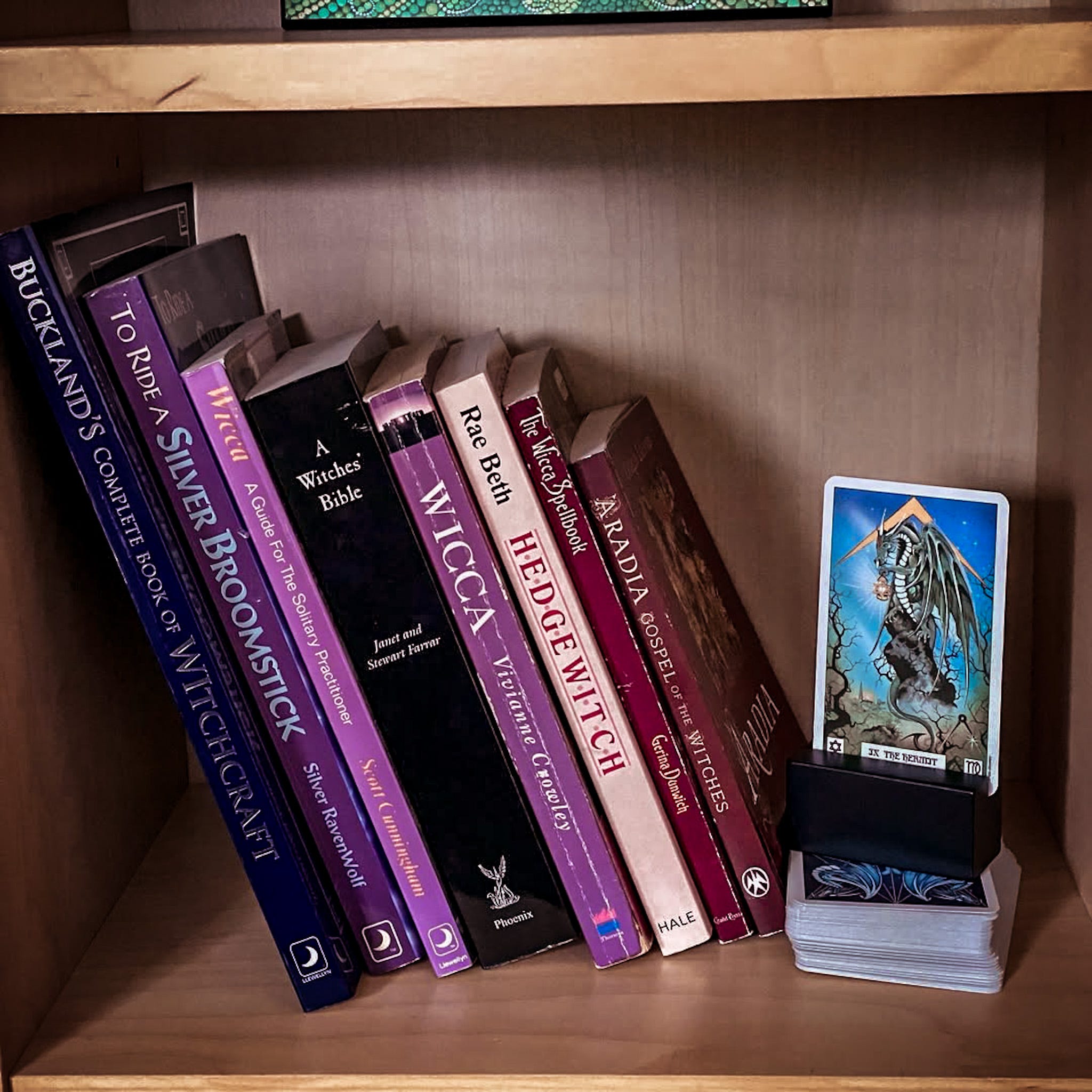
The first book I bought on Witchcraft was The Wicca Spellbook by Gerina Dunwich. It was the mid-’90s, I was in college, and I had been drafting a novel about teenage witches. I told myself that the purchase of this book was “for research purposes”, but by then I’d already grown up with some teachings in hedgerow medicine and folk tales, so — as the comedian/writer Tim Minchin has said — “in for a penny, in for a pound”. The book was not quite everything I needed for my research, but it was everything I needed at that point on my spiritual path.
I’d grown up with a sense of the spiritual, the supernatural, the magical, all around me. A love of Nature had been planted and nurtured by my maternal grandparents (who would have never called themselves “Witches”, far from it; they were more gardeners and bakers with a deep reverence for Nature and Her gifts), and I’d had a few experiences that I could not explain by the time I was in double-digits. Perhaps a child’s fanciful imagination; knowing what I know now, perhaps not.
Several early and significant bereavements had fostered in me an interest in life after death, and, by my teens, this had brought me into contact with members of a local paranormal investigation team as well as folks from the Spiritualist Church. Coupled with all this was an early addiction to fantasy novels, especially ones with dragons, witches, and/or herbalists, so connecting with magic and spirituality was “in my blood” — quite literally, in fact! I was to later learn that my paternal great-grandmother had been the village wise woman, so to speak: the person who would concoct potions and salves in exchange for a chicken or something, and such exchanges were always via the back door, and always at odd hours.
So, at around five years old, it felt entirely natural for me to take a birthday candle, whisper my desires into it, burn it down, and offer the remaining wax to the local land spirits.
As that small child, my favourites had been the Meg and Mog books by Helen Nicoll and Jan Pieńkowski, a series about a witch and her cat. By the time I bought The Wicca Spellbook, I’d inwardly self-identified as Pagan — particularly after discovering The Pagan Federation when I was eleven or so; I remember standing in my childhood bedroom, clutching a leaflet or an article or something like that, with tears on my cheeks when I found out that I wasn’t a freak for loving Nature the way I did, or for making offerings to the land, or for believing in magic and spells. There were other people out there who believed as I did, who practised as I did — and there were enough of these people out there to form an organisation! To my young mind, this was significant and I didn’t feel quite as alone. It would be a few years later that I realised that my life had been, up to that point, filled with magic, spirituality, and herb lore, and I would claim the label of “Witch” for my own.
Perhaps that was why I was writing a novel about teenage witches when I was around fifteen; in writing about that world, those characters, I was re-defining my own world, my own sense of identity. Said novel was never published, and, looking at the manuscript now, it needs a lot of work — but for the time, it was deeply important to me and fundamental to my sense of self and values. My English teacher back then was very supportive of my writing in all its forms, but beseeched me to write something “real and gritty”. Alas, I could not, as I was searching for the words to describe the world I inhabited, a world of magic and wonder — a world I still inhabit, one foot in the mundane and one in the magical; a world for which I am still searching for the right words to describe.
Hanging out with paranormal investigators and those of a Pagan persuasion in my teens did a lot to bolster my confidence and interests, and I still have my copy of A Witches’ Bible by Janet and Stewart Farrar a dear friend bought me for a birthday back then; a friendship that outlasted my decade or so in paranormal investigation, and with whom I’m still connected today, so at least twenty-five years, by my count. And I am deeply grateful for those I’ve met on my journey, though circumstances may mean we are no longer in touch.
The Wicca Spellbook didn’t stay alone on my bookshelf for long: I began buying and reading books on Witchcraft and the occult like it was going out of style, and this included many of the “classics” — The Spiral Dance by Starhawk; Wicca: The Old Religion in the New Millennium by Vivianne Crowley; The Meaning of Witchcraft by Gerald Gardner; Wicca: A Guide for the Solitary Practitioner by Scott Cunningham; To Ride a Silver Broomstick by Silver RavenWolf; Hedge Witch by Rae Beth; Buckland’s Complete Book of Witchcraft by Raymond Buckland; Aradia: Gospel of the Witches by Charles G. Leland, and so many others. I would swallow them whole, word for word and page for page.
I worked spell after spell, ritual after ritual, and began to understand that I had an innate understanding of, and instinct for, what we could term today as contemporary Witchcraft. Most of my pocket money — and, later, wages — would go on books and supplies: candles, herbs, salt, crystals. By the time I was eighteen, I had declared myself out of the broom closet and was actively taking courses in Witchcraft, Reiki, mediumship, and holistic therapies, and delving deeper into the history of the Craft and its influences, building on the nuggets I had experienced in my childhood. In formal academia, I was reading for my undergraduate degree in English and, later, my postgraduate in Creative Writing, but always behind the scenes was Witchcraft, a place where I felt strong and safe and sacred.
Being the odd kid, the weirdo, the outsider in school, had granted me a certain sense of solitude; I could count the number of friends on one hand, and close friends on even less. An introvert, I now realise that this suited me just fine, as it meant I could explore any and all threads of Witchcraft which attracted me, but as a young girl I was saddened by the number of friends I didn’t have. I know differently now. I bought my first tarot deck at sixteen — Peter Pracownik’s Dragon Tarot — and, even though my collection has grown since then, I still have it. I read better with different decks now, but it still has a special place in my heart — as does that first book, those first experiences, that first candle spell.
Join the magic: Do you remember your first Witchcraft book? Are you interested in the Craft but don’t know where to start? If you’ve been on the path for a while, what was your first experience of Witchcraft or the occult? Feel free to drop me a comment on this post; I’ll read and respond to every one.
Thank you for reading, and please remember that you’re valued here whether you have a free or paid subscription. I welcome your presence and thank you for the space in your inbox. Blessings and love to you and yours. 🧡
Note: A version of this post once appeared on the previous incarnation of my website.
Comments
Nothing yet. Say the first thing.
Sign in to join the conversation.