
Suppose that you won a raffle and that for your prize you were given this choice: one hundred dollars tomorrow or two hundred dollars a year from now. Which would you choose? (Make your choice before you read on. I’ll post the poll results next week.)
Which would you choose if instead your option was one hundred thousand dollars tomorrow or two hundred thousand dollars a year from now?
And now which of those would you choose if you were struggling to make the rent payment each month?
The differences in how people answer these questions may help solve a riddle that has bugged me for a very long time: why are poor people more likely to smoke?
The relationship between smoking and income is startling. People living in poverty are five times as likely as those making $200,000 a year to light up.
It’s not just poverty, though. The relationship runs across the entire range of income. Middle class people making $75,000 - $100,000 per year are twice as likely to smoke as those at the top of the income range. With smoking - by some accounting - the leading killer in America, this pattern is incredibly important to our nation’s health.
There’s a similar pattern for junk food. People with less income have much junkier diets.
It’s not at all obvious why people with less money have these unhealthier habits. Here are possible explanations, some of which we can quickly discard:
Awareness of health risk
Could lower-income people just be less aware of the health risks of smoking?
Nope. In a phone survey of more than 2,000 people, knowledge of specific health risks of smoking was no different in low, medium, and high-income people.
Lower-income people are a little less aware of the health risks of ultra-processed food, but not by enough to explain their eating habits.
Cost
Are low-income people just voting with their wallets, choosing lower-cost options?
No, especially for smoking. Going through even a half pack of cigarettes a day costs $1,825 per year. The alternative – not smoking – is free.
And as I discussed in a previous post, contrary to what I often hear, healthy food is not substantially more expensive, and may be less expensive, than unhealthy food.
Access
Could people in lower-income neighborhoods just have greater access to tempting tobacco and junk food?
They do. In most but not all studies there are more stores selling cigarettes in low-income neighborhoods. And low-income neighborhoods tend to have fewer supermarkets and more corner stores offering mostly junk food.
I see these as problems and I’m a big believer in making neighborhood environments healthier. But it doesn’t seem likely that differences in access could fully explain the huge differences in people’s habits. For example, low-income people usually travel outside of their neighborhoods to shop for food, which means that nearby stores may not be very important to their food choices. And a major national study of food purchases found that less than 10% of the differences in people’s food choices were explained by the neighborhoods in which they lived. In that study, even when shopping at the same stores, people with less income bought less-healthy food than people with higher incomes.
Coping with stress
Some argue that lower-income people smoke to cope with stress. There is evidence to back this up: on surveys roughly 40% of smokers say they smoke to relieve stress, and levels of subjective stress increase as incomes go down. Some might argue that eating junk food is just a way of coping with stress, too.
But I’m a little skeptical of this argument. In most studies, exercise reduces stress, but people with less income aren’t more likely to exercise. It may be that the stress-coping argument is just getting close to the real reason, which has been thought up mostly by economists: hyperbolic discounting.
Hyperbolic discounting
All of us are often forced to choose between getting something today and getting something better tomorrow. Should we buy that pair of pants now or wait for it to go on sale in a month? Trade in our old car for a newer one or put the money in a 401k? How people make those decisions depends on how much they “discount” the future compared to the present, so it’s called “time discounting” or “temporal discounting”.
Most of us aren’t rational about this: the farther away a time period is from us, the less we tend to care about it. For example, when people are asked if they would rather get $50 today or $100 a year from now, many choose $50 today. But if the choice is $50 in five years or $100 in six years, almost everyone chooses $100 in 6 years – even though the one-year delay before getting the higher payment is the same. Valuing future time less than near time is called hyperbolic discounting. The greater the hyperbolic discounting, the more people live for today, not tomorrow.
Studies from around the world have consistently found that people living in poverty are more likely than people who have money to discount the future. For example, in a survey of more than 40,000 people in the U.K., when given a hypothetical choice between receiving £45 in three days or £70 in three months, people living in poverty were much more likely to choose the almost-immediate but lower payment.
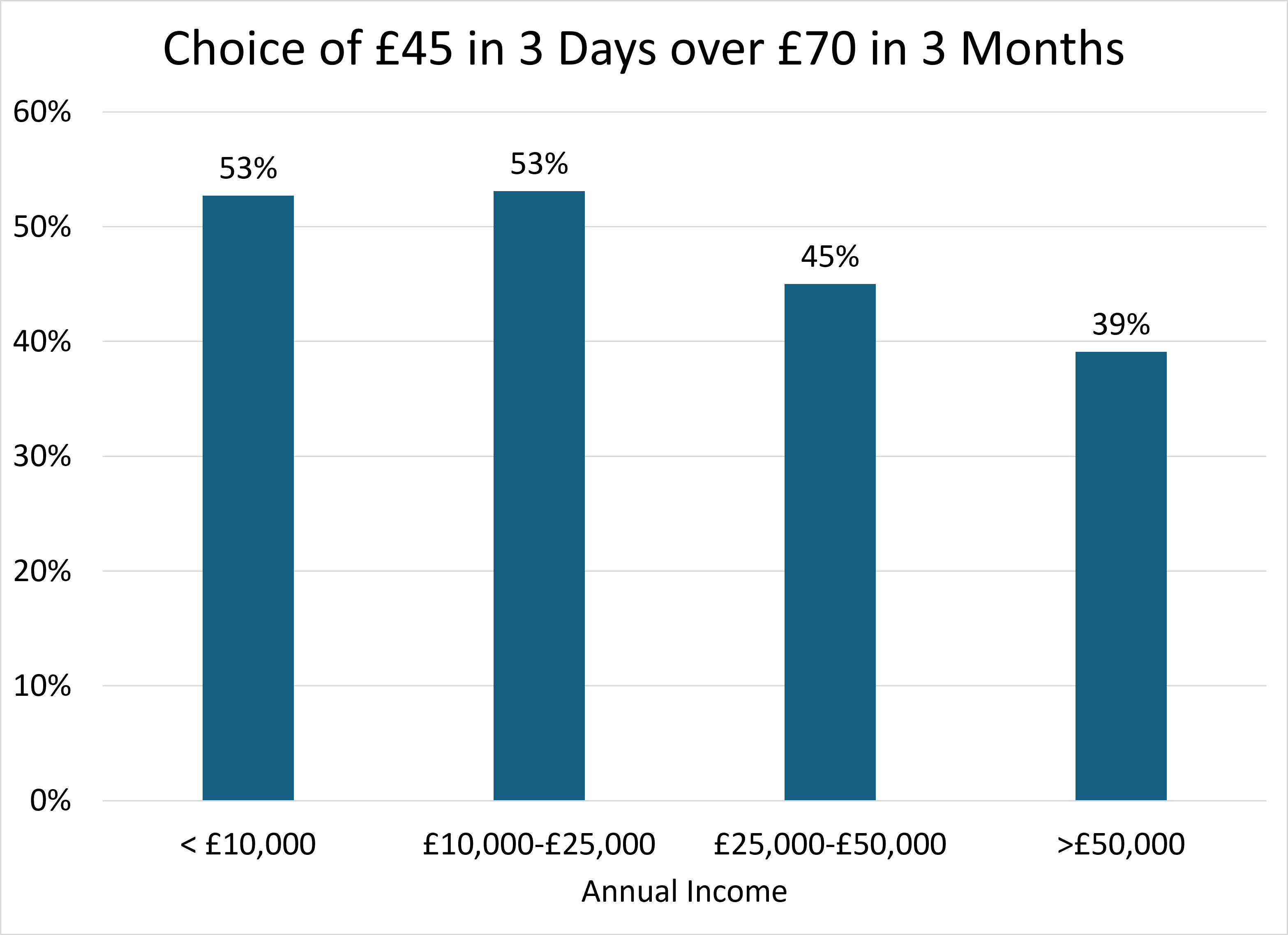
People living in poverty are much more likely to take out payday loans, in which they borrow a few hundred dollars to spend immediately but then must repay much more just a few weeks later.
Some might think that a “live for today” attitude is what made people poor, but many studies suggest that poverty itself may cause people to be biased toward immediate rewards. This has been called the psychology of scarcity. Researchers, for example, have shown that people are more likely choose immediate (versus delayed) rewards just before a payday, when their financial situation is at its worst, than afterwards.
This may seem irrational - some have called it the “cognitive burden of poverty” - but a bias toward today over tomorrow can be very reasonable. If you’re about to be evicted for overdue rent, it makes sense to take out a usurious payday loan (or grab your $100,000 raffle winnings, in the poll above) to pay that rent, even if doing otherwise sounds better financially over the long term. That long term doesn’t look so great if your family becomes homeless.
In fact, there is an entire mathematical theory (called bankroll management) about rational financial decision-making when you have a limited amount of money. Not surprisingly, the less money you have in your bank account, the less money you should risk. And risking less in a financial sense typically means spending rather than investing money.
Unfortunately, even if the habit of choosing short-term benefits over long-term rewards makes sense financially, it’s harmful when it spills over into behaviors that matter to health. People who discount the future are more likely choose the immediate pleasures of nicotine, other drugs, and junk food over the long-term health benefits of passing them up. The result is that they’re stuck with chronic diseases, from obesity and diabetes to lung cancer.
What does this mean for how we get healthier as a nation? Answering that question would take more words than I want to use in this post. But, because the relationship between income and unhealthy behavior seems to be a fundamental one, it does argue that we would be healthier if there were less of a gap between the rich and the poor.
And it also argues that those of us in the health business should listen a little more to economists, who have figured out a thing or two about how we humans behave.
Comments
Nothing yet. Say the first thing.
Sign in to join the conversation.