
Traveling this week, so just a short note.
Here’s an update on a modern epidemic that hasn’t gotten enough attention: depression in young people.
Between 2011 and 2021-22 there was a near tripling of the percent of teens and young adults who were so depressed that they couldn’t function for at least two weeks. The tip of that terrible iceberg was a ~30% rise in suicide rates in young people over the same years. I’m convinced, as are many others, that this epidemic was caused by the combination of smartphones and social media – hardware and software in young people’s hands 24/7 that made them miserable.
Last year, though, I was excited to discover that the trend had begun to reverse itself, with depression falling since 2021 in teens and since 2022 in young adults. Now, the source of these stats – the National Survey on Drug Use and Health – has been updated with 2025 data. The downward trend has continued, showing a roughly 30% drop in depression since those peak years.
That continued decrease was paralleled by a drop in deaths from suicide in older teens and adults through age 34.
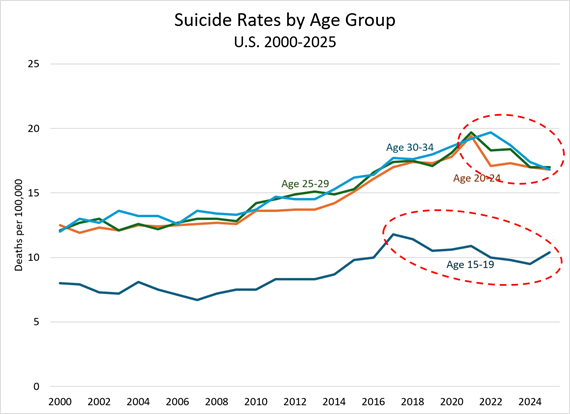
Granted, these markers of mental illness are still way too high, but the turnaround in the past few years is a very welcome surprise.
I’m sure that some of the spike in depression can be explained by the COVID disruptions in 2020-22, which threw us all for a loop. But the epidemic started long before COVID arrived and the fall has continued long after the lockdowns ended, which says that other, longer-term factors are responsible.
What are they? When I wrote about this last year, I noted that young people were using smartphones as much as (or more than) ever, but that the way they were using smartphones had changed. Today teens and young adults are spending less time comparing themselves to others on Facebook (which makes their own lives seem dreary) and more time watching videos on TikTok (which may not be educational but isn’t depressing).
Maybe that’s all that is behind the continued trend, too. Or - a more hopeful explanation - maybe teens and young adults as a group are learning how to avoid the mentally-toxic effect of smartphones, spending less time boasting, snarking, and doomscrolling and more time getting together in real life.
Middle-aged adults seem to be the trailing group in both the rise and fall of this trend. (Check out the age 26-49 line in the top graph above.) I now wonder: do those young people have something to teach the rest of us about how to avoid being driven crazy by those devices?
Comments
Nothing yet. Say the first thing.
Sign in to join the conversation.