
Six months ago the consensus on Indian markets was simpler. Inflation was low, the RBI had room to cut, and the resultant cheaper money would do the heavy lifting for economic growth.
That view has fallen apart.
India retail inflation (CPI) hit 4.45% in July, a 19-month high. Food inflation reached 5.52%. The RBI has held its repo rate at 5.25% for four consecutive meetings, and some economists have started talking about a hike rather than a cut. The reason sits outside India, in commodity markets that have been repricing all year.
What began as an energy shock has spread into fertilizer, freight, metals and now food, and it has arrived in your monthly budget with a lag.
Which measure of inflation is primarily used by the Reserve Bank of India to assess inflation for its monetary policy framework?
A. Wholesale Price Index (WPI)
B. Index of Industrial Production (IIP)
C. GDP Deflator
D. Consumer Price Index (CPI)
3 lucky winners will receive a copy of Narrative and Numbers by Aswath Damodaran. Contest ends on 17th Aug’26. Winners will be selected at random from all correct entries and announced after the contest closes.
📝 How to Participate
● Join our WhatsApp Channel to participate in the quiz.
● Click the Google Form link shared on the channel.
● Take the quiz & submit your answers.
The pattern across commodity markets is broad rather than narrow. Crude, refined fuels, industrial metals, precious metals and grains have all moved higher over the past year.
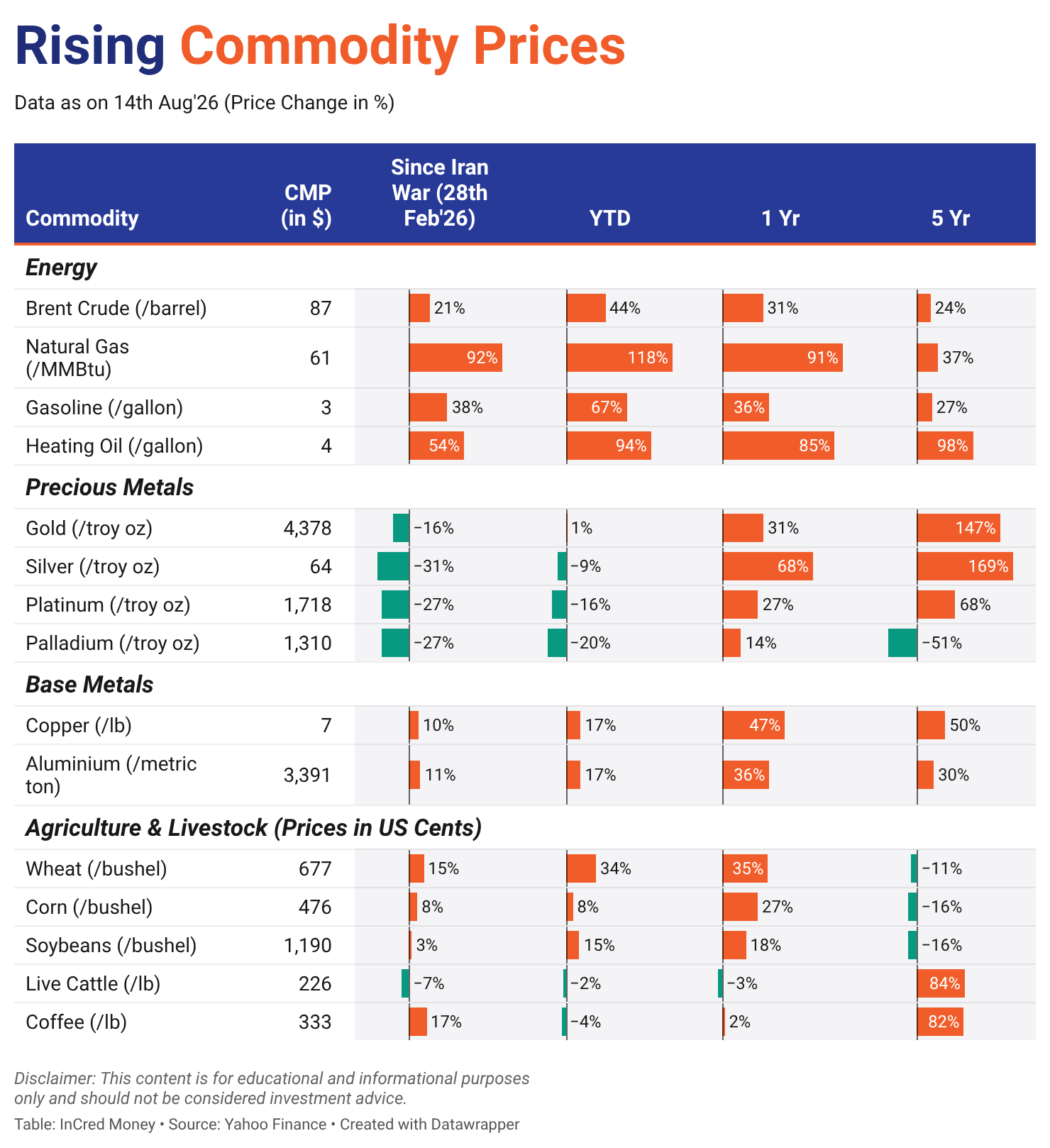
Most of it traces back to a single stretch of water. The Strait of Hormuz carries around a fifth of the world’s seaborne oil and gas. Flows reduced significantly in March and April before partially resuming in June. The oil was never destroyed but it simply could not get out, which is why everything refined from it repriced at once.
European gas has roughly doubled over the same period, and that matters more than it looks, for reasons we have explained later.
Precious metals are the other rows worth a look. Gold is roughly flat this year and silver is actually much lower, after both ran hard through 2025. The FOMO trade was made last year, and it has been drifting since.
Global commodity prices may feel abstract but the Indian CPI (retail inflation number) shows that now it’s impacting you too.
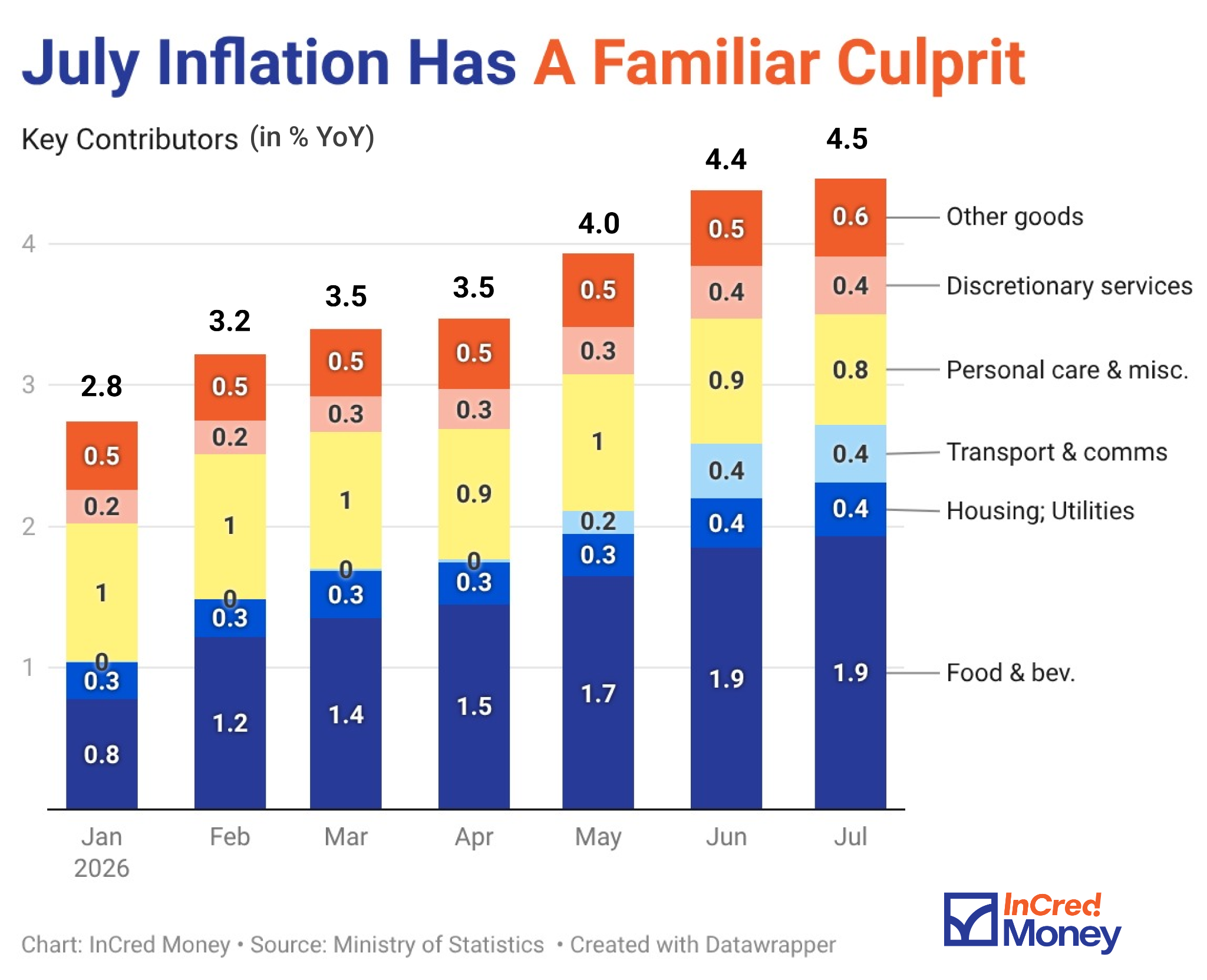
Food and beverages contributed 0.8 percentage points to headline inflation in January. By July that had more than doubled to 1.9 points. Transport went from contributing nothing to being clearly visible, which is the fuel shock arriving on schedule.
Nearly half of India’s inflation is coming from a single category, and it is the one nobody can opt out of buying i.e. Food and beverages.
Here’s the part the chart doesn’t show: this could have been much worse. When crude crossed $100 in March, the government cut fuel excise duty sharply, and the oil marketing companies absorbed most of what was left.
So the crude shock got split three ways, between the government’s tax revenue, the oil companies’ profits, and you. Had the full increase reached the pump, the inflation number would have looked very different.
The war explains the first rise in energy prices i.e. Crude and Natural Gas. Unfortunately, so much of our economy is dependent on these two commodities that any sustained increases in their price permeate into other inputs. Additionally, there is another big trend taking place, i.e. the AI boom, which is putting pressure on metals.
1. Fertilizer
This is the chain almost nobody watches. Natural gas is the main feedstock for nitrogen fertilizer, and much of the world’s urea and phosphate trade moves through the same waters. Costlier fertilizer means farmers apply less, thinner application means lower yields, and lower yields reach food prices a full season later. That is what keeps food inflation running long after energy has calmed down.
2. Metals
Data centres, transmission upgrades and electrification are pulling hard on copper and aluminium while mine output stays constrained. A new mine takes the better part of a decade, so higher prices cannot summon supply quickly.
3. Weather
El Nino conditions threaten yields globally. Closer to home, economists point to crop damage from excess rainfall and a longer harvest cycle that could lift food prices.
4. Biofuel
When oil is dear, blending vegetable oil into fuel gets more attractive. Every produce diverted into a fuel tank leaves the food chain making agri products costlier.
Most of these are not something a central bank can fix easily by raising interest rates. Rate hikes work by cooling demand and the major issue here is geopolitical in nature.
The rate cut is off the table for now. The RBI has held the interest rates at 5.25% for four consecutive meetings, and is waiting to see whether energy costs feed into broader prices. Some economists now see a possible hike as early as December if the direction of inflation continues in this direction. The European Central Bank (ECB), Indonesia and the Philippines have already increased interest rates. Whether it helps reign in this supply side inflation is up for debate.
This is a major problem for the US too. US core inflation has now run above the Fed’s 2% target for 64 straight months, which keeps the Fed cautious and making it difficult for them to lower interest rates, which they desperately need. Cheap money is not coming back quickly anywhere.
Coming to your investment portfolio, equities still work as a hedge during inflationary times, but not evenly. Over long periods, companies can raise prices and earnings grow in nominal terms, which is why equities have tended to outpace inflation historically. What this quarter shows is that revenue growth across Indian companies has been healthy, while profit growth has been softer as input costs ate the margins.
In this kind of a cycle, pricing power matters more than growth. The businesses that hold up tend to be the ones that can pass on a cost increase without losing the customer.
The other interesting asset class is Precious metals. Gold and Silver have seen a sharp drawdown since the highs it made in January and are now at levels where it makes sense to increase your allocation if you’re underallocated.
Sustained high inflation is bad news for any economy. Everything gets costlier, the most vulnerable feel it first, and growth eventually slows too. So the real hope is that the Middle East crisis settles soon, before these price rises turn sticky.
Till the next time,
Vijay
CEO - InCred Money
P.S. I share my thoughts on Investing and the Economy regularly. You can follow me here.
Disclaimer: The Logos displayed above belong to the respective company(ies) and do not belong to us and are used for representation purpose only. We do not make warranties as to the quality of the company, disclosures, IPO timelines, valuations or any other matter. It is specifically informed that if you enter into the buy transaction, it shall be on the basis that you have understood and agreed that we and/or our group company/ies shall be the counterparty to the transaction and you shall have no objections to the same at a later date. InCred Money and its representatives are not SEBI-registered analysts or advisors. Any decision to invest or not to invest shall be at your own discretion. Carefully read and understand the risk profile and disclosures of unlisted equities before investing. InCred Money is the brand name of ETA Fintech Private Limited. Pre-IPO shares are unlisted securities, but this should not be interpreted as InCred Money guaranteeing or confirming that an IPO will take place for these shares. The decision to proceed with an IPO is entirely at the discretion of the issuing company, which may choose not to go public. We do not make warranties as to the quality of the company, disclosures, IPO timelines, valuations or any other matter. The information mentioned on the platform is based on publicly available data and to the best of our knowledge, does not constitute insider information. Detailed Disclaimer
Comments
Nothing yet. Say the first thing.
Sign in to join the conversation.