
Consumption accounts for over half of India’s GDP and festivals are when that consumption compresses into a few frenetic weeks.
This year the festive season is set to kick off with Onam, which falls on August 26 this year. The festival is traditionally seen as the informal starting pistol- the season’s first real test. This will soon be followed by Ganesh Chaturthi in a month from now. From there it builds through Navratri, starting October 11, into Dussehra on October 20, and peaks with Diwali on November 8.
The festive economy is much bigger than shopping. Think about Diwali for instance. A family buys a new car. Another upgrades its television, washing machine, refrigerator or at least a phone bought in one of the e-commerce platforms’ flagship sales. There are sweets, new clothes, holiday bookings…behind each purchase is another business- a manufacturer, wholesaler, retailer, delivery company, salesperson or small trader.
The festive spending translates into higher sales -> production ->jobs -> incomes and in turn, more spending. August and September are important as they set the stage for all of this. Retailers and e-commerce platforms start building inventory, launch offers, plan logistics, and hiring in the gig economy spikes ahead of the demand surge.
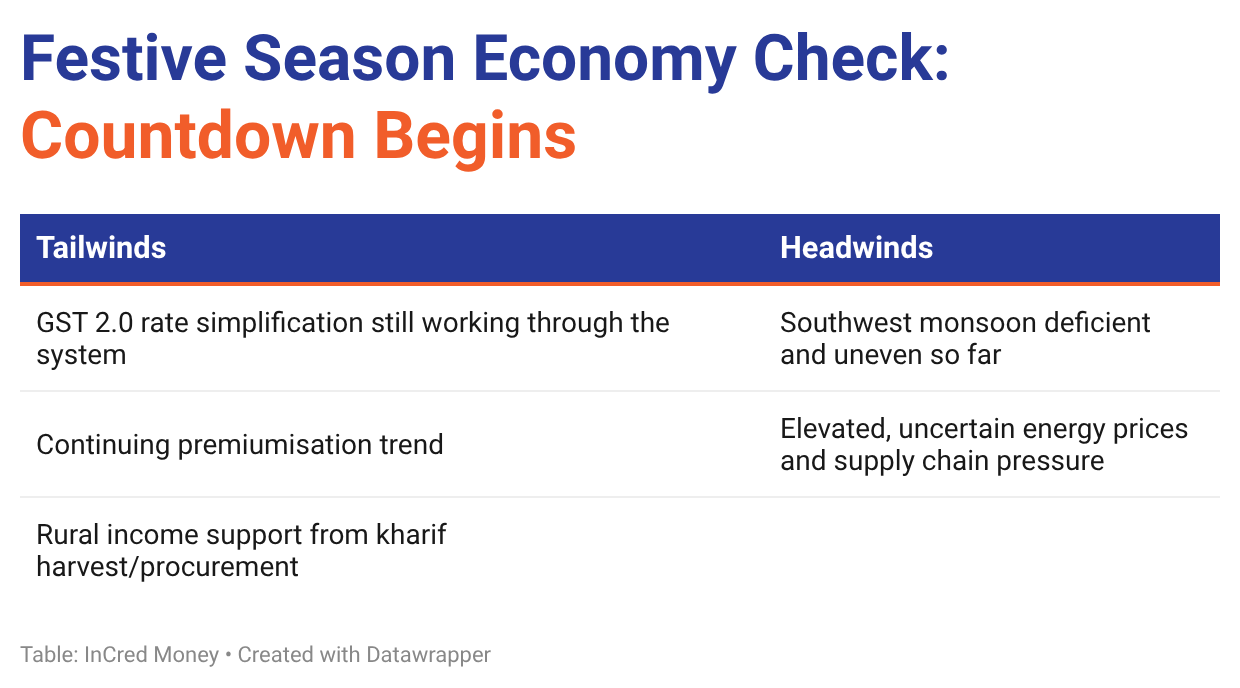
Rural spending too tends to accelerate around the festive season as several cash-flow and consumption triggers come together. By this period, farmers have greater visibility on the progress of the south-west monsoons and progress of the kharif crops. Harvesting and procurement begins in several regions, improving rural incomes.
The season is entangled with weddings, amplifying the boost to the economy created from the festive season that spills over to the next year. As per estimates by the Confederation of All India Traders, Diwali generated over Rs 5 lakh crore in festive sales last year. While we are still in the run up to this season, the economy can benefit from a festive boost.
“The turbulent global economy is likely to have some bearing on domestic economic activity”, the RBI Monetary Policy Committee cautioned in it’s bi-monthly statement earlier this month. Energy prices and supply chain pressures remain elevated and uncertain. While the south-west monsoon is deficient and uneven so far, it’s an evolving situation. Two tailwinds continue to do some of the work this cycle too- last year’s GST 2.0 rate simplification is still working through the system, and the trend of premiumization continues.
The honest caveat: most of the data available for this year right now is still forward-looking. The real read will come from Navratri onward in October. But so far, the setup looks strong on paper.
Join our WhatsApp channel for daily updates on domestic & global markets, plus the latest IPO insights.
Follow InCred Money on WhatsApp
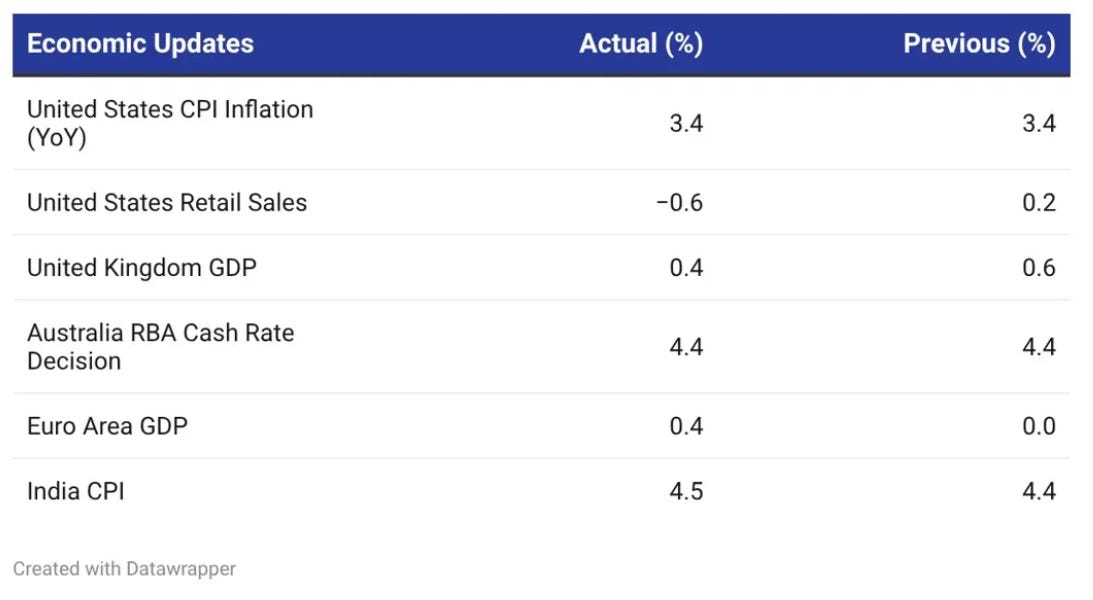
CPI cooled to 3.4% YoY (from 3.5%)- the “good news” number of the week
PPI flat MoM, missing the +0.2% forecast
Retail sales fell 0.6% MoM, missing forecast
Michigan Consumer Sentiment dropped to 51.0, well below the ~55 expected
WPI inflation eased marginally to 9.78% YoY, though food prices rose even as fuel/power cooled
Merchandise trade deficit widened to a six-month high of $31.98 billion
Exports hit a record $44.24bn; imports at a nine-month high of $76.22bn
Passenger vehicle sales jumped to 31.2% YoY (from 18.2%) — an early signal of pre-festive-season buying
If you enjoyed reading this newsletter, feel free to share it with your friends and family using the link below!
Disclaimer: This is for educational and informational purposes only and does not constitute financial advice.
Comments
Nothing yet. Say the first thing.
Sign in to join the conversation.