
It is clear that bodies, especially in the literature and cinema of the last decade or so, are in some sense privileged texts. They hold a special place in the intertexts we might write and read with.
They’ve been proposed as the irreducible site of trauma. In her Nobel lecture Han Kang described writing using her body: “I try to infuse those vivid sensations that I feel as a mortal being with blood coursing through her body into my sentences.” It was the vile and leaking centre, the part of the characters that could not be bargained with or bought off, of Succession.
But what exactly is special about a body?
Well both you and I have (or perhaps are) one. But there are plenty of shared facts in a writer/reader relationship. We are also both using language, we are on the same planet, we’re living in the anthropocene.
And the boundaries of our bodies, like all borders, require policing to maintain their coherence. As Steven Thrasher writes:
“Think about the body you live in: with every breath you breathe in and out, the idea that your body has permanent borders between what’s inside and outside it is revealed to be a fiction. ... There are no stark borders between races, between those living with viruses and without, between those in the United States and outside it, between being American and non-American (or un-American), between men and women. Borders are myths, and while viruses are used to justify their necessity and marginalize those who don’t fit neatly on one side of them, viruses ironically disprove them.”
But I can’t stop thinking about bodies, reading bodies, wondering what’s next for our bodies. What kind of kin can I make with them, as they pile up? Alongside Didi in Waiting for Godot, I’m asking of the dark, “Where are all these corpses from?”
In the first story from Alligator and Other Stories, Dima Alzayat restages Antigone through the act of Ghusl Mayyit. A young woman ritually purifies her brother’s body after his murder. They fled despotic violence “seeking darkness, the quiet of unlit rooms and the absence of knocks”. But violence found them anyway, transfigured into western xenophobia. And now all that the sister can do, all that the story contains, is the ritual act of caring for the body. Of accepting what was abjected into your subject.
But is there something in the body itself that could actually threaten the state? Sometimes it seems unlikely. In another Antigone story, The Other Place by Alexander Zeldin, the unburied body is comically un-sacred, desecrated. Annie and Issey’s father’s body, for many years now, has lingered on as ash in an urn. On stage he gets divvied into thirds in a ziplock bag. Specks of ash get brushed off the counter top like crumbs.
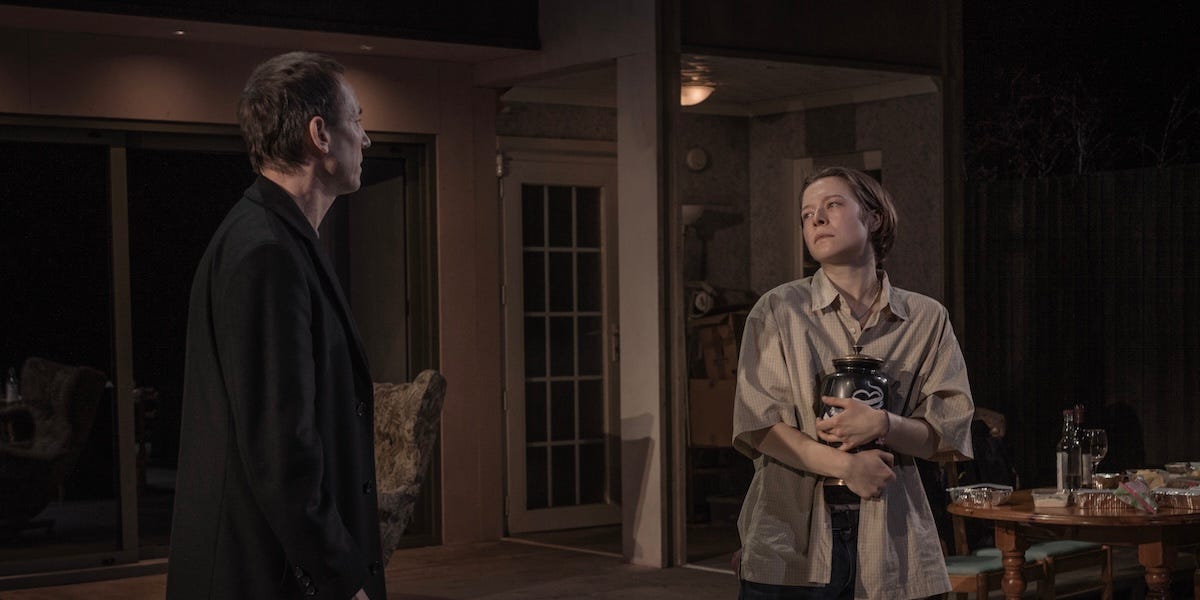
Any reverence for the body, any ancient rites of care and love, is reduced to empty psychodrama. Annie and Issey’s father is not in the broken house. There is nothing special about the pile of ashes that used to be a person.
Perhaps special isn’t what we should be looking for. In her posthumous article in Environmental Values, Val Plumwood writes towards what she calls “A Food Based Approach to Death”. She describes being nearly eaten by a Saltwater Crocodile. She “survived – slightly tenderised, but basically set aside for another occasion.” And she writes about burying her son in a more sustainable plot of land, letting him be eaten by the land and overcoming “the narrative of no narratives, that is expressed in the massive mute modernist headstones.”
She writes beautifully about the transient nature of our bodies, the temporary assemblages that become food for other assemblages:
“I had the sense that my life was something I owned, and that the crocodile now outrageously demanded. After decades of reflection, I can discern a kind of fairness and sharing in all this, justice, and even a kind of democracy. As I see it now, on the earth community model, life is like a book, but not the kind you can own or buy. It’s much more like a library book. You don’t own it – it’s borrowed from the earth community circulating library.”
But as she extends the metaphor, grief slips in: “Like a library book, it’s subject to immediate recall by another borrower – and you haven’t even finished reading/writing it!” Through context, we suddenly become aware that we’re reading the words of a mother who buried her son. And that body, long since disassembled and shared with the earth community, returns to us.
Also, my dear dear friend Rosa Mäkelä just won the The Stinging Fly/FBA Fiction Prize for her short story Breathwork. It’s such a beautiful story and they’ve taken it out from behind the paywall here! Read it and love it please!
Comments
Nothing yet. Say the first thing.
Sign in to join the conversation.