
Post-structuralist philosophy and literary theory radically expanded the possibilities of what we could call a text. Texts aren’t just essays or novels or poems any more. Texts are now nations or prisons or carbon dioxide in the atmosphere or a dead body in a sleeping bag. In fact, according to Derrida, there is nothing outside the text. Our world consists of texts upon texts upon texts, crossing each other’s borders.
But what does naming all of these things texts actually change? What are we to do with these infinitely proliferating texts? The simple answer is that we have to read them.
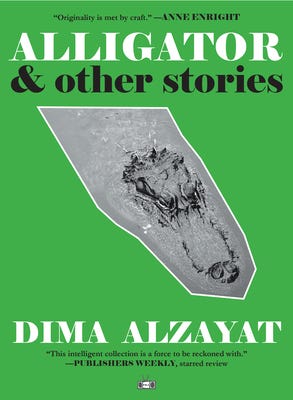
In the title story from her searing collection, Alligator and Other Stories, Dima Alzayat presents us with a proliferation of texts; e-mails, articles, forum posts, YouTube video transcripts, TV scripts, census entries, presidential addresses, court testimony, and more. Some of these are fictional and some are reproduced – the text of the story ends with a citation list of historical documents ranging from 1830 to 2017.
The texts all circle the 1929 death by state and mob violence (two profoundly interwoven texts throughout modern history) of a Syrian-American couple. But a closed text is not enough to describe this event, this is not an isolated and private murder. So Alzayat rips up the floorboards of American history, showing how a network of race and power produced and have then been produced by this gruesome event.
One story, walled off and well behaved in the borders of a conventional piece of literature, isn’t enough. We need borderless writing, writing that flees from text to text and state to state. The end of the book, as per Derrida, may be the beginning of writing.
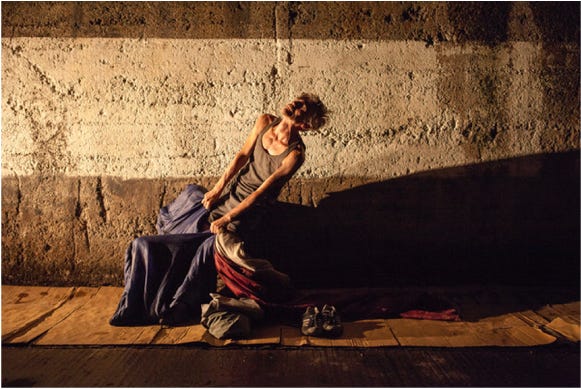
Theatre can be particularly good at foregrounding this radical intertextuality of being alive. In Company SJ’s Beckett in the City project, we find Beckett’s texts into conversation with texts of space, bodies and history.
After working abroad, the director SJ Scaife returned to Dublin in the wake of the Global Financial Collapse and in the era of the Murphy and the Ryan reports. She was reading the city, the bodies and environments and societies that live there. And she was reading Beckett.
So in her Act Without Words II the archetypal mid-century sacks became cheap synthetic sleeping bags outside a methadone clinic.
She staged Fizzles as these broken pieces of testimony, these sedimented layers of failure, failed lives, in a crumbling house beside an impromptu RIP mural for a homeless man who was found dead in the building.
And she staged Not I, Footfalls, Rockaby and Come and Go as “a woman howling from the margins of Ireland’s history”. These late plays, often thought of as pieces of abstract universalism, were used to give voice to the experiences of women in the Magdalene Laundries in the ruin of the former National Ballroom.
In her own words:
“Rather than create theatre in the city, we aspired to create a theatre of the city, placing it side by side with Beckett’s texts. The text of the city, its institutions and inhabitants, including the marginalised and dispossessed, all came into focus and interaction with the bodies and props in Beckett’s text. The bells very quarter-hour, and the sound of the party-goers, could be heard, as could the police and ambulance sirens.”
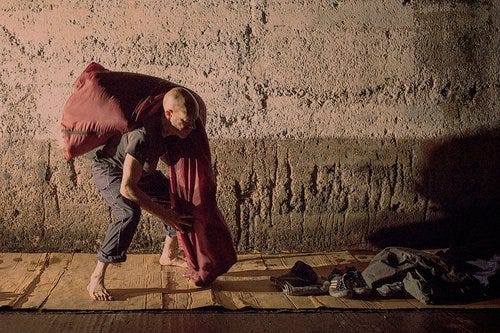
Scaife brings up maybe the most interesting texts we might try to read: bodies. Some of the turn away from poststructuralism is an insistence on the body and on embodiment as something that can’t be reduced to discursive and textual reality. That the fleshy and liquid elements of being alive might be something that is truly outside the text.
But what a body is, the boundaries and the borders, is still defined discursively. Is the food inside you part of your body? What about the estimated 380 trillion viruses in and on every body you’ve ever met? And what if these things, like covid or AIDS, exist across bodies? These are all matters of interpretation, and therefore these are all matters of reading.
And bodies, our own and the bodies of others, can be tragically misread. Pain can go unaddressed and unattended to. Bodies can be starved and injured and polluted and destroyed.
I think that part of being alive therefore, is to have a moral duty to read these bodies with care and attention and compassion. That is to say we have a responsibility to love the texts around us.
Comments
Nothing yet. Say the first thing.
Sign in to join the conversation.