

Last year, the day after I submitted my master’s thesis at Trinity, I expected to feel light. I had imagined relief, perhaps even a small celebration. Instead, a strange and awkward emptiness settled over me.
The assignments were gone.
The deadlines had cleared
And, in their absence, I felt not freedom but a hollow I could not name. It has taken me a while to understand that the hollow was not ingratitude, and it was not a failure of character.
“It was biology.”
I write this in June because I know I am not the only one sitting in it.
Many of my colleagues have just finished their own submissions, their theses, their reports, their long-postponed deadlines, and more than a few have described the same quiet that follows. For those of us who live with ADHD, that quiet has a particular texture. This is my attempt to make sense of it, not as a reporter observing the condition from the outside, but as someone who was diagnosed at forty-seven and has spent the years since learning, slowly, how my own brain is actually wired.
The most exhausting part of living with ADHD has rarely been the work itself. It has been the gap between intention and action.
You know exactly what needs doing, you genuinely want to do it, you are painfully aware of what your inaction will cost, and still you sit immobilised before the blinking cursor, the unopened post, the sink full of dishes.
In a culture that treats productivity as a measure of character and grit, this gap is quickly relabelled as laziness or a want of discipline.
The research, however, is consistent: ADHD is not a deficit of willpower but a challenge in the brain’s systems of self-regulation. Telling someone with ADHD to try harder is rather like telling a severely short-sighted person to squint harder at a sign a mile away. The effort is real, but the hardware is configured differently.
Professor Russell Barkley offers the most useful place to begin.
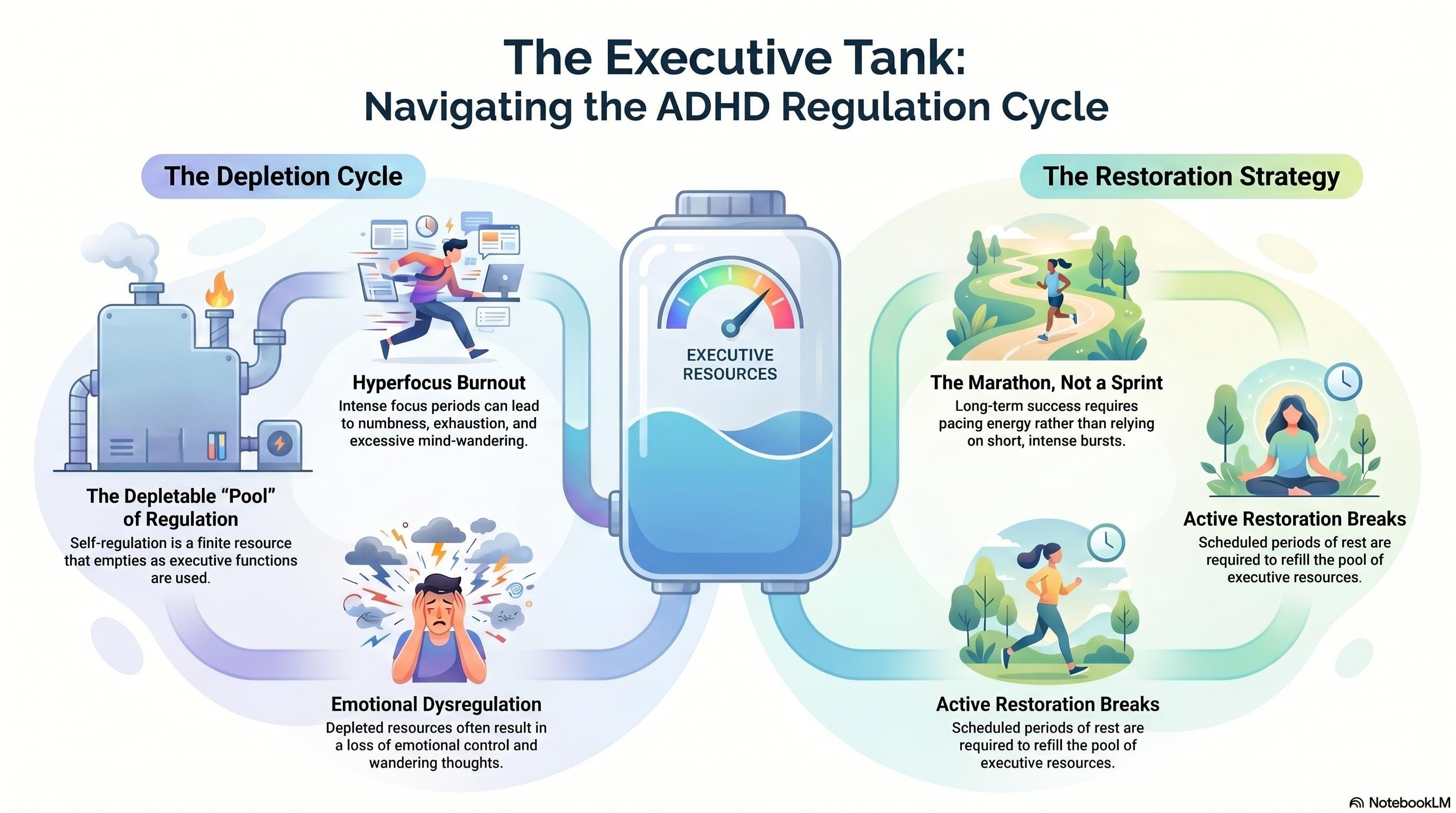
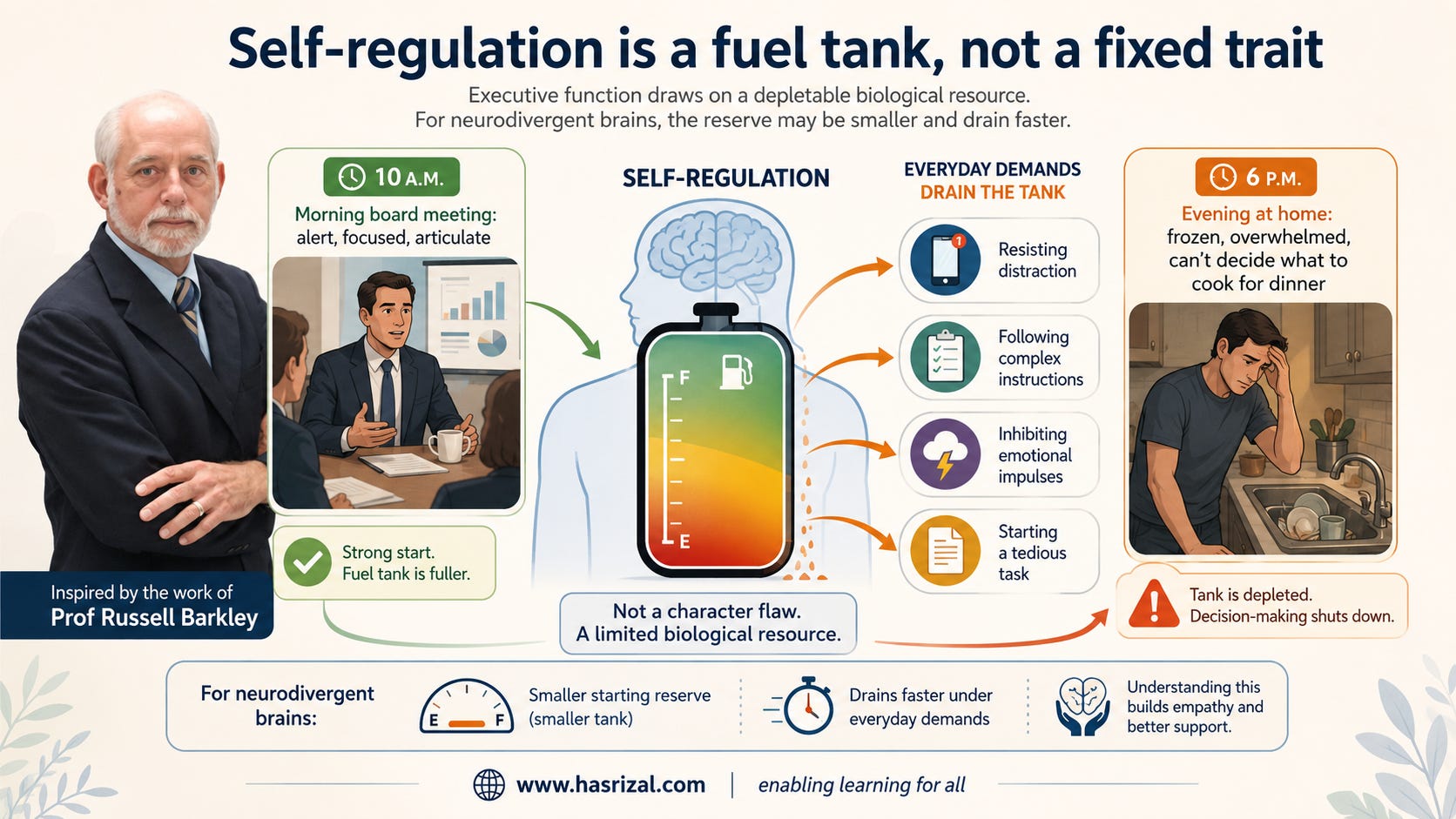
In his account of executive function, self-regulation is not a stable skill that a person simply has or lacks, but a depletable biological resource, a tank that empties with use. Every time we resist a distraction, follow a complex instruction, inhibit an emotional impulse, or force ourselves to begin a tedious task, we draw from that tank. For the neurodivergent brain, the reserve is often smaller, and it drains faster. This is why a professional with ADHD can be articulate and sharp in a board meeting at ten in the morning and yet, by six in the evening, find themselves paralysed, staring at the kitchen sink, unable to decide what to cook for dinner.
What matters here is that the depletion is metabolic, not moral.
Knouse and Barkley (2010) describe self-regulation as physically expensive, drawing heavily on the glucose burned in the frontal lobes, so that when the fuel is gone the system simply shuts down. Barkley (2012) goes so far as to call it a resource “depleted by the very act of using it” (p. 101).
Read this way:
The so-called laziness that arrives with the evening is nothing of the sort. We have not become weaker as the sun goes down. Our tank for self-regulation is empty, and an empty tank cannot be refilled by scolding.
Popular culture loves to call hyperfocus the ADHD superpower.
Those rare hours when the world falls away and the mind locks onto a single task with startling intensity. Pink and Emery (2023) are honest about its darker side.
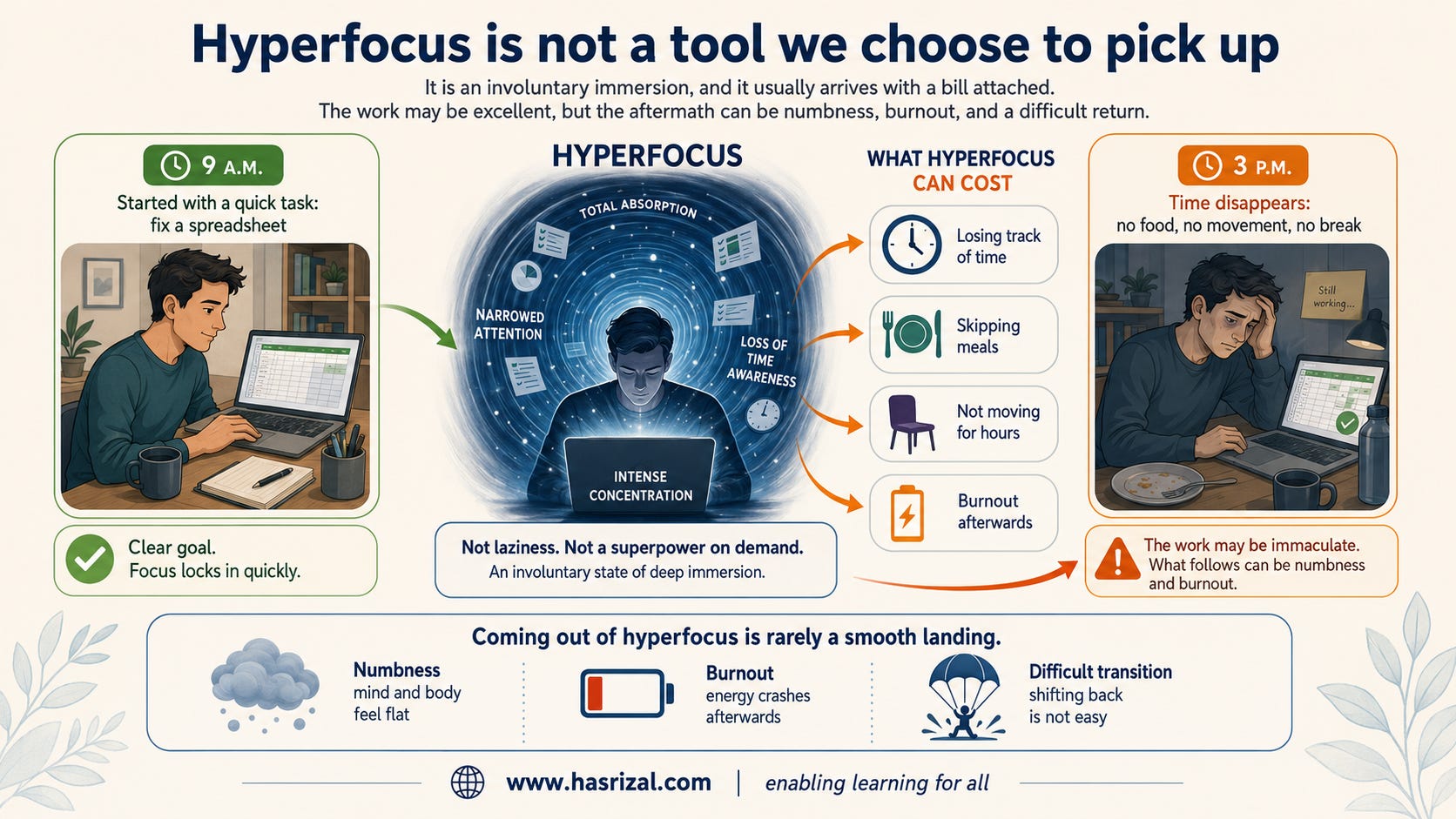
Hyperfocus is not a tool we choose to pick up; it is an involuntary immersion, and it usually arrives with a bill attached. We sit down at nine to “quickly” fix a spreadsheet, and the next time we look up it is three in the afternoon. We have not eaten, not moved, not stood up. The work may be immaculate, but what follows is numbness and burnout rather than satisfaction.
Coming out of that state is rarely a smooth landing.
Pink and Emery (2023) describe the crash that follows, the heaviness and irritability that can linger for hours, and the reason is structural. Because the ADHD brain struggles to modulate the intensity of its attention, it tends to run all or nothing, and its task-switching machinery is genuinely impaired. The exhaustion that arrives after a burst of high productivity is therefore not a sign of failure. It is the predictable cost of an unsustainable sprint. Hyperfocus is not a luxury cruise. It is a runaway train that eventually runs out of track.
We tend to imagine distraction as something done to us from outside: a notification, a noise, a passing colleague.
For the ADHD brain, the most powerful distractions are usually internal.
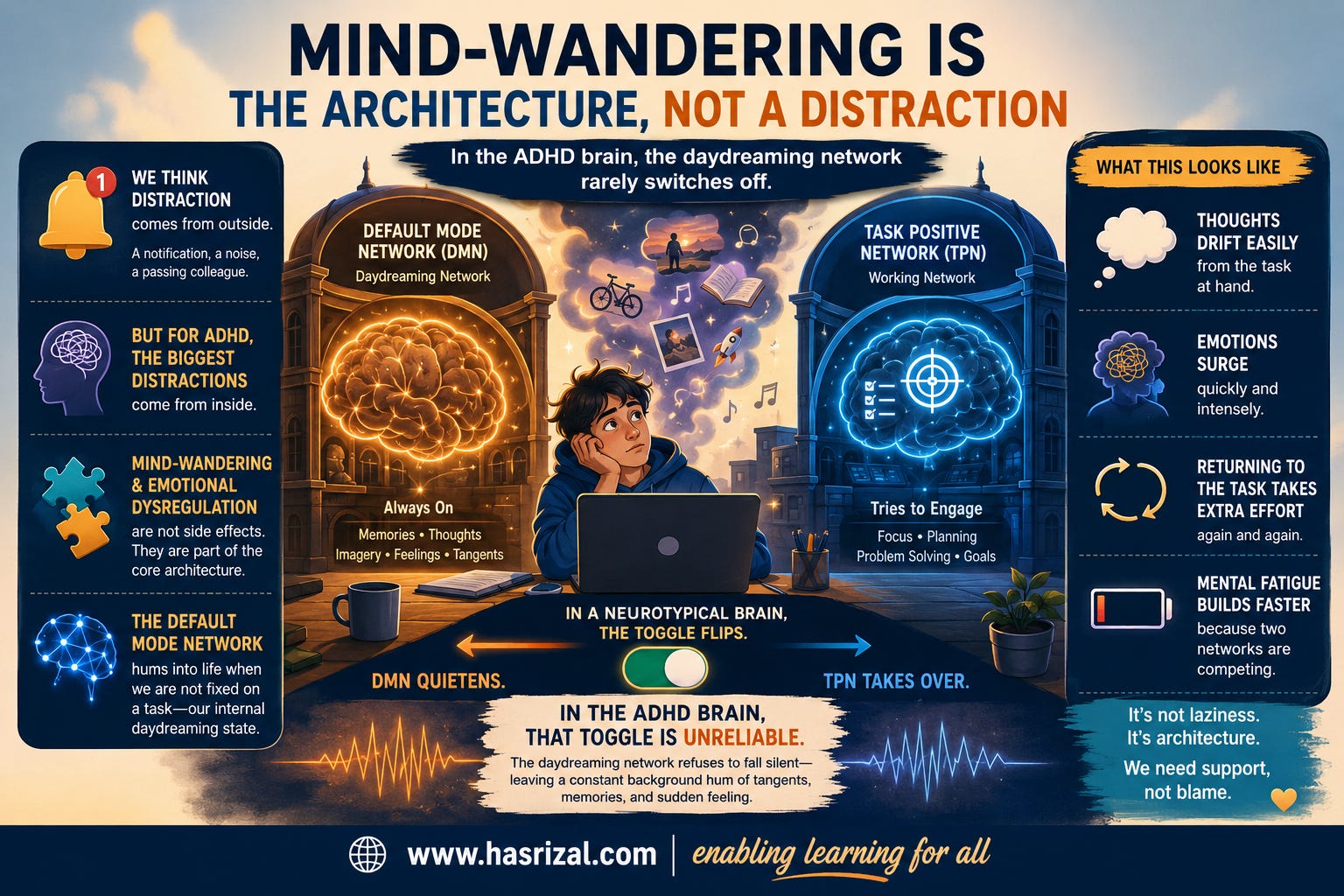
Excessive mind-wandering and emotional dysregulation are not side effects bolted onto the condition; they are part of its core architecture. The mechanism lies in the Default Mode Network, the system that hums into life whenever we are not fixed on a task, the daydreaming state.
In a neurotypical brain a kind of toggle flips when work begins: the Default Mode Network quietens and the Task Positive Network takes over.
In the ADHD brain, that toggle is unreliable.
The daydreaming network refuses to fall silent even as the working network tries to engage, leaving a constant background hum of tangents, memories, and sudden feeling.
The ADHD Experts material from ADDitude (n.d.) makes the point plainly: spacing out is a biological reality, not a shortfall of effort. When your mind drifts mid-conversation, it is not because you do not care. It is because the chatter inside your own head is, at that moment, louder than the world outside it.
Recognising this will not switch the network off, but it does strip away a great deal of the shame, and it points towards the tools that genuinely help: the external prompts and the quiet presence of another person working beside you.
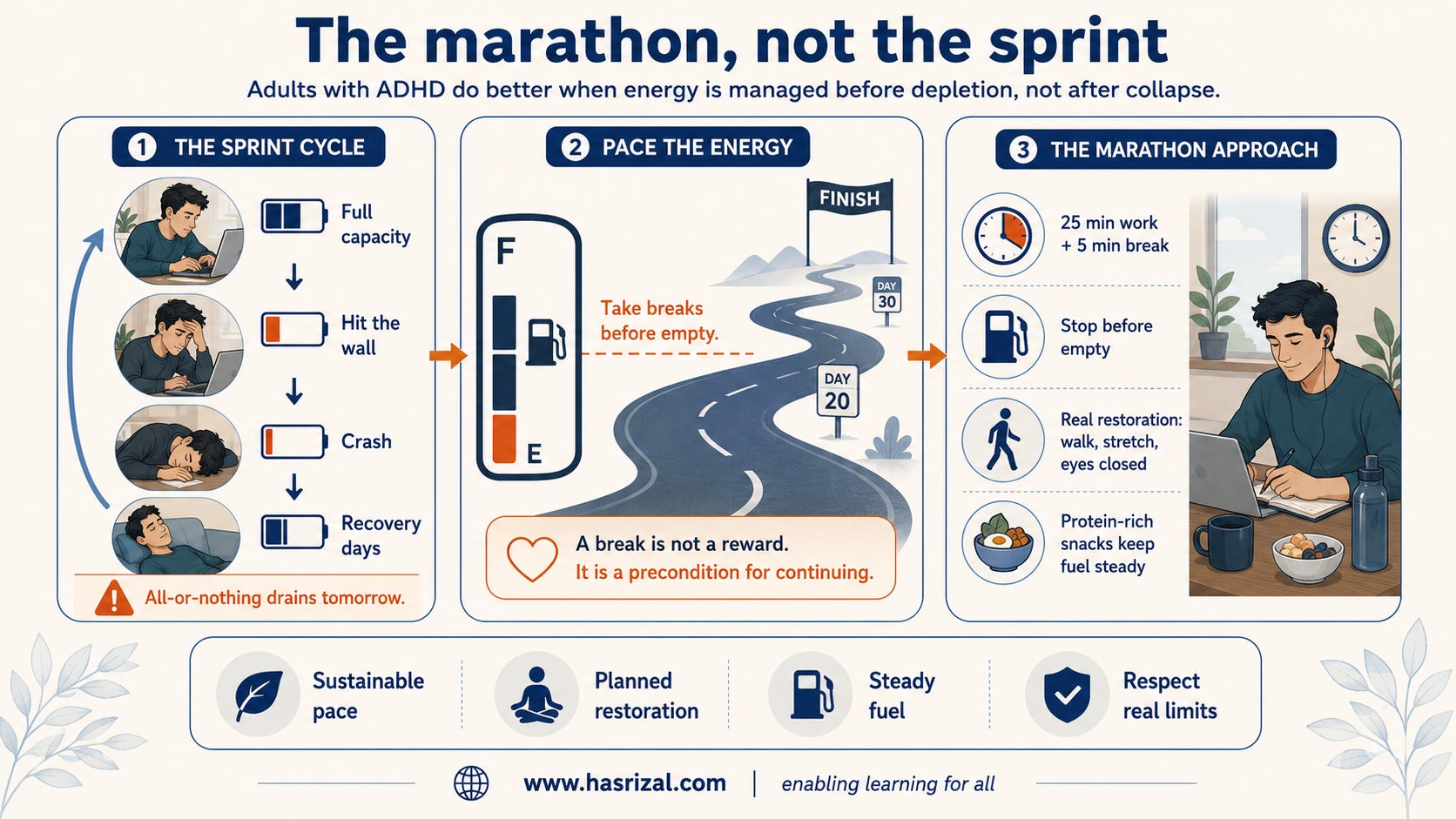
The all-or-nothing rhythm pulls many adults with ADHD into a destructive loop: work at full capacity until you hit the wall, collapse, and lose the days that follow to recovery.
Knouse and Barkley (2010) argue that the way out is to trade the sprint for the marathon, to manage energy proactively rather than reactively. The heart of this is the restoration break, and the crucial shift is one of timing. Most of us wait until we are already overwhelmed before we stop, which for the ADHD brain is far too late, because once the tank is dry the recovery is disproportionately slow. Restoration has to be scheduled before depletion, not earned after it. A break is not a reward for finishing. It is a precondition for continuing.
In practice this means a few unglamorous habits held with some discipline.
Working in timed intervals with genuine hard stops helps, twenty-five minutes followed by five, and the discipline lies in stopping even when we are in the zone, precisely so that there is fuel left for the afternoon.
It also means choosing restoration that actually restores: scrolling a phone is simply more input for an overloaded brain, whereas stepping outside, stretching, or sitting with our eyes closed gives the executive system a real chance to reset.
And because the frontal lobes are metabolically costly to run, steady blood sugar matters more than we like to admit, so small protein-rich snacks across the day keep the raw fuel flowing.
Treat life as a marathon and we stop trying to power through.
We start building a structure that respects the limits we actually have.
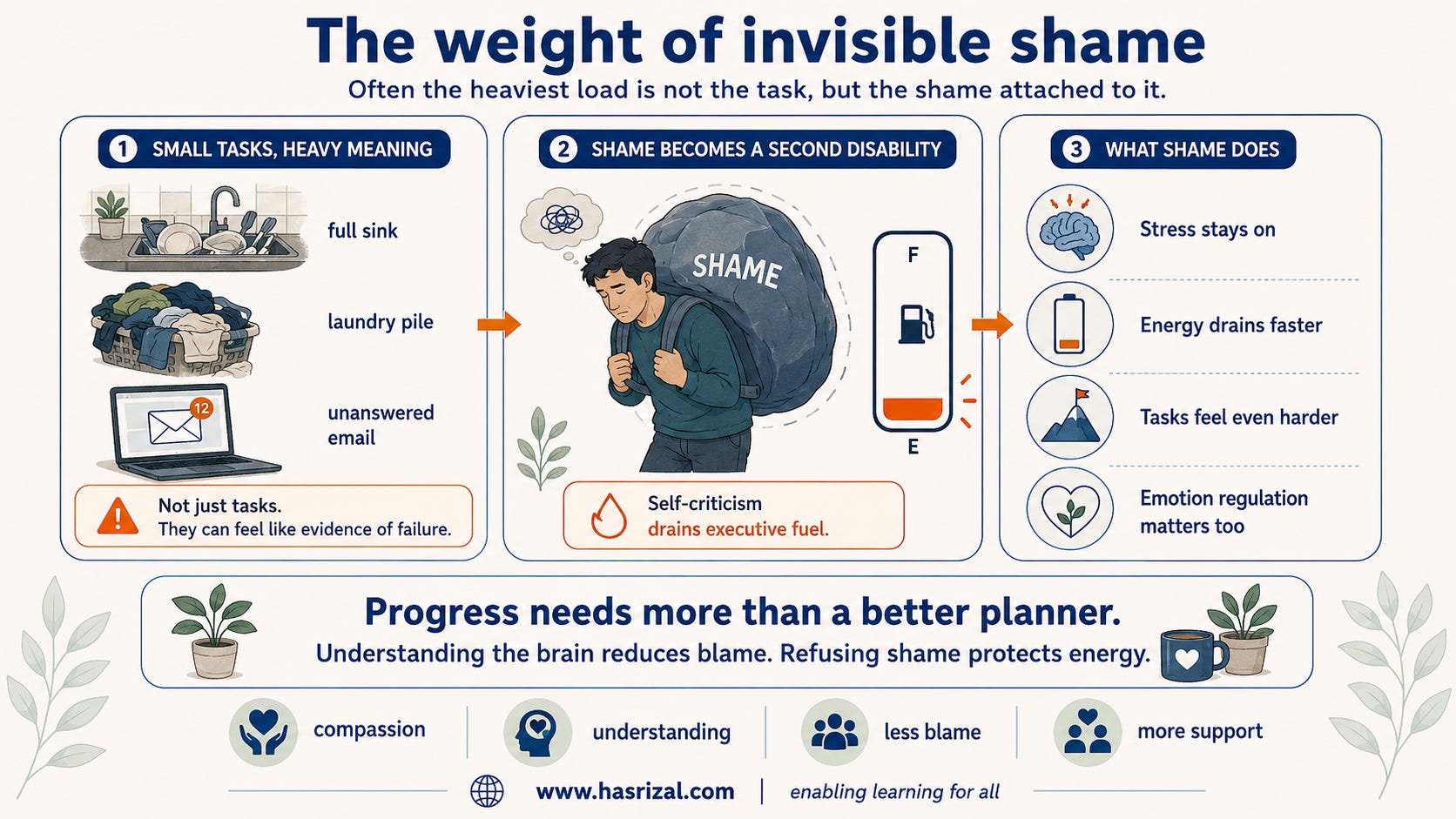
The heaviest thing many of us carry is not the symptoms but the shame accumulated across a lifetime of small failures.
Pink and Emery (2023) use the image of dirty laundry, the literal and metaphorical piles that feel like evidence of some basic inadequacy.
For an adult with ADHD, a full sink or an email left unanswered for three weeks is never just a task. It is a quiet indictment, a reminder of every deadline missed and every person let down. This is how shame becomes a second disability. It generates a constant low hum of emotional stress that drains the very self-regulation pool we are trying to protect, and so it makes the original difficulty even worse.
The clinical picture, reflected in the European consensus that ADDitude (n.d.) draws on, is that emotional regulation matters as much to managing ADHD as time management does.
Every hour spent berating ourselves for being neurodivergent is an hour of executive fuel burned on self-criticism rather than living. Lasting progress with ADHD asks for more than a better planner or a sharper app. It asks for a deliberate refusal of the shame attached to the laundry, and that refusal begins with understanding that the off-switch for our wandering mind is simply wired differently from most.
Which brings me back to the hollow I felt the morning after I submitted.
I have come to think of a deadline as a borrowed executive function. While it lasts, it does from the outside what our own regulation cannot reliably do alone: it supplies urgency, it holds the toggle in place, it keeps the last reserves of the tank burning. It is external scaffolding, and for months it props us upright.
When it lifts, two things happen at once.
The tank, run down by a long sprint, is empty, and at the same moment the structure that was regulating us from the outside disappears overnight.
The hollow we feel is the sound of that scaffolding being taken away. It is not that we are ungrateful for the opportunity to rest. It is that the brain, suddenly unsupported, has to remember how to hold itself.
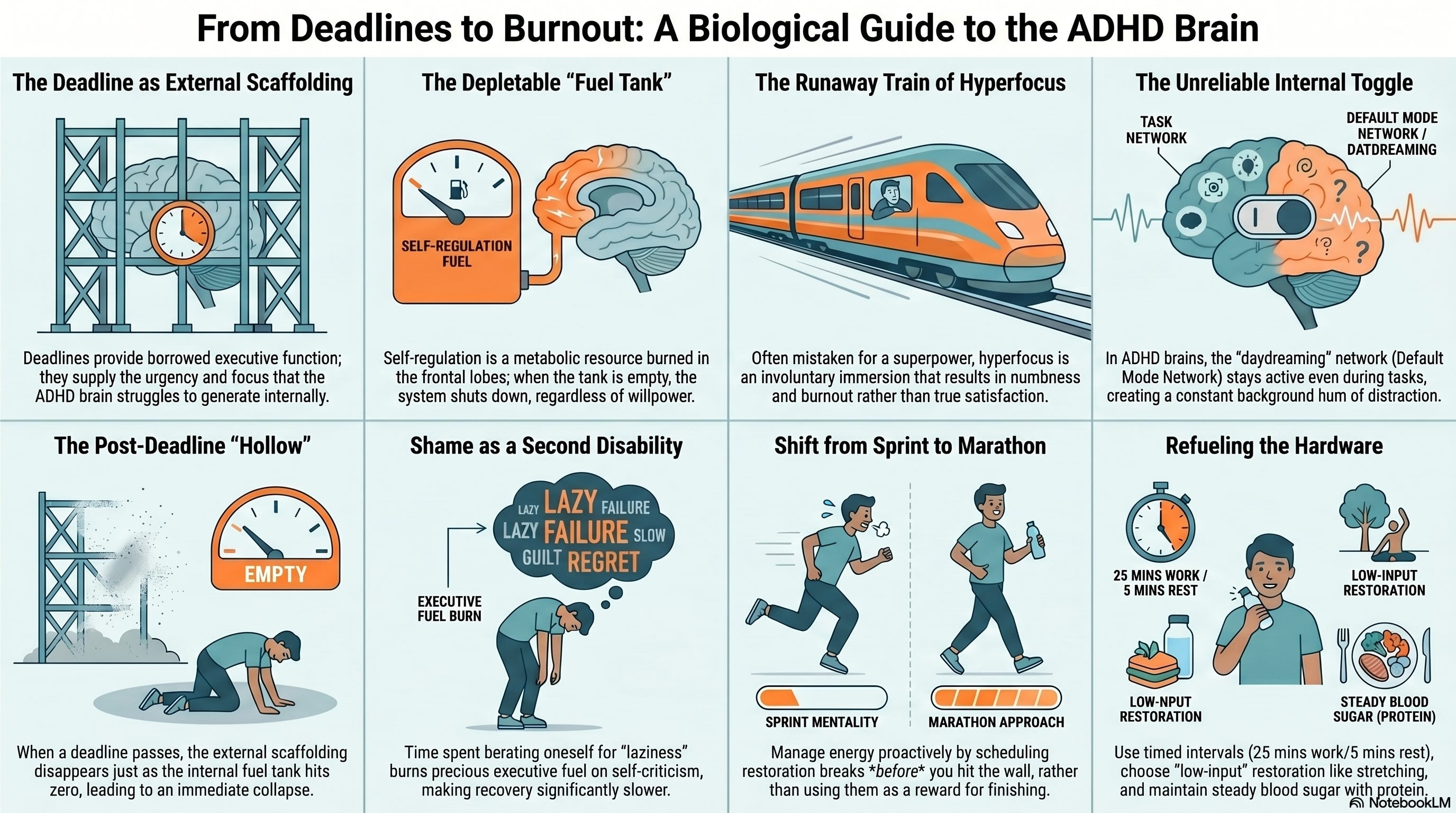
So to all fellow ADHD colleagues sitting in the June quiet, having handed in the thing that consumed you: the emptiness is not a verdict on our character. It is an empty tank and a missing scaffold, arriving together. The kinder and more accurate question is not “why am I failing to feel grateful?” but “what has drained me, and what would help me refuel?”
When we stop reading our exhaustion as a flaw and start reading it as biology, the way forward gets clearer, Insya-Allah.
The work, after all, was never the problem.
The recovery was simply never built in.
This season, perhaps, we can build it.
Hasrizal Abdul Jamil
www.hasrizal.com
ADHD Experts. (n.d.). *How the ADHD brain works* [Expert eBook]. ADDitude.
Barkley, R. A. (2012). *Executive functions: What they are, how they work, and why they evolve*. Guilford Press.
Knouse, L. E., & Barkley, R. A. (2010). *Living well with adult ADHD*. Guilford Press.
Pink, R., & Emery, R. (2023). *Dirty laundry: Why adults with ADHD are so ashamed and what we can do to help*. Vintage.
Comments
Nothing yet. Say the first thing.
Sign in to join the conversation.