
Hasrizal Abdul Jamil Director of Education, Khalifah Education Foundation; LaunchPAD Ambassador; doctoral researcher in inclusive education (Universal Design for Learning and Maqasid al-Shariah), Trinity College Dublin
I write this article as a researcher whose work sits at the meeting point of inclusive education and Islamic ethical reasoning, and as a LaunchPAD Ambassador, a role that keeps me close to the lived realities of disabled students moving into and through higher education. My purpose here is not to deliver a verdict but to organise my own understanding of a development that I find genuinely worrying: the quiet but accelerating reversal, across universities in several countries, to invigilated, handwritten, and oral examinations as a defence against generative artificial intelligence. The worry is specific. A measure introduced to protect academic integrity may, if adopted as a blanket policy, undo hard-won gains in inclusion and return disabled and neurodivergent students to the disadvantage from which more flexible assessment had begun to release them. This article explores that tension through the available evidence, and then evaluates it through Jasser Auda’s al-tafkir al-maqasidi (maqasidi thinking), applied as a stated analytic procedure rather than an invisible worldview.
The launch of ChatGPT in late 2022 confronted universities with an assessment problem they had deferred for a generation. The response, in many quarters, has been to reach for the format that generative tools cannot easily enter: the supervised room, the blank page, the spoken defence. This article argues that such a reversal, while understandable as a short-term integrity measure, is a poor long-term strategy, and that it carries an equity cost that its proponents rarely name. The stronger response, supported by regulators and assessment scholars alike, lies in building a culture of integrity among learners, upskilling educators in the pedagogy of AI, and redesigning assessment for authenticity and inclusion. Assessment format is never a neutral administrative choice. It distributes advantage, and a return to standardised timed formats redistributes that advantage away from the students least able to absorb the loss.
The retreat to traditional examinations is documented rather than hypothetical. In the United Kingdom, the law school at Birkbeck, University of London, reintroduced invigilated examinations after academics found themselves confronting large volumes of suspect work. Professor Stewart Motha described his department as having become unwilling to assess essays that, in his words, had for the most part “not been written by students,” and reported that the change generated “a very large number of academic misconduct allegations” (Motha, cited in Rowsell, 2026). At Durham University, Professor Andy Hamilton explained that he stood down from chairing a board of examiners because he “couldn’t tell any more which ones had used AI improperly and which ones had used it properly” (Hamilton, cited in Rowsell, 2026). Colleagues at Swansea have signalled a return to supervised formats, with one arguing that at least half of assessment should be supervised (Draper, cited in Rowsell, 2026).
The pattern extends well beyond Britain. In the United States, reporting traced a surge in examination “blue book” sales of more than thirty per cent at Texas A&M University and higher still at the University of Florida and the University of California, Berkeley, attributed directly to the AI-driven revival of handwritten examinations (Cohen, as reported in Fox News, 2025). In Ireland, the Higher Education Authority (HEA) has urged institutions to adopt oral verification, asking students to explain and defend their work in person rather than relying on take-home assignments or unreliable detection software (RTÉ, 2026). Institutional anxiety underlies these moves. A survey of higher-education leaders found that a majority believed cheating had increased since generative tools became widely available, and that many doubted their faculty could recognise AI-generated text (American Association of Colleges and Universities & Elon University, 2025). The reversal, then, is a considered response to a real problem, and it deserves to be met on its strongest ground before it is criticised.
The most defensible argument for supervised examinations is not nostalgia but validity. Dawson, Bearman, Dollinger, and Boud (2024) reframe the assessment problem away from cheating, and towards the inference an assessment licenses: a credential matters because it warrants a claim that a named person can do something, and generative AI corrodes that warrant whether or not misconduct has occurred. On this reading, some secured assessment supplies defensible evidence that a student can perform independently. Corbin, Dawson, and Liu (2025) sharpen the point by distinguishing “discursive” changes, which rely on rules and declarations that students may simply ignore, from “structural” changes that alter the mechanics of a task so that integrity no longer depends on compliance. An invigilated examination is a structural solution in exactly this sense, which is what gives the reversal its intuitive appeal. Where the temptation to misuse AI is high and the stakes are significant, the argument that supervision offers a cleaner inference is a serious one, and any critique that ignores it is incomplete.
The difficulty is that the format now being restored was, for many disabled and neurodivergent students, a barrier before it was a safeguard. Around a fifth of United Kingdom domestic students report a disability, a figure that has risen steadily and that disability organisations attribute partly to greater recognition of neurodivergence, chronic illness, and mental health conditions (Times Higher Education, 2024). For these students, the standardised timed examination measures more than the intended learning outcome. It also measures handwriting speed, processing fluency, and composure under pressure, traits that have little to do with the competence being certified.
The empirical evidence here is direct. In a sociomaterial study of examinations and disability, Tai and colleagues (2023a) found that pandemic-era changes, including moving examinations online, extending time, and adopting open-book formats, “contributed to increased inclusion for most students,” who could work in spaces and with equipment adapted to their needs, often without recourse to their usual accommodations (Tai et al., 2023a, p. 390). Their conclusion bears directly on the present reversal: assessment flexibility enhances inclusion, and in some cases the most inclusive move is to reconsider the examination itself rather than to reinstate it. A return to standardised handwritten examinations does not merely decline to extend inclusion. It withdraws inclusion that students had already come to rely upon.
A second cost is the re-stigmatisation of accommodation. Nieminen and Eaton (2024) show that reasonable adjustments, which exist to secure access rather than advantage, are frequently reframed as a form of cheating, a suspicion they situate within a wider societal “fear of the disability con.” In an atmosphere already primed to detect illicit assistance, disabled students risk being doubly suspected: once for their AI use and once for the accommodations that make assessment accessible at all. Nor does technology offer an inclusive escape route, since remote proctoring reproduces the same harm by design, flagging as suspicious the very bodily and behavioural differences that disability produces (Center for Democracy and Technology, 2020). The equity problem, in other words, spans both the analogue and the digital forms of “locking down” assessment.
There is, finally, a legal dimension that sharpens the ethical one. In University of Bristol v Abrahart (2024), the High Court upheld a finding of disability discrimination where a university failed to adjust oral assessments for a student with social anxiety, and drew a consequential distinction between a genuine competence standard, which is exempt from the duty to make reasonable adjustments, and a mere method of assessment, which is not. The implication for assessment design is significant. Where speed or a particular examination format is not itself the competence being certified, reverting to a timed handwritten paper without interrogating what is actually being measured exposes institutions to discrimination risk. Inclusion here is not only a pedagogical aspiration. It is, in part, a legal obligation.
If reversion carries these costs, the constructive question is what to do instead, and here the regulatory and scholarly consensus is clear. Australia’s Tertiary Education Quality and Standards Agency cautions that banning particular tools offers “oversimplified solutions to a complex set of problems,” and warns that defaulting to familiar secure formats can reduce authenticity and deepen inequity (Lodge et al., 2025). The alternative is not unregulated AI but deliberate design. It combines an explicit culture of academic integrity, built with students rather than imposed upon them, with sustained investment in educators’ AI literacy, so that the profession is equipped to teach and assess in a transformed environment. It draws on authentic assessment, in which AI use is expected, declared, and scrutinised rather than merely policed (Ajjawi et al., 2023), and on evaluative judgement, which shifts attention from what students produce to how they discern quality (Bearman et al., 2024). Frameworks such as the AI Assessment Scale allow educators to specify permitted AI use along a graduated continuum rather than through a single prohibition (Perkins et al., 2024).
Universal Design for Learning offers the design grammar that ties these responses together. In its canonical formulation, UDL organises teaching around multiple means of engagement, representation, and action and expression (Meyer et al., 2014), the last of which implies offering varied ways to demonstrate learning rather than funnelling all students through one high-stakes handwritten paper. When paired with the wider programme of assessment for inclusion (Tai et al., 2023b), UDL reframes the problem entirely. The task is not to choose between integrity and inclusion but to design assessment so that flexibility is built in from the outset, reducing the need for individual accommodation and, with it, the suspicion that accommodation attracts. This is the third way that the reversal debate too often obscures: neither a defensive retreat to tradition nor an uncritical embrace of AI, but proactive inclusive design.
This section applies al-tafkir al-maqasidi, following Auda (2023), operationalised as eight analytic moves. The point of declaring the lens in this way is to make the reasoning examinable rather than assumed. Maqasidi thinking is treated here as a method, a disciplined way of reasoning from and towards the higher objectives of the Shariah, and kept distinct from Maqasid al-Shariah as descriptive content. The object of analysis is the policy of reverting to traditional invigilated examinations as a blanket response to generative AI. A maqasidi reading is warranted because the reversal presents itself as a formally valid solution while its ethical weight lies in its purposes and its consequences, which a purely procedural analysis would miss.
Move 1: Name the purposes at stake. Several objectives are engaged at once. The preservation of intellect (’aql), read developmentally as education and the countering of ignorance (Auda, 2008), is served both by the integrity of the credential and by the genuine cultivation of learning. Human dignity, Auda’s developed reading of the preservation of life (nafs), is engaged by the treatment of disabled learners, whose access to assessment is a condition of their access to education itself. Justice (’adl) is engaged by the fair distribution of assessment advantage. The integrity of the credential may reasonably be classed as a communal necessity (daruriyya), since a society whose qualifications certify nothing cannot order its professional life. Equitable access for disabled learners is at least a pressing need (hajiyya) and, where it conditions access to education as such, approaches a necessity for the individual. This classification is offered as reasoned judgement rather than settled ruling, and the argument does not depend on resolving it precisely.
Move 2: Read the particular through the universal. The choice of examination format is a particular (juz’i) that must be read in the light of the universal (kulli) aim it serves. That aim is the truthful cultivation of intellect for all learners, not the preservation of any single procedure. Reframed this way, the governing question is not “how do we stop AI cheating” but “how do we assess so that we both certify learning honestly and honour the dignity of every learner.” The reversal answers the narrower question while leaving the wider one unaddressed.
Move 3: Separate ends from means. The invigilated handwritten examination is an instrument (wasila), not an objective (maqsad). Its end is a defensible inference about a learner’s competence and integrity. In maqasidi reasoning a means takes the ruling of its end but remains revisable when it ceases to serve that end. When a format that once secured valid inference now systematically excludes disabled learners and measures traits irrelevant to the outcome, it has drifted from its purpose and must be reconsidered. This is precisely the logic that underlies UDL’s insistence on multiple means of expression, in which varied pathways are revisable instruments serving a fixed end.
Move 4: Separate the constant from the variable. What is constant here is the objective: a truthful demonstration of learning, and the dignity and equity of the learner. What is variable is the format, timing, medium, and modality through which that objective is pursued. The reversal treats a variable, the timed pen-and-paper format, as though it were a constant, which in maqasidi terms is a category error. Fidelity to the objective does not require fidelity to any one of its historically contingent instruments.
Move 5: Test the consequences (ma’alat). Judged by what it actually produces, blanket reversion generates outcomes that count against it. It reimposes demands of speed, fluency, and composure that disproportionately burden dyslexic, ADHD, autistic, anxious, and chronically ill students (Tai et al., 2023a). It intensifies the climate in which accommodation is read as suspicion (Nieminen & Eaton, 2024), and its technologised alternative, proctoring, reproduces exclusion rather than resolving it (Center for Democracy and Technology, 2020). It carries legal exposure where format is mistaken for competence (University of Bristol v Abrahart, 2024). A solution that is formally secure but produces exclusion and re-stigmatisation is, by the measure of its outcomes, deficient.
Move 6: Weigh and prioritise (muwazana and awlawiyyat). Three goods compete. The integrity of the credential serves intellect and justice; the dignity and access of disabled learners serve human dignity; administrative defensibility serves a lower-order interest. The maqasidi principle that averting a definite harm takes precedence over securing a contingent benefit is decisive here, because the exclusion of vulnerable learners is certain and falls on those least able to bear it, whereas the integrity benefit, though real, is obtainable by other means: authentic assessment, programmatic assurance across a whole programme, and a genuine culture of integrity. The priority, therefore, is to preserve inclusion while securing integrity through redesign, not to purchase integrity at the price of exclusion through a single blunt instrument.
Move 7: Check against universal values. Tested against justice, dignity, mercy, and wisdom, blanket reversion falls short. It fails the test of justice and dignity for disabled learners, and it reflects the defensive, closed posture that maqasidi thinking identifies as a disorder of reasoning rather than the open, value-anchored posture it commends. An inclusively designed approach honours all four: justice as equity, dignity as the standing of every learner, mercy as the removal of unnecessary hardship (raf’ al-haraj), and wisdom (hikma) as the fitting of means to ends and to the reality in which they operate.
Move 8: Audit the reasoning (naqd). The debate is habitually posed as a binary: either secure examinations or unchecked AI. Maqasidi thinking rejects this atomism and false framing, since the real option is a differentiated, programmatic model that secures some assessment points inclusively while redesigning the majority for authentic, AI-integrated demonstration of learning. One correction was made in the course of this analysis. An earlier framing risked treating traditional examinations as intrinsically illegitimate; this was corrected, since inclusively designed supervised assessment can be entirely legitimate. The object of critique is blanket reversion as a sole strategy, not supervision as such.
The maqasidi moves are structurally cognate with the design logic of Universal Design for Learning, which is what allows the two frameworks to be placed in genuine dialogue rather than mere juxtaposition. Six of the eight moves pair with a specific UDL principle, and the pairing does analytic work for the present issue. The remaining two, moves 2 and 8, are listed for completeness but operate at the level of the argument itself rather than the design cross-walk: move 2 keeps the analysis tied to the wider aims of inclusive education, and move 8 is a reflexive audit of the reasoning, so neither maps onto a single UDL principle without distortion.
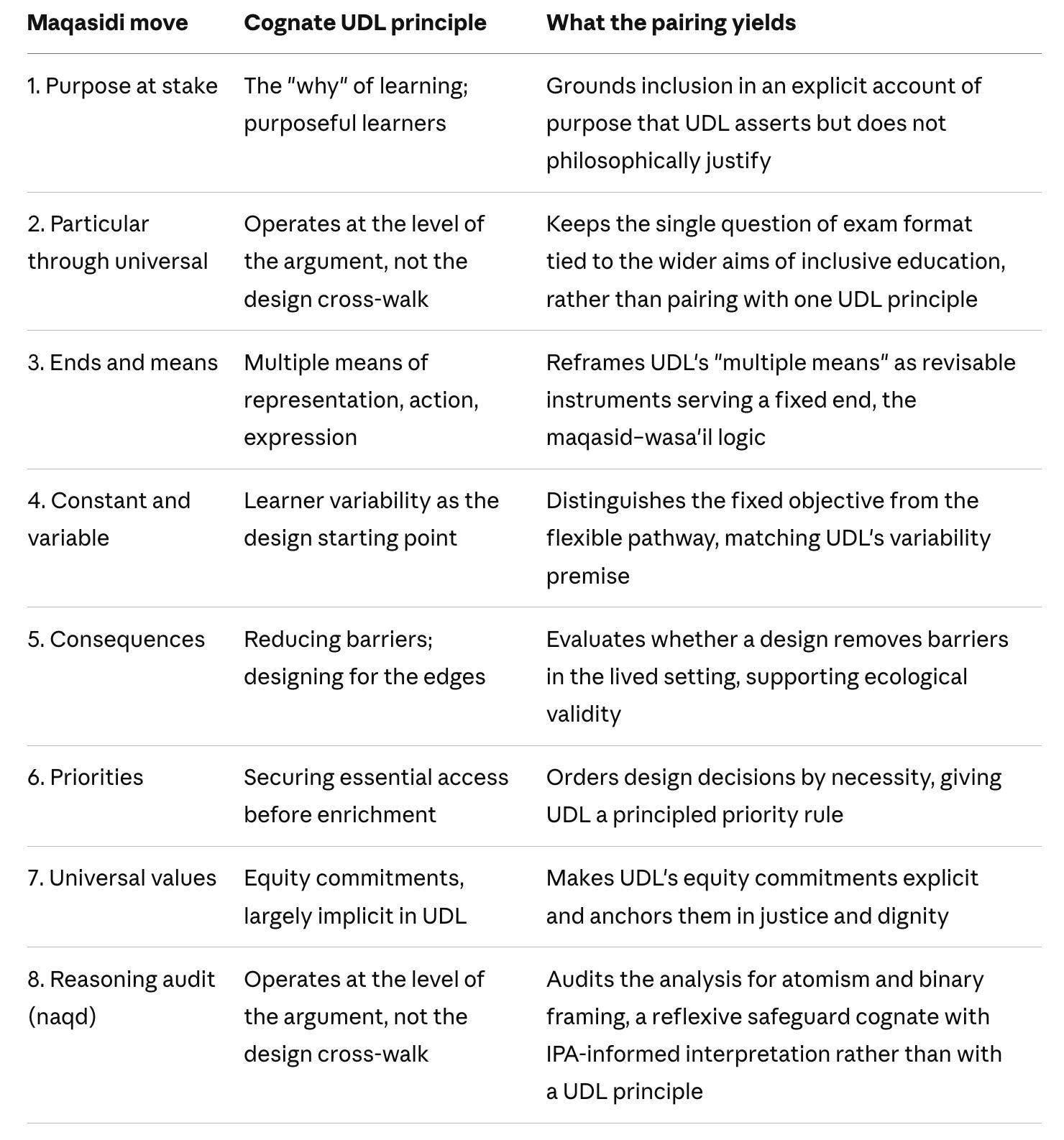
The maqasidi reading yields a clear judgement. Blanket reversion to traditional examinations mistakes a revisable means for a fixed end, and, judged by its consequences, it sacrifices a necessity, the dignity and access of disabled learners, in order to secure a benefit, credential integrity, that can be obtained by less exclusionary means. The maqasidi and UDL logics converge on inclusive design as the proper response, with Maqasid supplying the teleological and ethical anchoring that secular UDL tends to leave implicit. This is the article’s central contribution to my developing doctoral argument: that Maqasid al-Shariah and Universal Design for Learning are not merely compatible but structurally cognate, and that reading a live policy dispute through both at once produces a more defensible position than either framework reaches alone.
I began this article worried, and the analysis has clarified rather than dissolved the worry. As a LaunchPAD Ambassador, I take into serious consideration the students for whom an examination hall is not a neutral space, and as a researcher I am persuaded that the reversal now underway, if left unexamined, will quietly re-embed the barriers that inclusive assessment had begun to lower. The argument I have organised here is not that supervision is never justified, but that caution exercised without a purpose is not caution at all. The measure of any assessment reform is whether it preserves the truthful cultivation of intellect while honouring the dignity of every learner who sits it, and by that measure a blanket return to tradition asks the wrong students to pay for the sector’s uncertainty about AI.
Hasrizal Abdul Jamil
www.hasrizal.com
Ajjawi, R., Tai, J., Dollinger, M., Dawson, P., Boud, D., & Bearman, M. (2023). From authentic assessment to authenticity in assessment: Broadening perspectives. Assessment & Evaluation in Higher Education, 49(4), 499–510. https://doi.org/10.1080/02602938.2023.2271193
American Association of Colleges and Universities, & Elon University. (2025). Leading through disruption: Higher education executives assess AI in the curriculum. Imagining the Digital Future Center.
Auda, J. (2008). Maqasid al-Shariah as philosophy of Islamic law: A systems approach. International Institute of Islamic Thought.
Auda, J. (2023). Al-tafkir al-maqasidi: Muraja’at li-tartib al-’aql al-muslim [Maqasidi thinking: Reviews for reordering the Muslim mind]. Dar al-Mashriq.
Bearman, M., Tai, J., Dawson, P., Boud, D., & Ajjawi, R. (2024). Developing evaluative judgement for a time of generative artificial intelligence. Assessment & Evaluation in Higher Education, 49(6), 893–905. https://doi.org/10.1080/02602938.2024.2335321
Center for Democracy and Technology. (2020). How automated test proctoring software discriminates against disabled students. https://cdt.org/insights/how-automated-test-proctoring-software-discriminates-against-disabled-students/
Cohen, B. (2025, June). Schools turn to handwritten exams as AI cheating surges [As reported by Fox News]. Fox News. https://www.foxnews.com/tech/schools-turn-handwritten-exams-ai-cheating-surges
Corbin, T., Dawson, P., & Liu, D. (2025). Talk is cheap: Why structural assessment changes are needed for a time of GenAI. Assessment & Evaluation in Higher Education, 50(7), 1087–1097. https://doi.org/10.1080/02602938.2025.2503964
Dawson, P., Bearman, M., Dollinger, M., & Boud, D. (2024). Validity matters more than cheating. Assessment & Evaluation in Higher Education, 49(7), 1005–1016. https://doi.org/10.1080/02602938.2024.2386662
Lodge, J. M., Bearman, M., Dawson, P., Gniel, H., Harper, R., Liu, D., McLean, J., Ucnik, L., & Associates. (2025). Enacting assessment reform in a time of artificial intelligence. Tertiary Education Quality and Standards Agency. https://www.teqsa.gov.au/guides-resources/resources/corporate-publications/enacting-assessment-reform-time-artificial-intelligence
Meyer, A., Rose, D. H., & Gordon, D. (2014). Universal design for learning: Theory and practice. CAST Professional Publishing.
Nieminen, J. H., & Eaton, S. E. (2024). Are assessment accommodations cheating? A critical policy analysis. Assessment & Evaluation in Higher Education, 49(7), 978–993. https://doi.org/10.1080/02602938.2023.2259632
Perkins, M., Roe, J., & Furze, L. (2024). The AI assessment scale revisited: A framework for educational assessment [Preprint]. arXiv. https://arxiv.org/abs/2412.09029
RTÉ. (2026, January 11). Over 500 students found using AI illegally in coursework. https://www.rte.ie/news/2026/0111/1552530-ai-college-work/
Rowsell, J. (2026, June 29). Are universities returning to in-person exams to combat AI cheating? Times Higher Education. https://www.timeshighereducation.com/depth/are-universities-returning-person-exams-combat-ai-cheating
Tai, J., Mahoney, P., Ajjawi, R., Bearman, M., Dargusch, J., Dracup, M., & Harris, L. (2023a). How are examinations inclusive for students with disabilities in higher education? A sociomaterial analysis. Assessment & Evaluation in Higher Education, 48(3), 390–402. https://doi.org/10.1080/02602938.2022.2077910
Tai, J., Ajjawi, R., Bearman, M., Boud, D., Dawson, P., & Jorre de St Jorre, T. (2023b). Assessment for inclusion: Rethinking contemporary strategies in assessment design. Higher Education Research & Development, 42(2), 483–497. https://doi.org/10.1080/07294360.2022.2057451
Times Higher Education. (2024). Fifth of UK students report disability, true total likely higher. https://www.timeshighereducation.com/news/fifth-uk-students-report-disability-true-total-likely-higher
University of Bristol v Abrahart [2024] EWHC 299 (KB).
Comments
Nothing yet. Say the first thing.
Sign in to join the conversation.